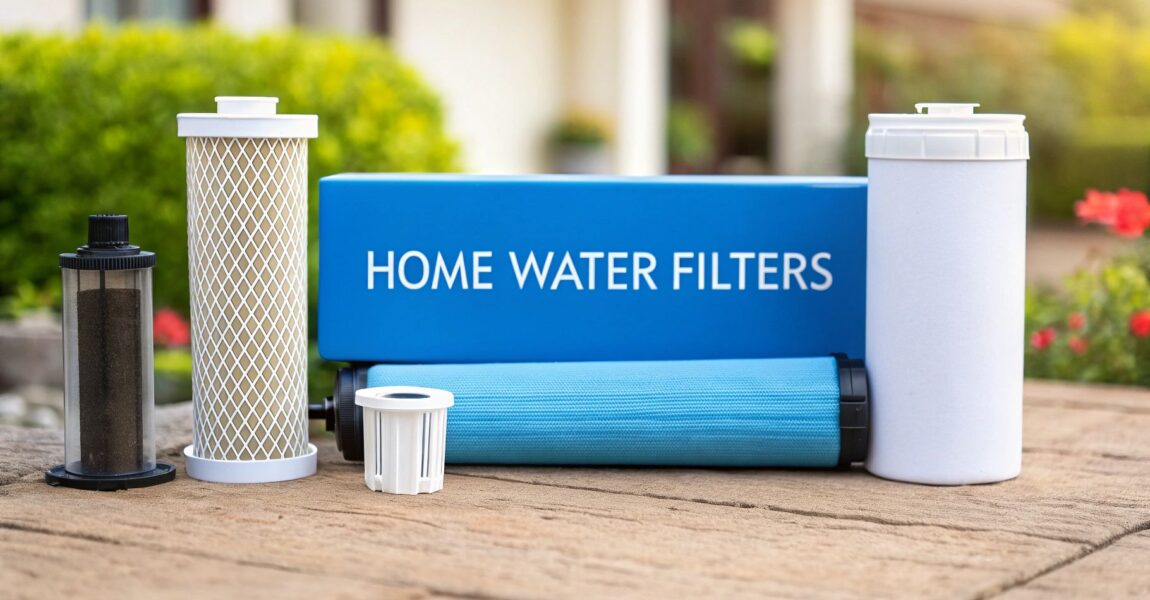
Choosing the Right Types of Home Water Filters for Your Home
That glass of water from your tap looks pristine, but it’s been on a long, wild journey to get to your kitchen. Along the way, it can pick up some invisible hitchhikers. Most types of home water filters are designed to be the final, bouncer-at-the-door, grabbing these unwanted passengers—everything from the chlorine that makes your water smell like a public pool to microscopic party-crashers you’d never even see.
Figuring out what might be in your water is the first step to picking the perfect filtration sidekick for your home.
What's Really Lurking in Your Tap Water?
Think of your water supply like a cross-country road trip. It starts its journey at a treatment plant where it gets a basic cleaning, but it still has miles of pipes to navigate before it reaches your faucet. Some of these pipes might be older than your favorite classic rock band. It’s during this trip that all sorts of substances can hop aboard.
The point isn't to scare you into drinking nothing but sparkling water, but to arm you with knowledge. Once you understand the usual suspects, you'll see why a good home water filter is like a VIP checkpoint, making sure the water your family drinks is as clean and refreshing as it looks.
Common Contaminants on the Water Highway
Your tap water is more than just H₂O; it’s a cocktail of minerals, disinfectants, and sometimes, things you’d rather not be sipping. Here are some of the usual suspects that home water filters are built to tackle:
- Chlorine: This is the chemical bodyguard most cities use to kill bacteria in the water supply. It does a fantastic job, but it can leave behind a chemical taste and smell that’s, well, pretty off-putting.
- Lead and Heavy Metals: If you live in a home with vintage plumbing, there's a chance that lead from old pipes and solder could be leaching into your water. Other metals like mercury can also sneak into the water supply from industrial or environmental sources.
- Microplastics: This is a newer, and frankly, weirder concern. These tiny bits of plastic are popping up in tap water worldwide, coming from larger plastic items breaking down over time. Scientists are still studying the long-term health effects.
This infographic breaks down these common contaminants, showing where they come from and just how common they are.
As you can see, contaminants can be anything from the byproducts of disinfection to pollutants from our environment, and they can enter the water at any point along its journey.
The Growing Demand for Cleaner Water
It’s not just about what you drink, either. The quality of your tap water can have a real impact on your appliances. For example, learning how tap water quality affects dishwasher performance can save you a lot of headaches from hard water spots and chalky buildup. This kind of awareness is a big reason why more people are looking into home filtration.
As people learn more about what's in their water, the demand for good filtration systems is skyrocketing. It’s all part of a bigger shift toward being more proactive about health and wellness at home.
The global market for home water filters is projected to hit about $28 billion by 2033, all because people want to live healthier lives. It really shows that for many families, a water filter isn’t a luxury anymore—it’s a non-negotiable part of a healthy household.
A Quick Guide to Filtration Technologies
Stepping into the world of home water filters can feel a bit like trying to read a menu in a foreign language. With so many terms and technologies floating around, it's easy to get lost. Before we dive into specific models, let’s get to know the core technologies that do all the heavy lifting.
Think of it like this: each filtration method is a specialist with a unique skill set. Most systems you'll find for your home use one of three main technologies: Activated Carbon, Reverse Osmosis (RO), or Ultraviolet (UV) Purification.
The Big Three of Water Filtration
Let's break down what each of these powerhouses does.
Activated carbon is the crowd-pleaser, great for improving the general taste and smell of your water by grabbing things like chlorine. Reverse osmosis is the perfectionist, using a super-fine membrane to strip out an incredible range of dissolved solids and contaminants. And UV purifiers? They're the silent bodyguards, using light to neutralize nasty microorganisms without adding a single chemical to your water.
You wouldn't use a spatula to hammer a nail, right? The same logic applies here. You've got to match the right filtration tool to the specific problem lurking in your water.
If your city water just has a funky chlorine taste, a simple carbon filter will probably do the trick. But if you're on well water and worried about bacteria, a UV system is a non-negotiable part of the setup. It's all about diagnosing the problem first.
Home Water Filter Technology at a Glance
To give you a clearer picture, let's put these technologies side-by-side. The table below is a great cheat sheet to quickly see what each filter type is designed to do, what it removes, and what kind of budget you'll need.
| Filter Type | Primary Function | Removes | Best For | Average Cost |
|---|---|---|---|---|
| Activated Carbon | Adsorption (traps contaminants) | Chlorine, pesticides, bad taste & odor | Improving taste and smell of city water | $ (Low) |
| Reverse Osmosis | Pushes water through a fine membrane | Heavy metals, fluoride, salts, bacteria | Maximum purity and removing a wide range of contaminants | $$$ (High) |
| UV Purifier | Neutralizes microorganisms with light | Bacteria, viruses, protozoa | Disinfecting well water or microbiologically unsafe water | $$ (Medium) |
Use this as your starting point. Seeing it all laid out like this really helps narrow down which filtration path makes the most sense for your home and your water.
Activated Carbon Filters: The Everyday Contaminant Magnet
If there's an MVP in the world of home water filtration, it’s the activated carbon filter. This is the technology you'll find in almost everything, from the simple pitcher in your fridge to more advanced under-sink systems.
Why is it so common? Because it nails one job perfectly: making your tap water taste and smell a whole lot better.
Think of activated carbon as a microscopic sponge with an enormous appetite. Thanks to millions of tiny pores, a single gram of the stuff can have more surface area than a football field. These pores act like magnets for certain contaminants as water flows past.
This isn't your typical filter that just strains out particles. The process is called adsorption, which means contaminants literally stick to the carbon's surface like static cling. It’s fantastic at grabbing onto things like chlorine, pesticides, herbicides, and other volatile organic compounds (VOCs) that give water that funky chemical flavor.
Two Forms: Granular vs. Block
When you start shopping, you’ll see activated carbon filters in two main styles. Knowing the difference will help you pick the right one for your setup.
-
Granular Activated Carbon (GAC): This is just what it sounds like—loose granules of carbon packed into a cartridge. They're great at knocking down chlorine and improving taste, which is why they're the go-to for water pitchers and refrigerator filters where a fast flow rate matters.
-
Carbon Block: These filters are made from finely powdered carbon that's been compressed into a solid block. This dense structure forces water through a much more winding path, giving it more contact time with the carbon. Because of this, carbon block filters are usually more powerful and can snag a wider range of contaminants, sometimes even heavy metals like lead. They also act as a physical barrier, filtering out sediment down to a certain micron level.
The real job of an activated carbon filter is to make your water more enjoyable to drink. It tackles the sensory stuff—the bad tastes and weird smells—that make so many people reach for bottled water instead of using the tap.
This makes it a perfect, wallet-friendly starting point for anyone on city water who just wants a simple upgrade.
The Strengths of Activated Carbon
For a huge number of households, an activated carbon filter is all they really need to completely transform their drinking water experience. The benefits are obvious right away.
- Amazing Taste and Odor Removal: Nothing beats it for getting rid of that swimming-pool chlorine smell and taste, which is hands-down the most common complaint about tap water.
- Super Affordable: Carbon filters are everywhere and are some of the most budget-friendly options you can buy.
- Easy to Use: Whether it's a pitcher or a faucet attachment, these filters are almost always a breeze to install and replace.
Knowing Its Limits
It's just as important, though, to know what activated carbon can't do. It’s a specialist, not a cure-all. For a really good technical breakdown, check out this a comparison of carbon filters with other filtration types.
These filters will not remove:
- Dissolved minerals (like the calcium and magnesium that cause hard water)
- Fluoride
- Nitrates
- Bacteria or viruses
So, if your water worries go beyond just taste and smell—like if you're dealing with high levels of lead or potential microbial threats from a private well—you'll need to level up to a more advanced system. We'll get into those next.
Reverse Osmosis Systems for Maximum Purity
When just improving taste and smell isn't quite cutting it, you’ll eventually find your way to Reverse Osmosis (RO). If you're after the highest level of purification you can get in your home, this is the technology to look at. RO is the gold standard for stripping out the widest possible range of contaminants, leaving you with exceptionally pure water.
The secret sauce is the semipermeable membrane. Think of it like a microscopic nightclub bouncer with a very, very strict guest list. It lets the tiny, pure water molecules pass right through but turns nearly everything else away at the door—dissolved salts, heavy metals, fluoride, even bacteria.
This kind of performance puts RO systems in a class of their own, especially for anyone dealing with specific water quality issues that simpler filters just can't touch.
How the Multi-Stage Process Works
An RO system isn't just one filter; it's a whole team working in perfect harmony. It's a multi-stage process where each component preps the water for the next step, all leading up to that final, pure result.
- Sediment Pre-Filter: This is the first line of defense, catching all the big stuff like dirt, rust, sand, and silt. Its main job is to protect the more sensitive filters down the line from getting clogged up.
- Carbon Pre-Filter: Next up, the water hits an activated carbon filter. This stage is crucial for grabbing chlorine and other chemicals that could damage the delicate RO membrane.
- The RO Membrane: This is the heart of the whole operation. Your home's water pressure forces the water through this tightly wound membrane. Here, up to 99% of total dissolved solids (TDS) are separated out and flushed away.
- Carbon Post-Filter: As a final step, the now-purified water gets a "polishing" pass through one last carbon filter. This gets rid of any lingering tastes or odors the water might have picked up from its storage tank, making sure what comes out of your tap is crisp and clean.
The Unmatched Purity of RO Water
The biggest draw of a reverse osmosis system is its sheer filtration power. It's one of the few technologies that can remove an incredibly long list of contaminants you really don't want in your glass.
- Heavy Metals: It's incredibly effective at reducing lead, arsenic, mercury, and chromium.
- Dissolved Solids: Say goodbye to salts, nitrates, and fluoride.
- Microorganisms: The membrane's pores are so fine that they block bacteria and viruses.
The real power of an RO system is the peace of mind it gives you. If your water report shows contaminants that have you worried, no other system offers this level of thorough removal.
Its effectiveness is a big reason why RO technology dominates the market. In 2021, the global home water filtration market was valued at $10.85 billion, and RO-based filters made up over 38% of global revenue. That tells you just how many homeowners trust RO for ultimate purity. You can dive deeper into the market trends over at Grand View Research.
The Trade-Offs to Consider
While RO systems deliver amazing results, they aren't perfect. It's important to understand the trade-offs before deciding if it's the right fit for your home.
The most common criticism is water waste. To separate the pure water, the system has to flush the contaminants away with what's called "brine" or wastewater. Older models were notorious for this, wasting several gallons for every one gallon of clean water they produced. Thankfully, modern systems have gotten much more efficient.
Another thing to know is that the RO membrane is so good that it also removes beneficial minerals like calcium and magnesium. While we get most of these minerals from food, some people find demineralized water tastes a bit "flat." To fix this, many RO systems now come with an optional remineralization stage that adds a healthy balance of minerals back into the water right before it hits your glass.
Finally, these systems are more complex than your average pitcher filter and require more maintenance. You'll need to swap out the pre- and post-filters every 6-12 months and the RO membrane itself every 2-5 years.
UV Purifiers: A Guardian Against Germs
So we've covered how activated carbon gets rid of nasty tastes and how reverse osmosis tackles dissolved solids. But what about the invisible threats? Microscopic bugs like bacteria, viruses, and cysts can easily slip through a standard filter. To deal with them, you need a different kind of guardian: an Ultraviolet (UV) purifier.
Unlike filters that physically trap contaminants, a UV system attacks on a microbiological level. It zaps the water with a powerful lamp that emits UV-C light, a very specific wavelength of ultraviolet light that’s absolutely lethal to microorganisms.
Think of it like giving germs a targeted, terminal sunburn. This intense UV-C radiation blasts through the cell walls of bacteria, viruses, and other pathogens, completely scrambling their DNA. They can't reproduce, they can't make you sick—they're effectively neutralized on the spot.
It's a Purifier, Not a Filter
This is a really important distinction. UV systems are purifiers, not filters. They don’t actually remove anything from the water—not sediment, not chlorine, not heavy metals. Their one and only job is to make your water microbiologically safe to drink.
Because a UV system only deals with living organisms, it’s almost always installed as the final piece of a larger filtration puzzle. The UV light needs a clear shot at the germs, and any murkiness or sediment in the water can create tiny shadows for them to hide in, making the system less effective.
That's why you'll almost always see a UV system installed after a sediment filter and often a carbon filter, too. Those pre-filters handle the dirty work of clearing out particles, giving the UV light an unobstructed path to zap every last potential threat.
Who Really Needs a UV Purifier?
So, do you need this level of protection? While it's great for peace of mind in any home, for some folks, it’s downright essential.
- Homes with Well Water: Private wells aren't treated by a city, leaving them vulnerable to contamination from farm runoff or septic tanks. A UV purifier is your 24/7 defense against bacteria like E. coli and other viruses.
- Areas with Boil Water Advisories: If your town is constantly issuing boil water notices, a UV system is a far more convenient and reliable way to ensure your tap water is always safe.
- Immune-Compromised Individuals: For households with anyone who has a weakened immune system, a UV purifier adds a critical layer of protection against dangerous waterborne illnesses.
Benefits and Upkeep of UV Systems
The biggest win for UV is that it disinfects without chemicals. You get no chlorine taste and no weird disinfection byproducts. They’re also incredibly good at their job, wiping out 99.9% of harmful microorganisms when they're running properly.
Maintenance is simple but non-negotiable. That UV lamp has a limited lifespan, usually about a year of continuous operation. Even if the bulb still turns on after a year, its germ-killing power has faded significantly. To keep your water protected, you absolutely must replace the UV bulb annually.
Beyond the Sink: Whole House and Specialty Filters
Getting great-tasting water from your kitchen tap is one thing, but what about the water you shower in, wash your clothes with, and run through your expensive appliances? That’s where the conversation shifts to a much bigger-picture solution.
We're talking about point-of-entry (POE) systems, more commonly known as whole house filters.
Instead of treating water at a single faucet, these systems are installed right where the main water line enters your home. Think of it as a gatekeeper for your entire plumbing system. Every single drop that flows into your house—for the shower, the dishwasher, the washing machine—gets cleaned first.
This isn't just about better drinking water. It's about protecting your home's entire plumbing infrastructure from scale and corrosion, helping your appliances last longer, and getting softer skin and hair because you’re not showering in chlorinated water anymore.
First Line of Defense: Sediment Filters
Before you can even think about microscopic contaminants, you have to deal with the grit and grime you can actually see. This is where sediment filters come in. They are the unsung heroes of any serious water treatment setup.
They act like a bouncer at the door, catching all the obvious troublemakers:
- Sand and silt
- Rust flakes from aging city pipes
- Dirt and other random gunk
By grabbing all this physical debris right away, a sediment filter keeps your more sophisticated (and more expensive) filters downstream from getting clogged up. They are an absolute must-have pre-filter that makes the rest of your system run better and last longer.
Solving Hard Water Woes: Water Softeners
If you're tired of seeing chalky white spots on your glassware and fighting a never-ending battle with soap scum, you have hard water. The solution isn't a typical filter, but a specialty system called a water softener.
A water softener is more of a water conditioner. It uses a process called ion exchange to literally swap out the "hard" minerals like calcium and magnesium for "soft" sodium ions. These hard minerals are the culprits behind all that nasty limescale buildup.
The result? Water that actually lathers up, is kinder to your appliances, and leaves your dishes sparkling clean. It’s a perfect example of a targeted system designed to solve one of the most common and annoying water problems out there.
The Ultimate Purity: Water Distillers
For those who want to get as close to pure H₂O as possible, water distillers are the gold standard. This method mimics nature’s own purification cycle: it boils water to create steam, leaving contaminants behind, and then condenses that pure steam back into clean liquid water.
Distillation is incredibly thorough, removing nearly everything—heavy metals, minerals, bacteria, and viruses. It’s a slower and more energy-intensive process, but the purity of the final product is unmatched.
It’s clear that people are thinking more seriously about their water quality. The residential water purifier market is expected to jump from $24.88 billion in 2025 to a whopping $76.61 billion by 2034. This boom is all about a growing awareness of what’s in our water and the desire for real solutions at home. You can dig deeper into these trends in the full report on residential water purifier market growth.
Answering Your Top Water Filter Questions
Alright, now that we’ve walked through everything from carbon filters to UV purifiers, you probably have a few practical questions bubbling up. Let's tackle those common "what about this?" and "how do I…?" thoughts to clear up any confusion and get you ready to choose the right system with total confidence.
How Do I Know Which Water Filter I Really Need?
Picking the right filter always starts with one thing: knowing what’s actually in your water. The best first step is to get your hands on your local water quality report, which your utility provider should offer for free. Think of it as a report card for your tap water—it tells you exactly what you’re dealing with.
If your biggest complaint is just a chlorine taste or that swimming pool smell, a simple activated carbon filter is a great, wallet-friendly fix. But if that report flags bigger issues like lead, fluoride, or a cocktail of other contaminants, then you need a heavy-hitter: a reverse osmosis system is going to give you the most complete purification.
And for anyone on private well water? A UV purifier isn't just a nice-to-have; it's a must. You'll almost always want to pair it with a sediment pre-filter to make sure it can do its job effectively against nasty bacteria and viruses.
How Often Should I Change My Water Filters?
There's no single, universal schedule for changing filters. It really boils down to the type of filter you have and how much water your family uses. Following the manufacturer's timeline is non-negotiable, because an old, gunked-up filter doesn't just stop working—it can turn into a breeding ground for bacteria.
As a rough guide, here’s what you can generally expect:
- Pitcher Filters: These little guys usually need a swap every 2 months.
- Faucet Filters: Plan on replacing these about every 3 months.
- Under-Sink Carbon Filters: The larger cartridges give you more time, typically lasting 6 to 12 months.
- RO Systems: The initial pre-filters need changing every 6-12 months, but the main RO membrane is the long-haul champ, lasting 2 to 5 years.
Remember, a filter's job is to trap contaminants. If you don't change it on time, you're essentially forcing your water through a collection of the very things you wanted to remove in the first place.
Will a Water Filter Remove Healthy Minerals?
That's a fantastic question, and the answer is: it depends entirely on the technology.
The most powerful systems, like reverse osmosis and distillation, are so thorough they strip out nearly everything—and that includes beneficial minerals like calcium and magnesium. Now, most of our minerals come from food, but some people simply prefer the taste of mineral water. If you want to dive deeper into this, you can find a ton of great resources offering in-depth water filter advice.
To get the best of both worlds, many modern RO systems now come with an optional remineralization stage. This cool feature adds those healthy minerals right back into the water after it’s been purified. On the flip side, filters like activated carbon, sediment, and UV are designed to leave all those good minerals completely alone.
Is Bottled Water a Better Option Than a Filter?
While it’s easy to grab a bottle of water on the go, it comes with some serious baggage. For starters, it’s way more expensive per gallon than filtered tap water, and it creates a mountain of plastic waste. Plus, studies have shown that some bottled water is just filtered municipal water anyway, and many popular brands have been found to contain microplastics.
Investing in one of the many types of home water filters gives you clean, great-tasting water on tap for a tiny fraction of the cost. It’s also a much more sustainable and environmentally friendly way to stay hydrated.
At Water Filter Advisor, our goal is to help you cut through the noise and find the perfect water solution for your home. Our detailed guides and honest reviews are here to give you the clarity you need for safer, better-tasting water. Explore all our resources today at https://www.waterfilteradvisor.com.
