Diagnose & Fix Your Whole House Water Filter Sulfur Smell
You turn on the kitchen tap, fill a glass, and catch that unmistakable rotten egg smell. Then you test the shower. Same thing. Maybe the hot water is worse. Maybe the smell showed up after rain, after changing a filter, or after moving into a house with a well. Either way, it’s maddening.
Most homeowners jump straight to the wrong conclusion. They blame the filter, the well, or the city water, then buy equipment that doesn’t match the actual problem. Sulfur odors are fixable, but only if you diagnose them in the right order.
That Rotten Egg Smell in Your Water Is Not Normal
That smell usually comes from hydrogen sulfide gas, often written as H2S. In home water, it’s the classic sulfur odor. It can show up in well water, inside plumbing, or inside a water heater. It doesn’t always mean the same thing, and that’s where people get into trouble.
In the field, the pattern is familiar. A homeowner notices the smell, swaps a cartridge, pours bleach somewhere in the system, gets a few days of improvement, and then the odor creeps back. That doesn’t happen because sulfur is mysterious. It happens because the smell can come from more than one place, and each source needs a different fix.
What’s usually happening
Hydrogen sulfide forms naturally in low-oxygen environments. That includes some wells, sections of plumbing, and water heaters where bacteria and reactive metals create the right conditions. At very low levels, you may only notice a faint odor. At higher levels, the smell can hit every faucet in the house.
The practical point is simple. A whole house water filter sulfur smell problem is not one single problem. It’s a symptom.
Practical rule: Don’t buy a sulfur filter until you know whether the smell is coming from the source water, the heater, or both.
Why this matters beyond the smell
A sulfur odor doesn’t just ruin a glass of water. It can make bathing unpleasant, affect cooking, tarnish fixtures, and contribute to plumbing headaches. It also makes homeowners lose trust in the entire water system, even when the fix may be fairly targeted.
Three common scenarios show up again and again:
- Only hot water smells: the water heater is the prime suspect.
- Hot and cold both smell: the source water or main treatment train needs attention.
- The smell started after a new filter install: sizing, placement, or pre-filtration may be wrong.
You don’t have to live with it, and you don’t have to guess. The smart approach is to test first, isolate the source, and only then choose the treatment method that fits your water.
Is It Your Well Water or Just Your Water Heater?
Before anyone spends money, run one simple test. Check hot water and cold water separately. This is the fastest way to avoid misdiagnosis.

A lot of sulfur complaints that sound like “bad well water” turn out to be heater problems. According to Aquasana’s sulfur smell guidance, EPA data shows hydrogen sulfide levels above 0.05 mg/L can trigger odors, anode reactions can amplify that 10 to 20 times in water heaters older than 5 years, and a 2025 study in Journal of Water Process Engineering found 68% of U.S. well households misdiagnose heater issues as well problems.
The hot versus cold test
Run this test at a sink where you can isolate temperature easily.
Run only cold water first
Let it flow long enough to clear water that’s been sitting in the faucet branch. Smell the water directly from the stream and from a glass.Run only hot water next
Use the same faucet if possible. Again, smell the stream and a fresh glass.Compare the result
Don’t overthink it. You’re looking for a clear pattern, not lab perfection.Repeat at another fixture
A bathroom sink and the kitchen sink usually give enough confirmation.
How to read the result
Use this decision guide:
- Hot water smells, cold water doesn’t: your water heater is the likely source.
- Cold water smells, hot water smells too: the issue is likely in the source water or treatment system.
- Cold water smells but hot doesn’t seem worse: still treat it as a source water problem until testing says otherwise.
- The smell comes and goes: look at seasonal changes, plumbing dead legs, or intermittent bacterial activity.
If the odor appears only on the hot side, don’t start by replacing your whole house filter. Start at the heater.
Why heaters cause sulfur odor
Most heater-related sulfur problems come from the anode rod. That rod is there to protect the tank. In some water conditions, especially where sulfates and certain bacteria are present, a magnesium anode can contribute to hydrogen sulfide production. The result is a strong odor that seems like “the whole house water is bad,” when the cold water may be fine.
The fix can be much smaller than people expect:
- Inspect the anode rod
- Flush the water heater
- Replace the rod with an alternative type if appropriate
- Check for age-related buildup inside the tank
If a house only has odor in hot water, a sulfur filter on the main line may not solve the actual cause. At best, it masks part of it. At worst, it leaves the smell untouched and drains your budget.
Signs the heater is the problem
A heater-driven odor usually has a recognizable pattern:
- The smell is stronger first thing in the morning
- Hot water at every fixture has the same odor
- Cold water from the same fixture smells normal
- The heater is older or hasn’t been flushed regularly
Signs the source water is the problem
Source-water sulfur behaves differently:
- Both hot and cold water smell
- Outdoor spigots or untreated lines show the same odor
- The smell gets worse after rain or seasonal shifts
- You also see staining or sediment that suggests multiple contaminants
A smart order of operations
Don’t buy equipment in the dark. Use this order instead:
- Step one: isolate hot versus cold.
- Step two: if it’s the heater, inspect and service the heater first.
- Step three: if it’s both, get a water test for hydrogen sulfide and the basics that affect sulfur treatment, especially iron, manganese, and pH.
- Step four: only after that should you choose a whole-house system.
People get frustrated because sulfur smell feels urgent. It makes the house feel dirty, even when the fix is straightforward. But this is one of those problems where patience saves money. The difference between a heater repair and a full sulfur treatment train is huge in practice, so this first diagnosis matters.
Matching Your Filter System to Your Water Test Results
Once you know the smell is coming from the source water, the next step is matching the treatment to the actual hydrogen sulfide level. Generic advice becomes ineffective for this specific task.
According to Frizzlife’s sulfur treatment guide, hydrogen sulfide can occur at less than 0.3 ppm, where point-of-use carbon filters may offer temporary relief. Levels of 0.3 to 5 ppm, common in household wells, require catalytic carbon or oxidation filters. Concentrations above 5 ppm often need chemical injection systems to work effectively.
That framework is practical and lines up with what works in real homes. Low sulfur can sometimes be managed with simpler media. Moderate sulfur usually needs oxidation in the treatment process. High sulfur is where many undersized systems fail.
Read the water test before reading the product label
A sulfur system shouldn’t be picked by brand name first. It should be picked by water chemistry.
The minimum useful test includes:
- Hydrogen sulfide
- Iron
- Manganese
- pH
Iron and manganese matter because they compete for treatment capacity and can foul media. pH matters because oxidation performance changes with water conditions. A sulfur filter that looks fine on paper can struggle badly when the water contains more than one issue.
If your home also has hard water, this is the point where treatment planning matters. A sulfur system and a water softener system often need to be placed and sized as part of the same whole-house setup, not treated as unrelated purchases.
Three system categories that actually make sense
Catalytic carbon for lighter sulfur problems
Catalytic carbon is often the best fit when sulfur is present but not severe. It improves odor by adsorbing contaminants and works best when the load is manageable.
What it does well:
- Handles lower sulfur levels better than standard carbon
- Improves smell and taste without adding a chemical feed
- Fits homeowners who want simpler upkeep
Where it falls short:
- It can exhaust too quickly if sulfur is stronger than expected
- It’s not the best choice when iron and manganese are also significant
- Standard carbon gets confused with catalytic carbon all the time, and they are not interchangeable in sulfur service
Often, homeowners waste money. They install a basic carbon tank because “carbon removes odors,” then wonder why the rotten egg smell returns.
Air injection oxidation for moderate sulfur
Air Injection Oxidation, usually called AIO, is one of the most effective middle-ground solutions. It adds air into the treatment process so dissolved hydrogen sulfide can be oxidized, then captured by the media bed. Many well setups do very well with this approach when sulfur is no longer “light” but not so extreme that chemical injection becomes the obvious answer.
What it does well:
- Stronger sulfur control than carbon alone
- Good fit for whole-house treatment
- Often a better long-term answer when you want to avoid constant media burnout
Trade-offs:
- It needs proper backwash setup
- Placement and drain access matter
- It still has to be sized for the home’s flow rate and contaminant load
AIO systems are often the sweet spot because they treat the problem rather than trying to merely mask it.
Chemical injection for heavy sulfur
When hydrogen sulfide gets into the higher range, oxidation usually needs reinforcement. That’s where chemical injection enters the picture. The injection stage oxidizes the sulfur, and downstream retention and filtration finish the job.
What it does well:
- Handles strong sulfur loads more reliably
- Better suited to difficult water with multiple contaminants
- More forgiving when sulfur spikes are severe
What homeowners need to understand:
- It’s more equipment
- It needs refill and maintenance discipline
- A bad install can create as many headaches as the original odor
This is not the setup to choose because it sounds powerful. It’s the setup to choose when the water test says simpler options are likely to struggle.
Whole House Sulfur Filter System Comparison
| System Type | Best For (H₂S Level) | How It Works | Pros | Cons | Approx. Upfront Cost (Installed) |
|---|---|---|---|---|---|
| Catalytic carbon | Lower sulfur levels in source water | Uses catalytic carbon media to reduce sulfur odor and polish water | Simpler setup, no chemical feed, good odor improvement in lighter applications | Can exhaust faster under heavier sulfur load, less tolerant of complex water | Qualitatively varies by size and installer |
| Air Injection Oxidation (AIO) plus catalytic carbon | Moderate sulfur, especially whole-house odor issues | Introduces air to oxidize H₂S, then filters and polishes residual odor | Strong whole-house performance, avoids constant chemical handling, good balance of effectiveness and maintenance | Needs correct sizing, backwash, drain access, and careful placement | $2,500 to $4,000 installed for the AIO plus catalytic carbon approach in the referenced methodology, per Frizzlife’s AIO sulfur filter guide |
| Chemical injection with retention and filtration | Higher sulfur levels, especially above the range where media-only systems struggle | Injects oxidant, allows reaction time, then filters out oxidized sulfur | Best fit for severe sulfur, handles tougher water conditions | More moving parts, refill needs, higher maintenance burden | Qualitatively higher than simpler media systems |
What works and what doesn’t
A few practical truths save people from buying the wrong setup.
- What works: matching the system to the test result.
- What doesn’t: buying a “universal whole-house filter” and assuming sulfur will disappear.
- What works: planning for iron and manganese if they’re present.
- What doesn’t: treating sulfur in isolation when the water clearly has multiple issues.
- What works: asking how the system backwashes, drains, and will be serviced.
- What doesn’t: focusing only on tank size or marketing claims.
The right sulfur system doesn’t smell like a miracle. It looks boring, sized correctly, and matched to the water.
One more decision that matters
If a salesperson recommends carbon for every sulfur problem, be cautious. If another one pushes chemical injection on every job, be equally cautious. Sulfur treatment is one of those categories where the best answer often sits in the middle. The test result decides.
Getting Your New Sulfur Filter System Installed Correctly
A good sulfur filter can perform badly when it’s installed in the wrong place, with the wrong support equipment, or without enough room to service it. Most installation problems aren’t dramatic. They show up as weak odor control, pressure complaints, short media life, and a callback nobody wanted.
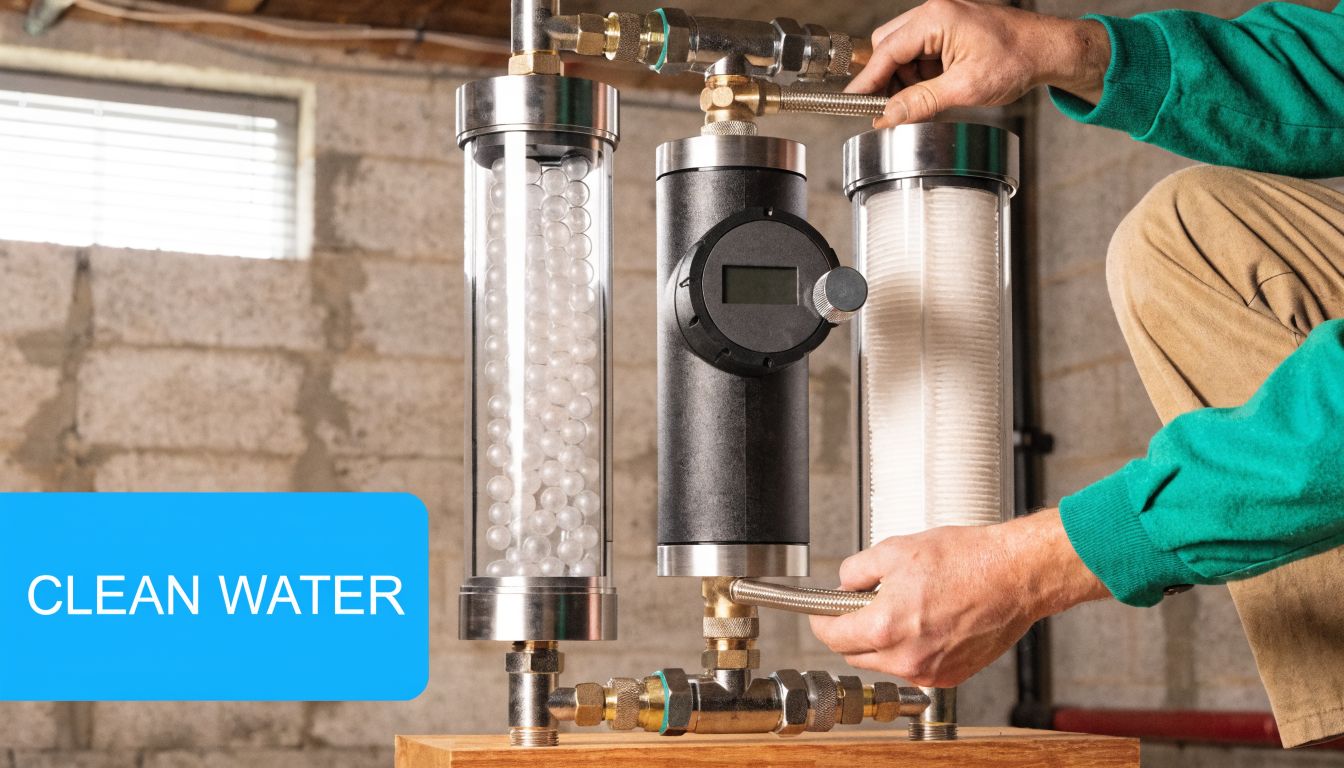
According to Olympian Water Testing’s discussion of sulfur filter performance, 2026 projections for major markets say whole house filters in sulfur-prone areas remove 97% of associated chlorine and chloramine while targeting H2S through multi-stage media, but proper sizing and pre-filtration are critical to prevent 95% of filter-induced sulfur amplification and protect plumbing. The current takeaway isn’t the projection itself. It’s the installation lesson. Sizing and pre-treatment decide whether the system behaves.
Placement matters more than homeowners expect
On a well system, sulfur equipment usually belongs in a logical sequence after the pressure tank, with enough isolation points to service each piece. If the system includes oxidation, backwash, or polishing stages, each part needs room to work and room to be maintained.
Three installation details matter almost every time:
- A bypass valve gives you a way to service the system without shutting down the house.
- Drain access matters for any backwashing system.
- Working space around the tanks matters because media systems eventually need inspection, rebuilding, or replacement.
A clean install is not just about neat pipes. It’s about future access.
Don’t skip the pre-sediment stage
If there’s one mistake that steadily ruins sulfur systems, it’s neglecting sediment control. Sand, silt, rust, and debris load up downstream equipment fast. If the water also carries iron, the need for pre-filtration gets even stronger.
A proper pre-sediment filter helps by:
- Catching grit before it reaches control valves
- Reducing fouling in sulfur media
- Protecting backwash performance
- Improving consistency across the whole treatment train
People often blame the sulfur filter when the root cause is upstream debris choking it.
A sulfur filter should treat sulfur. It shouldn’t be forced to act as the home’s main dirt catcher.
Flow rate and tank size are not optional details
A sulfur filter has to keep up with the house. If the family can run multiple showers, laundry, and a sink at the same time, the system needs to support that demand. An undersized tank or valve can lead to pressure complaints, poor contact time, and uneven treatment.
That’s why the install conversation should include:
- How many bathrooms the house has
- Whether irrigation or outdoor lines are on the same service
- Peak household water use
- Whether other equipment, such as a softener, sits before or after the sulfur stage
Here’s a useful visual overview before you approve a layout:
A better installation checklist
Walk through these points before anyone glues pipe or tightens fittings:
Confirm the source of the odor
If the hot-only test points to the heater, fix that first.Verify the treatment order
Sediment, sulfur treatment, polishing, and hardness treatment need the right sequence.Make sure a bypass is included
This is one of the first details experienced installers look for.Check drain and power needs
Backwashing and powered systems need infrastructure, not just floor space.Leave service access
If a tank can’t be opened or a valve can’t be reached, future maintenance gets sloppy fast.
DIY or professional
Some homeowners can install their own equipment well. But sulfur systems punish guesswork more than simple cartridge filters do. Even if a licensed pro does the work, it helps to know what “good” looks like so you can ask better questions and spot bad shortcuts.
Keeping Your Water Fresh and Your System Running Smoothly
Sulfur treatment is not a set-it-and-forget-it category. If the system is doing real work, it needs maintenance that matches the water conditions. The maintenance schedule changes by technology, leading homeowners to either protect the investment or slowly lose performance until the smell returns.
According to Mid Atlantic Water’s sulfur filter maintenance discussion, standard carbon-based filters exhaust quickly under high H2S loads above 1 ppm and may need media replacement every 3 to 6 months. Aeration-oxidation systems can offer media life of 5+ years, and a 2025 AWWA report on 150 installations showed 92% efficacy versus 65% for older greensand technology.
Why sulfur systems fail early
When a sulfur system starts smelling again, the cause is usually one of these:
- The media is spent
- Backwash isn’t running properly
- Sediment or iron has fouled the tank
- The original system was undersized
- Seasonal water changes pushed the system beyond its capacity
That failure often feels sudden to the homeowner. In reality, it builds gradually. Odor control weakens, then the smell returns on heavy-use days, then it becomes permanent.
What each system needs from you
Different sulfur setups ask for different habits.
Carbon-based systems
These are simpler to live with, but they can demand more frequent media attention when sulfur is strong. If the smell starts creeping back, don’t assume the whole system is defective. Check whether the media has reached the end of its useful life.
Aeration and AIO systems
These typically reward homeowners with longer media life, but only if the backwash cycle is working as intended. If a valve malfunctions or a drain line clogs, the system can lose performance while still looking “on.”
Chemical injection systems
These can be very effective for difficult water, but they need a homeowner who monitors the feed tank, pump behavior, and downstream filtration. They don’t tolerate neglect well.
Sulfur treatment fails quietly. The house tells you first through smell, not through alarms.
A maintenance rhythm that makes sense
A simple ownership routine works better than waiting for odor to return:
- Look at the system regularly: check tanks, valves, and any feed solution level.
- Pay attention to backwash behavior: if a unit should be regenerating or backwashing and isn’t, performance will slide.
- Keep basic notes: write down media changes, service dates, and any odor flare-ups.
- Re-test water when performance changes: water chemistry can shift over time.
If you want a broader maintenance reference for home filtration equipment, this water filtration advice library is a useful place to compare upkeep expectations across system types.
The ownership trade-off
Carbon systems often look easier at purchase. Aeration systems often look more involved. Over time, the “easier” system can become the one that needs more frequent intervention if the sulfur load is high. That’s why the cheapest-looking option at install isn’t always the most comfortable option to own.
The best sulfur setup is the one you can maintain consistently.
Knowing When to Call a Water Treatment Professional
Some sulfur problems are manageable for a careful DIY homeowner. Others need a professional from the start.
Call a water treatment specialist when the smell comes with iron staining, black manganese staining, heavy sediment, pressure issues, or repeated system failure. Those combinations usually mean the water needs a coordinated treatment plan, not a single replacement tank.
You should also bring in a pro if:
- The odor is strong throughout the house and keeps returning after simple fixes
- Your water heater and source water may both be contributing
- The home has multiple bathrooms and high peak demand
- The existing treatment equipment was installed in pieces over time and nobody is sure of the order
- Backwashing equipment has no clear drain setup or service access
A professional is also the better choice when you already spent money on the wrong solution once. At that point, paying for proper diagnosis is usually cheaper than another guess.
Good sulfur treatment depends on testing, hydraulic fit, equipment order, and maintenance planning. That mix is where experienced installers earn their keep. They can also separate a true sulfur issue from odor problems caused by stagnant plumbing, heater conditions, or filter fouling.
If a contractor talks only about the tank they want to sell and never asks about hot versus cold water, iron, manganese, pH, drain access, or household flow rate, keep looking. Sulfur odor is a system problem. It needs a system answer.
Your Next Steps for Sulfur-Free Water
The fastest path to clean-smelling water is also the least glamorous. Diagnose first. Test second. Buy equipment third. That order prevents most expensive sulfur mistakes.
If the smell is only in hot water, inspect the heater before shopping for a whole-house solution. If the smell is in both hot and cold water, get the water tested and match the treatment method to the sulfur level and the rest of the water chemistry. If the home also has hardness, sediment, or staining, plan the treatment train as one system rather than a stack of random add-ons.
For homeowners comparing layouts, treatment stages, and house-wide options, this guide to a whole home water filtration system is a useful companion read because it helps frame where sulfur treatment fits in the broader plumbing setup.
Quick answers homeowners usually ask next
Can a water softener remove sulfur smell
Not by itself. A softener addresses hardness. It’s not a sulfur treatment device. In some homes, a softener belongs in the overall plan, but it isn’t the cure for hydrogen sulfide odor.
Does shock chlorination fix sulfur smell
Sometimes temporarily. It can help knock back odor-causing activity for a while, especially after seasonal changes, but it usually doesn’t replace proper ongoing treatment when source water keeps producing sulfur odor.
Why do ice cubes smell bad when the tap doesn’t
Cold temperatures and storage can make odor seem different in ice than in flowing water. A refrigerator line, old filter, or stagnant branch line can also make the smell more noticeable there first.
Why did the smell start after I installed a new whole house filter
That often points to system mismatch, poor sizing, wrong media choice, or missing pre-filtration. The new filter may not be causing sulfur, but it may be exposing an untreated source or struggling under the actual contaminant load.
What’s the smartest first move today
Run the hot-versus-cold test. That one step narrows the problem immediately and keeps you from buying the wrong fix.
If you want help comparing sulfur filter types, maintenance demands, and whole-house treatment options without the sales pressure, Water Filter Advisor is a solid place to research your next move. It’s especially useful when you’re trying to decide between carbon, oxidation, and full system upgrades based on what your water is doing.