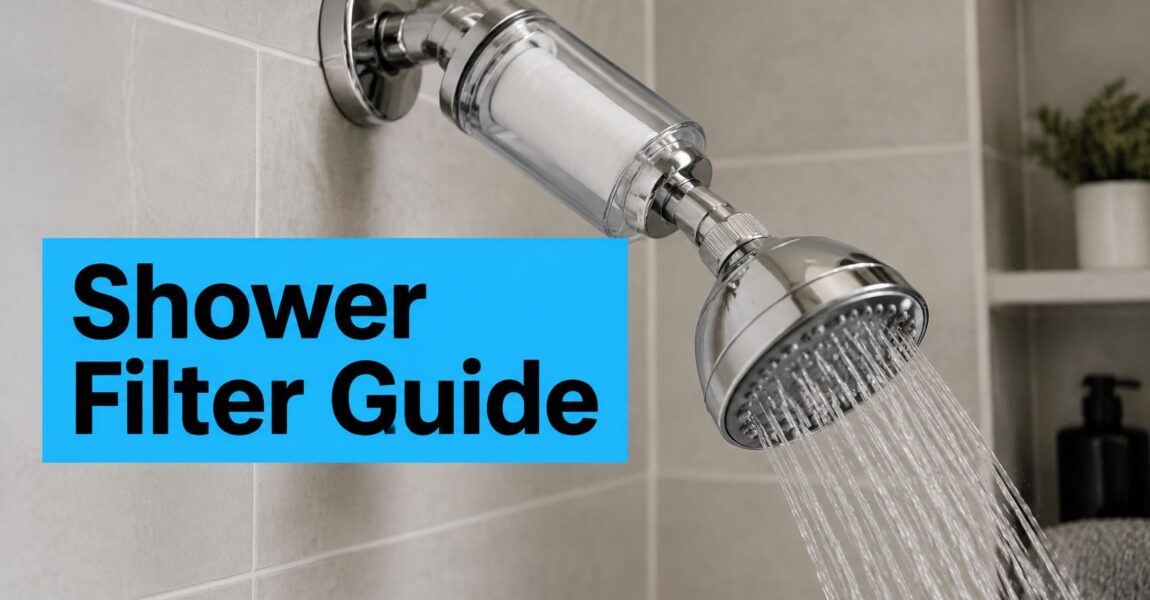
Shower Head Filter System: What It Removes and Costs
The most popular shower-filter advice is to pick a cartridge with the most stages and trust the label. Start somewhere less flashy: find out whether your water utility uses free chlorine, chloramine, or both. Then check whether the filter's certification covers that disinfectant, and only after that compare cartridge replacement costs.
A shower head filter system can be a sensible home upgrade when its tested purpose matches your water. It can also be the wrong purchase if you're trying to solve a problem its certification doesn't cover. The useful question isn't how many layers a filter advertises. It's what the assembled system has been independently verified to reduce, under what conditions, and for how long.
What a Shower Filter Removes and What It Misses
A shower head filter system certified to NSF/ANSI 177 is verified to reduce free available chlorine. The standard doesn't establish reduction of most other contaminants. Consider it a bit like sunglasses for your water: it can cut the glare of chlorine-related taste and odor, but it isn't sunscreen that protects against every possible harm.
NSF/ANSI 177 covers materials safety, mechanical design, labeling, and verified reduction of free available chlorine in potable water. Its scope is limited to aesthetic effects, not general health protection. The standard's requirements and scope are set out in the NSF/ANSI 177 standard preview.
| Contaminant | Covered by NSF/ANSI 177 | What It Means at the Shower |
|---|---|---|
| Free available chlorine | Yes, at least 50% reduction of a 2.0 mg/L challenge | Less chlorine taste and odor |
| Chloramine | No, not verified by the standard | Needs manufacturer data specific to chloramine |
| Lead | No, not established by the standard | Needs separate contaminant-specific certification |
| Iron | No | Rust-colored stains aren't addressed by a 177 claim |
| Hydrogen sulfide | No | Rotten-egg smell is outside the standard |
| Fluoride | No | Not covered |
| Hardness minerals | No | Scale and dry-skin causes need a different approach |
| Bacteria and Legionella | No | The cartridge doesn't sterilize water; clean the head regularly |
The chlorine test is tied to defined operating conditions, including the test water, temperature, pressure, flow, and rated service life. That matters because a filter working under one set of conditions isn't making an unlimited promise about every home's water. Check the rated flow and service life, not just the certification badge.
Also confirm that certification applies to the complete assembled shower system, not only to a cartridge or one media component. A product can advertise several contaminant reductions while its certification verifies only one. NSF explains that certification to a particular water-treatment standard doesn't mean a system reduces every possible contaminant in its consumer guidance on water-treatment standards.
Start with your utility's disinfectant, then read the certification against that result. If your water uses chloramine, a free-chlorine certification alone doesn't answer your main question.
Filter Media Compared From Vitamin C to Catalytic Carbon
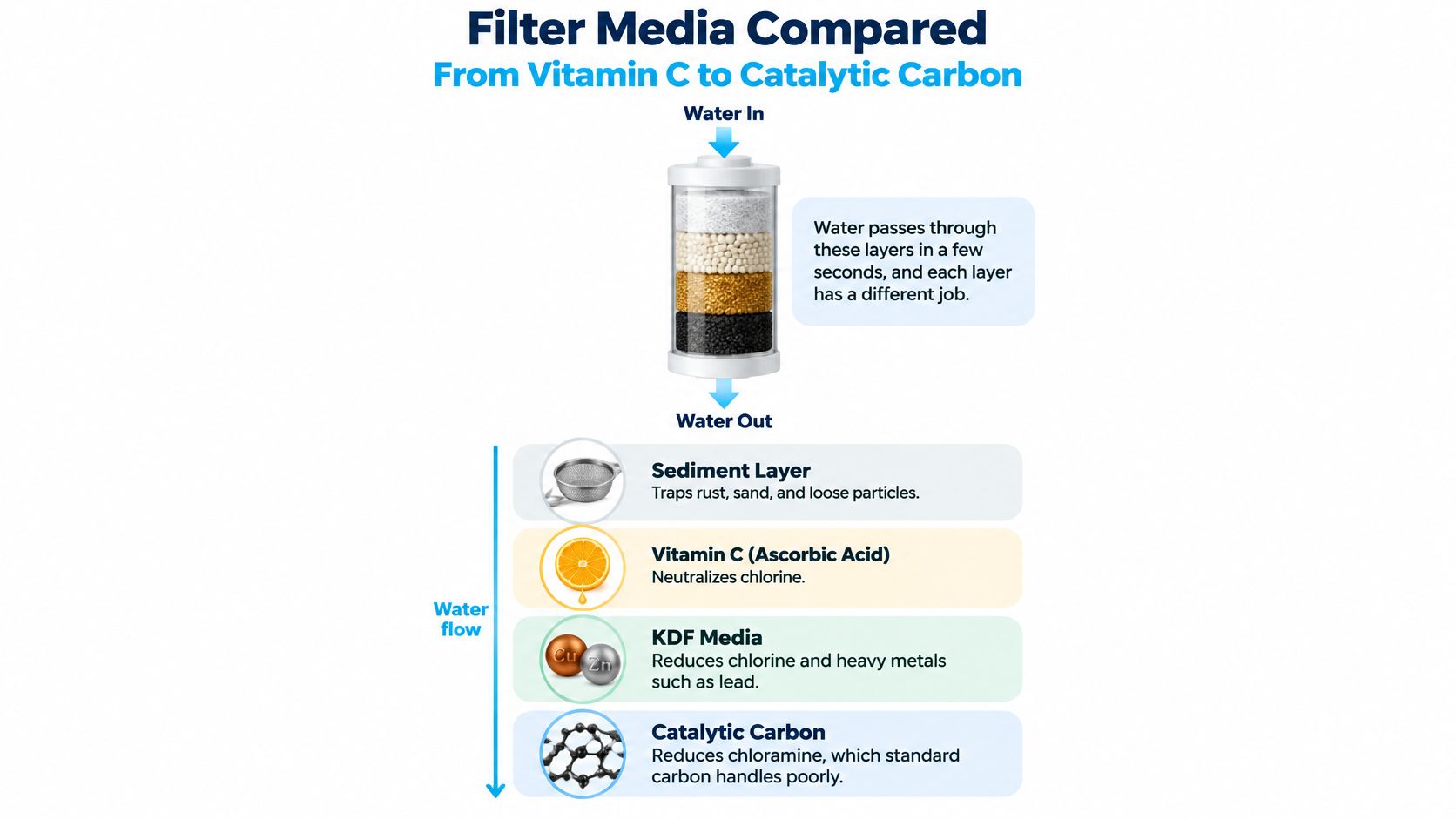
A cartridge is a stack of layers that water passes through quickly. Each layer has a different job, but fast shower flow leaves little time for water to contact the media. That's why the material inside matters more than a long list of “stages.”
| Media | Main Target | Strength | Limit |
|---|---|---|---|
| Vitamin C (ascorbic acid) | Free chlorine | Fast, low-cost chlorine neutralizing | Used up quickly at high chlorine; doesn't control bacteria |
| KDF (copper-zinc alloy) | Chlorine and some heavy metals | Works in hot water and lasts well | Limited odor and sediment removal |
| Activated carbon | Chlorine, odor, and taste | Good taste and odor reduction | Clogs with sediment; weak on chloramine |
| Catalytic carbon | Chlorine and chloramine, depending on the model | The media most often marketed for chloramine | Claims need product-specific data |
| Calcium sulfite | Free chlorine | Common in lower-cost cartridges | Limited capacity at high flow |
| Mixed KDF and carbon | Chlorine and odor | Broader taste coverage in one cartridge | Check rated life; lead performance is rarely certified |
These media aren't interchangeable. Activated carbon is familiar from many drinking-water filters, but a shower cartridge operates under different conditions. Catalytic carbon is often marketed for chloramine, yet the media name alone doesn't prove a particular shower filter reduces it. Ask for product-specific test results that identify the contaminant and the conditions tested.
Sediment can interfere with the cartridge, too. Rust, scale, and loose particles can clog layers and reduce flow; carbon fines may also appear after installation if the cartridge hasn't been flushed as directed. A cartridge that slows down may need replacement, not a more persuasive marketing description.
Practical rule: A named media plus a certified rated service life tells you more than a generic “advanced filtration” badge. Ask what's inside, what it's tested to reduce, and when the manufacturer says to replace it.
How Flow Rate, Heat and Pressure Change Results
A family of four taking 10-minute showers at 2.0 gallons per minute goes through about 80 gallons a day, roughly 2,400 gallons a month. That arithmetic rests on the stated shower times and flow rate, so treat it as an example rather than a universal estimate. What it does show is why a cartridge's rated capacity has to match household use, and why two homes can drain the same cartridge at very different speeds.
The starting point is set by regulation. The Energy Policy Act of 1992 set a maximum showerhead flow rate of 2.5 gallons per minute (gpm), about 9.5 liters per minute. EPA WaterSense showerheads use no more than 2.0 gpm, at least 20% less than that federal maximum, according to the EPA showerhead guidance. A filter under a 2.0-gpm head processes 20% less water per minute than one running at the federal limit, and a restrictive cartridge can cut delivered flow further. That trade-off between water savings and spray force is covered in this guide to whether shower filters reduce water pressure.
Delivered flow is not proof of contaminant removal. It shows water delivery, nothing more. Pressure, contact time, water chemistry, temperature, and cartridge capacity all shape what the system does in practice, and a cartridge that flows freely may be giving the water too little contact time with the media.
Certified results are tied to stated test conditions, which is why I read certificates before marketing copy. The NSF/ANSI 177 performance test defines fixed parameters: a published description lists water heated to 40°C, dynamic pressure of 80 psig, and the manufacturer's rated flow in Water Conditioning & Purification Online's overview of the shower-filter standard. Your supply may run cooler, sit at lower pressure, or carry chloramine where the test used free chlorine. A certificate proves performance at the conditions tested. Check your utility's disinfectant first, free chlorine, chloramine, or both, then confirm the certificate names what you need reduced.
To estimate service time, find the rated gallons on the package and your expected daily use, then divide the rated capacity by gallons used per day. Compare that figure with the manufacturer's rated time limit and follow whichever arrives first.
How to Install a Shower Head Filter Step by Step
Most shower filters are inline, between the shower arm and the showerhead. Some handheld models place the cartridge in the handle. This walkthrough covers the common inline setup, where a sound gasket and correctly prepared threads matter more than brute force.
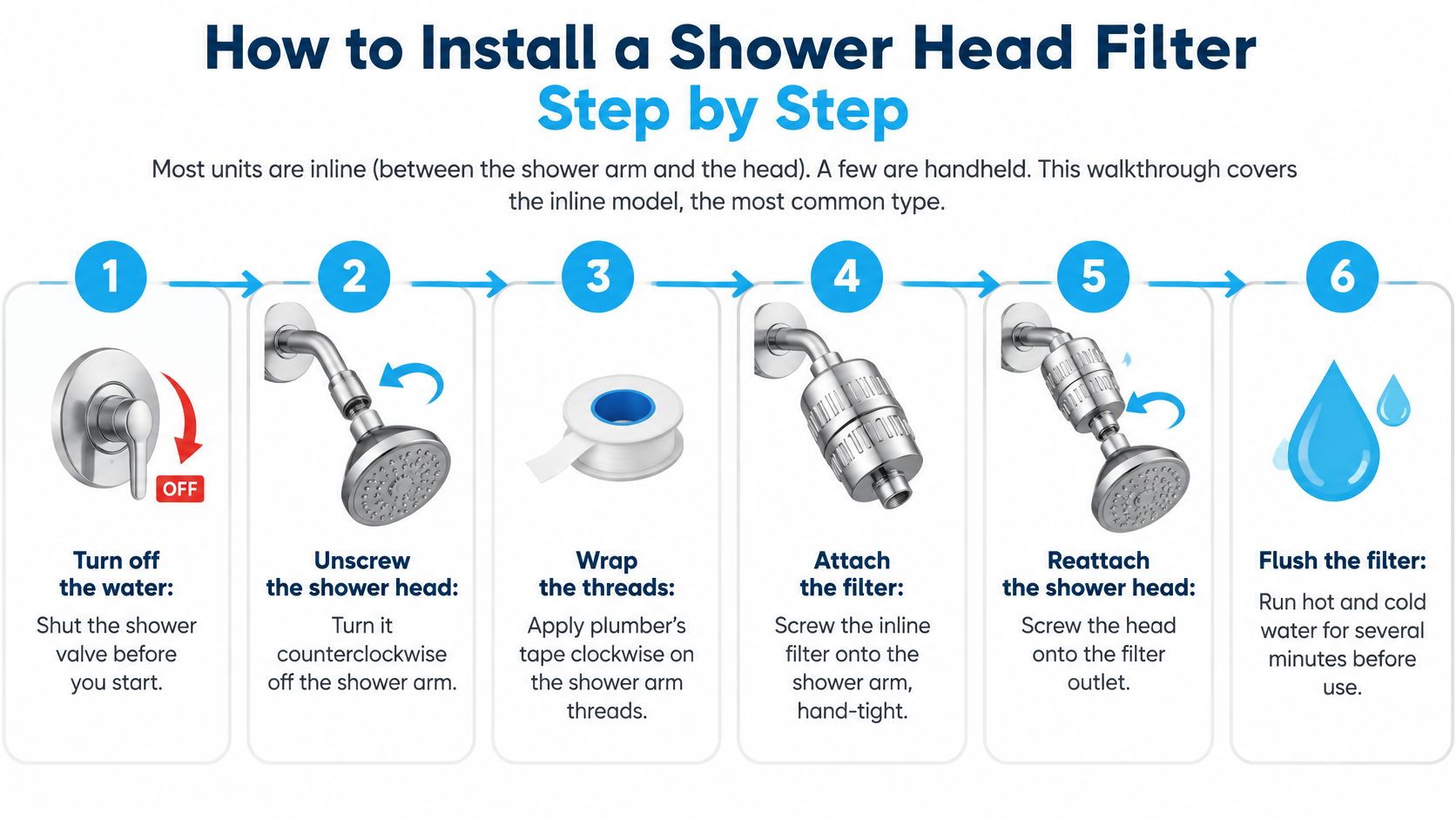
Turn off the shower valve and inspect the arm. Look for corrosion, mineral crust, or damaged threads before you loosen anything. Check that the filter adapter matches the shower arm's thread size, commonly 1/2-inch NPT, to avoid cross-threading.
Remove the showerhead. Turn it counterclockwise by hand. If it sticks, wrap a rag around the nut and use an adjustable wrench gently; direct wrench contact can damage the finish.
Prepare the threads. Wrap PTFE plumber's tape clockwise around the shower-arm threads, using three to four turns. Winding it in the direction of installation helps keep the tape in place.
Check the gasket and cartridge. Make sure the housing gasket is present and not flattened. A missing or worn gasket is a common cause of leaks. If the cartridge has a flow arrow, point it toward the showerhead, in the direction the water travels.
Attach the filter housing. Thread it onto the arm by hand, then tighten it with a quarter turn using a wrench on the housing flats only. Don't overtighten: plastic housings can crack.
Reconnect the showerhead and flush the cartridge. Use tape on the outlet threads, attach the showerhead, and run water for the manufacturer's flush time. Some instructions call for about five minutes to clear carbon fines; follow the product label rather than assuming every cartridge has the same requirement.
Open the water slowly and check every joint. If you see a drip, retighten carefully instead of forcing the connection. A reversed cartridge can reduce performance, and skipping the flush can send black specks into the shower. Write the installation date on the housing so you'll know when to check the replacement schedule.
Replacement Schedule, Hygiene and Yearly Cost
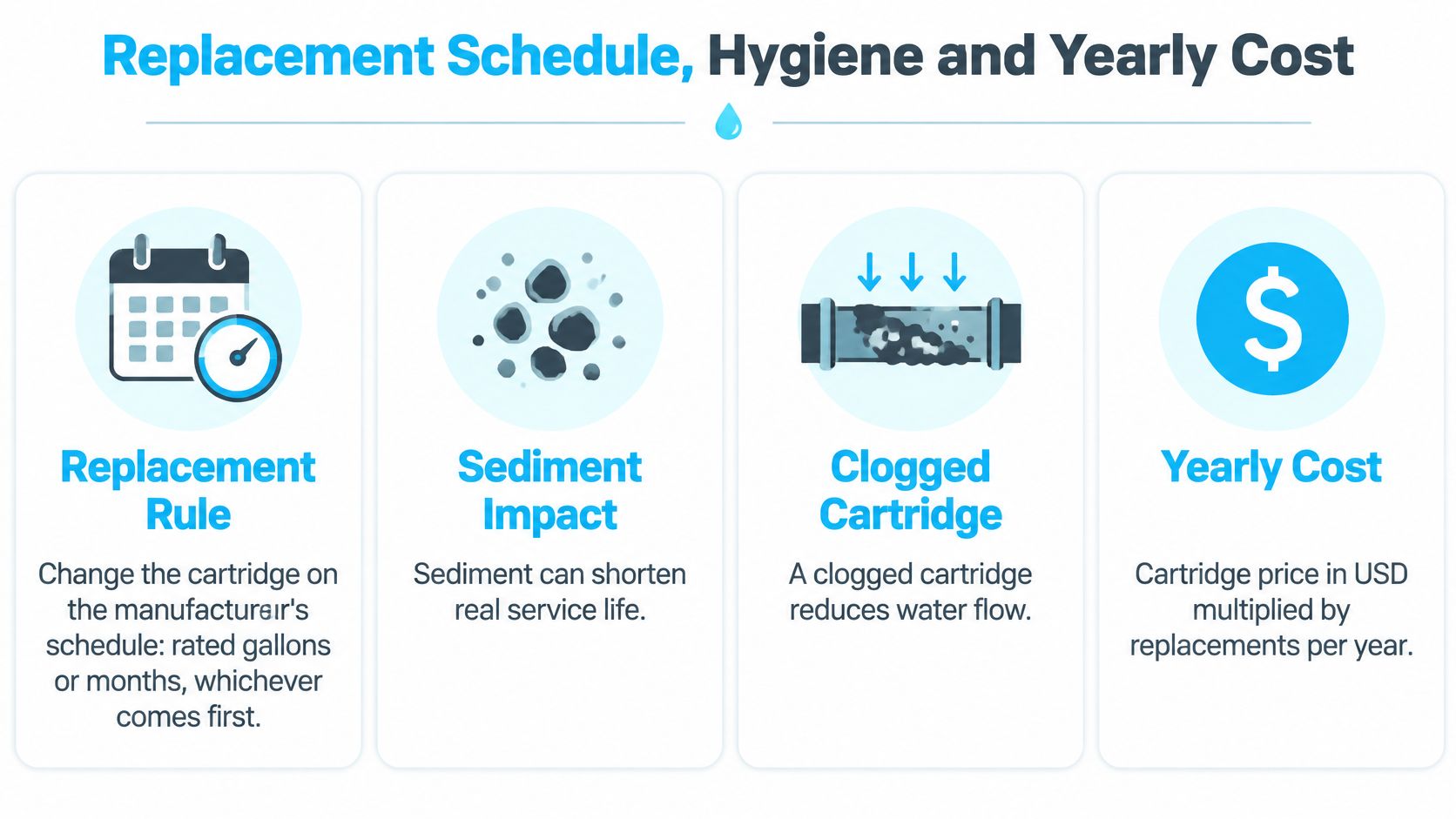
I write the install date on every cartridge housing I fit. The manufacturer rates life in gallons or months, and the honest rule is simple: change it at whichever limit arrives first. Sediment can clog a cartridge well before its advertised interval, and once flow drops the media is no longer performing the way the certificate assumed. An overdue cartridge is dead weight on the pipe.
Portland Water Bureau guidance adds a hygiene point most product pages skip: used filters can collect Cryptosporidium, so wear gloves and have someone who isn't immunocompromised handle the swap. Its home water-filter guidance explains why maintenance and replacement schedules matter.
Once the certificate says a filter handles your disinfectant, the cartridge price is where most of the cost lands. Use the table below for planning ranges.
| Cartridge Type | Typical Service Life | Cartridge Price Range | Estimated Yearly Cost |
|---|---|---|---|
| Single-stage vitamin C cartridge | 3–6 months | $25 | $50–$100 |
| KDF and carbon combination | Varies by product | $25–$50 | Depends on rated life |
| High-capacity catalytic carbon | Varies by product | $40–$80 | Depends on rated life and price |
| Handheld replaceable cartridge | 3–6 months | $20–$40 | Depends on cartridge price |
The label and the manufacturer's tested service life control what you actually spend. The math itself is easy: count the cartridges you will burn through in a year, multiply by the unit price, then add any housing parts you need.
Here's a worked example. A family of four using a single-stage vitamin C cartridge priced at $25 and rated for three months buys four cartridges a year, landing around $100 annually. Change the cartridge price, the rated interval, or the household's water use and the number moves. Two products with similar media can still carry very different service lives, so compare the rated life on the certificate rather than the media list.
Cleaning matters, too
Showerheads can release Legionella into indoor air through droplets. CDC guidance notes the bacteria can grow in and spread through showerheads when fixtures sit unused for a week or more, or when they haven't been cleaned or replaced for a long time and visible buildup coats the aerators. A cartridge doesn't clean the fixture for you. The CDC guidance on Legionella in vacation-rental plumbing describes these maintenance concerns.
Clean the showerhead and aerator on a regular schedule, and follow the filter maker's instructions for flushing. If your water is hard, a monthly 30-minute soak in white vinegar loosens mineral buildup. After the shower sits unused for a week, run hot water for several minutes before stepping in. These habits keep the fixture sanitary. They don't turn a filter into a disinfectant, so don't expect chlorine removal to cover biological growth.
Troubleshooting Low Flow, Odor and Dry Skin
Most shower-filter complaints come down to a clogged or overdue cartridge, exhausted media, or a mismatch between the filter and the water chemistry. Check those causes before replacing the whole unit.
- Flow drops to a trickle. Sediment may have clogged the cartridge, or the cartridge may be overdue. Replace it, then inspect and clean the showerhead aerator.
- Chlorine smell returns. The media may be exhausted, or the water's disinfectant load may exceed what the cartridge can handle for its rated life. Check the product's replacement schedule and verified claim.
- Black or gray specks appear. Carbon fines may remain after installation. Run water for the full flush time in the manufacturer's instructions.
- Dry or itchy skin persists. Hardness or chloramine may be a better match for the problem than free chlorine. A filter certified for free chlorine won't establish a solution to either of those concerns.
- The housing leaks. Check for a missing or flattened gasket and a cross-threaded joint. Reseat the gasket, align the threads, and tighten by hand before using a wrench.
- The head smells musty or has slime. Stagnant water or buildup may be involved. Clean the showerhead and aerator, and replace the cartridge if it's due.
- The water smells like rotten eggs. That points to a possible hydrogen sulfide concern, which NSF/ANSI 177 doesn't cover. A chlorine-reduction certificate doesn't answer it.
If a fresh cartridge and a clean showerhead don't resolve the problem, stop troubleshooting the filter and test the water. A filter can only be judged against the contaminant it's designed and verified to address.
Match Your Filter to Your Water Before You Buy
The buying order is simple: disinfectant first, certificate second, replacement cost third. That order prevents a common mistake: choosing media because its name sounds impressive, then discovering it doesn't match the disinfectant coming from the tap.
Start with the utility report
Look up your utility's annual water-quality report or call the supplier. Ask whether the system uses free chlorine, chloramine, or both. Note any reported lead or iron concerns while you're there. If you're on a private well, or the report doesn't answer your question, test the water before buying a shower filter.
The disinfectant choice is especially important because NSF/ANSI 177 verifies reduction of free available chlorine, not general contaminant removal. Its test water contains total chloramines below 0.1 mg/L, so a result from that test shouldn't automatically be applied to a utility that intentionally uses chloramine. The standard's scope and chlorine-versus-chloramine limitation are described in the NSF/ANSI 177 standard information.
Match the result to the evidence
If your utility uses free chlorine and your goal is to reduce chlorine-related taste or odor at the shower, a complete system certified to NSF/ANSI 177 may fit its stated purpose. Check the actual listing and rated service life. Don't treat an ingredient list or a badge for one component as proof about the assembled product.
If your utility uses chloramine, ask for independent, product-specific chloramine test data. Marketing language such as “multi-stage,” “premium media,” or “advanced filtration” doesn't establish that the assembled filter reduces chloramine under shower conditions. A product may have a valid free-chlorine certification and still leave your chloramine question unanswered. If the seller can't show evidence for the specific claim, don't assume the filter works for that purpose.
Lead, iron, hydrogen sulfide, and bacteria also need a different answer from a free-chlorine shower-filter certification. If one of those is your concern, test the water and consider a treatment system designed and verified for that contaminant. A shower filter is a point-of-use device at one fixture, not a whole-house treatment system or a drinking-water purifier.
Check the full system and its running cost
Confirm that the certification applies to the complete assembled shower system. Read the rated flow, tested contaminant, service life, and replacement instructions. Then estimate cartridge expense from the replacement interval and price. Long or frequent showers can use up rated capacity sooner; sediment can shorten real-world life further.
Be cautious about using skin or hair claims as a substitute for test results. NSF/ANSI 177 doesn't validate skin benefits, hair benefits, or general water safety. If hard water and scale are the actual problem, a shower filter's chlorine claim won't remove hardness minerals. Compare options for shower filters and hard water with that distinction in mind.
Make the call based on your situation
- Renter on chlorinated city water: A certified shower filter may be a practical choice for its verified free-chlorine reduction claim. Check the system certification and cartridge schedule before buying.
- Home using chloramine: Don't rely on NSF/ANSI 177 certification alone. Require credible data specific to chloramine, or consider a different treatment approach.
- Private-well owner: Test first. Without a clear result, buying a chlorine-focused cartridge is guesswork.
Once you choose a system, write the installation date on the housing and set a reminder for the earlier of its rated gallon capacity or time limit. Water Filter Advisor publishes consumer guidance on shower filters, installation, cartridge maintenance, and water testing, so use those resources to compare options against your own water results.
Compare shower filter systems, learn what their certifications really cover, and find practical guidance on installation and cartridge care at Water Filter Advisor. Start with your utility's disinfectant or a water test, then choose a filter and replacement schedule that fit the results.
