Home Sulfur Water Treatment Guide

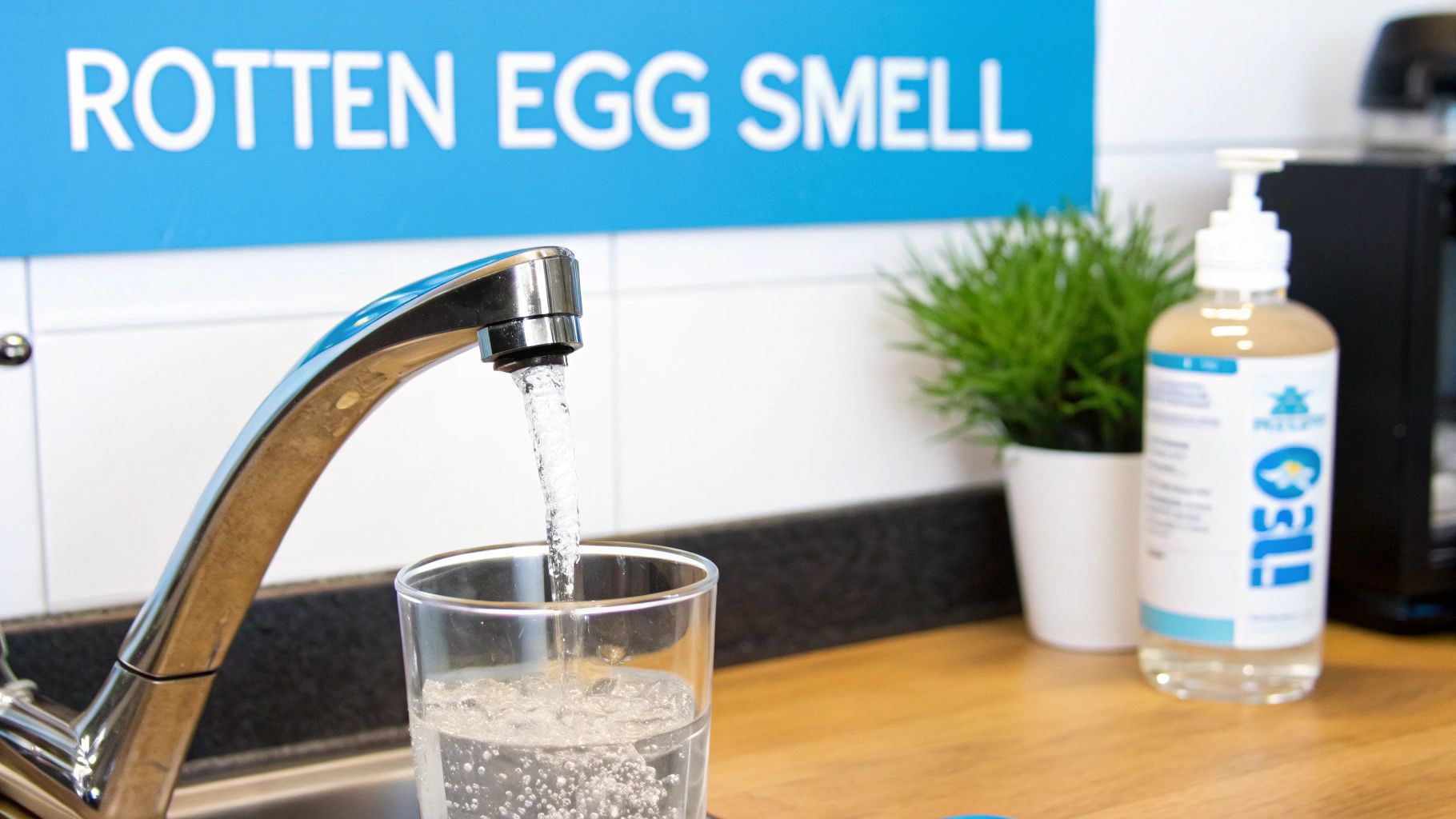
You turn on the faucet for a glass of water, lean in, and get hit with that rotten egg smell again. Then you notice it in the shower. Then in the dishwasher. At that point, most homeowners stop asking whether the smell is real and start asking how expensive this is going to get.

The good news is that sulfur water treatment is usually very fixable when you diagnose it in the right order. The bad news is that a lot of people buy the wrong filter first. They throw carbon at a bacterial problem, shock chlorinate a heater issue, or install an oxidation filter without checking whether the water chemistry will let it work well.

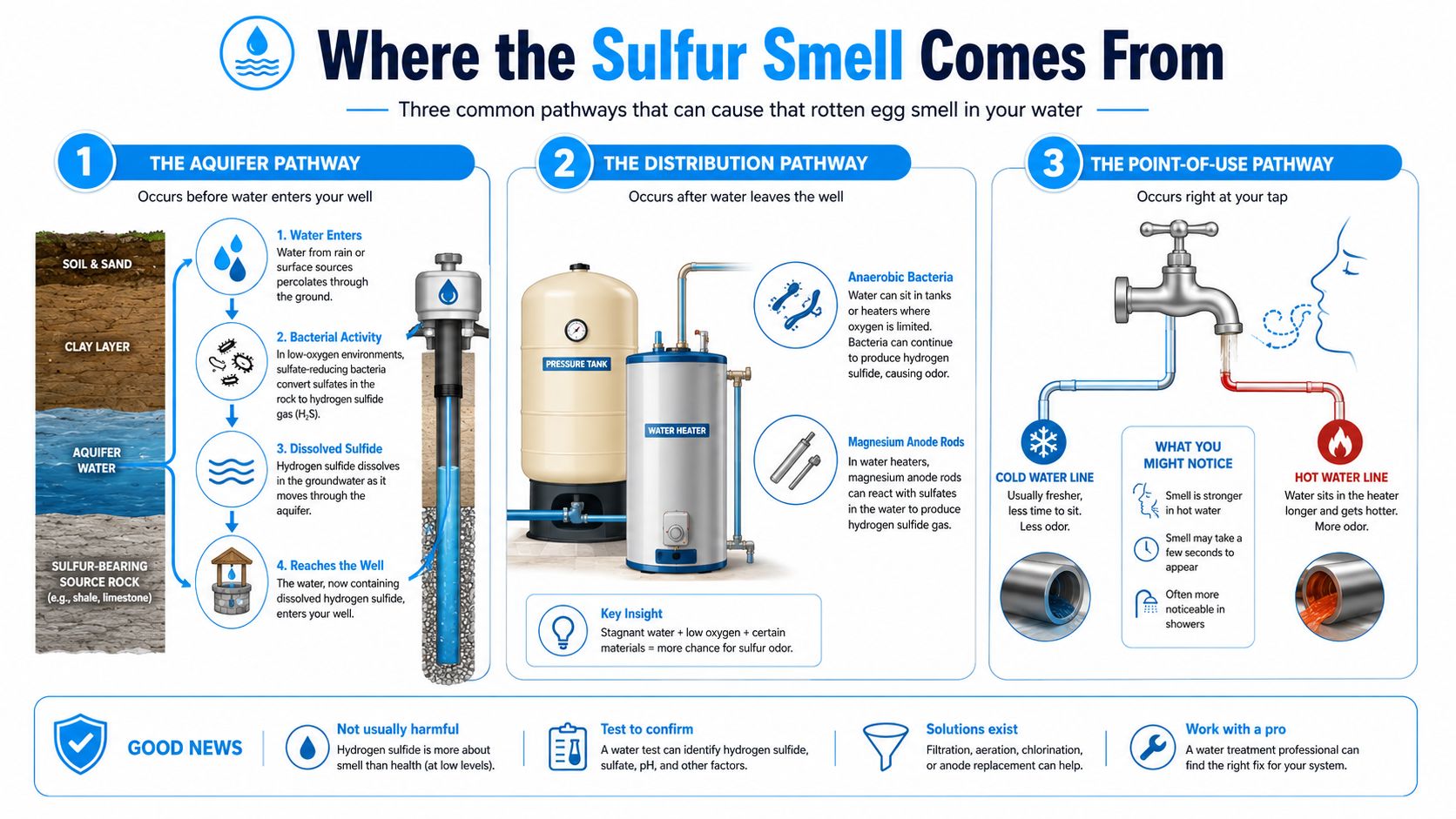
A sulfur problem feels mysterious because the smell can come from different places. The source water. The well. The plumbing. The water heater. Sometimes more than one at once. Once you sort out where the odor starts and how strong it is, the treatment path gets much simpler.

That Rotten Egg Smell Ends Today

You fill a pot at the kitchen sink and catch that sulfur smell right away. An hour later, the shower is worse. By evening, you are wondering whether you need a filter, a plumber, or a whole new well setup.

Start with the right question. Where is the odor showing up, and under what conditions?

Rotten egg odor usually points to hydrogen sulfide or a related sulfur issue, but the smell alone does not tell you which fix will work. One house needs a water heater service call. Another needs oxidation and filtration at the entry point. A third has a one-faucet problem that has nothing to do with the well itself.

Practical rule: Don’t choose equipment based on smell alone. Two homes with the same rotten egg odor can need completely different fixes.

I’ve seen homeowners replace fixtures, change cartridges, and blame the municipal supply when the actual problem was in the well system. I’ve also seen the reverse. A family assumes the well is contaminated, but the odor only shows up on the hot side, with the heater causing most of it.

The right sulfur water treatment doesn’t start with shopping. It starts with separating symptoms from causes, then matching the fix to the source, concentration, and budget.

That decision process is what keeps costs under control. If the smell is only in hot water, the least expensive answer may be at the heater. If it shows up in both hot and cold water at every tap, treatment usually needs to happen earlier in the plumbing line. If the odor is light and occasional, a simpler approach may hold up well. If it is strong, constant, and paired with staining or corrosion, the treatment plan usually needs more than a basic filter.

Sulfur problems are usually fixable. The key is choosing in the right order so you do not spend whole-house money on a local problem, or patch a whole-house issue with the wrong small fix.

Diagnosing the Source of the Sulfur Odor

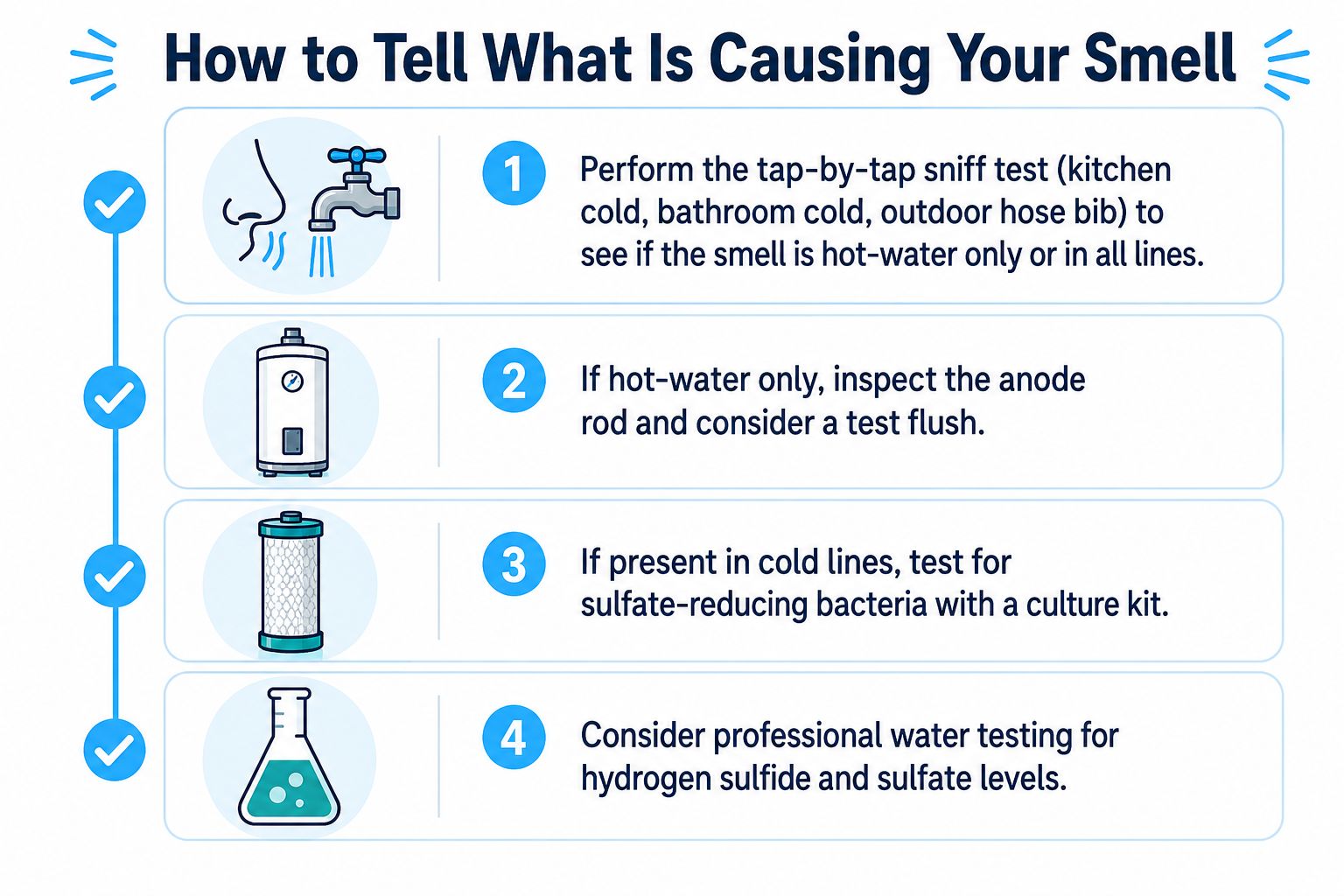
A sulfur smell at the kitchen sink in the morning can point to one problem. The same smell only in the shower on the hot side points to a different one. That is why the first step is always location, not equipment.

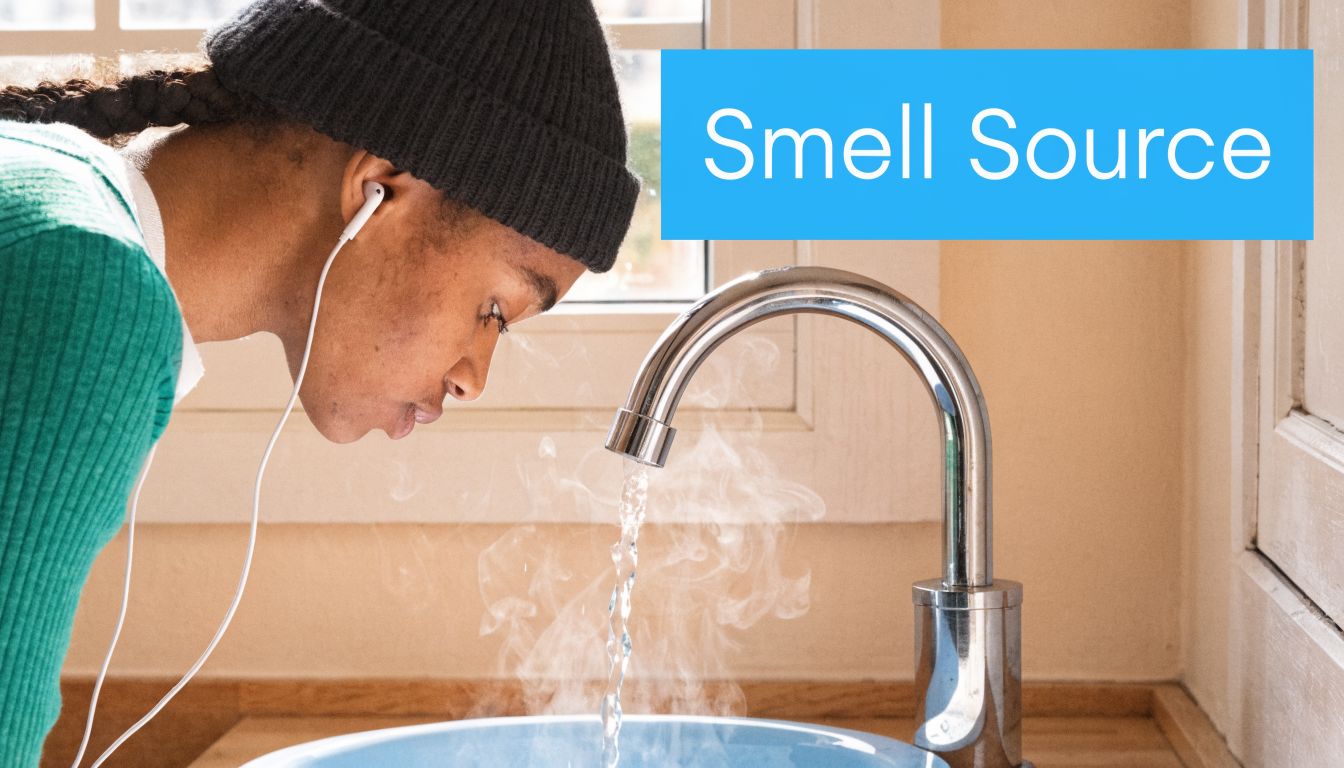
A person leans toward a steaming bathroom sink faucet to smell the hot water flowing out.

Start with hot water versus cold water

Run a simple check at two or three fixtures. Test cold water first, then hot. If the odor shows up only in hot water, the water heater moves to the top of the list. I see this often with older heaters, inactive heaters, or tanks with conditions that let odor problems build inside the unit.

If the odor is present in both hot and cold water, look upstream. On a well, that usually means the source water, pressure tank, or plumbing before the heater. If the smell is strongest after water sits for hours and improves after a minute or two, stagnant plumbing or bacterial growth inside parts of the system may be contributing.

Use this quick home checklist

  • Hot water only: Start with the water heater. This is usually the lowest-cost place to investigate.
  • Hot and cold at every tap: Suspect incoming water or the well system.
  • Only one faucet: Check that fixture, its drain, and nearby plumbing before blaming the whole house.
  • Hot water much worse than cold: The heater may be making a mild sulfur issue smell much stronger.
  • Odor comes and goes: Seasonal well changes, plumbing stagnation, or intermittent bacterial activity are common causes.

This distinction is simple but important. A sulfur odor can be a nuisance at low levels and can also contribute to corrosion and unpleasant-tasting water over time. As noted earlier, the smell problem is not always just a smell problem.

Well water and city water don't behave the same way

For private well owners, sulfur odor often starts in the groundwater or somewhere in the well system itself. Sulfur bacteria can also be part of the picture, especially if the smell is persistent or returns quickly after shock treatment.

For municipal water users, a true source-water sulfur issue is less common. In city homes, I would first check the water heater, dead-end plumbing, infrequently used fixtures, and any point-of-use filters that have been left in service too long.

A good diagnosis follows a simple flow. First ask where the smell appears. Then ask whether it is hot only, cold only, or both. Then ask whether it affects one fixture or the whole house. That sequence narrows the repair fast and keeps you from buying a whole-house system for a problem sitting inside one appliance.

If the smell is only in hot water, don’t buy a whole-house filter first. Confirm the heater is not the real culprit.

If you want a grounded overview of sampling and interpretation before you test, these practical water quality insights are worth reading.

How to Accurately Test Your Water for Sulfur

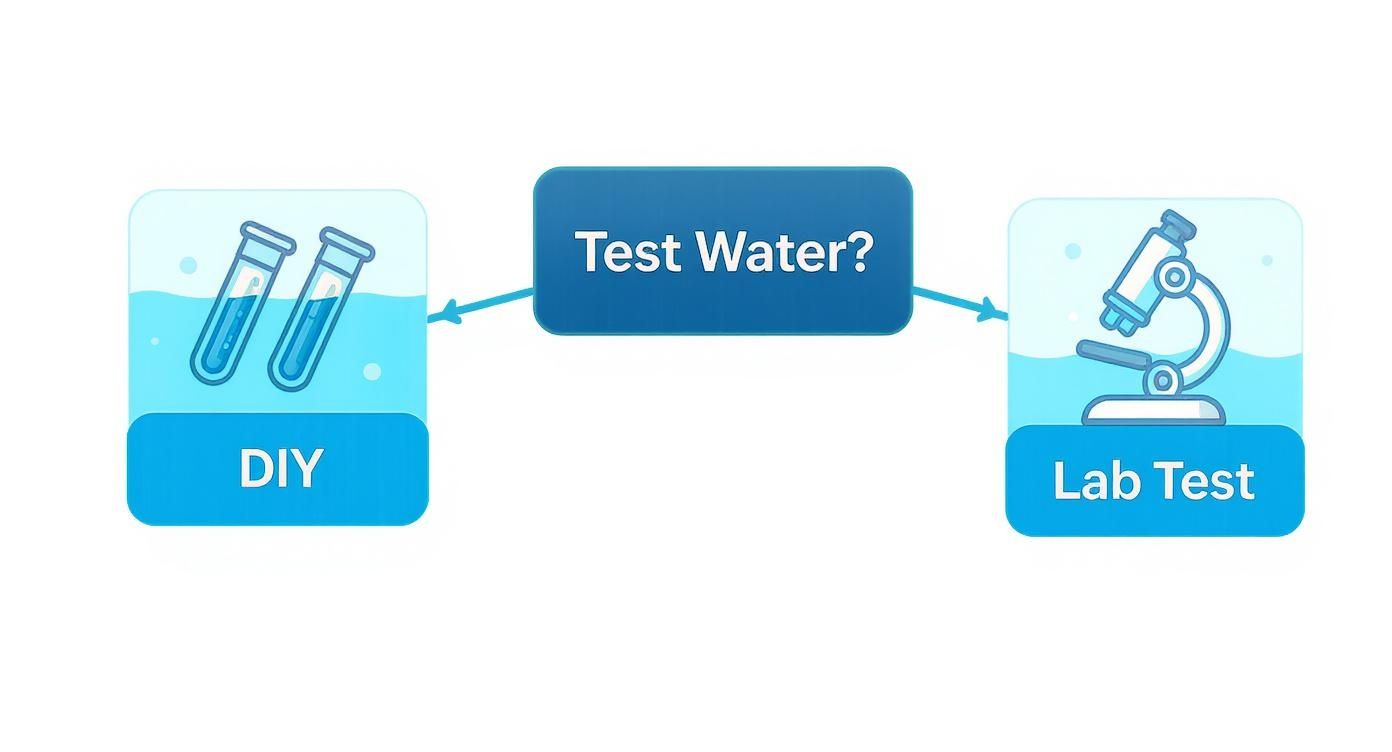
Once you know where the odor appears, stop guessing and test the water. Smell tells you there’s a problem. It doesn’t tell you the concentration, whether iron is tagging along, or whether the treatment system you’re considering is oversized, undersized, or just wrong.

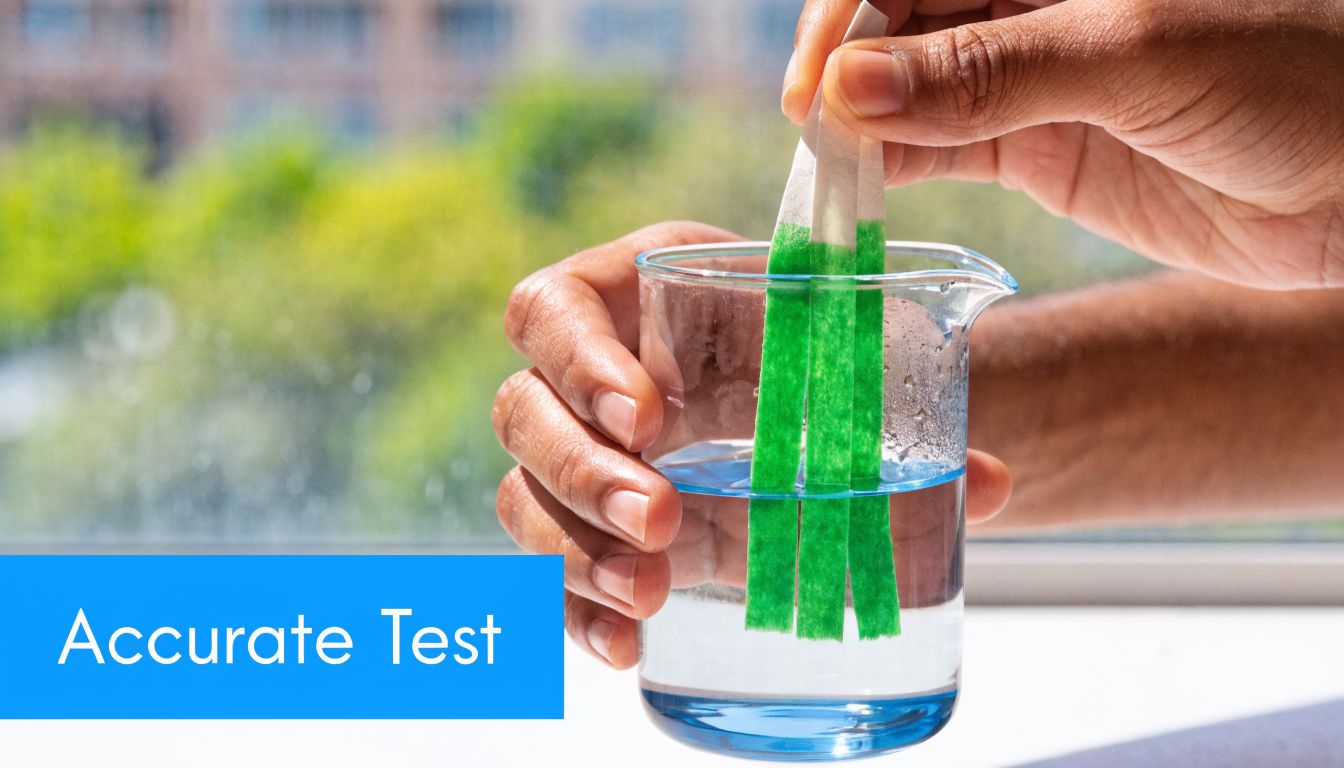
A close-up of a person's hands holding green testing strips inside a glass beaker filled with water.

Start with screening, then confirm with a lab

A simple home strip or kit can help you confirm that the odor isn’t your imagination and can point you toward a sulfur issue. That’s useful as a first pass, especially if you’re deciding whether to call a lab.

For system selection, though, a certified water test is the smarter move. Hydrogen sulfide is volatile, so sample handling matters. If the sample isn’t collected properly, the gas can escape and the result won’t reflect what’s reaching your fixtures.

If you want a grounded overview of sampling and interpretation, these practical water quality insights are worth reading before you order a test kit or schedule lab work.

What to ask for in your test

You don’t need to become a chemist. You just need a usable water profile.

Ask the lab or water professional about:

  • Hydrogen sulfide level: This is the key number for treatment matching.
  • Iron and manganese: These often change which media or oxidation approach makes sense.
  • pH and alkalinity: These affect oxidation performance and filter reliability.
  • Bacterial indicators: Helpful when odor patterns suggest biological activity.
  • Raw water sample location: Test before existing treatment equipment if possible.

A good video can make the process less intimidating before you collect samples:

Read the result like a buyer, not a scientist

What matters most is whether your result lands in a low, moderate, or high treatment range. That’s what drives equipment choice.

A low reading may allow a simpler odor-polishing setup. A moderate reading usually points toward oxidation or air-injection style treatment. Higher levels often need stronger pretreatment, longer contact time, or chemical injection before filtration.

Bring your test sheet to any installer conversation. If they recommend equipment without looking at the raw numbers, slow the process down.

The right sulfur water treatment starts with a real number attached to the smell.

A Clear Path to Choosing Your Treatment

Most sulfur filter decisions get messy because homeowners compare products before they compare conditions. That flips the process upside down. You want to pick a treatment category first, then narrow to models.

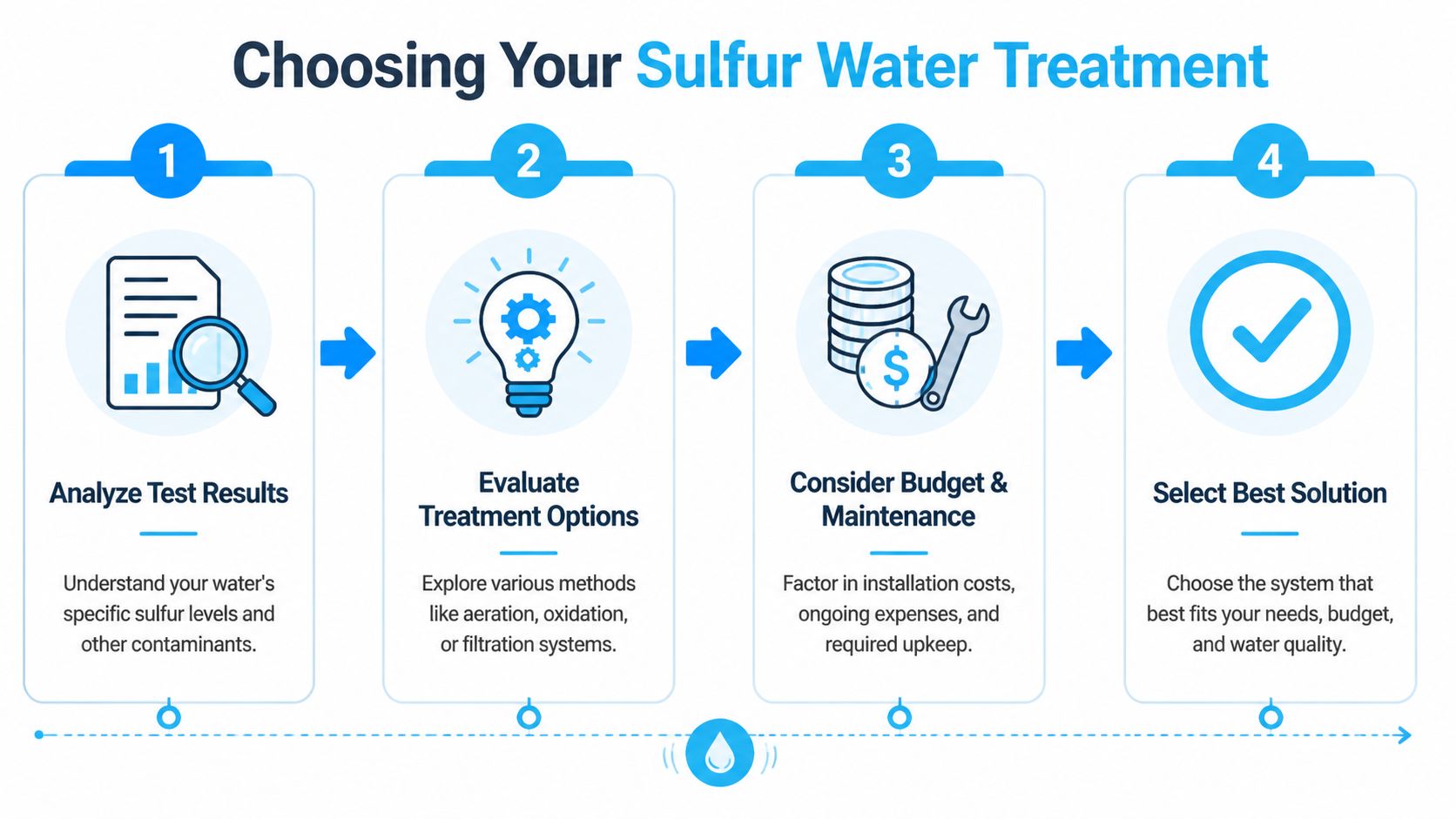
A four-step infographic illustrating the process of selecting a sulfur water treatment system for your home.

Follow the decision flow

Use this practical flow instead of shopping by brand name.

  1. Check where the odor starts
    If it’s hot-water-only, investigate the heater first. If it’s in hot and cold, treat the incoming water.

  2. Match the treatment to the hydrogen sulfide range
    Low levels can sometimes be handled with simpler filtration. Moderate levels often respond well to aeration or oxidizing media. Higher levels usually need a stronger oxidation approach with contact time and follow-up filtration.

  3. Look for iron and manganese before finalizing the system
    A sulfur-only filter can struggle if the water also carries metals. In practice, combination problems often call for combination treatment.

  4. Decide how much maintenance you’ll really do
    Some systems are clean and simple. Others work well but need regular chemical handling, backwashing, or media attention.

Budget and upkeep matter as much as performance

A system can be technically correct and still be a bad fit for the household. If you don’t want to refill tanks, handle regenerants, or monitor settings, don’t choose a method that depends on owner discipline.

That’s why it helps to compare broader residential water filter options before locking into one sulfur-specific setup. You’re not just solving odor. You’re choosing how your home will live with the solution.

For deeper homeowner-focused guidance on evaluating fit, maintenance, and filtration categories, the advice library at Water Filter Advisor is a useful place to continue the comparison process.

A fast way to narrow the field

  • Mild sulfur odor, no major side issues: Start by evaluating catalytic carbon.
  • Moderate sulfur with possible iron or manganese: Look closely at air injection and oxidizing filters.
  • Higher sulfur levels or recurring bacterial problems: Consider chemical injection with filtration.
  • You want stronger oxidation without chlorine residuals: Ozone can be attractive, but it’s more complex.
  • You hate maintenance: Avoid systems that only work well when the owner keeps up with frequent chemical steps.

A good choice feels boring after installation. The odor stops, the water runs normally, and you’re not thinking about the filter every week.

Comparing Top Sulfur Treatment Methods

There isn’t one best sulfur water treatment method. There’s a best fit for your water, your plumbing, and your tolerance for maintenance. Here’s how the main options stack up in real homes.

Aeration systems

Aeration or AIO systems introduce air so hydrogen sulfide can oxidize and then be filtered out. For many households, this is one of the cleanest long-term approaches because it avoids continuous chemical feed.

The catch is that oxidation systems need the water chemistry to cooperate. For many aeration and oxidation-based sulfur filters to work efficiently, minimum influent alkalinity of 100 ppm is required, and performance suffers if alkalinity is too low, according to the Culligan High Efficiency Sulfur-Cleer owner’s guide.

Aeration works best when the sulfur load is within the equipment’s comfort zone and the rest of the water profile supports oxidation.

Catalytic carbon filters

Catalytic carbon is often the first thing people hear about because it’s familiar and easy to understand. It can be a solid choice for lighter odor issues, especially as a polishing stage after oxidation.

On its own, though, it’s easy to overestimate. Carbon doesn’t magically solve every sulfur problem. If the odor is strong, the load fluctuates, or bacteria are involved, carbon alone may become a short-lived fix instead of a durable one.

Manganese greensand filters

Manganese greensand has been around for a long time because it works well in the right conditions. It can handle sulfur along with iron and manganese, which makes it useful when the water has more than one issue.

The trade-off is maintenance. Greensand systems usually need regeneration, and that means paying attention to chemicals, settings, and schedule.

Greensand is often a strong performer for mixed contaminant water, but it’s not a “set it and forget it” choice.

Chemical injection systems

Chemical injection uses an oxidant, commonly chlorine, ahead of filtration. This approach is effective for tougher sulfur situations and can also help when bacterial activity is part of the problem.

It’s not the most hands-off option. You’ll need solution refills, contact time, and post-filtration to clean up taste or residual effects. But when sulfur levels are beyond what simpler media can comfortably handle, chemical injection often makes the system more dependable.

Ozone treatment

Ozone is powerful and appealing because it oxidizes aggressively and doesn’t leave the same kind of chemical residual homeowners worry about with chlorine. It can work very well.

It also brings more complexity. Ozone systems are more equipment-heavy, more sensitive to design quality, and usually a better match for homeowners who are comfortable with a more advanced setup or are working with a seasoned installer.

Quick comparison table

Method Effective H2S Range (ppm) Initial Cost Maintenance Needs Best For
Aeration system Moderate range Moderate Backwashing and periodic checks Homeowners who want chemical-free oxidation
Catalytic carbon Low range Lower Media replacement Mild sulfur odor, especially as a polishing stage
Manganese greensand Up to 6 ppm in common residential use Moderate Regeneration and chemical handling Sulfur with iron or manganese
Chemical injection Above 6 ppm and tougher cases Moderate to higher Refill solution, monitor feed, post-filtration Strong sulfur odor and recurring source issues
Ozone Moderate to high range Higher More technical service and monitoring Homes needing strong oxidation without standard chlorine feed

What tends to work and what tends to disappoint

Works well: matching the technology to the actual sulfur level and the presence of metals.

Disappoints: buying the cheapest odor filter without testing, or installing a system that looks good on paper but doesn’t match the home’s flow rate or maintenance habits.

The best sulfur water treatment method is the one that keeps working after the first month, not the one with the flashiest product page.

Installation Costs and Long-Term Maintenance

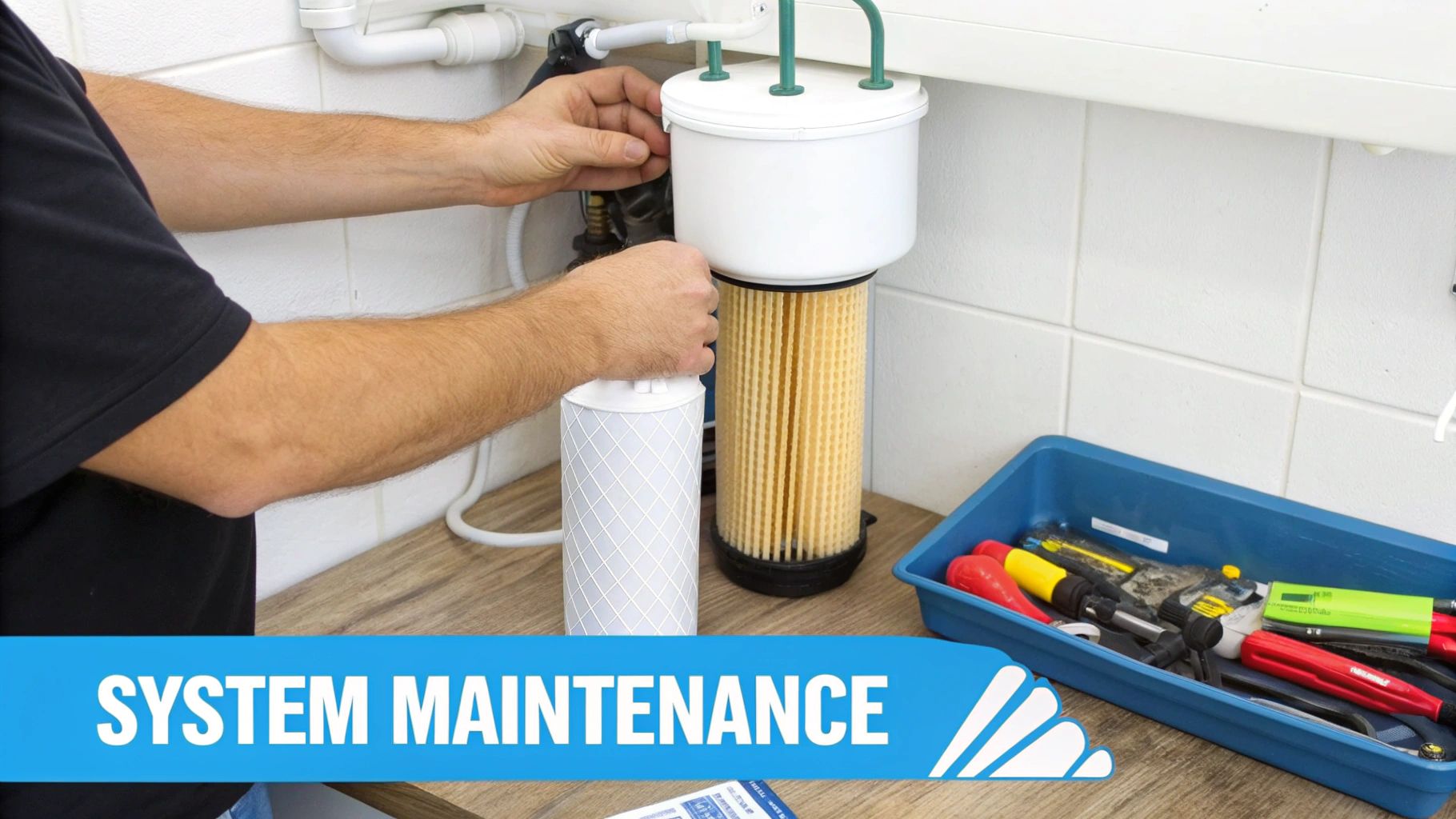
A sulfur system earns its keep over years, not on installation day. The price on the estimate matters, but the better question is what it will cost to run, service, and keep working when life gets busy.

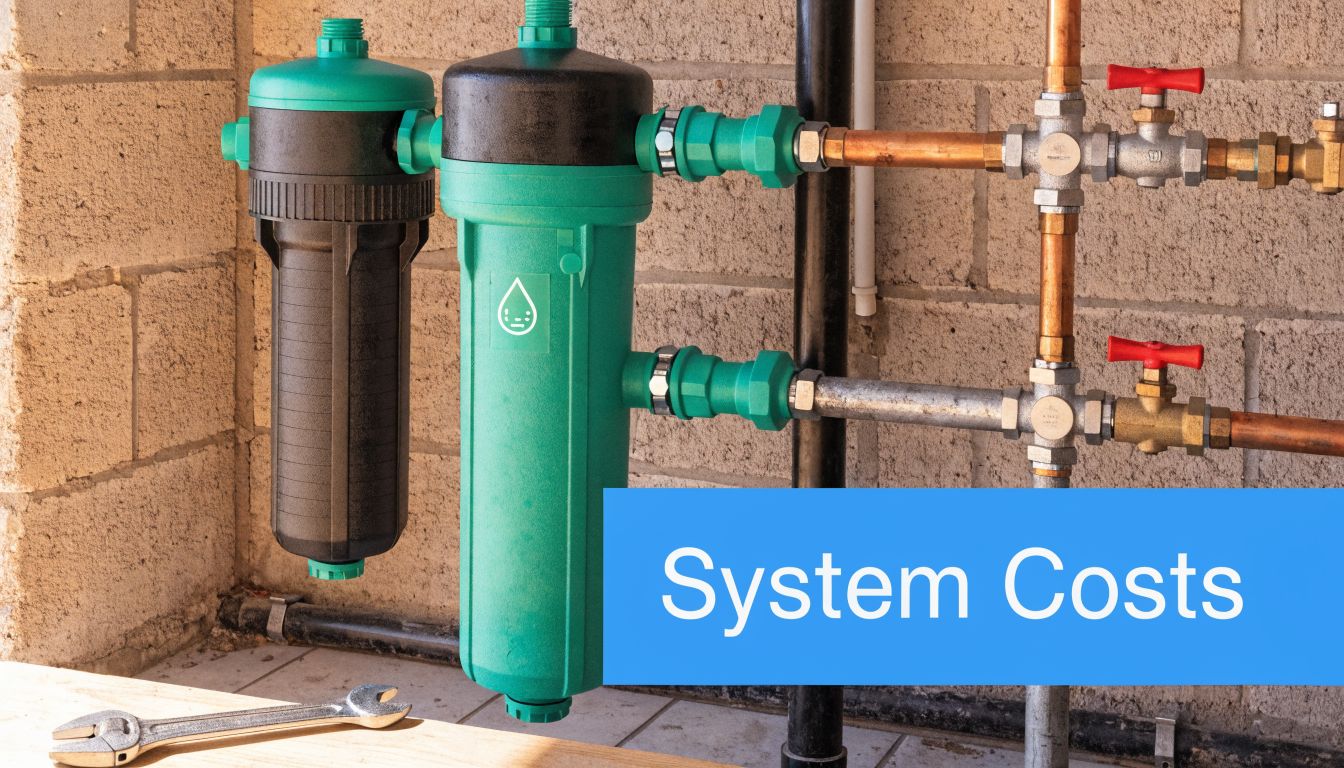
A professional water filtration system installed on a brick wall with tools nearby for maintenance.

Think beyond the day it goes on the wall

Two systems can solve the same odor and feel very different to own. One may need little more than periodic media changes. Another may ask you to refill solution tanks, clean an injector, check a feed pump, and stay on top of settings. Neither is automatically wrong. The right choice depends on your water, your budget, and how much upkeep you will realistically do.

That ownership side gets missed all the time.

For example, oxidizing filters that use manganese greensand often bring ongoing chemical costs that buyers do not factor in up front. Potassium permanganate regeneration can add $50 to $200 annually in chemical expense, according to Penn State Extension guidance on hydrogen sulfide odor in wells.

DIY versus professional installation

DIY installation can work if the job is simple and the water test is clear. A single-tank backwashing filter in an accessible basement is one thing. A setup with chemical injection, a retention tank, drain routing, and multiple treatment stages is another.

Professional installation usually pays for itself when the system depends on correct contact time, feed rate, backwash flow, or control settings. I have seen good equipment underperform because the injector fouled early, the drain line was undersized, or the backwash schedule never got dialed in for the household's actual use. The equipment was fine. The setup was not.

Key maintenance questions to ask before buying

Ask these before you sign off on a system:

  • What will I refill, replace, or clean each year? Media, chemicals, injector parts, test kits, and prefilters all count.
  • How often does it need attention? Monthly checks feel very different from annual service.
  • What happens if service gets delayed? Some systems lose performance gradually. Others let odor break through fast.
  • Can I tell when it is falling behind? Clear indicators and simple testing are easier to live with than guessing.
  • Who will service it if I do not want to? Some local dealers support what they install well. Some do not.

Those answers should steer the purchase as much as sulfur level and equipment type.

Where homeowners get caught off guard

The most common problem is a mismatch between the system and the owner's habits. A chlorine injection system, for example, can be very effective on stubborn sulfur problems, especially when the water also needs disinfection or has recurring odor swings. But if the solution tank runs dry, the feed pump is ignored, or the post-filter is left past its service life, the smell comes back and confidence in the whole setup drops fast.

The cheapest sulfur water treatment is often the one you’ll maintain properly for years.

Low-involvement households usually do better with simpler equipment, even if the installed price is higher. Households willing to check tanks, refill supplies, and schedule service can justify more aggressive treatment. Use that as part of the decision flow. Match the sulfur source and concentration first, then choose the system your budget and maintenance tolerance can support.

Enjoying Your Clean Odor-Free Water

Once the diagnosis is right and the system fits the water, sulfur problems usually stop feeling dramatic. The kitchen stops smelling. Showers feel normal again. You stop apologizing for the tap water when someone visits.

That’s the ultimate payoff of good sulfur water treatment. Not just cleaner-smelling water, but confidence that the fix matches the problem instead of masking it for a few weeks.

The best results usually come from a simple discipline. Confirm the source. Test the water. Match the treatment to the concentration and the chemistry. Choose a system you’ll maintain. Homeowners who follow that sequence waste less money and get to a dependable solution faster.

There’s also a promising future angle worth watching. An emerging treatment trend uses sulfur-oxidizing bacteria to convert hydrogen sulfide into sulfate without chemicals, a direction described in this overview of the sulfur cycle in wastewater systems. For residential wells, it’s more of a future-facing option than a mainstream one right now, but it shows where low-chemical sulfur treatment may head next.

For today, the smartest move is still the practical one. Solve the odor you have, with equipment designed for the water that’s entering your home.


If you’re comparing systems, testing options, or replacement media, Water Filter Advisor is a solid next stop for homeowner-focused guidance on choosing and maintaining the right filtration setup without overspending.

Your Ultimate Guide to Well Water Sulfur Smell Removal

The first step in well water sulfur smell removal is figuring out what’s causing that awful rotten egg smell. The culprit is almost always hydrogen sulfide gas (H₂S), a sneaky compound that can come from naturally occurring sulfur deep in your groundwater or from bacteria throwing a party in your plumbing.

Don't worry—while the smell is a massive nuisance and can even corrode your pipes over time, it's a completely fixable problem. With the right water filtration approach, you can banish that stench for good and get back to enjoying fresh, clean water.

Uncovering the Source of That Rotten Egg Smell

If your well water suddenly smells like it's been hard-boiled and left in the sun, you're not alone. That unmistakable odor is one of the most common complaints we hear from homeowners on private wells. It comes from a gas called hydrogen sulfide, and even in microscopic amounts, it makes its presence known every time you turn on a faucet.

So where is this stinky invader coming from? There are two usual suspects:

  • Naturally Occurring Sulfur: Sometimes, the groundwater your well taps into is just naturally high in dissolved sulfur compounds. As that water travels to your home, this sulfur can convert into hydrogen sulfide gas, releasing that signature stench.
  • Sulfate-Reducing Bacteria (SRB): More often than not, the issue is biological. Certain types of bacteria, known as sulfate-reducing bacteria, thrive in oxygen-poor environments. Think wells, plumbing lines, and their absolute favorite hangout spot—your water heater. They essentially "breathe" sulfates found in the water and "exhale" hydrogen sulfide gas. It's a non-stop, stinky party, and your water heater is the club.

Why Pinpointing the Source Matters

Before you can choose the right filtration system, you have to play detective. Is the smell only coming from the hot water, or both hot and cold? Does it show up right away, or only after the water has run for a bit?

These answers are the critical clues. A problem isolated to your water heater, for instance, needs a completely different (and much cheaper) fix than an issue starting deep within your well that requires a whole-house filtration solution.

Hydrogen sulfide (H₂S) is a widespread issue for well owners. A detailed analysis of over 100 studies found that H₂S levels become noticeable by smell at just 0.05 mg/L. The research also showed private wells have prevalence rates up to 30% higher than municipal systems because the water is untreated.

In the U.S. alone, the EPA estimates 15 million households use private wells, and some reports suggest that up to 25% of them deal with sulfur odors. You can dig into the specifics in the full research on hydrogen sulfide prevalence.

To help you narrow it down quickly, here's a simple diagnostic chart focused on filtration-first thinking.

Quick Guide to Sulfur Smell Sources

Symptom Likely Source First Action Step
Smell is only in the hot water. Bacteria in the water heater. Turn up the water heater's temperature or consider a shock chlorination of the tank.
Smell is in hot and cold water, but fades after a few minutes. Bacteria in the well or plumbing. Perform a well shock chlorination to see if the smell disappears.
Smell is in hot and cold water and is constant. Hydrogen sulfide (H₂S) is present in the groundwater itself. Get your water tested to confirm the H₂S concentration and select the right filtration system.
Smell is only at one or two faucets. Bacteria is likely localized in the faucet aerator or drain. Clean the aerator and the drain P-trap thoroughly.

Figuring out whether your problem is geological or biological is the single most important step toward choosing the right filtration solution.

The bottom line is this: that awful sulfur smell is a clear signal from your water system that something needs attention. Once you’ve identified the likely cause, you can move on to a simple diagnostic test to confirm your suspicions and find the right filtration solution.

Putting on Your Detective Hat: A Practical Guide to Diagnosing Your Sulfur Problem

Before you can tackle that rotten egg smell for good, you need to do a little detective work. Pinpointing where the problem is coming from is the only way to choose the right water filtration solution. A few simple diagnostic tests you can do right at home will save you a ton of time, money, and frustration down the road.

Your first clue is the easiest one to get: just turn on a faucet and trust your nose. That smell—or the lack of it—is your most powerful piece of evidence. I always tell homeowners to think of their plumbing as having three main zones: the well itself, the pipes running through the house, and the water heater. Any one of them could be the culprit.

The Hot vs. Cold Water Test

This is, without a doubt, the most important test you can run. It’s a game-changer that immediately narrows down the suspects and points you toward the right fix.

Just head to the faucet closest to your water heater and run only the cold water for a minute or so. Do you smell it?

Now, switch over to the hot water. Let it run until it’s fully heated up, then give it another sniff. The difference you notice is the key.

  • The smell is ONLY in the hot water: This is the best-case scenario. It almost always means the problem is isolated inside your water heater. There’s a particular kind of bacteria, sulfate-reducing bacteria, that thrives in the warm, oxygen-poor environment of the tank. They have a chemical reaction with the standard magnesium anode rod that comes in most heaters, and voilà—you get hydrogen sulfide gas.
  • The smell is in BOTH hot and cold water: This tells us the issue is more widespread, and a whole-house filtration system is likely in your future. The source is either bacteria throughout your well and plumbing, or—more likely—the hydrogen sulfide gas is already dissolved in your groundwater before it even gets to your house.

The "Does It Fade?" Test

Okay, so you’ve found the smell in both hot and cold water. There’s one more quick test to try. Turn on a cold-water faucet and fill up a glass. Smell the water in the glass right away. Then, walk into another room, away from the sink, and smell it again after a minute.

If that rotten egg odor was strong at first but seems to disappear pretty quickly, that's a good sign the hydrogen sulfide is being produced by bacteria within your plumbing. The gas simply dissipates once it hits the open air.

But if that smell stays strong and pungent, even away from the tap, the hydrogen sulfide is dissolved in the groundwater itself. This means the problem starts at the source—your well—and you’ll need a whole-house filtration system to fix it.

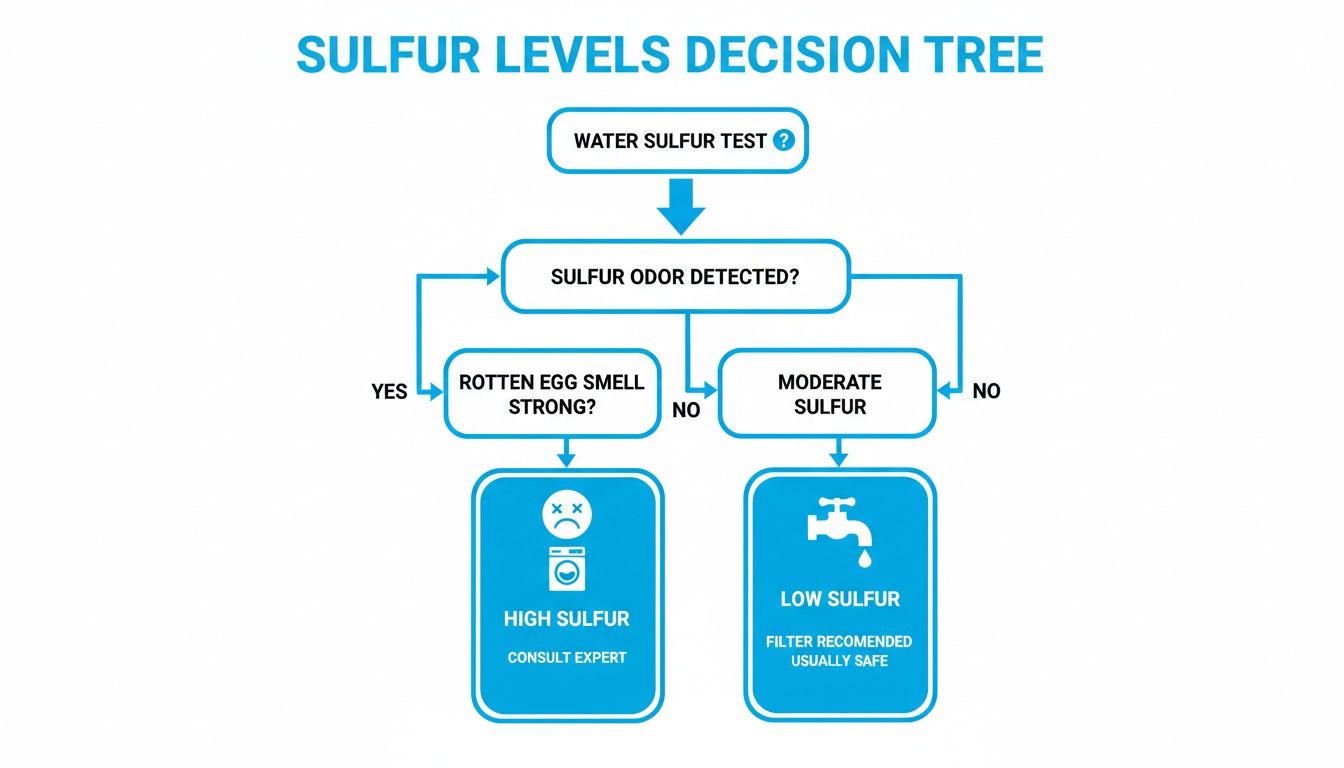
This chart can help you visualize how these simple tests guide your diagnosis.

Decision tree for sulfur smell source, identifying issues in hot, cold, or both water supplies.

As you can see, figuring out if the smell is in the hot, cold, or both is the critical first step to finding where the problem lies.

Why a Professional Water Test Is Non-Negotiable

While these at-home "sniff tests" are fantastic for getting you started, they can't provide the one thing you absolutely need for a permanent fix: hard data. Getting a professional water test from a certified lab is your most powerful weapon in this fight.

A lab test doesn't just confirm that you have hydrogen sulfide; it measures the exact concentration in milligrams per liter (mg/L). This number is absolutely crucial for choosing a filtration system that’s strong enough for your water but isn't expensive overkill.

The lab will also check for other common well water troublemakers like iron and manganese, which often show up alongside sulfur. I've seen it countless times: someone buys a filtration system that works great for hydrogen sulfide, but it fails completely because high iron levels were never addressed. Skipping the professional water test is like trying to build a house without a blueprint—it’s just a recipe for costly mistakes and a smell that keeps coming back.

Immediate Fixes and Water Heater Solutions

When that rotten egg smell hits, you want it gone yesterday. While a whole-house filtration system is often the long-term answer, you can get some serious relief right now by focusing on the most common culprit for a "hot water only" stench: your water heater.

Think of your water heater tank as the perfect incubator for sulfate-reducing bacteria. It's warm, dark, and low on oxygen—everything they need to thrive. As they multiply, they pump out hydrogen sulfide gas, which gets released the second you turn on a hot water tap.

A man is squatting, working on a water heater with a blue bucket on a concrete floor.

The Anode Rod Swap: A True Game-Changer

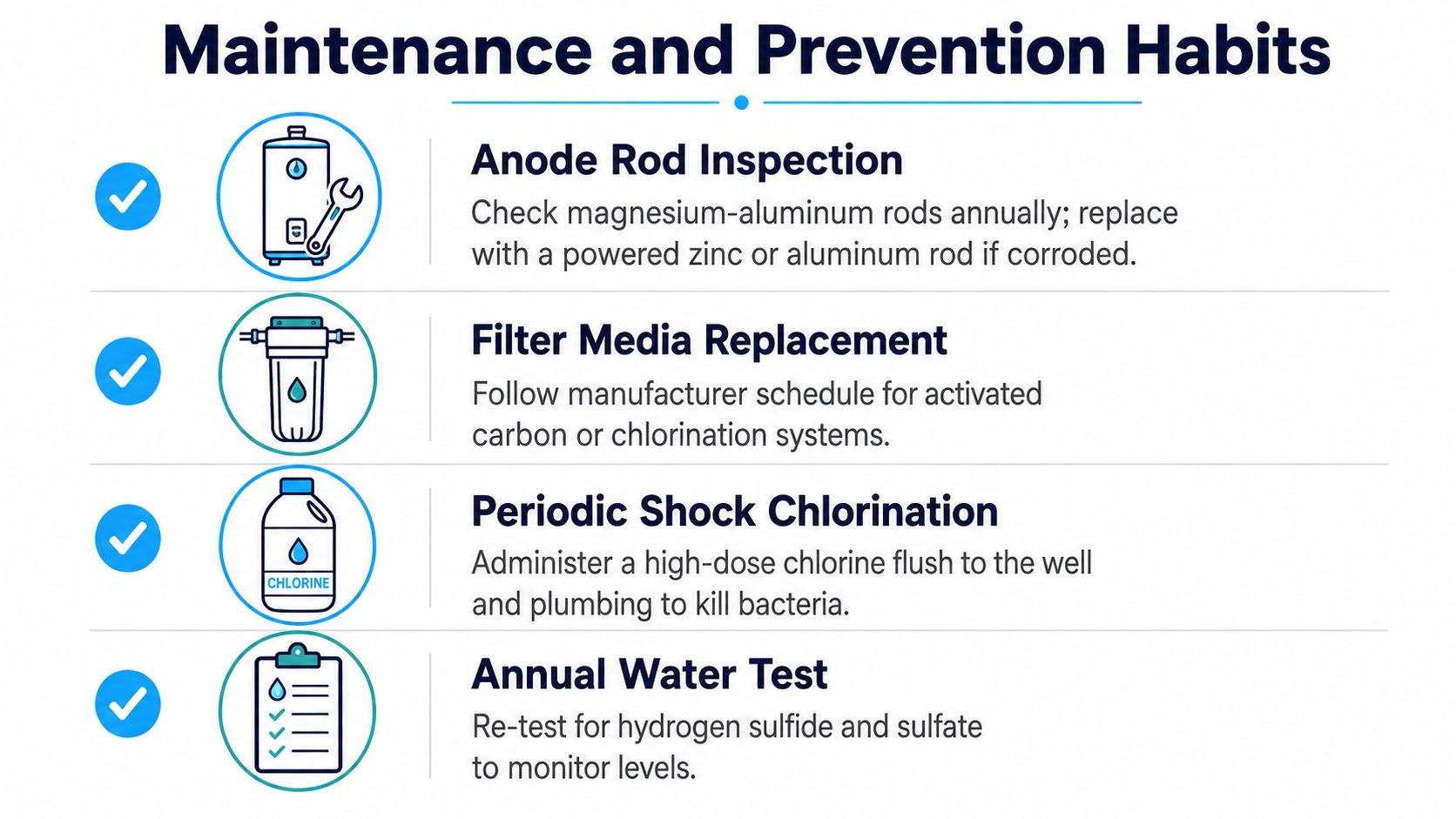
Here's a pro-tip that solves this problem for a surprising number of people: check your anode rod. Most water heaters are sold with a standard magnesium anode rod. Its entire job is to sacrifice itself by corroding, which protects the steel tank from rusting out.

The catch? The chemical reaction from the corroding magnesium rod essentially supercharges the sulfate-reducing bacteria. It's like giving them an energy drink.

The fix is often as simple as swapping that magnesium rod for an aluminum/zinc alloy rod. The zinc is toxic to the bacteria, cutting off their power source and stopping the stinky chemical reaction cold.

For the handy homeowner, this is a very doable weekend project. It just requires shutting off the power and water to your heater first. If that sounds a bit out of your comfort zone, any plumber can knock it out for you in no time.

Flushing and Disinfecting Your Water Heater

If a new anode rod doesn't quite do the trick, or you just want to completely reset the system, a deep clean is your next move. Flushing and disinfecting the tank will wipe out the entire bacterial colony that’s taken up residence.

Here’s the basic game plan:

  • Kill the Power: First things first, turn off the electricity or gas supply to the water heater.
  • Drain the Tank: Hook up a garden hose to the drain valve and let it empty completely. You'll probably see a good bit of sediment come out, too.
  • Add a Disinfectant: You can use either 3% hydrogen peroxide or plain, unscented chlorine bleach. A good rule of thumb is about one gallon of peroxide for every 40 gallons of tank capacity.
  • Refill and Wait: Close the valve and fill the tank with cold water. Let it sit for at least a few hours to give the disinfectant time to work its magic.
  • Flush It Out: Drain the tank one more time. Then, refill it and run the hot water taps around your house to make sure you’ve rinsed all the cleaning solution out of your plumbing.

If you suspect your water heater is the source of the problem or you're weighing your options, getting help from professional water heater services can give you a clear diagnosis and a fast, reliable fix.

Shock Chlorinating Your Well

What if the smell is in your cold water, too, but it seems to clear up after running the tap for a minute? That’s a classic sign the bacteria are living in the well itself or somewhere in your plumbing.

When this happens, shock chlorination is a powerful—though often temporary—solution. It involves pouring a high concentration of chlorine bleach directly into your well to disinfect the entire system from top to bottom. This is a much bigger job than cleaning a water heater and requires careful calculations to get the dosage right without overdoing it.

Keep in mind, shock chlorination is more of a reset button than a permanent filtration fix. If the bacteria are constantly seeping into your well from the surrounding aquifer, the smell will eventually return. It cleans the slate but doesn't solve the underlying problem.

Choosing the Right Whole-House Filtration System

So your water tests confirmed the rotten-egg smell is coming from the well itself. This means you've moved past temporary fixes and are ready for a permanent solution: a whole-house filtration system. This is the point where you invest in a system that cleans your water right as it enters your home, ensuring every faucet delivers fresh, odor-free water.

Man holding a tablet displaying 'Choose Filtration' in a room with a complex well water treatment system.

I know the sheer number of options can feel overwhelming. But here's the key: your decision should always come back to your water test results. The amount of hydrogen sulfide (H₂S), along with other common culprits like iron and manganese, will point you directly to the best technology for your situation. Let's look at the most common workhorses for well water sulfur smell removal.

Air Injection Oxidation (AIO) Systems

Think of an AIO system as using a simple, powerful trick: oxidation. It's an elegant, single-tank setup that creates a pocket of compressed air at the top. When your well water flows through, it gets a shot of this oxygen, which instantly changes the dissolved hydrogen sulfide gas into solid sulfur particles.

Basically, it turns an invisible, stinky gas into tiny, filterable solids. The system’s filter media then easily catches these particles. Every so often, the system cleans itself out with a backwash cycle, flushing the trapped sulfur down the drain and refreshing its air bubble.

AIO systems are a fantastic choice for:

  • Moderate H₂S Levels: They shine when dealing with concentrations up to 10 mg/L.
  • Combined Iron Problems: AIO is a great two-for-one deal, as it also oxidizes and removes the dissolved iron that often goes hand-in-hand with sulfur.
  • Hands-Off Maintenance: These are chemical-free systems, so you never have to mix solutions or top off tanks. It just runs.

An air injection system can be a powerful cornerstone of your whole-house setup, offering a robust, self-managing solution for multiple water quality headaches at once.

Chemical Injection and Chlorination Systems

If you're up against seriously high levels of hydrogen sulfide or have a stubborn bacteria problem, it's time to bring in the heavy artillery. Chlorination is a more aggressive method that uses a chemical feed pump to inject a very specific dose of chlorine into your water.

The chlorine is a potent oxidizer, knocking out H₂S on contact and killing any sulfur or iron bacteria in the process. From there, the water sits in a contact tank to give the chlorine time to work its magic. The final step is a carbon filter that strips out any leftover chlorine, taste, and odor, leaving you with purified water.

While it’s a more involved setup, chlorination is hands-down the most powerful tool for severe sulfur and bacteria issues. It’s the go-to solution when H₂S levels climb above 10 mg/L or if you’re also fighting a recurring bacteria problem.

The main ongoing task with this system is keeping the chemical solution tank filled. But for really tough water, its effectiveness is unmatched.

Catalytic Carbon Filters

At first glance, a catalytic carbon filter looks just like a standard carbon filter, but it has a secret advantage. The carbon media inside has been specially treated to create a highly reactive surface. This "catalytic" surface turbocharges the reaction that turns hydrogen sulfide gas into harmless solid sulfur.

Once converted, these solid particles get trapped within the carbon's massive network of internal pores. This approach is incredibly effective for lower H₂S concentrations, typically in the 1-4 mg/L range.

The biggest draw here is simplicity. It's a single tank with no chemicals and very little maintenance besides the automatic backwashing cycles. The trade-off is that the carbon media will eventually wear out and need to be replaced, usually every 3-5 years, based on your water chemistry and how much water you use. It's an excellent "set it and forget it" choice for mild sulfur smells.

Comparing Well Water Sulfur Removal Systems

Here’s a side-by-side comparison of the most popular whole-house filtration methods for hydrogen sulfide, helping you choose the best fit for your home's needs and budget.

Filtration Method Best For (H₂S Level) Pros Cons Estimated Cost
Air Injection (AIO) Moderate (2-10 mg/L) Chemical-free, low maintenance, also great for iron removal. May not work on very high H₂S levels; needs a drain for backwashing. $1,000 – $2,500
Chlorination System High (10+ mg/L) Extremely effective on high sulfur and bacteria; kills microorganisms. Needs ongoing chemical refills; more complex, multi-component installation. $1,500 – $3,000+
Catalytic Carbon Low (< 4 mg/L) Simple setup, no chemicals, very effective for low-level odors. Filter media must be replaced periodically; not ideal for high iron. $800 – $1,800

Choosing the right filtration system is a major step toward finally solving your water problems for good. Use your water test as your guide, and you can confidently pick the technology that will deliver the most effective well water sulfur smell removal for your home.

Getting Your System Installed and Keeping It Running Smoothly

You’ve done the hard work—you’ve tested your water, weighed the options, and finally picked the right whole-house filtration system to knock out that sulfur smell. But the job isn't done yet. Getting the system installed properly and sticking to a simple maintenance routine is what separates a long-term solution from a temporary fix. Think of your new filter as a serious investment in your home's water quality; a little care goes a long way in protecting it.

Whether you're breaking out the toolbox yourself or calling in a local pro, the placement is non-negotiable. The filtration system needs to be installed on your main water line, right after the pressure tank but before the line tees off to your water heater and the rest of the house. This setup ensures that every single drop of water, hot or cold, gets treated before it reaches a tap.

The Installation: DIY or Pro?

If you're comfortable with basic plumbing, installing a single-tank catalytic carbon or an AIO filter can be a manageable weekend project. It typically involves cutting into your main water line, fitting the in/out connections, and setting the control valve's regeneration schedule. One pro tip I always give DIYers: make sure you install a bypass loop. This simple set of valves lets you shut off the water flowing to the filter for maintenance without turning off the water to your entire home.

That said, for more complex setups like a full-blown chlorination system, hiring a professional is almost always the better call. These systems have a lot of moving parts—chemical pumps, contact tanks, and delicate calibration—that need to be just right. A good water treatment specialist will not only install it by the book but will also fine-tune it to your home's specific flow rate and water pressure for peak performance.

A flawless installation is your first line of defense against future problems. An incorrect setup can lead to pressure drops, leaks, or even prevent the system from performing well water sulfur smell removal effectively.

Your Long-Term Maintenance Plan

A water filtration system isn't something you can just set and forget. It's working hard 24/7, and it needs a little TLC to keep doing its job. Luckily, most of the upkeep is straightforward and easy to schedule.

It’s just like changing the oil in your car—a small, proactive task that helps you avoid a huge, expensive headache down the road. Letting maintenance slide is the surest way to invite that rotten egg smell right back into your life. I once visited a homeowner whose AIO system failed after just a year. The culprit? He'd never once run a manual backwash cycle to flush out the gunk. The filter media was completely choked with sulfur and iron, rendering it useless.

Here’s a quick-glance maintenance checklist for the most common sulfur removal systems:

  • Air Injection (AIO) Systems:

    • Monthly Check-in: Just listen. Make sure the system backwashes on schedule (usually every 2-3 days). You should also hear a distinct hissing sound during the air draw cycle—that's the sound of it working.
    • Annual Service: Take apart and clean the injector assembly. It's a small but critical part that can get clogged with iron or sediment, which stops the system from creating the air pocket it needs to oxidize sulfur.
  • Chlorination Systems:

    • Weekly Check: Take a quick look at the chemical solution tank. You’ll get a feel for how fast your system goes through the chlorine and can plan refills. The number one rule is to never let it run dry.
    • Quarterly Task: Clean out the injection point on the chemical feed pump. This little check valve is prone to getting gummed up with mineral deposits over time.
  • Catalytic Carbon Filters:

    • Semi-Annual Check: Manually start a backwash cycle to make sure it runs properly and flushes out any trapped sediment.
    • Every 3-5 Years: This is the big one. The catalytic carbon media has a finite lifespan. Once it has absorbed all the sulfur it can hold, it’s done. You’ll need to replace the media to get the system working like new again.

When It's Time to Call a Water Treatment Professional

Look, tackling a sulfur smell can be a really satisfying DIY project. There’s a certain pride in fixing your own water. But there are absolutely times when you need to put down the wrench, pick up the phone, and call in an expert. Knowing when to make that call can save you a ton of headaches, money, and time.

If your water test results come back looking like a complex chemical cocktail—say, sky-high hydrogen sulfide levels mixed with a heavy dose of iron and manganese—you're officially in professional territory. An off-the-shelf filter from a big-box store just isn't going to cut it here. This kind of water chemistry demands a custom-designed, multi-stage system, and that's something an expert needs to spec out to avoid creating new issues, like a massive drop in your water pressure.

The Telltale Signs You Need Expert Help

Recurring problems are another huge red flag. Have you shock-chlorinated your well, only to have that rotten egg smell creep back a few weeks later? Then you do it again, and it comes back again? That points to a persistent, underlying issue that a professional needs to diagnose.

It also just comes down to comfort level. If you're not confident cutting into your plumbing or you're unsure how to properly integrate a whole-house filtration system, hiring a pro is the smart move. It’s all about peace of mind.

A certified water treatment specialist isn't just selling you equipment; they're providing a complete solution. They can spot underlying problems with the well itself, correctly size a system for your home's specific flow rate, and make sure the installation is done right the first time.

How to Find a Reputable Pro

When you start looking for a professional, keep an eye out for certifications. A specialist certified by the Water Quality Association (WQA) has demonstrated their expertise and is bound by a strict code of ethics. Don't ever feel shy about interviewing them before you hire them.

  • Ask to see their WQA certification. This is a non-negotiable for me. It’s a solid indicator of their knowledge and commitment to the industry.
  • Drill down on their experience with your specific issue. Ask them, "Have you dealt with wells that have high sulfur and high iron before? What was your approach?"
  • Insist on a detailed, on-site water analysis. They should be testing your water at your home, not just giving you a quote based on a phone call. One-size-fits-all solutions rarely fit anyone.

Bringing in the right expert turns the challenge of well water sulfur smell removal from a stressful guessing game into a smart, confident investment in your home's water quality.

Common Questions About Well Water Sulfur Smell

Even when you have a solid plan, questions are bound to pop up, especially when you're dealing with something as frustrating as that rotten egg smell. Let's tackle a few of the most common concerns homeowners have about well water sulfur smell removal so you can feel confident moving forward.

Is It Safe To Drink or Shower in Sulfur Water?

The short answer is yes, it's generally safe. At the levels you typically find in a household well, hydrogen sulfide (H₂S) is more of a nuisance than a real health threat. For most people, drinking it won't cause any issues, though some with sensitive stomachs might experience a bit of an upset. Showering in it doesn't pose a direct health risk, either.

That said, long-term exposure can leave you with dry, irritated skin and has a nasty habit of stripping color from dyed hair. And let's be honest, that lingering smell on your skin and hair really kills that fresh-out-of-the-shower feeling.

The biggest risk from sulfur in your water isn't actually to your health—it's to your home. Hydrogen sulfide gas is corrosive. Over time, it will eat away at copper and brass pipes, plumbing fixtures, and appliances, leading to some pretty expensive repairs down the road.

Will a Standard Water Softener Remove the Sulfur Smell?

This is a classic misconception, and I hear it all the time. A standard salt-based water softener is built to do one thing: remove hardness minerals like calcium and magnesium. It isn't designed to deal with dissolved gases like hydrogen sulfide.

While some softeners might slightly reduce a very faint odor, they are absolutely not the right tool for a noticeable sulfur problem.

In fact, trying to make your softener do a job it wasn't built for will likely foul the resin bed, damaging the system and potentially making your water quality even worse. To get a real, lasting fix, our water filtration advice can guide you to the technology that actually targets your specific problem. It all comes down to using the right tool for the job.


Ready to enjoy fresh, odor-free water from every tap? At Water Filter Advisor, we provide the expert guides and unbiased reviews you need to choose the perfect filtration system for your home. Explore our resources today at https://www.waterfilteradvisor.com.

Removing Sulphur from Well Water: Your Guide to Odor-Free, Clean Water

So, you have a well, and your water has decided to smell like a science experiment gone wrong. That infamous "rotten egg" aroma is a problem you want to fix—yesterday. The secret to kicking that smell to the curb involves a one-two punch: first, you oxidize the sulfur compounds (using air, chlorine, or even ozone), and then you filter them out.

This oxidize-then-filter strategy is the undisputed champion for knocking out that nasty smell, giving you back the fresh, clean water you deserve.

Why Your Well Water Smells Like Rotten Eggs

A corroded outdoor faucet drips water, illustrating the problem of a 'rotten egg smell'.

When you turn on a tap and get smacked with that rotten egg odor, you've met the culprit: hydrogen sulfide (H₂S). It’s a colorless gas that gets trapped in groundwater, and your nose is exceptionally good at detecting it. That’s why even a tiny amount can turn a relaxing shower into a miserable experience or make a glass of water completely undrinkable.

Where does this stinky gas come from? Sometimes, it's just nature doing its thing, breaking down organic matter deep underground. But often, the problem is turbocharged by some unwelcome microscopic guests living in your well system.

The Role of Bacteria in Sulfur Odors

Let's meet sulfate-reducing bacteria (SRB). These little microbes thrive in oxygen-poor environments like your well, plumbing, and especially your water heater. While they won't make you sick, they have a nasty party trick: they feast on sulfates in the water and burp out hydrogen sulfide gas.

Think of them as tiny, freeloading tenants in your pipes, constantly producing that foul smell. This is precisely why the odor often seems ten times worse from the hot water tap—the warm, cozy spa inside your water heater is their favorite five-star resort.

You can play detective to narrow down the source of the problem:

  • Smell in Hot Water Only? If the funk is exclusively coming from your hot water faucets, you've likely got an SRB colony partying in your water heater. The anode rod inside the tank can also react with the water and create a similar stink.
  • Smell in Both, But Fades? When you smell it in both hot and cold water, but it vanishes after the tap runs for a minute, the H₂S is probably in your well but not at panic-inducing levels.
  • Strong and Constant Smell? A powerful, persistent odor from every tap points to a higher concentration of H₂S in your groundwater, meaning you'll need a serious home water filtration system to win this battle.

Hydrogen sulfide isn't just an annoyance—it's corrosive. At high enough levels, it will tarnish your silverware, leave ugly black stains on fixtures, and slowly eat away at copper and iron pipes.

This is a super common headache for well owners. Both hydrogen sulfide (H₂S) and sulfate (SO₄²⁻) are the main sulfur troublemakers in wells worldwide. To put it in perspective, some U.S. counties report that at least 45% of private wells tested have sulfate levels that exceed EPA secondary standards. You can dig deeper into the data on the prevalence of sulfur in groundwater on journals.sagepub.com.

Figuring out if you're dealing with natural gas, a bacterial rave, or a bit of both is your first mission. Your diagnosis will point you straight to the right filtration strategy for removing the sulfur for good.

Alright, let's crack open that water test report. I know, it looks like it's written in another language, full of weird abbreviations and numbers that don't mean much at first glance. But trust me, figuring this out is the single most important thing you'll do to get rid of that sulfur smell for good.

First things first, you'll probably see parts per million (ppm) and milligrams per liter (mg/L). Don't get hung up on this—for our purposes, they're the same thing. 1 ppm is the same as 1 mg/L. To put that in perspective, 1 ppm is like one drop of ink in a whole sink full of water. A tiny amount, but it can make a huge difference in your water.

Now, your report should show two types of sulfur. Knowing which is which is crucial.

Hydrogen Sulfide vs. Sulfates

The infamous "rotten egg" smell? That’s all hydrogen sulfide (H₂S). It's a gas dissolved in your water, and our noses are incredibly sensitive to it. You can smell H₂S at levels as low as 0.5 ppm. If the smell is what's driving you crazy, this is the number you need to find on that report.

Sulfates (SO₄²⁻) are a different beast. These are sulfur compounds that usually don't smell. Instead, high concentrations give your water a bitter, almost medicinal taste. The bigger issue with sulfates is that at high levels—typically over 250 mg/L—they can have a laxative effect. This is especially something to watch out for if you have infants or young children in the house.

Key Takeaway: If it's the smell you're fighting, zoom in on the hydrogen sulfide (H₂S) level. If it's a bitter taste or health concerns, check the sulfate (SO₄²⁻) concentration.

Don't Forget About Sulfur's Sidekicks

Sulfur rarely shows up to the party alone. Your well is a complex environment, and it's almost a guarantee you have other minerals along for the ride. The two most common culprits are iron and manganese, and you absolutely cannot ignore them. They can completely throw a wrench in your treatment plans.

  • Iron (Fe): If you see those nasty reddish-brown stains on your sinks, toilets, and laundry, you've got iron. A simple carbon filter isn't going to cut it when you have both. You’ll need a system that oxidizes everything, like aeration or ozone.

  • Manganese (Mn): This one leaves behind ugly, greasy-looking black stains. Just like iron, it complicates the sulfur removal process and has to be dealt with.

A lot of people make the mistake of buying a filter just for sulfur, only to find it gets clogged up and fails in a few months because they didn't account for their high iron levels. Your test results tell the whole story, so you can get a system that knocks out all the problems at once.

To help you connect the dots between your test results and a real-world solution, I’ve put together this quick-reference table. It shows what different sulfur levels mean for your home and points you toward the right kind of treatment.

Sulfur Concentration Levels and Recommended Actions

This table is a handy guide to translate your water test numbers into actionable steps. Find your H₂S or sulfate level to see what you're dealing with and which treatment methods are most effective.

Sulfur Level (H₂S/Sulfate) Common Household Impact Primary Treatment Recommendation
Low
H₂S: 0.5 – 1 ppm
Sulfate: < 250 mg/L
Faint "rotten egg" smell, especially in hot water. Water may have a slightly "off" taste. Activated Carbon Filter or a simple Aeration System.
Moderate
H₂S: 1 – 5 ppm
Sulfate: 250 – 400 mg/L
Noticeable, unpleasant odor from all taps. Tarnishing of silverware and yellow/black stains on fixtures. Water has a distinct bitter taste. Oxidizing Filter (e.g., Greensand, Birm) or an Aeration System with a contact tank.
High
H₂S: > 5 ppm
Sulfate: > 400 mg/L
Overpowering rotten egg smell throughout the house. Severe staining and corrosion of pipes. Significant laxative effect from sulfates. Chemical Injection System (Chlorine or Hydrogen Peroxide) followed by filtration, or an Ozone Injection System.

Think of this chart as your starting point. Once you've pinpointed your sulfur level, you'll have a much clearer idea of the type of system you'll need to finally get that clean, odor-free water you're after.

Choosing the Right Sulfur Removal System

Okay, you've got your water test results back. Now the real work begins. We're moving past diagnosis and into finding the right hardware to get that rotten egg smell out of your well water for good. This is all about matching the right filtration technology to your specific water chemistry, your home's daily usage, and, of course, your budget.

There’s no magic bullet here. The system that's perfect for your neighbor might be completely wrong for you, especially if their water doesn't have the same iron content as yours. Let's walk through the most common and effective options so you can pick the right one with confidence.

Aeration Systems: The Natural Approach

Sometimes, the simplest solution is the best. The easiest way to deal with hydrogen sulfide is to expose it to its worst enemy: oxygen. Aeration systems are designed to do just that, forcing air into your water. This triggers a process called oxidation, which converts the dissolved hydrogen sulfide gas into tiny, solid particles of sulfur.

Once it's a solid particle, it's no longer dissolved in the water and can be easily caught by a sediment filter. Think of it this way: aeration makes the invisible, stinky gas visible so a filter can grab it.

You'll generally see two kinds of aeration setups:

  • Air Injection Filters: These are slick, single-tank systems. Air gets injected right into the top of the filter tank. As water passes through, it gets oxidized, and the newly formed sulfur particles are trapped by the filter media—all in one go.
  • Aeration Tanks: If you're dealing with higher sulfur levels, you might need a separate, non-pressurized tank. Water is sprayed into this tank, which lets it mix thoroughly with air and release those trapped gases before it gets re-pressurized and sent on its way to your taps.

This flowchart can help you visualize how your sulfur level points you toward different solutions.

Decision tree flowchart for assessing water sulfur levels and recommended actions based on odor detection.

As you can see, what works for a faint, annoying odor is a world away from the heavy-duty systems needed to tackle seriously high sulfur concentrations.

Oxidizing Filters: The Heavy Lifters

When you've got moderate-to-high levels of sulfur, especially if it’s teamed up with iron and manganese, you need something with more muscle than simple aeration. Oxidizing filters use a special media coated with an oxidizing agent like manganese dioxide.

This media works like a catalyst, aggressively forcing hydrogen sulfide, iron, and manganese to become solid particles, which are then trapped within the filter bed. Every so often, the system cleans itself with a "backwash" cycle, flushing all those trapped contaminants down the drain to refresh the media.

Pro Tip: You'll hear names like Greensand, Birm, and Filox. Greensand is a classic but needs to be regenerated with potassium permanganate (a messy purple chemical). Newer media like Filox are more powerful and just need a simple backwash, making them far easier to live with.

Activated Carbon Filters: For Minor Odors

If your water test shows just a trace of hydrogen sulfide (usually under 1.0 ppm), a good activated carbon filter might be all you need. Carbon has an incredibly porous surface that's great at adsorbing the gas, effectively trapping the compounds that cause the smell.

But carbon has its weaknesses. It's a poor choice if you also have iron, because the iron will quickly clog the carbon's pores and make it useless. Carbon filters also wear out and need to be replaced, so they’re really only a fit for minor, nuisance-level odors.

Chemical Injection Systems: Maximum Power

For the really tough cases (often over 5-7 ppm of sulfur), it's time to bring in the big guns. Chemical injection systems use a small pump to add a precise dose of a strong oxidant directly into your water line, usually before a holding tank or filter.

Your two main choices here are:

  • Chlorine Injection: This is the old-school, time-tested method. It's extremely effective at wiping out sulfur odors and also kills any iron bacteria lurking in your system. The trade-off? You’ll need a second carbon filter downstream to remove the chlorine taste and smell from your drinking water.
  • Hydrogen Peroxide Injection: This is a fantastic, modern alternative to chlorine. Peroxide is a beast of an oxidant that breaks down into just oxygen and water, so it leaves no chemical aftertaste. Many homeowners prefer it for a "deluxe" solution without the baggage of chlorine.

These heavy-duty methods deliver proven results. When sized correctly, air or chemical injection systems can achieve removal rates exceeding 90% for hydrogen sulfide. A whole-house oxidizing system can run from $1,500 to $6,000 installed—a serious investment, but one that provides a permanent fix.

Comparing Your Top Options

It can feel a bit overwhelming, but looking at your options side-by-side really helps clear things up. As you get closer to a decision, it's always a good idea to seek out more filtration advice available to homeowners.

System Type Best For Initial Cost Ongoing Maintenance Key Drawback
Aeration System Low to moderate H₂S with low iron. Moderate Low (no chemicals) Can struggle with high iron levels or bacteria.
Oxidizing Filter Moderate H₂S with iron/manganese. Moderate-High Low to moderate (media/chemical replacement). Some media types require messy chemicals (potassium permanganate).
Activated Carbon Very low H₂S (<1 ppm), no iron. Low High (frequent cartridge replacement). Easily overwhelmed by moderate sulfur or any iron.
Chemical Injection High to severe H₂S, bacteria issues. High Moderate (replenishing chemical solution). More complex setup; chlorine requires a second filter for taste removal.

In the end, let your water test be your guide. By matching the concentration of sulfur, iron, and other contaminants to the strengths of each system, you can confidently choose a solution that will give you clean, fresh, and odor-free water for years to come.

Getting the Sizing and Installation Right

Picking out the right type of filter is a huge win, but your job isn't done yet. You've got to make sure the system is the right size for your home. This is one of those things people get wrong all the time, and you'll feel the consequences immediately.

Imagine installing your brand-new, powerful sulfur removal system only to find your shower pressure has dropped to a pathetic trickle. That’s exactly what happens when you install a filter that’s too small. An undersized system simply can't keep up with your home's water demand, creating a bottleneck that just kills your water pressure.

Figuring Out Your Home's Peak Water Flow

To avoid that headache, you need to figure out your home's peak water flow rate, measured in gallons per minute (GPM). This number is all about the maximum amount of water your household might use at any given moment—think running the shower, the dishwasher, and a load of laundry all at once.

Your filtration system's flow rate has to handle this peak demand without breaking a sweat. You can get a pretty good estimate yourself:

  • Count your fixtures: Tally up the showers, tubs, sinks, toilets, washing machines, and dishwashers.
  • Assign 1 GPM to each: As a rule of thumb, just count each major fixture as 1 GPM.
  • Add it all up: A home with 3 bathrooms, a kitchen, and a laundry room could easily have 8-10 major fixtures, meaning you're looking at a peak demand of 8-10 GPM.

A more precise way to look at it is to add up the actual GPM ratings of your biggest water users and assume about half might run at the same time. For instance, a modern showerhead uses about 2.5 GPM, a dishwasher needs 2 GPM, and a washing machine pulls another 2.5 GPM. If all three are going, that’s 7 GPM right there.

Always choose a filter with a service flow rate that meets or, even better, slightly exceeds your calculated peak GPM. Sizing it right is the key to making sure your system performs without choking your home's water supply.

Key Installation Tips for a Smooth Setup

While a full step-by-step installation guide is a whole other topic, knowing the key decision points will make a world of difference, whether you’re doing it yourself or hiring a plumber. To get your sulfur removal system running efficiently, a solid grasp of fluid transfer principles is a game-changer for proper sizing and setup.

Here are the non-negotiables for a proper installation:

  • Placement is Everything: Your whole-house filter should always be installed after your well pressure tank but before your water heater and any water softener. This protects the filter from the well pump’s intense pressure cycles and makes sure all your water—hot and cold—gets treated.
  • Install a Bypass Valve: This is absolutely essential. A bypass valve is a simple three-valve setup that lets you reroute water around the filtration system. When it’s time for maintenance, you can just turn the valves to bypass the unit without shutting off water to the whole house.
  • Plan for a Drain: Many sulfur filters, especially oxidizing and chemical injection systems, need to backwash to clean themselves out. This process flushes all the gunk they've trapped, so you must have a proper drain line nearby.

The demand for these solutions is really taking off as more households deal with odor and corrosion. Industry analysts estimated the market for sulphur removal absorbents was worth about $1.5 billion in 2023 and is projected to hit $2.6 billion by 2032, with home-scale systems becoming a bigger piece of the pie.

Arming yourself with this knowledge helps you ask a plumber the right questions and ensures your investment in clean water pays off with years of hassle-free performance.

Keeping Your System Running and Fixing Common Glitches

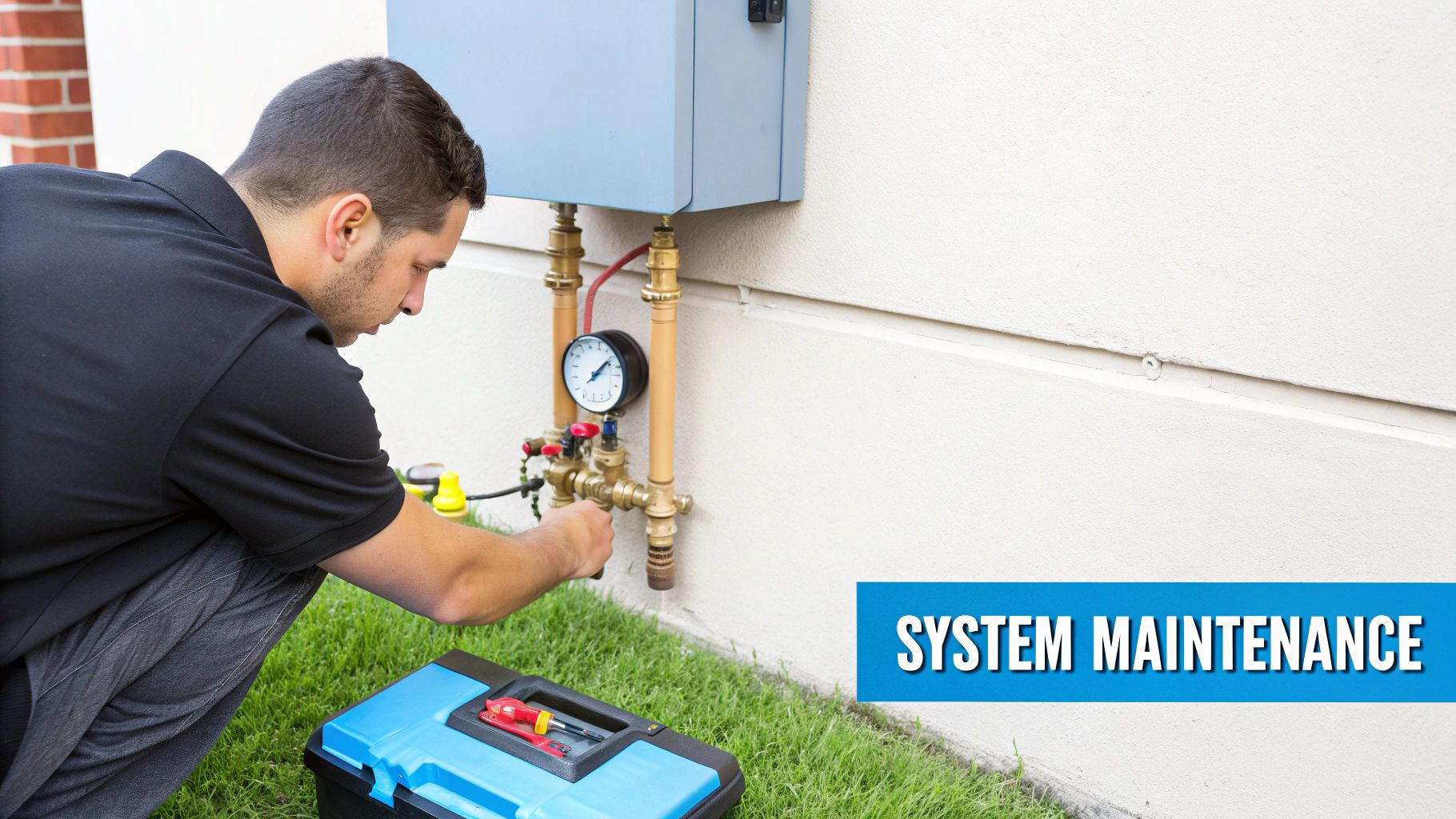
A technician crouches, performing system maintenance on outdoor water pipes with a gauge and valves.

So, you've invested in a system for removing sulphur from well water, and that rotten egg smell is finally a memory. Great! But the job isn't quite done.

Think of your water filter like your car—it needs a regular tune-up to perform its best. If you ignore it, you’re just asking for that sulfur smell to come creeping back in.

Proper maintenance isn't a huge chore, but it's absolutely essential. A system you take care of will give you clean, odor-free water for years. A neglected one? It could fail you in just a few months. Sticking to a schedule is how you protect your investment and keep your water fresh.

To stay on top of things, you might find it helpful to use something like a preventive maintenance schedule template. It's a simple way to track tasks so nothing gets forgotten.

Your Essential Maintenance Checklist

Breaking it down into monthly, semi-annual, and yearly tasks makes it all feel less overwhelming. Here’s a basic schedule that works for most common sulfur removal systems.

  • Monthly Checks (5-10 minutes):

    • Chemical Levels: If you have a chemical injection system (chlorine or peroxide), peek at the solution tank. Is it getting low? As a rule of thumb, I never let mine drop below a quarter full.
    • Visual Inspection: Just give the whole setup a quick look-over. See any drips or leaks? Are all the connections tight? Catching a tiny drip now saves you from a big watery mess later.
  • Semi-Annual Tasks (30-45 minutes):

    • Clean Injection Points: On chemical feed systems, that little injector fitting is notorious for getting gunked up with mineral deposits. Just disconnect it and let it soak in a descaling solution to keep things flowing freely.
    • Test Your Water: Grab a simple test strip. Is the system still knocking out the sulfur? It’s a fast, easy way to confirm everything is working like it should.
  • Annual Service (1-2 hours):

    • Media Replacement: Activated carbon and other filter media don't last forever. Dig out your manual and check the replacement schedule. For carbon, it's typically every 1-3 years. For a heavy-duty catalytic media like Filox, it can be much longer.
    • Professional Tune-Up: Honestly, it’s smart to have a water treatment pro give your system a once-over every year. They can service the control valves, recalibrate pumps, and spot little issues you might not notice.

Troubleshooting Common Problems

Even with perfect maintenance, stuff happens. But before you pick up the phone and call for backup, here are a couple of common issues you can probably diagnose and fix yourself.

The Rotten Egg Smell Is Back

This is hands-down the most common—and annoying—problem. If that all-too-familiar sulfur smell starts making a comeback, it's time to do some detective work.

Likely Causes:

  1. Chemical Solution is Empty: It sounds basic, but we’ve all done it. Your chlorine or peroxide tank simply ran dry.
  2. Clogged Injector: The pump is working, but a mineral clog is blocking the oxidant from getting into the water.
  3. Backwash Cycle Failed: Your oxidizing filter missed its cleaning cycle. Now the media is saturated and fouled with sulfur particles.
  4. A Change in Your Well: A heavy rain or a change in the water table can alter your well's chemistry, cranking up the sulfur level beyond what your system is set to handle.

First Steps: Check your chemical tank first. If it's full, try manually starting a backwash or regeneration cycle on your filter. If the smell is still there after the cycle finishes, your next move is to clean that injector.

My Water Pressure Suddenly Dropped

A sudden nosedive in water pressure across the whole house is a classic symptom of a bottleneck in your filtration system. The water is having a hard time pushing through.

Likely Causes:

  1. Clogged Sediment Pre-filter: This is the #1 culprit. That little cartridge filter right before your main system is probably choked with dirt and sediment.
  2. Filter Stuck in Backwash: It's possible the control valve on your main filter has malfunctioned and is stuck in the backwash position, which severely restricts normal water flow.
  3. Severely Fouled Media: If the filter media hasn't been backwashing correctly, it can get so packed with iron and sulfur that water can barely squeeze through.

Always start with the easiest fix: check that sediment pre-filter. If a new one doesn't solve it, use the bypass valve on your main unit to see if your pressure comes back. If it does, you know the problem is inside the main filter. Regular maintenance is the best way to prevent these little headaches, ensuring your system for removing sulphur from well water keeps delivering the clean, great-tasting water you expect.

A Few More Questions About Getting Rid of Sulfur

Once you've got a game plan for tackling that rotten egg smell, a few common questions always seem to pop up. We hear them all the time from folks just like you. Let's get them answered.

Can I Just Boil the Water to Get Rid of the Smell?

That's a definite no. While boiling is a great way to handle certain bacteria, it does absolutely nothing for hydrogen sulfide. In fact, you might find it does the opposite—heating the water can actually make the gas release faster, giving you an even stronger whiff of sulfur for a little while. The only real fix is filtration.

Will a Water Softener Help With the Sulfur Odor?

A standard water softener is built for one job: removing hardness minerals like calcium and magnesium. It's simply not designed to handle sulfur. You might notice a very slight, temporary improvement, but the sulfur and any associated iron bacteria will quickly foul up the softener's resin bed.

Think of it this way: using a softener for sulfur is like using a rake to shovel snow. It's the wrong tool for the job and you'll likely damage the resin and create a perfect breeding ground for sulfur-reducing bacteria. You really need a dedicated oxidation system.

How Is Sulfur Hurting My Appliances?

Hydrogen sulfide is no friend to your home's plumbing and appliances. It's corrosive. Over time, you'll see it tarnish your silverware, leave ugly black stains in toilets and on fixtures, and even start to eat away at copper and iron pipes.

Your big-ticket appliances are especially at risk.

  • Dishwashers: You'll start to notice black stains inside and a nasty smell that just won't go away.
  • Washing Machines: Don't be surprised if your clothes, especially after a hot wash cycle, come out smelling like sulfur.
  • Water Heaters: The warm, dark tank is the ideal home for sulfur-reducing bacteria, which is why the smell is often much stronger when you turn on the hot water.

Is There Any Kind of Temporary Fix?

If you're stuck waiting for a full system to be installed, you have a couple of short-term options. An activated carbon pitcher filter can make a small amount of drinking water taste and smell better. For your water heater, a plumber can "shock chlorinate" the tank, but this is just a temporary band-aid—the bacteria and the smell will be back.

These are just quick fixes. The only way to permanently solve the problem of removing sulphur from well water is to install a properly sized filtration system that gets to the root cause. It's a smart investment that protects your home and gives you back your peace of mind.


At Water Filter Advisor, we're here to help you find that perfect, long-term solution for your water. Dig into our detailed guides and reviews to make a choice you can feel good about at https://www.waterfilteradvisor.com.

Removing Sulfur Smell from Well Water: Your Guide to Clean, Odor-Free Taps

So, your well water smells like rotten eggs. Welcome to the club! It’s one of the most common—and let’s be honest, most gag-worthy—complaints from homeowners with private wells. The good news? You can absolutely fix it. Getting rid of that sulfur stench comes down to one thing: picking the right home water filtration system.

But before you start shopping, you need to play detective. Is the smell coming from a harmless gas in your groundwater, or is a colony of funky bacteria having a party in your pipes? Once you know the villain, you can choose the perfect hero—like aeration, oxidation, or a carbon filter—to save your water for good.

Why Your Well Water Smells Like Rotten Eggs

When you turn on the faucet and get hit with that unmistakable rotten egg odor, you're getting a big, smelly clue that your water chemistry is off. The culprit behind this olfactory assault is almost always a gas called hydrogen sulfide (H₂S).

Just a tiny amount of this stuff can make a glass of water undrinkable and a hot shower unbearable. The first and most critical step in your mission to reclaim your water is figuring out where that gas is coming from.

Water pours from a kitchen faucet into a glass, with a 'ROTTEN EGG SMELL' sign overhead.

In the world of well water, hydrogen sulfide usually comes from one of two places. It's crucial to identify which one you're dealing with because the filtration solutions are completely different.

The Two Main Culprits

One possibility is that H₂S is a natural feature of your local groundwater. This is common in areas with geological formations like shale or sandstone. As groundwater seeps through these layers, it picks up the gas and carries it right into your well. If this is your situation, you have a constant source of smelly water that needs a powerful, whole-home filtration system to treat it 24/7.

The second cause—and the one we see most often—is biological. We're talking about sulfur-reducing bacteria (SRBs). These microscopic critters thrive in oxygen-free environments, like the inside of your well casing, plumbing, or hot water heater. They aren't harmful to your health, but they have a nasty habit of munching on sulfates in the water and "exhaling" hydrogen sulfide gas. Voilà, instant rotten egg smell.

Key Takeaway: You're not just fighting a smell. You're either treating the water as it enters your home or evicting a colony of tiny organisms from your water system. Figuring out which it is will lead you to the right filtration fix.

A Quick At-Home Diagnostic Test

Before you spend a dime on professional testing, you can run a simple sniff test to get a huge clue about the source of the smell.

Grab two clean glasses. Fill one from the cold tap and the other from the hot tap. Now, walk them into another room (away from any stinky sink drains) and give them a sniff.

  • Smell only in the hot water? Bingo! The problem is almost certainly your water heater. The anode rod inside can react with sulfates to create H₂S gas, and the tank itself is a warm, cozy spa for sulfur-reducing bacteria.
  • Smell in both, but it fades after a minute? If the smell is strong at first but vanishes as you let the water run, the bacteria are likely living in your well or plumbing system.
  • Smell is constant in both hot and cold? A persistent stink that never goes away, no matter how long the water runs, points directly to hydrogen sulfide being naturally present in your groundwater.

This isn't just about an annoying odor. High sulfate levels that lead to hydrogen sulfide are a global issue. A 2025 study estimated that 194 million people live in areas where sulfate in drinking water exceeds WHO recommendations, which can lead to digestive issues. This makes proper filtration a health essential, not a luxury. You can read more about these global water quality findings on ScienceDaily.com.

Once you've narrowed down the source, you're ready to pick the right home filtration system and banish that rotten egg smell for good.

Getting to the Bottom of Your Sulfur Problem

When it comes to water filtration, guessing is the most expensive game you can play. Before you even think about buying a filter to fix that rotten egg smell, you need to know exactly what’s in your well water.

It's like going to a doctor: you want a diagnosis before you get a prescription. Throwing money at fancy equipment without hard data is the fastest way to get frustrated and end up right back where you started—with stinky water.

A comprehensive water analysis is your roadmap to success. It goes beyond confirming "yep, it smells" and gives you the complete chemical breakdown of your water. This is a non-negotiable step because other contaminants often tag along with hydrogen sulfide. These unwanted guests can clog or ruin certain types of filters, making one system a perfect match and another a total waste of money.

What You Absolutely Need to Test For

When you get your water tested, don't just ask them to check for "sulfur." You need specifics to choose the right home filtration system.

Make sure your report includes precise measurements for:

  • Hydrogen Sulfide (H₂S): This is the gas causing the rotten egg smell. You need to know the exact concentration.
  • Sulfates: This is the "food" for the sulfur-reducing bacteria that create the gas.
  • Iron & Manganese: These two are notorious for fouling up sulfur filters. If you have them, your filtration system needs to be able to handle them.
  • pH Level: Your water's acidity or alkalinity dramatically affects how well certain filtration methods, especially oxidation, will work.
  • Total Dissolved Solids (TDS): A high TDS level can signal other issues that might need a pre-filter or a more robust system.

With these numbers, you can confidently choose a home filtration system that’s perfectly tailored to your well's unique chemistry.

DIY Test Strips vs. a Real Lab Analysis

I know it’s tempting. You see those DIY water test kits at the hardware store and think, "Easy peasy." But for sizing a whole-home filtration system, they have serious limitations.

My Two Cents: DIY strips are fine for a ballpark guess on things like water hardness. But for hydrogen sulfide? They're notoriously unreliable. The gas can literally escape from the water sample before the strip even gets an accurate reading.

A certified lab analysis is an investment in getting it right the first time. You get precise, accurate results that allow you to buy the correct filtration equipment from the start, saving you the massive headache of installing an expensive system that can't do the job.

This detail is critical. Sulfate levels in groundwater can be all over the place. According to research from the EPA, some wells might have sulfate concentrations as low as 10 mg/L, while others can spike to over 1,000 mg/L. Without a real test, you're just flying blind.

Choosing the Right Sulfur Filtration System for Your Home

Alright, armed with your water test results, it's time for the main event: choosing a whole-house filtration system to permanently solve your rotten egg problem. This isn't a temporary patch; it's a long-term upgrade that delivers fresh, odor-free water to every faucet in your house.

Diving into the world of water filters can feel overwhelming, but for sulfur issues, it really boils down to a few proven technologies. The best one for you depends entirely on what your water test revealed. The concentration of hydrogen sulfide (H₂S), along with other party-crashers like iron and bacteria, will point you straight to the perfect system.

Flowchart showing two options for water testing: DIY with test tubes and professional lab test with a microscope.

Whether you used a home kit for a preliminary check or got a full lab analysis, this data is your guide to selecting the right hardware for your home.

Air Injection Oxidizing (AIO) Filters

One of the most popular and effective solutions is the Air Injection Oxidizing (AIO) filter. Think of it as the chemical-free workhorse of sulfur removal. This all-in-one system uses a simple, brilliant trick: it pulls in oxygen from the air and mixes it with your water as it enters the tank.

This kicks off a natural process called oxidation, which instantly converts the dissolved hydrogen sulfide gas into tiny solid particles. These particles are then easily trapped by a specialized media bed inside the tank. Every few days, the system automatically backwashes, flushing all the trapped sulfur and iron down the drain. It’s a clean, efficient, and low-maintenance solution.

I often recommend an AIO system when a water test shows low to moderate hydrogen sulfide—up to around 6-8 ppm—especially if there's also some iron. For most homeowners, it's a true "set it and forget it" solution.

Catalytic Carbon Filters

If you're dealing with a milder sulfur odor, a catalytic carbon filter can be an excellent and straightforward fix. These are best for H₂S levels under 1-2 ppm. While they look like standard carbon filters, the media inside has a special catalytic coating that dramatically speeds up the oxidation process.

As water flows through, H₂S gas is converted to solid sulfur and absorbed by the carbon. They’re simple, effective for slight smells, and don't use any chemicals. The only catch is that the carbon media will eventually need to be replaced, typically every couple of years.

Chemical Feed Pump Systems

Now, if your water test came back with some truly scary numbers—we're talking high hydrogen sulfide (10 ppm or more), iron bacteria, or other nasty microorganisms—it's time to bring in the heavy artillery. That’s where a chemical feed system, usually using chlorine, comes into play.

This setup injects a precise amount of chlorine into your water, which then flows into a holding tank. Chlorine is a powerful oxidizer that obliterates hydrogen sulfide and kills bacteria on contact. After the holding tank, a large carbon filter removes any leftover chlorine and sulfur particles, leaving you with completely purified, odor-free water.

This is the undisputed champion for severe water problems, but it does require more hands-on maintenance, like keeping the chemical solution tank filled. For a deeper dive into different filter types, our guides and advice section has a ton of great information and reviews.

Comparing Home Filtration Systems for Sulfur Smell Removal

Choosing the right system is a balancing act between performance, cost, and maintenance. What's perfect for your neighbor's well might be all wrong for yours. This side-by-side comparison should help clarify your decision.

Filtration Method Effective H₂S Range (PPM) Initial Cost Ongoing Maintenance Best For
AIO Filter 1 – 8 PPM Moderate Low (No chemicals) Moderate H₂S & iron
Catalytic Carbon 0.3 – 2 PPM Low-Moderate Moderate (Media change) Low H₂S, simple installs
Chemical Feed 6+ PPM High High (Refill chemicals) High H₂S & bacteria

By matching your lab results to the capabilities of each system, you can confidently invest in a home filtration solution that will finally kick that rotten egg smell to the curb.

Short-Term Fixes for Immediate Odor Relief

While you're deciding on the perfect long-term filtration system, you don't have to suffer through smelly showers. There are some powerful, immediate steps you can take to clear the air—and your water.

Think of these as your emergency first-aid kit for stinky water. They provide fast, welcome relief.

The two most common hotspots for a sudden sulfur smell are sulfur-reducing bacteria partying in your well or a similar colony that has checked into the warm, cozy spa of your water heater. Luckily, there are targeted ways to deal with both situations right now. And sometimes, if bacteria are your only problem, these fixes might even solve it for good.

Shock Chlorinating Your Well

If you've traced the odor back to bacteria in your well or plumbing, the most effective quick fix is shock chlorination. This is exactly what it sounds like: you're giving your well a sanitizing shock with a strong chlorine solution to kill off the bacteria producing that awful hydrogen sulfide gas.

It's a deep clean for your entire water system and an incredibly effective way to remove sulfur smell from well water when bacteria are the root cause. You just have to follow the steps carefully to do it safely.

Here’s the basic game plan:

  • Calculate the Dose: The amount of unscented household bleach you need depends on your well's depth and diameter. A common guideline is 2-3 pints of bleach for every 100 gallons of water in the well.
  • Mix and Circulate: Dilute the bleach in a bucket of water and pour it directly into the well. Then, connect a garden hose to an outdoor spigot and run water back into the well for at least an hour to circulate the chlorine.
  • Flush the System: Let the chlorine sit in the well for 8-24 hours. Then, go to every faucet in your house (hot and cold), run it until you smell chlorine, and shut it off. Finally, run an outdoor hose away from any landscaping or septic systems until the chlorine smell is completely gone.

Pro Tip: Shock chlorination can often keep the smell away for several months. If it comes back, you've confirmed a persistent bacteria problem. That’s your signal that a permanent filtration solution, like an AIO filter or a chemical feed system, is the next step.

Addressing the Water Heater Problem

What if your sniff test revealed the smell is only coming from the hot water? This is a dead giveaway that your water heater is the culprit. It’s a perfect breeding ground for sulfur bacteria—warm, dark, and oxygen-poor.

The anode rod inside the tank, designed to prevent rust, can sometimes make things worse. A standard magnesium rod can react with sulfates in the water, creating hydrogen sulfide gas as a byproduct.

Fortunately, the fix is pretty straightforward and doesn't involve your well at all.

You'll need to drain and flush the water heater to clear out the smelly, bacteria-filled water. For a more lasting solution, replace the standard magnesium anode rod with an aluminum-zinc alloy rod. This type of rod is much less reactive and helps prevent odor-causing bacteria from growing back. This simple swap can completely eliminate a hot-water-only sulfur smell.

While tackling your water, it never hurts to think about the bigger picture of home freshness. You can explore general strategies for eliminating common household odors to complement your efforts.

Installing and Maintaining Your Filtration System

You’ve done the heavy lifting—you tested your water, researched your options, and picked the perfect filtration system to banish that rotten egg smell for good. But the job isn't quite done. Proper installation and routine upkeep are what will make your investment pay off for years to come.

Getting this last part right is the difference between flawless, fresh water and future headaches.

First, decide whether to DIY the installation or call in a pro. Many modern systems, like a catalytic carbon filter, are designed for a handy homeowner. But for more complex setups like a chemical feed system, having an expert handle the plumbing and initial setup is money well spent.

A person's hands are replacing a water filter in a home filtration system during maintenance.

Hiring a Professional Installer

If you go the pro route, don’t just hire the first name you find. A true water treatment specialist understands how to optimize your system for your specific water chemistry.

Before you commit, ask a few key questions:

  • Do you have experience with my specific type of system? An expert with AIO filters might not be the best choice for a chlorine injection pump.
  • Can you provide references from recent installations? Hearing from other homeowners is the best way to gauge reliability and quality.
  • What kind of warranty do you offer on your installation? You want to know you’re covered if a leak appears after they leave.
  • Will you program the system based on my water test results? This is critical. A properly set regeneration cycle ensures top performance and prevents water waste.

Getting solid answers here ensures your system is installed right from day one.

Long-Term Maintenance Your System Needs

Okay, your new system is humming along, and the water is glorious. Now what? A little routine maintenance is all it takes to keep it removing sulfur smell from well water effectively. Ignoring it is like never changing the oil in your car—eventually, you'll have a big, expensive problem.

A Quick Analogy: Think of your filtration system like a garden. You can't just plant it and walk away. It needs regular, simple care to thrive and keep producing that fresh, clean water you love.

Staying on top of maintenance stops small issues from becoming big, smelly ones.

Your Essential Maintenance Checklist

The exact tasks depend on your system, but here’s a practical checklist for the most common sulfur removal setups. Set a recurring reminder on your phone for these—it's easy to forget!

For Air Injection Oxidizing (AIO) Systems:

  • Check the Air Injector (Every 6-12 months): This tiny part can get clogged with iron or sediment, preventing the system from drawing in air. A quick cleaning is usually all it takes.
  • Inspect the Control Valve (Annually): Just listen to the backwash cycle. Make sure it sounds right and that the valve is moving through its positions smoothly.

For Chemical Feed Pump Systems:

  • Replenish the Solution Tank (As needed): This is your most frequent task. Keep an eye on the chemical level (usually chlorine) and top it off.
  • Clean the Injection Point (Annually): Mineral scale can clog the injection fitting where the chemical enters your water line, stopping your system cold. A quick check and clean will prevent this.

For Catalytic Carbon and Media Filters:

  • Replace the Media (Every 2-3 years): This is a bigger job, but infrequent. You’ll know it’s time when that faint rotten egg smell starts to creep back. That’s your signal that the media is saturated and needs to be replaced.

Following a simple schedule like this will ensure you get clean, odor-free water for years, protecting both your investment and your nose.

Common Questions About That Rotten Egg Smell

Even after diving into the science and solutions for that sulfur smell, it’s normal to have a few questions left. Sorting through home filtration systems can feel like a lot, but getting clear answers is the last step before you can choose a solution with total confidence.

Let's tackle the most common questions homeowners ask when they're battling the rotten egg beast.

Will a Water Softener Get Rid of the Sulfur Smell?

This is probably the biggest myth in water treatment. The short answer? No.

A standard water softener is a one-trick pony: it removes hardness minerals like calcium and magnesium. It is simply not designed to capture a dissolved gas like hydrogen sulfide.

In fact, the resin beads inside a softener can become a breeding ground for sulfur-reducing bacteria, which can make the rotten egg odor even worse. If you have a sulfur problem, you need a dedicated system for removing sulfur smell from well water.

Why Does My Water Smell Worse at Certain Times?

A sulfur smell that comes and goes can be maddening. This fluctuation usually points to a few common culprits.

  • Changes in the Water Table: Heavy rain or a dry spell can alter the groundwater chemistry, causing the smell to flare up.
  • Bacterial Activity: If bacteria are the cause, their activity level isn't always constant. It can ebb and flow, making the smell seem intermittent.
  • Water Stagnation: When water sits in your pipes or hot water heater, hydrogen sulfide gas concentrates. This is why the smell is often strongest when you first turn on a faucet after it's been off for a while.

Here's the key takeaway: an inconsistent smell still points to a consistent problem. Even if the odor vanishes for a day, the underlying cause is still there and needs a permanent filtration solution.

Is It Safe to Drink Water That Smells Like Sulfur?

At the low levels typically found in homes, the smell itself isn't considered a direct health hazard. But you absolutely shouldn't ignore it. Think of that rotten egg smell as your water’s built-in alarm system.

It’s a huge red flag that your water quality is compromised. It can signal the presence of bacteria or high levels of sulfates, which can cause digestive issues like diarrhea—especially for young children or guests. The smell is your water telling you it's time to get it tested and find the right filtration plan.

How Long Does Shock Chlorination Last?

This all depends on the source of your sulfur problem.

If the smell was caused by bacteria colonizing your well, a thorough shock treatment could solve the problem for several months, or in some cases, for good.

But if hydrogen sulfide is naturally present in your aquifer, the smell will always return as new, untreated water is drawn into the well. In that case, shock chlorination is just a temporary fix. It’s a great way to get immediate relief, but it also confirms that you need a permanent filtration system for a true, long-term solution.


At Water Filter Advisor, we're dedicated to helping you find the perfect, lasting solution for your well water. Explore our expert guides and reviews to make a confident choice for your home at https://www.waterfilteradvisor.com.