Your Guide to an RO Water Filter System for Home
Your water can look perfectly clear and still leave you uneasy. Maybe your coffee tastes flat one week and oddly bitter the next. Maybe your ice cubes turn cloudy. Maybe your town sent out a water quality notice, or maybe you're on a private well and you don't like guessing what's in the glass your kids drink from every day.
That's usually the moment homeowners start comparing filters and get buried in marketing language. One system promises crisp taste. Another promises “advanced purification.” A third looks sleek but never clearly says what it removes. If you're trying to make a smart decision, that's frustrating.
A Reverse Osmosis water filter system stands apart because it isn't just a taste improver. It's a point-of-use purification method built to remove dissolved contaminants that simpler filters often leave behind. For a homeowner, that difference shows up in practical ways. Water for coffee tastes cleaner. Soup and pasta water lose that metallic or chemical edge. You stop wondering whether a basic carbon filter is enough for lead, arsenic, nitrates, fluoride, or PFAS.
Is Your Tap Water as Clean as You Think
The first clues are usually ordinary. Your coffee tastes sharper one morning and dull the next. Ice cubes turn cloudy. Tap water smells faintly like a pool, a penny, or wet stone. None of that proves your water is unsafe, but it does tell you something important. Clear water and clean water are not always the same thing.
That gap is where many homeowners get stuck.
Municipal water can meet legal standards and still carry things you would rather reduce in the glass you drink from every day. Well water can look perfectly clean while holding dissolved minerals, nitrates, or metals you cannot see. A basic taste filter may improve odor and chlorine, but it does not answer the bigger question many families are really asking. What is still dissolved in the water after the obvious smells and flavors are gone?
Clear water can still hide dissolved contaminants
It helps to separate water problems into two buckets. One bucket holds particles, such as sand, rust, or sediment. Those are easier to picture because they are physical bits floating in the water. The other bucket holds dissolved contaminants. Those are mixed into the water more like sugar stirred into tea. Once dissolved, they do not show themselves with visible cloudiness.
That distinction matters when you shop for a filter.
If your main complaint is taste or chlorine odor, a carbon filter may solve the problem at a lower cost. If your concern includes contaminants that are dissolved into the water itself, the decision changes. You start looking for a system designed for reduction at that smaller, harder-to-catch level.
Practical rule: If your concern is mostly taste, a simpler filter may be enough. If your concern is dissolved contaminants and peace of mind, an RO system deserves a close look.
Why homeowners land on RO
Reverse osmosis appeals to homeowners for a practical reason. It is built to reduce many dissolved substances that simpler filters often miss. That technical difference shows up in ways people notice. Coffee tastes cleaner because excess dissolved solids are lower. Baby formula and drinking water feel less like a guess when your concern is lead, nitrates, arsenic, or similar contaminants. You get a clearer match between what the system is designed to do and the reason you are buying it.
This is also where two common objections tend to surface. One is water waste. The other is mineral removal. Both are real trade-offs, but neither is a reason to dismiss RO without context. If your tap water already tastes fine and your only goal is better flavor, RO may be more system than you need. If you are trying to reduce dissolved contaminants with more confidence, those trade-offs can be reasonable, especially if you choose an efficient system and use RO water mainly for drinking and cooking.
For a homeowner, the choice usually comes down to one plain question. Are you trying to improve taste, or are you trying to reduce a broader range of dissolved contaminants in the water your family drinks every day?
How an RO System Purifies Your Water
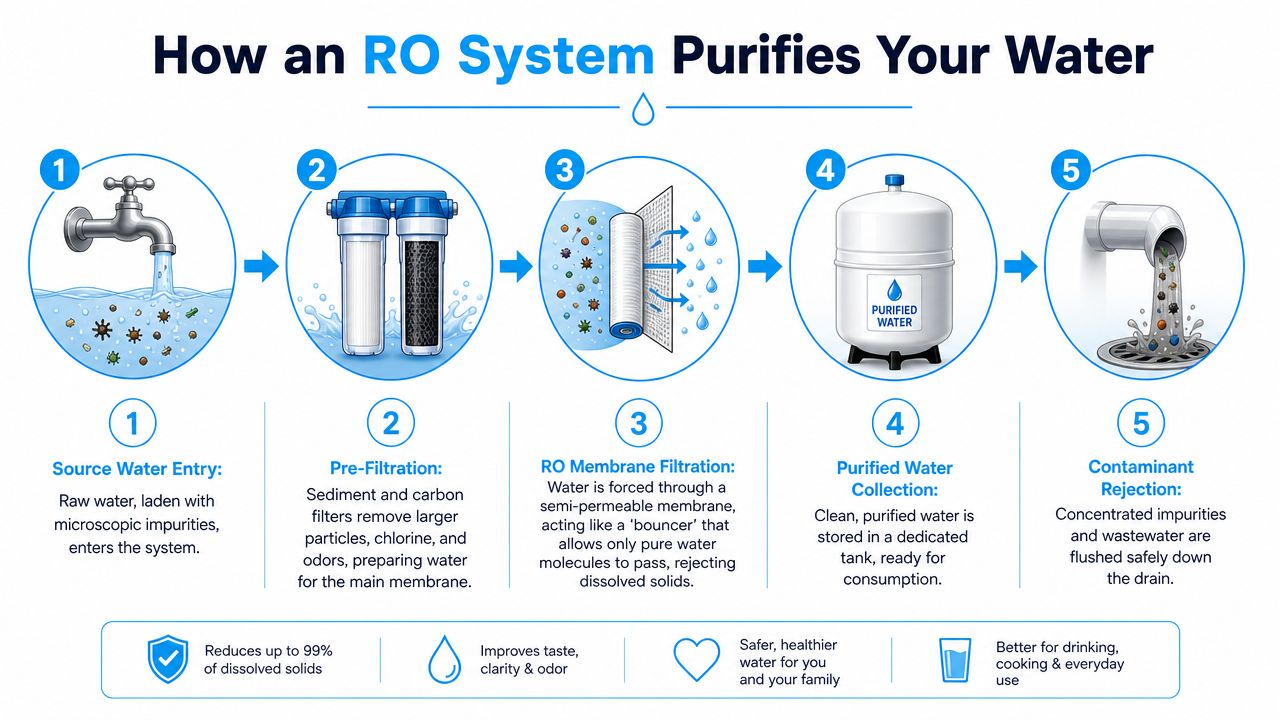
Think of an RO system like a tiny water treatment line living under your sink. Each stage has a job. The early filters do the dirty prep work, the membrane does the hard separation, and the last filter polishes the taste before the water reaches your glass.
The membrane itself is often a source of confusion. The easiest way to understand it is to picture a nightclub with a brutally selective bouncer. Water molecules make the guest list. Many dissolved contaminants don't.
The membrane is the bouncer
In a residential RO system, water is pushed under pressure through a semi-permeable membrane. According to Puretec Water's reverse osmosis basics, thin-film composite membranes can use pores as small as 0.001 microns and reject 95% to 99% of total dissolved solids. Puretec also explains that RO uses cross-flow filtration, which means the system continuously sweeps rejected contaminants away in a separate stream instead of letting them pile up directly on the membrane.
That's why RO can do something a standard pitcher usually can't. It doesn't just trap chunks. It separates water from many dissolved substances.
The four main stages in plain English
A standard residential setup follows a familiar sequence. Water Technologies describes the process this way: sediment filtration traps dirt and rust, pre-carbon block filtration captures chlorine and volatile organic compounds, the reverse osmosis membrane rejects heavy metals and microbes, and post-carbon filtration gives the water final polishing.
Here's what that means in everyday use:
Sediment filter
This is the first line of defense. It catches dirt, rust, and grit that would otherwise clog the system. If your home has older plumbing or you're on a well, this stage matters even more.Carbon pre-filter
Chlorine is useful in municipal treatment, but it's bad news for RO membranes. This carbon stage reduces chlorine and helps with chemical odors, so your membrane isn't damaged before it starts doing its job.RO membrane
This is the heart of the system. It separates purified water from rejected contaminants. If earlier filters are the prep crew, this is the specialist doing the precision work.Post-carbon filter
The last stage cleans up any remaining taste or odor before the water reaches your dedicated faucet.
Why the order matters
You can't skip to the membrane and expect good results. The early stages protect the expensive part of the system and help it work the way it's supposed to.
The membrane isn't built to handle raw abuse from chlorine and sediment. It's built to perform precision separation after the pre-filters have done their part.
That's also why a well-designed RO system often produces water that tastes noticeably cleaner in coffee, tea, baby formula, and plain drinking water. The improvement usually isn't one dramatic feature. It's the cumulative effect of several stages working in the right order.
The Unseen Contaminants an RO System Removes
You fill a pot for pasta, brew coffee the next morning, and hand your child a glass of water without a second thought. The water looks clear. That is what makes dissolved contamination tricky. Some of the biggest concerns in drinking water are invisible, and a standard taste test will not catch them.

Heavy metals and dissolved inorganics
RO earns its reputation by reducing contaminants that are dissolved into the water itself, not floating around as visible particles. That group can include lead, arsenic, nitrates, fluoride, and certain radioactive elements, depending on your water source and local conditions.
According to Aquasana's RO overview, reverse osmosis systems are the only type of household filter capable of removing fluoride and are considered by the EPA the best available technology for removing uranium, radium, and other radionuclides. Aquasana also notes that RO is effective against PFAS, arsenic, and total dissolved solids, and that it is uniquely effective against nitrate.
For a homeowner, those technical categories connect to practical decisions. Older plumbing can raise concerns about lead. Farm runoff can put nitrates on the radar. Well owners often face more uncertainty because water quality can change over time. RO is often chosen when the goal is broader reduction of dissolved contaminants at the point where your family drinks and cooks.
Chemicals that change taste and confidence
Some water problems are easier to notice. Chlorine can leave a pool-like smell. Certain chemical residues can leave a flat, bitter, or medicinal aftertaste even when the water meets basic treatment standards.
A good RO system is usually paired with carbon filtration, so you get two benefits at once. The carbon stages help reduce chlorine, odors, and many taste-related chemicals. The membrane then targets dissolved substances that carbon alone usually cannot handle as effectively. In daily use, that can mean cleaner-tasting coffee, better tea, clearer ice, and cooking water that does not add an odd background flavor to soup, rice, or baby formula.
That difference matters more than many homeowners expect.
Very small contaminants, including some microbes
RO is also valued for its ability to reduce some contaminants that are extremely small. Depending on the system and the water conditions, that can include certain bacteria and viruses along with dissolved salts and metals.
A short visual helps make that easier to grasp:
That does not mean every RO unit should be treated like a universal microbiological safeguard in every situation. If a home has a known biological contamination issue, especially on untreated well water, the right answer may include UV disinfection or another dedicated treatment step. RO is strong, but matching the system to the actual water problem is still the smart move.
Why RO stands apart
A carbon filter works like an odor and taste specialist. An RO membrane works more like a very fine screening barrier that separates many dissolved contaminants from the water you drink. That distinction explains why two filters can both improve taste while only one is designed to address a much wider range of dissolved concerns.
This is also where the homeowner decision gets more practical. If your main complaint is chlorine taste, a simpler filter may be enough. If you want help with dissolved solids, lead concerns, nitrate risk, or water that makes coffee taste dull and leaves you second-guessing what is in the glass, RO starts to make more sense.
Decoding RO Performance Metrics
You are standing in your kitchen at 6:30 a.m., filling the kettle, and trying to decide whether an RO system will improve daily life or just add another appliance to maintain. The spec sheet looks dense. Terms like TDS rejection, flow rate, and recovery can sound technical, but each one answers a simple homeowner question: Will my water taste better? Will filling a pot feel slow? Will this system send a lot of water down the drain?
That is the right way to read RO performance data. Translate the numbers into kitchen outcomes.
What TDS tells you
Total Dissolved Solids, or TDS, is a measurement of the dissolved material in water. It does not identify each substance by name, but it does help explain why one glass of clear water can taste crisp and another can taste flat, salty, chalky, or metallic.
For a homeowner, TDS matters because it connects directly to experience. High dissolved solids can affect the taste of drinking water, tea, and coffee. They can also signal the kind of dissolved material that simpler filters often do not address well. If your goal is water that tastes cleaner and behaves better in cooking, TDS reduction is one of the most useful RO metrics to watch.
The EPA explains in its point-of-use RO systems information that RO removes 90 to 99% of Total Dissolved Solids. That range helps explain why RO often makes such a noticeable difference in homes with mineral-heavy or off-tasting water.
Why water waste happens
Water sent to the drain is not a defect. It is part of how the membrane keeps concentrated contaminants from building up on its surface.
A simple comparison helps here. An RO membrane works like a checkpoint with two exit lanes. One lane carries the cleaner water you keep. The other carries the rejected dissolved material away so the membrane can keep working. Without that rinse flow, the system would foul faster and perform worse.
According to EWG's overview of reverse osmosis filters, RO systems typically waste approximately three times as much water as they treat, and the concentrate is flushed to the drain. EWG recommends using RO systems for drinking and cooking water rather than whole-house applications to conserve water.
That trade-off sounds more reasonable once you match it to actual use. For a few gallons a day used for drinking, baby formula, soup, pasta water, or better coffee, many homeowners decide the water cost is acceptable. Using RO for every shower and toilet in the house is usually a poor fit.
The mineral removal debate
Mineral removal gets discussed in extremes, which confuses people. Some homeowners hear that RO removes calcium and magnesium and assume the water becomes unhealthy. Others dismiss the question completely. The practical answer sits in the middle.
RO does remove beneficial minerals along with many unwanted dissolved substances. That can leave the water tasting very neutral, and to some people, a little flat. If your main priority is reducing dissolved contaminants, standard RO often does the job well. If you want the water to taste a little fuller after treatment, a remineralization stage may be worth considering.
A useful way to decide is to match the feature to the outcome you care about:
- Choose standard RO if your first priority is broad reduction of dissolved contaminants.
- Consider remineralization if you want a rounder taste for drinking water, tea, or coffee.
- Worry less about lost minerals from water if your diet already includes a normal range of foods and beverages.
That last point matters because many homeowners are solving the wrong problem. They are not choosing between "minerals" and "no minerals." They are choosing between water with dissolved material they may not want and purified water they can tune for taste if needed.
Flow, recovery, and real-world usability
A spec sheet can make two systems look similar even when they feel very different in daily use. Flow rate affects how fast the faucet fills a glass, a water bottle, or a stockpot. Recovery tells you how efficiently the system turns feed water into purified water instead of drain water. Higher recovery can mean better efficiency, but it should be weighed alongside filter life, noise, and maintenance needs.
Marketing language often trips up buyers. A high-performance claim sounds great until you realize the unit needs power, makes pump noise, or delivers strong flow but at a maintenance cost you did not expect.
Ask a few plain questions instead. How long will it take to fill the coffee maker? Will the system be quiet enough under the sink? Does the efficiency look reasonable for the amount of water your household drinks?
Those answers matter more than a flashy phrase on the box.
Finding Your Fit Common RO System Configurations
You test your water, compare specs, and narrow the list to a few RO systems. Then a more practical question shows up. Where will this thing go, and what will daily use feel like six months from now?
That question matters because the right configuration changes how well an RO system fits your home. The membrane may do the purification work, but the layout decides whether filling a coffee maker feels easy, whether you lose half a cabinet, and whether maintenance becomes a minor routine or a recurring annoyance.
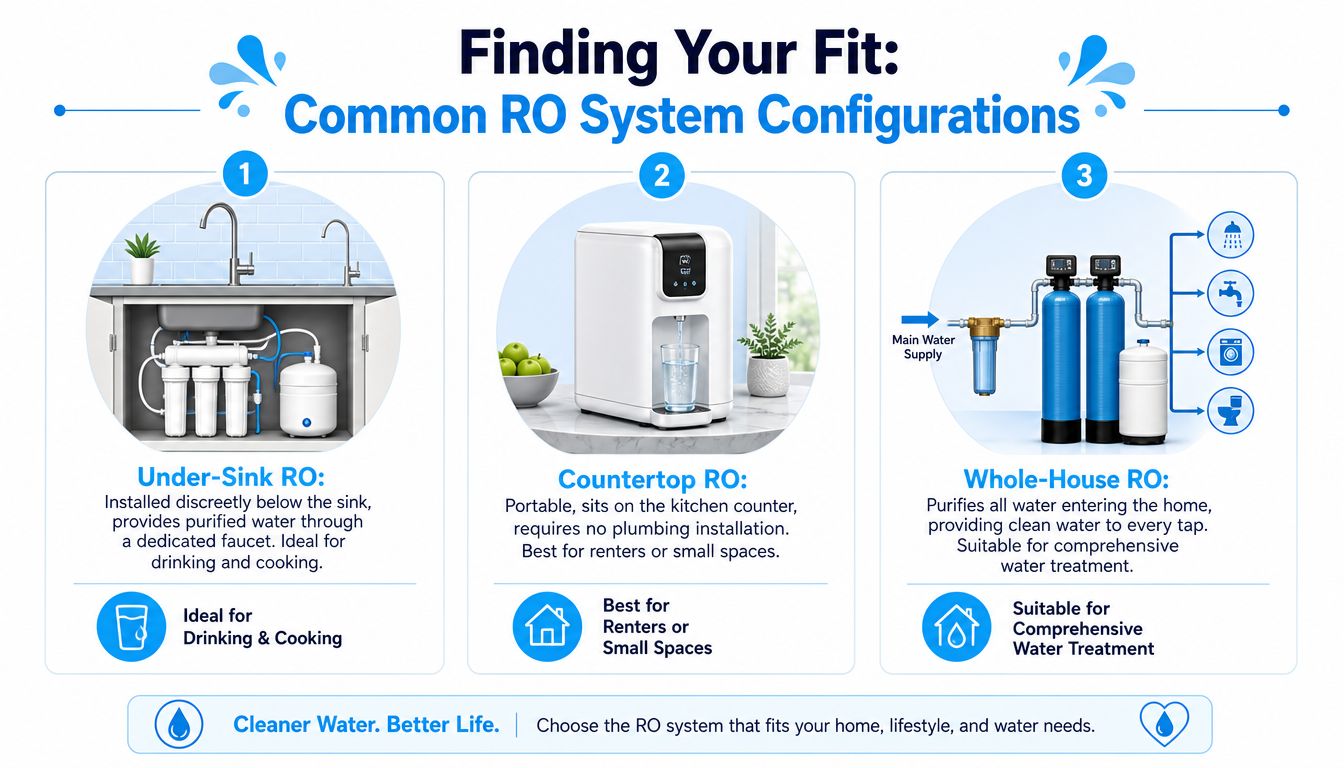
Under-sink systems
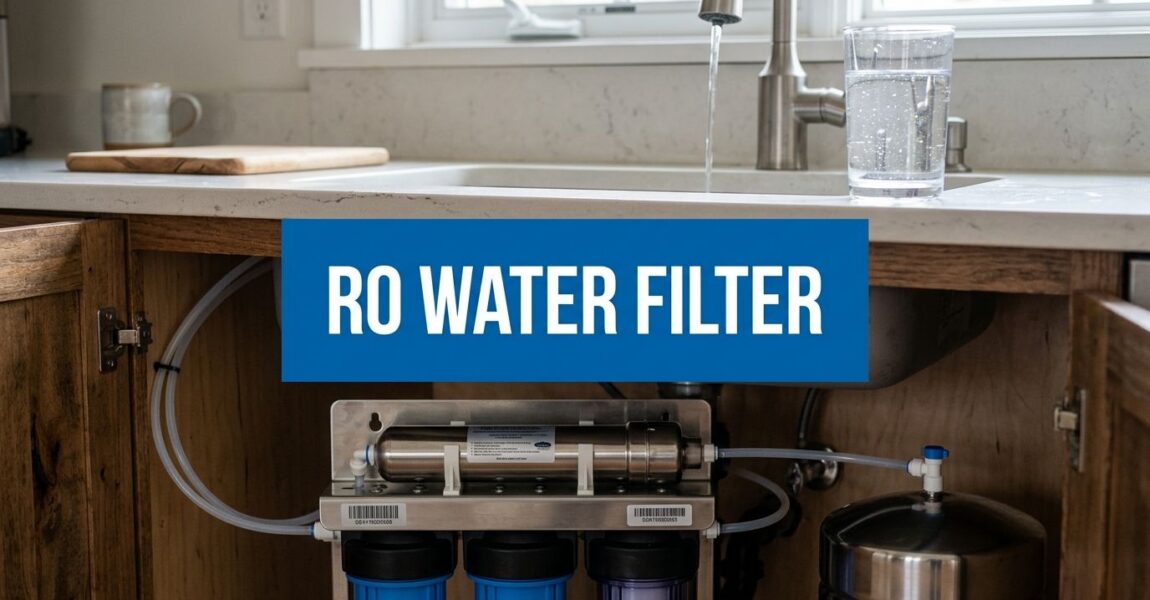
For many homeowners, under-sink RO is the practical middle ground. The filters stay tucked below the sink, and a separate faucet delivers purified water for drinking, cooking, tea, and coffee.
It helps to view this setup as a point-of-use tool. You are treating the water that affects taste and consumption most directly, instead of paying to purify water headed to toilets, laundry, or outdoor spigots. For a household that wants cleaner water without turning the plumbing system into a major project, that usually makes sense.
Under-sink systems also give you the widest range of choices. You can find traditional tank models, tankless versions, and systems with extras like remineralization or faster flow. If your main goal is better-tasting water at the kitchen sink, this is often the first place to look.
Tankless systems
Tankless RO systems appeal to homeowners who care about space and a cleaner-looking installation. Without a storage tank, the setup can feel less bulky under the sink and easier to fit into a tighter cabinet.
The trade-off is practical, not mysterious. Some tankless models need power, so you may need an outlet nearby. Some also produce noticeable pump noise during operation. In return, you often get a more compact footprint and a more modern design.
That balance matters in small kitchens. If cabinet space is limited, a tankless unit may be worth the added setup requirements. If you want quiet operation and the simplest possible install, a traditional under-sink tank system may still be the better fit.
Countertop systems
Countertop RO is the low-commitment option. It works well for renters, for households that cannot modify plumbing easily, or for anyone who wants purified water without drilling a hole for a dedicated faucet.
The convenience is real, but so are the compromises. A countertop unit takes visible space, usually offers a less built-in experience, and may feel less convenient for larger cooking tasks. Still, for a small apartment or temporary living situation, it can solve the core problem cleanly.
If you are still sorting through basic filter types and installation trade-offs, this home water filter buying advice library can help you compare options before you commit.
Whole-house RO systems
Whole-house RO is a specialized answer for a specific kind of water problem. It is usually considered when the incoming water itself is difficult across the entire home, which can happen with some private well setups or unusually challenging source water.
For a typical homeowner focused on drinking and cooking water, whole-house RO is often more equipment, cost, and maintenance than the situation calls for. It treats every gallon entering the house, including water used for bathing and flushing toilets. That can make sense in the right case, but it is rarely the starting point for someone who mainly wants safer water at the tap and better flavor in everyday use.
Which type suits which home
A quick side-by-side view helps:
| Home situation | Best fit | Why it makes sense |
|---|---|---|
| Typical family kitchen | Under-sink RO | Gives you purified drinking and cooking water where you use it most |
| Small apartment or condo | Tankless or countertop RO | Saves space or avoids plumbing changes, depending on the layout |
| Rental property | Countertop RO | Keeps installation simple and portable |
| Severe source-water concerns across the property | Whole-house RO | Treats incoming water throughout the home, but needs careful planning |
A good rule is simple. Choose the smallest configuration that fully solves your water problem.
That keeps the decision tied to real outcomes. Better-tasting coffee, cleaner ice, more confidence in the water you drink, and fewer regrets about wasted space or an overbuilt system you never really needed.
The Smart Buyer's Checklist for Your RO System
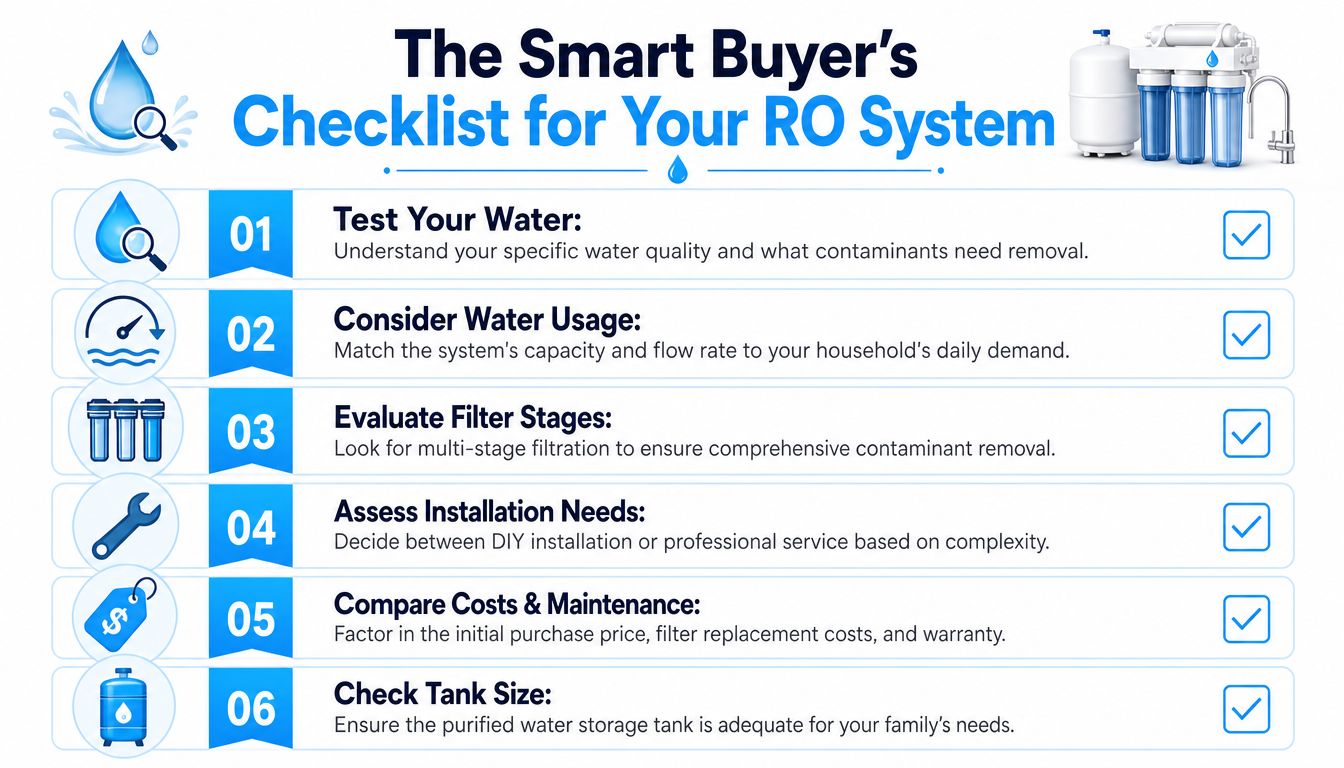
Buying an RO system gets easier once you stop shopping by brand slogan and start shopping by checklist. A strong system isn't just about what the membrane can remove. It's also about maintenance, pre-filtration, serviceability, and whether the setup fits your household without becoming annoying six months later.
The smart buyer thinks beyond launch day.
Start with your water, not the product page
Before comparing shiny features, figure out what problem you're solving. Municipal water and well water raise different questions. Taste issues point you one way. Lead, nitrates, or broad dissolved-contaminant concerns point you another.
If you want practical help sorting through filter types, certifications, and maintenance questions, Water Filter Advisor's advice library is a useful place to research the basics before you buy.
Use this checklist before you commit
- Test first: Know whether you're addressing taste, odor, dissolved solids, or a specific contaminant concern.
- Check the stage layout: A solid home RO system should include the pre-filtration and polishing stages that protect performance, not just a membrane headline.
- Look at replacement access: Some systems are easy to service. Others turn basic filter swaps into a cabinet yoga session.
- Match the system to your kitchen: Tankless, traditional under-sink, and countertop designs all solve different space problems.
- Review the long-term upkeep: An inexpensive system can become frustrating if replacement parts are hard to find or service is poor.
Don't neglect pre-filtration
This is one of the most expensive mistakes homeowners make. The membrane gets the attention, but the pre-filters protect the part you most want to keep alive.
According to Crystal Quest's reverse osmosis filtration guide, chlorine must be removed before water reaches the thin-film composite membrane, and delaying pre-filter replacement can reduce membrane lifespan from 5 years to under 2 years. That's a huge swing in cost of ownership from a maintenance habit many people treat as optional.
Buyer warning: Skipping pre-filter changes is like refusing to change engine oil and then blaming the car.
Ask practical installation questions
Not every buyer wants the same experience. Some people enjoy a DIY project. Others want a plumber to install it once and be done.
Use questions like these:
- Do I have room under the sink for filters and, if needed, a tank?
- Will I need an electrical outlet if I'm considering a pumped or tankless design?
- Can I easily reach shutoff valves and replacement cartridges?
- Does this system use common replacement parts, or am I locked into one supplier?
Think in years, not in unboxing moments
A good purchase feels easy after the excitement wears off. That means the filters are available, the replacement schedule is manageable, the faucet flow suits your routine, and the system doesn't become one more ignored appliance under the sink.
That's what separates a smart buy from an impulse buy.
RO Systems Versus Other Water Filters
You fill a glass from the tap, and it looks clean. A more pertinent question is simpler and more useful. What are you trying to change about that water?
For some homeowners, the goal is modest. They want water that tastes better and smells less like chlorine. A pitcher or faucet filter can often handle that. For others, the goal is broader reduction of dissolved contaminants that affect taste, kettle scale, baby formula, or the flavor of coffee and tea. That is where an RO system earns its place.
The easiest way to compare them is to match the tool to the job.
Filtration Method Comparison
| Feature | Pitcher Filter | Faucet Filter | RO System |
|---|---|---|---|
| Best for | Basic taste improvement | Convenient everyday filtering | Deeper purification for drinking and cooking water |
| Installation | None | Very easy | Moderate, usually under-sink or countertop |
| Contaminants addressed | Often taste and odor issues | Often taste and some common contaminants | Broad dissolved contaminant reduction, including fluoride |
| Water output | Slower, refill-based | On-demand from faucet | Depends on design, but built for dedicated purified water |
| Maintenance style | Frequent simple swaps | Routine cartridge changes | Multiple filters, membrane care, more involved upkeep |
| Mineral removal | Usually no | Usually no | Yes, which is why some buyers add remineralization |
A carbon filter works like an odor and taste specialist. It is very good at improving flavor and reducing chlorine. An RO system adds a much finer barrier for dissolved solids, so it addresses a different category of problems. That distinction matters in daily life. If your main complaint is pool-like taste, RO may be more system than you need. If you want cleaner-tasting water for espresso, clearer ice, and lower dissolved contaminant levels in what you drink and cook with, RO is often the stronger fit.
Fluoride and minerals usually create the most confusion. Standard carbon filters generally do not target fluoride well, while RO systems are commonly chosen when that reduction is a priority. The trade-off is that RO also removes beneficial minerals along with unwanted dissolved material. For many households, that is not a dealbreaker. Some prefer the cleaner, neutral taste. Others add a remineralization stage because they like a fuller taste profile.
Where whole-house carbon fits
Whole-house filtration solves a different problem. It treats water used for showering, laundry, dishwashing, and fixture protection across the home. If your concerns include chlorine smell in the shower or reducing exposure at every tap, a whole-house carbon system may make more sense than trying to force an under-sink RO unit to do everything. For a practical example of how whole-home treatment is presented for household use, JMJ Plumbing's Halo water services offers a useful reference point.
Many homes benefit from a two-layer approach. Use whole-house treatment for comfort and plumbing protection, then use RO at the kitchen sink for the water you drink most.
The right choice depends on your goal
Choose a pitcher or faucet filter if you want low cost, quick setup, and better everyday taste.
Choose RO if you want stronger reduction of dissolved contaminants in drinking and cooking water, and you are comfortable with filter changes, slower production, and the fact that some water is rejected during purification.
Choose a whole-house system if the problem shows up everywhere in the home, then add RO only where higher-purity water changes the outcome in the cup, the pot, or the bottle.
That last point helps cut through the "RO versus everything else" debate. This is usually not a contest. It is a matching exercise. The best filter is the one that solves your water problem without adding complexity you do not need.
If you're comparing systems and want help cutting through marketing claims, Water Filter Advisor offers practical guidance on choosing, comparing, and maintaining home water filtration options so you can buy with more confidence and fewer surprises.