Best Water Filter for Microplastics: What Actually Works
The most popular advice about microplastics is also the least useful: buy any filter that says “clean water.” A standard carbon pitcher may improve chlorine, taste, and odor while doing little for tiny plastic particles. Some carbon and ion-exchange devices have even produced higher microplastic counts in their effluent than in their influent under test conditions peer-reviewed point-of-use research.
The best water filter for microplastics is defined by its physical barrier, not by attractive packaging or a long list of generic contaminant claims. For most homeowners, that means reverse osmosis. A properly tested fine-pore membrane is the clearest route to high removal, while microfiltration and ultrafiltration can make sense when you want lower complexity and better mineral retention.
| Filter technology | Microplastic performance | Main advantage | Main drawback |
|---|---|---|---|
| Reverse osmosis | Near-total removal under relevant test conditions | Strongest barrier for very small particles | More installation, maintenance, and water-management demands |
| Microfiltration | 78%–86% removal for PVC fragments and 94%–100% for PET fragments in one point-of-use study peer-reviewed study | Strong particle capture without full RO complexity | Results depend on membrane design and operating conditions |
| Ultrafiltration | Effective physical-barrier option, with results dependent on pore rating and test conditions | Retains dissolved minerals | Less suitable for the smallest particles |
| Granular activated carbon | Can capture microplastics, but performance varies with loading and bed design | Excellent for taste, odor, and some dissolved contaminants | Carbon alone isn't a dependable microplastic strategy |
| Standard carbon pitcher | Often unverified for microplastics | Convenient and inexpensive | Usually selected for taste and chlorine, not fine-particle removal |
Why Most Filters Fail at Microplastics
A carbon filter is not automatically a microplastic filter. Activated carbon is primarily an adsorption medium, so it works well for certain dissolved chemicals, chlorine, taste, and odor. It may also provide physical depth filtration, but results depend on the carbon block's structure, particle loading, water flow, and the manufacturer's test method.
“Reduces impurities” is too vague to prove particle capture. A cartridge can perform well against chlorine while allowing small plastic fragments through. In the point-of-use study cited earlier, a device using only granular activated carbon and ion exchange performed poorly. Some tests even measured more particles after filtration than before it. The result shows why a broad contaminant list is not evidence of microplastic removal.
Pore size beats broad marketing claims
Microplastic removal is a size-separation problem. A membrane with a controlled pore structure creates a defined physical barrier. Carbon media force water through a variable bed, where capture changes as the media loads, particles collect, and flow channels shift.
That difference matters in a kitchen. A filter can perform well when new, then lose flow as sediment accumulates. If the product does not provide a meaningful micron rating or particle-specific testing, its effective size range remains unknown.
Practical rule: If a claim does not identify the filtration mechanism, particle size, test conditions, and replacement requirements, treat it as a taste-and-odor claim, not proof of microplastic removal.
Reverse osmosis is the strongest household option because its semipermeable membrane rejects extremely small contaminants. The cited RO overview describes membrane pores around 0.0001 micron and reports removal of more than 99% of microplastic and nanoplastic-sized particles reverse osmosis overview. Product performance still varies. Pretreatment, membrane condition, pressure, flow, and maintenance determine whether the system continues to deliver its rated barrier.
A dense carbon cartridge has a useful supporting role in a treatment train, especially for chlorine and taste. It should not receive credit for the membrane's microplastic performance unless independent testing demonstrates that capability. For buyers, the practical dividing line is clear: choose a verified membrane when particle removal is the priority, and view generic carbon marketing with caution.
What the Science Says About Microplastics in Drinking Water
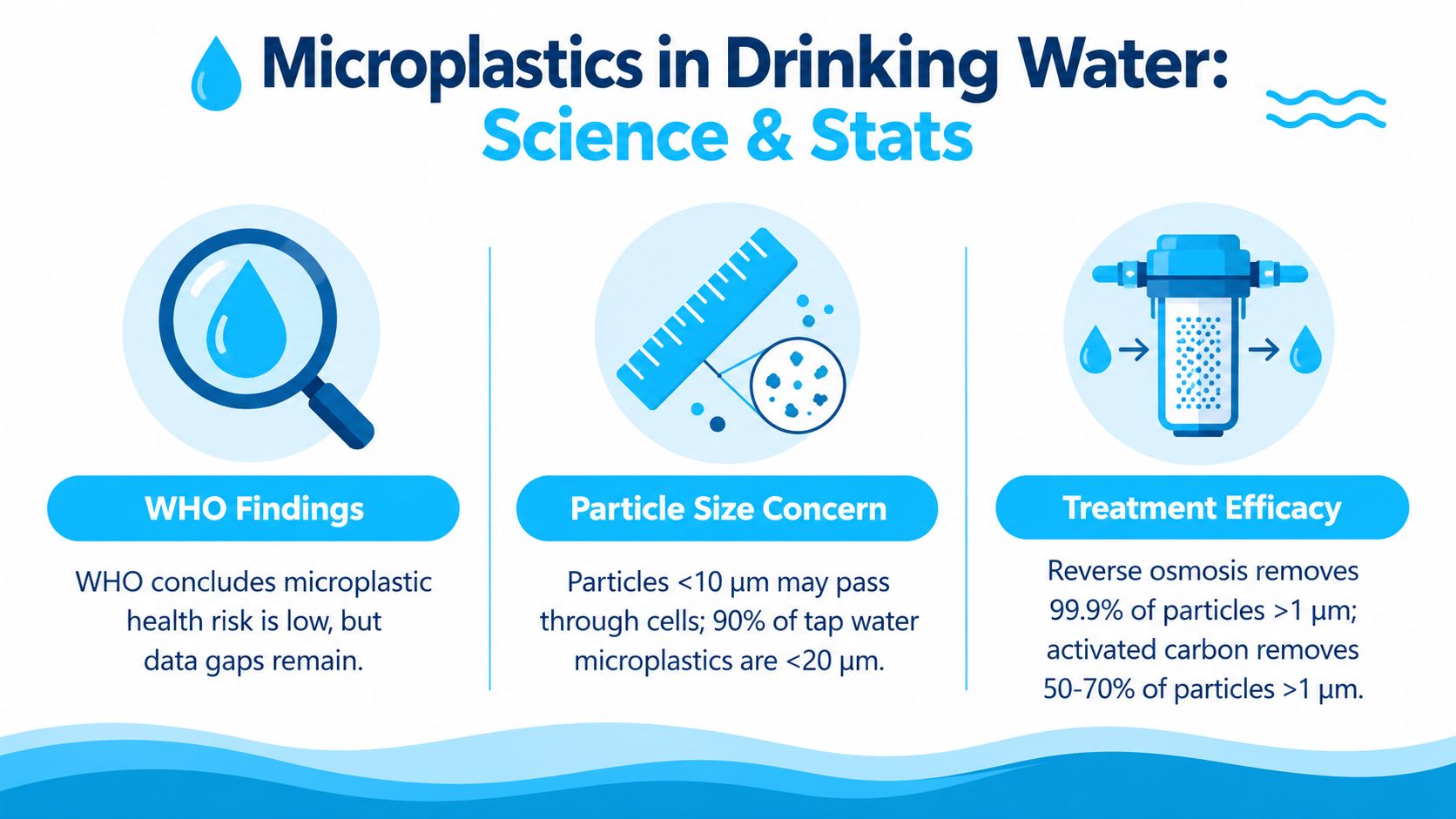
Microplastics deserve a measured response, not panic and not marketing hype. The World Health Organization's 2019 report was the first global assessment of microplastics in drinking water and concluded that current exposure presents a low health risk based on limited evidence World Health Organization report. The WHO also states that evidence remains incomplete, particularly for smaller particles and exposure across the water cycle.
Particle size still matters. Particles larger than 150 micrometers are unlikely to be absorbed by the human body, while uptake of smaller particles appears limited. That finding does not make filtration irrelevant. It sets a clear performance standard: a coarse screen or generic carbon cartridge cannot address concerns about the smallest particles unless testing proves that it can.
Removal results depend on the barrier
Peer-reviewed testing is more useful than broad product claims. A 2023 point-of-use study found that microfiltration systems removed 78%–86% of PVC fragments and 94%–100% of PET fragments. Another membrane-based device achieved 95%–100% removal of PVC fragments and 100% removal of nylon fibers under its test conditions published test results.
Treatment research generally found filtration more effective than simple coagulation-flocculation. For larger test particles, reviewed systems reached 86.9% ± 4.88% to nearly 99.9% removal. Recent research reports that municipal treatment plants and pilot systems can remove more than 97.5% of microplastics larger than 2 micrometers, while household results depend on membrane design, flow rate, and maintenance recent review.
For broader environmental context, find microplastic pollution resources. The buying conclusion is direct: physical filtration is the relevant feature. Choose a tested membrane barrier, and treat unsupported carbon claims as taste-and-odor marketing rather than proof of microplastic removal.
Comparing Filter Technologies for Microplastic Removal
Reverse osmosis is my first choice for homeowners who want the strongest household barrier. Its membrane rejects very small particles, but that protection brings trade-offs: added plumbing, wastewater, slower production, and filter changes. A 2026 treatment review reported very high removal for selected polymers, especially particles above the smallest tested range. Treat those results as controlled-test performance, not a guarantee for every installation.
Microfiltration is the practical compromise. A true membrane can remove suspended plastic particles while retaining more minerals and avoiding some of RO's operating demands. Performance still depends on membrane design, flow rate, pressure, and cartridge condition. Ultrafiltration offers another membrane option, but its real-world result depends on the product's stated rating and whether the system maintains that performance between replacements.
| Technology | Barrier and trade-offs | Best use |
|---|---|---|
| Reverse osmosis | Finest barrier in this comparison, with higher installation, wastewater, and maintenance demands RO source | Maximum particle control |
| Microfiltration | Membrane-based particle removal with simpler operation than RO, but performance varies by design and upkeep | Strong control without full RO complexity |
| Ultrafiltration | Fine membrane barrier with product-specific performance and mineral retention | Broad physical filtration where RO is unnecessary |
| Granular activated carbon | Useful for taste, odor, and selected chemicals. Particle capture varies with loading, bed length, concentration, and flow GAC research | Chemical and aesthetic improvement, not a primary microplastic barrier |
Carbon has a role, but not the lead role
Granular activated carbon can capture microplastics in controlled tests. Research reported strong removal for relatively large particles under a specified loading, while other loading conditions produced lower results activated-carbon study. The variation matters. A carbon block that improves taste is not automatically a dependable microplastic filter, and a saturated bed can lose performance as water quality and flow change.
The buying rule is simple: choose a system built around a documented membrane or another validated fine-particle barrier. Carbon is useful as a supporting stage, especially for chlorine and taste, but marketing language alone proves little. For broader product comparison, consult this guide to the top water filter for microplastics, then check the actual barrier, replacement schedule, and operating cost before buying.
How to Verify Filter Claims and Certifications
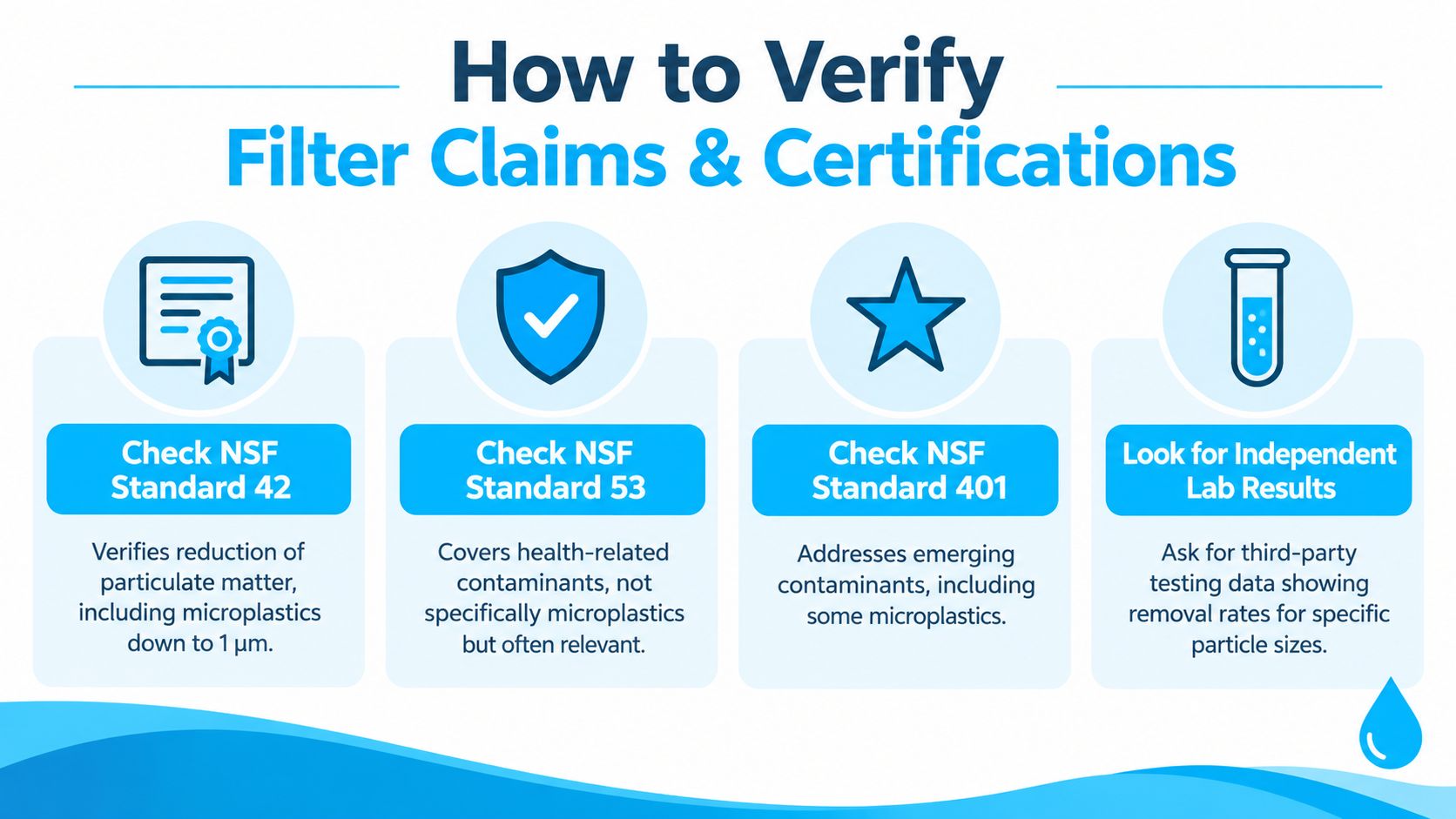
A certification logo is a starting point, not proof of microplastic removal. The NSF standards framework distinguishes Standard 42, which covers aesthetic effects such as taste, odor, and particulate reduction, from Standard 53, which covers health-effect claims such as lead reduction. Standard 401 addresses selected emerging contaminants and may appear on newer reduction claims.
Those standards apply to a defined product, contaminant claim, and test protocol. None guarantees removal of every microplastic size. Check the exact model, cartridge, membrane, and performance sheet rather than relying on a brand's general certification page.
Use this verification checklist
- Find the actual test claim: Confirm the particle material, size range, incoming-water conditions, flow rate, and cartridge condition.
- Confirm the model number: Certification for one cartridge does not automatically cover another cartridge in the same product family.
- Check the barrier: A stated membrane rating provides more useful information than phrases such as “advanced filtration” or “multi-stage purification.”
- Separate contaminants: Testing for chlorine, lead, or odor does not establish microplastic removal.
- Read the maintenance instructions: A clogged or overdue cartridge may perform differently from a new one.
Ask one precise question before buying: What contaminant was tested, at what particle size, under which flow conditions, and for how long?
Treat “particulate reduction” cautiously when the documentation does not identify the particles. The term can describe a broad particulate category rather than plastic fragments. Strong evidence pairs a recognized certification category with independent laboratory results naming the target particles and operating conditions.
For RO systems, require documentation for both the membrane and the complete assembled unit. For microfiltration or ultrafiltration, look for the membrane rating and supporting test data. For carbon systems, determine whether the result came from a controlled bench test or the actual consumer cartridge at its rated capacity. A carbon claim without particle-specific testing is marketing, not a reliable buying basis.
Choosing the Right System for Your Household
The strongest laboratory barrier is not automatically the best household choice. Select the system around your water source, the taps that need treatment, available space, and the maintenance you will perform. For many homes, a point-of-use filter for drinking and cooking water is more sensible than treating every tap with whole-house RO.

Renters and apartment residents
Choose a countertop RO unit when microplastic reduction is the priority and plumbing changes are not possible. It can move with you, but it needs electricity, space for treated water, and a way to handle reject water.
Limited counter space favors a faucet-mounted membrane or sub-micron system, provided its documentation identifies particle-specific performance. Standard carbon faucet filters remain useful for chlorine and taste. They should not be your first microplastic choice without testing that names plastic particles and the operating conditions.
Homeowners and families
For a permanent kitchen installation, under-sink RO is the clearest recommendation when maximum particle reduction matters. Add sediment pretreatment if the supply contains visible grit or the household plumbing sheds debris. The pretreatment protects the finer barrier and helps prevent unnecessary loading.
Choose membrane-based microfiltration or ultrafiltration when you want a simpler setup that retains dissolved minerals. Require a stated membrane rating and test data that match the cartridge you will buy. A generic “multi-stage” label does not establish microplastic removal.
Use the water filtration advice library to compare installation formats and maintenance requirements. Then verify the actual membrane or particle-removal evidence for the selected model.
Well-water users and whole-house buyers
Well water often places a heavier sediment burden on fine membranes. Begin with water testing and pretreatment instead of sending untreated water directly into the final barrier. A whole-house membrane can cover every tap, but it demands more flow, pressure, space, and service work than a dedicated drinking-water system.
If the concern is specifically drinking water, choose point-of-use RO in most cases. Whole-house treatment earns its place when every tap needs coverage and the plumbing, pressure, and pretreatment equipment can support it. Otherwise, the added complexity buys coverage you may not need.
This video provides useful visual context for how household filtration systems are arranged and maintained:
Long-Term Performance and Maintenance Realities
A filter's laboratory result matters only if the system maintains that performance in your kitchen. Fine membranes collect sediment, organic matter, and trapped particles. As loading increases, flow slows and pressure can fall. Continuing to use an overdue cartridge because the water still looks clear can leave the system operating outside its tested conditions.
Recent filtration research highlights the effect of system design and operating conditions. One pilot combination exceeded 99% microplastic separation while avoiding blockage, while removal in another setup changed substantially with flow rate. The strongest sand-and-anthracite arrangement reached 98% at 10 m/h, whereas other media performed less well recent filtration research.
What to monitor at home
- Flow decline: A noticeable slowdown usually indicates loading, fouling, or a pressure problem.
- Pressure change: RO systems require suitable pressure to move water through the membrane.
- Taste or odor return: This can signal exhausted carbon media even when the membrane still functions.
- Leaks and housing damage: A small leak can contaminate the area around a cartridge and may indicate a failing seal.
- Missed replacement dates: Follow the manufacturer's capacity and service schedule instead of waiting for visible failure.
Granular activated carbon depends heavily on bed design and loading. Research at a full-scale drinking-water plant found carbon filtration reduced microplastics to a low residual level, but the remaining count was similar to, or slightly higher than, sand filtration in that same context. Carbon is a useful treatment stage, not a universal standalone guarantee. Its marketing often sounds stronger than its particle-removal evidence.
RO ownership includes reject water, membrane replacement, prefilter changes, and possible remineralization. A microfilter may waste less water and install more easily, but its performance may fall short against the smallest particles. Compare the complete maintenance routine, replacement access, pressure requirements, and operating waste, not only the purchase price. A membrane that is difficult to service will not deliver its rated protection for long.
Final Recommendations by Budget and Use Case
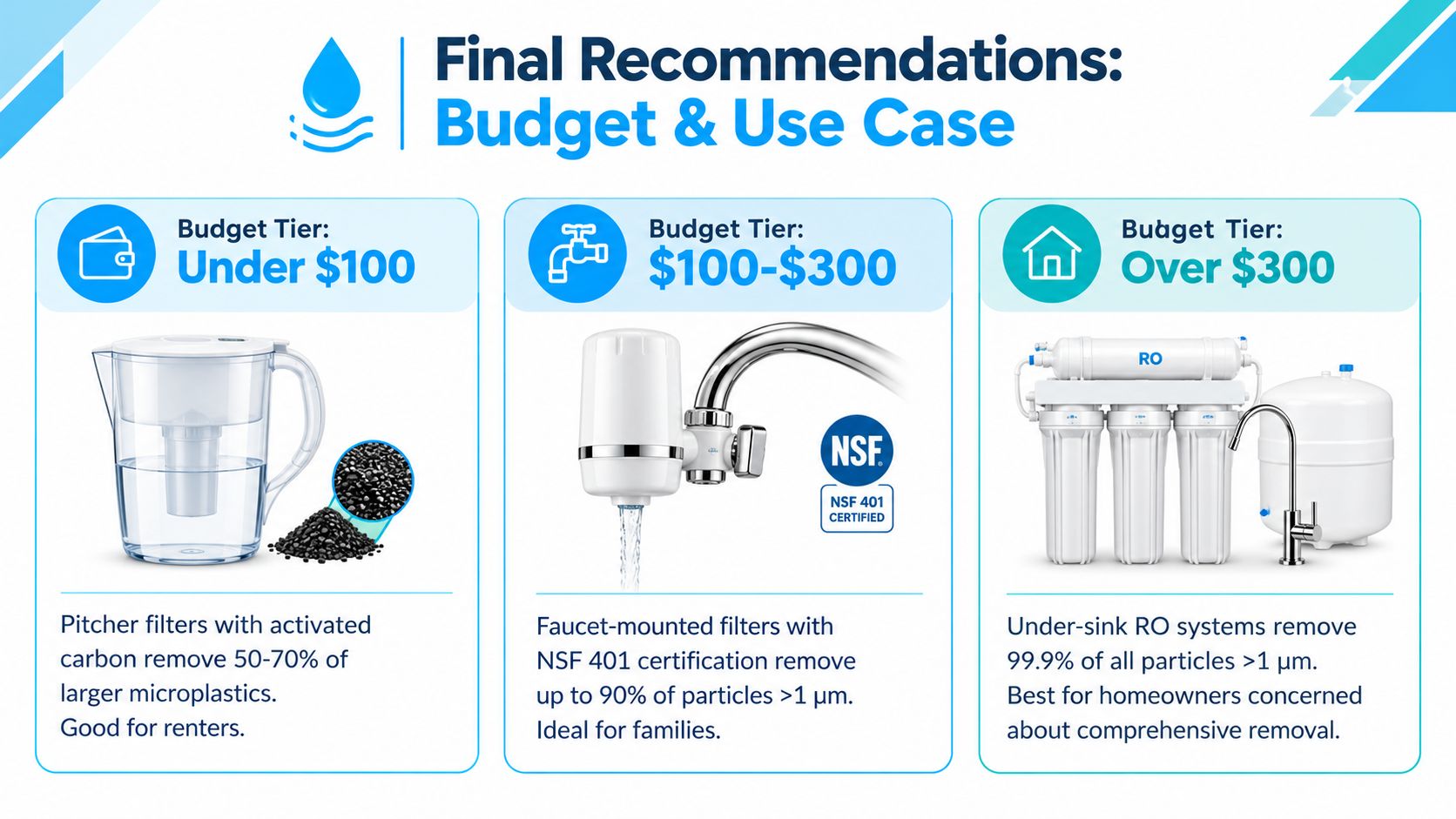
My recommendation is clear. Choose RO when maximum microplastic and nanoplastic reduction is the priority. Choose a validated microfiltration or ultrafiltration system when you want a simpler barrier and mineral retention. Choose carbon alone only when taste, odor, chlorine, or selected dissolved contaminants are the objective.
For renters and tight spaces
Buy a countertop RO system if you can manage the footprint and reject water. It offers the strongest physical barrier without permanent installation. If RO isn't practical, choose a countertop or faucet membrane system with independent particle-size testing, not a standard carbon pitcher with vague particulate language.
For budget-conscious buyers
A ceramic or fine-pore membrane system can be a reasonable starting point for larger microplastics, provided the manufacturer documents its pore structure and test conditions. Granular activated carbon may capture larger particles, but the cited research shows that results change with concentration and bed design, so don't treat a carbon-only unit as protection.
For families
Install an under-sink RO system at the kitchen tap. It concentrates treatment where your household drinks and cooks, avoids the complexity of treating every fixture, and gives you the most direct route to the smallest practical membrane barrier. Add sediment pretreatment when your water supply carries visible particles.
For whole-house coverage
Use whole-house treatment only when you have a reason to cover every outlet. A properly designed point-of-entry membrane system can address the broader household, but it requires careful sizing, pretreatment, pressure management, and disciplined maintenance. For many homeowners, an under-sink RO system is the better value because it focuses the strongest technology on water that enters the body.
The final buying test is simple:
- Identify the target: Larger fragments, fine particles, or the smallest particles?
- Choose the barrier: RO for the strongest protection, membrane filtration for a simpler compromise.
- Verify the claim: Match certifications and independent testing to the exact model.
- Plan maintenance: Confirm cartridge changes, pressure needs, sediment control, and storage.
- Buy for the household: Renters need portability, families need dependable kitchen flow, and well-water users need pretreatment.
Water Filter Advisor helps households compare water filters, understand certifications, choose replacement cartridges, and maintain systems for contaminants including microplastics. Visit Water Filter Advisor to find practical buying guides and maintenance advice before you choose your next home filtration system.
