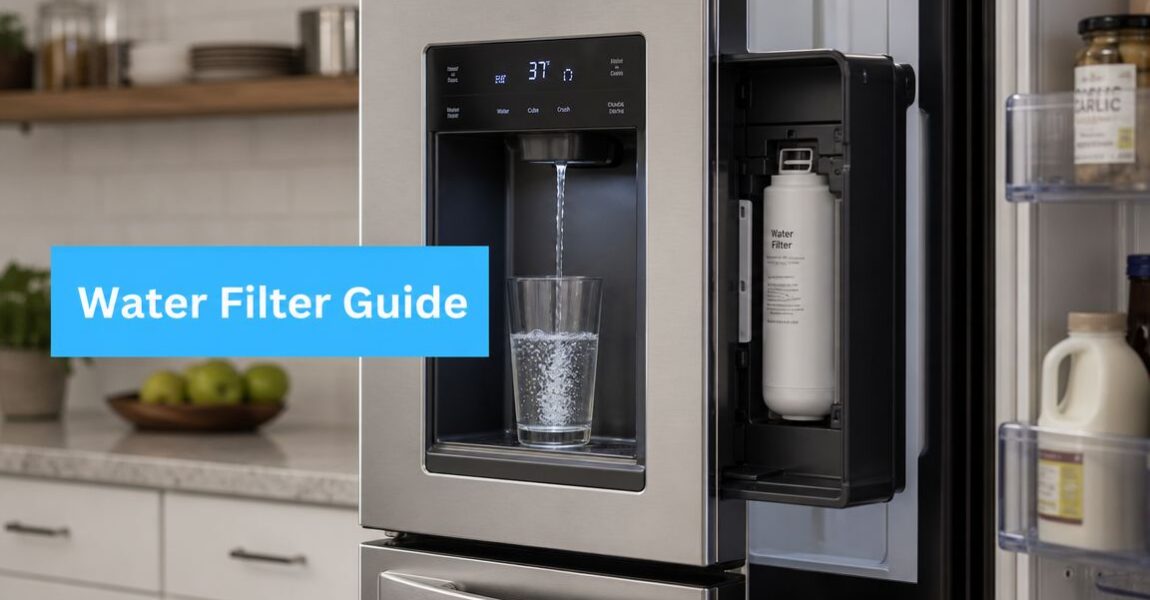
Refrigerator Water Filtration System: Ultimate Guide 2026
You fill a glass from the refrigerator, drop in a few cubes, and assume you're getting the cleanest water in the house. That's a reasonable assumption. The dispenser feels more advanced than the kitchen tap, and the filter tucked inside the fridge sounds like a built-in layer of protection.
Sometimes that assumption holds up well enough. Sometimes it doesn't.
A refrigerator water filtration system is convenient, familiar, and easy to ignore until the change light comes on or the water starts tasting flat. The trouble is that most homeowners don't get a straight explanation of what that filter does, what it doesn't do, and when it makes more sense to feed the fridge with better filtered water from somewhere else.
That's where most buying mistakes happen. People either overtrust the little cartridge in the fridge, or they replace it forever without asking whether a better setup would cost less, work better, and be easier to maintain.
That Little Filter in Your Fridge Does More Than You Think
You notice this section of your water system when something goes wrong. The dispenser slows to a trickle. The ice picks up an off taste. Or you stand in the appliance aisle holding a replacement cartridge and realize you are not sure what the old one was really handling.
A refrigerator filter does useful work. It improves the water you drink every day, keeps filtration tucked out of sight, and treats both the dispenser and the ice maker without adding another faucet at the sink. For many homes, that convenience is the whole appeal.
The catch is simple. Convenience often gets mistaken for broad protection.
Homeowners see “filtered water” on the front of the fridge and assume the cartridge is addressing every water quality concern coming into the house. In practice, many standard refrigerator filters are narrow-purpose parts. They often help most with taste and odor, and sometimes with a shorter list of contaminants if the cartridge has the right certification.
Practical rule: Treat your fridge filter as a useful finishing filter, not your entire water treatment plan.
That matters more in houses with older plumbing, private well concerns, lead risk, PFAS concerns, or a local water issue that shows up on your utility report. In those cases, the right question is not whether refrigerator filters work in general. The right question is what your exact filter is certified to reduce, and whether its capacity matches how much water your household uses for drinking and ice.
There is another blind spot I see all the time. Many homeowners assume the choices are limited to replacing the factory cartridge forever or installing a full whole-house system. There is a strong middle option that gets overlooked. Feed the refrigerator with cleaner water from an external inline filter or an under-sink system.
That setup is often a significant improvement when the built-in cartridge is expensive, hard to source, or too limited for the contaminants you care about. It can also lower long-term filter costs and give the ice maker better water than the refrigerator cartridge alone would provide.
The small filter inside the fridge still matters. It just should not get credit for jobs it was never built to do.
How Refrigerator Filtration Actually Works
A refrigerator water filtration system is usually a point-of-use activated carbon cartridge. Think of activated carbon like a sponge made of countless tiny tunnels and pockets. Water moves through it, and certain impurities cling to that carbon surface instead of continuing into your glass.
That process is called adsorption. It's not the same as a kitchen sponge soaking up water. The water keeps moving. The contaminants stick to the carbon.
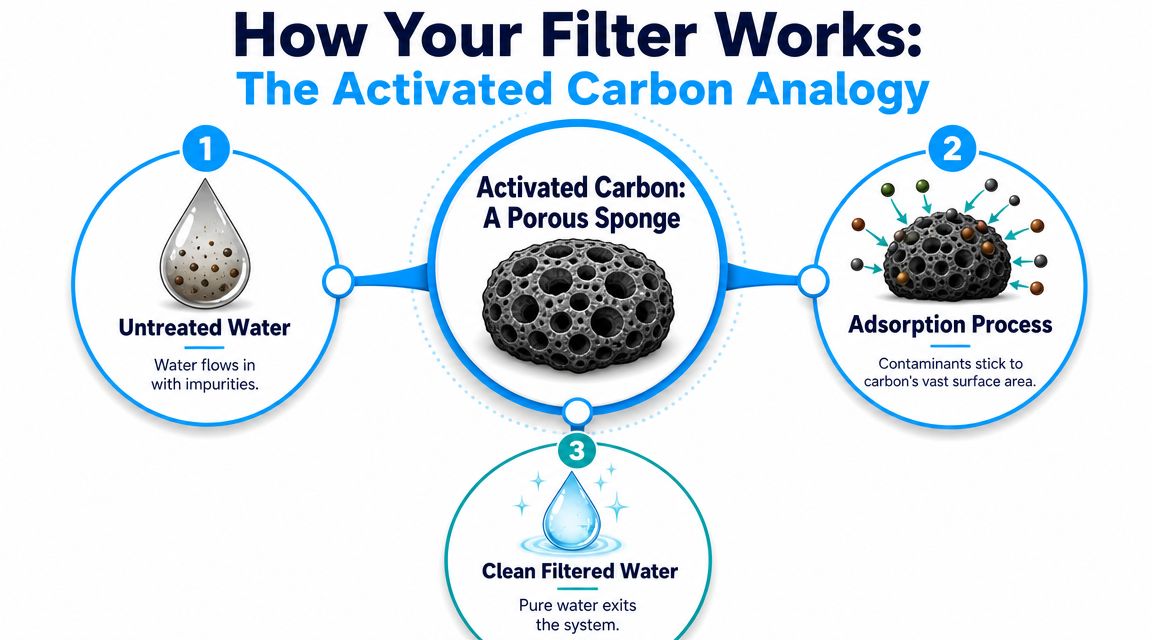
What the cartridge is actually doing
In most refrigerators, the filter's main job is to improve taste and smell by reducing things like chlorine-related off-notes. The CDC notes that most home filters, including fridge filters, aren't designed to remove germs, and refrigerator filters are mainly a taste-and-odor solution unless the cartridge carries additional contaminant certifications, as explained in the CDC's guide to choosing home water filters.
Many fridge cartridges use activated carbon alone. Some add other media, including ion-exchange media, to target specific contaminants more effectively. That extra media can help, but only if the cartridge is designed and certified for that purpose.
Flow rate, capacity, and the built-in compromise
Every refrigerator filter has to balance two competing jobs. It needs to clean the water, and it also has to keep enough pressure for the dispenser and ice maker to work properly.
Current guidance shows many cartridges are rated around 300–400 gallons while targeting flow in the 0.5–0.8 gpm range. Some higher-end inline ultrafiltration designs add a 0.01 micron membrane at about 0.75 GPM, according to this refrigerator water filter guide.
That balancing act is why tiny pores aren't always better in a fridge application. Finer filtration can capture more, but it also creates more pressure drop. In plain language, the tighter the screen, the harder the water has to work to get through.
The best refrigerator filter isn't the one with the boldest marketing. It's the one that matches your water problem without choking your dispenser.
Why older plumbing changes the equation
If your home has sediment, rust, or older plumbing, the fridge filter often gets loaded with junk it was never meant to handle alone. That shortens cartridge life and drags down flow.
A simple prefilter upstream can help protect the refrigerator filter from early clogging. That's especially helpful when the dispenser starts slowing down long before the replacement interval you expected.
The Three Main Types of Fridge Filter Systems
Homeowners usually think there's only one type of refrigerator water filtration system. There are three common approaches, and each one solves a different problem.
The smart choice depends on what you care about most. Simplicity, contaminant coverage, or long-term operating cost.
OEM internal cartridges
This is the standard setup built into the refrigerator. You twist or push a cartridge into the fridge housing, and the dispenser and ice maker run through that filter.
OEM filters are the easiest path when you want zero guesswork on fit. They're designed for that exact refrigerator model, and they usually play nicely with the fridge's filter indicator and bypass system.
The downside is familiar. Replacement costs add up, choices are limited, and performance may be narrower than you assumed.
External inline refrigerator filters
An external inline filter installs on the water line behind the refrigerator. Instead of filtering inside the appliance, it filters the incoming supply before the water reaches the fridge.
This approach gives you more flexibility. You can often choose a different filter format, a different housing style, or a cartridge with different certifications than the built-in option.
It also creates a cleaner maintenance setup in some kitchens. You aren't wrestling a cartridge out of a cramped fridge housing, and you can place the filter where access is easier if the line layout allows it.
Under-sink or external system feeding the refrigerator
This is the overlooked option, and in many homes it's the best one.
Instead of depending on the refrigerator's own cartridge, you install a better filtration system elsewhere, often under the sink, and route that filtered water to the fridge's dispenser and ice maker. Installation guidance shows this strategy is feasible, but many consumer guides still ignore compatibility, plumbing layout, and fridge-specific bypass details, as discussed in this video on routing filtered water to a refrigerator.
This setup makes sense when the fridge cartridge is expensive, hard to source, or too limited for your water concerns. It also makes sense when you want one stronger point-of-use system serving both a drinking faucet and the refrigerator.
If you hate paying for proprietary fridge cartridges, feeding the refrigerator from an under-sink filter is often the cleanest workaround.
Refrigerator Filtration System Comparison
| System Type | Installation Complexity | Typical Contaminant Removal | Long-Term Cost |
|---|---|---|---|
| OEM internal cartridge | Low | Often strongest on taste and odor improvement, with health-related reduction depending on model certification | Can be high because of proprietary replacements |
| External inline filter | Moderate | Varies by cartridge selected | Often more flexible than OEM |
| Under-sink system feeding fridge | Moderate to high | Usually broader than standard fridge-only filtration, depending on system chosen | Can be better over time if one system serves multiple uses |
Here's the practical takeaway. If your water tastes bad but your risk profile is otherwise straightforward, the built-in cartridge may be enough. If you're chasing stronger filtration or lower replacement hassle, external feed options deserve a serious look.
Decoding Certifications and Contaminant Claims
The label on a filter box can feel like alphabet soup. NSF/ANSI 42, 53, 401, sometimes more. Once you know the code, the label gets much easier to read.
The simplest way to think about it is this: certifications are like a checklist from an independent referee. They don't tell you a filter removes everything. They tell you what it was tested and certified to reduce.
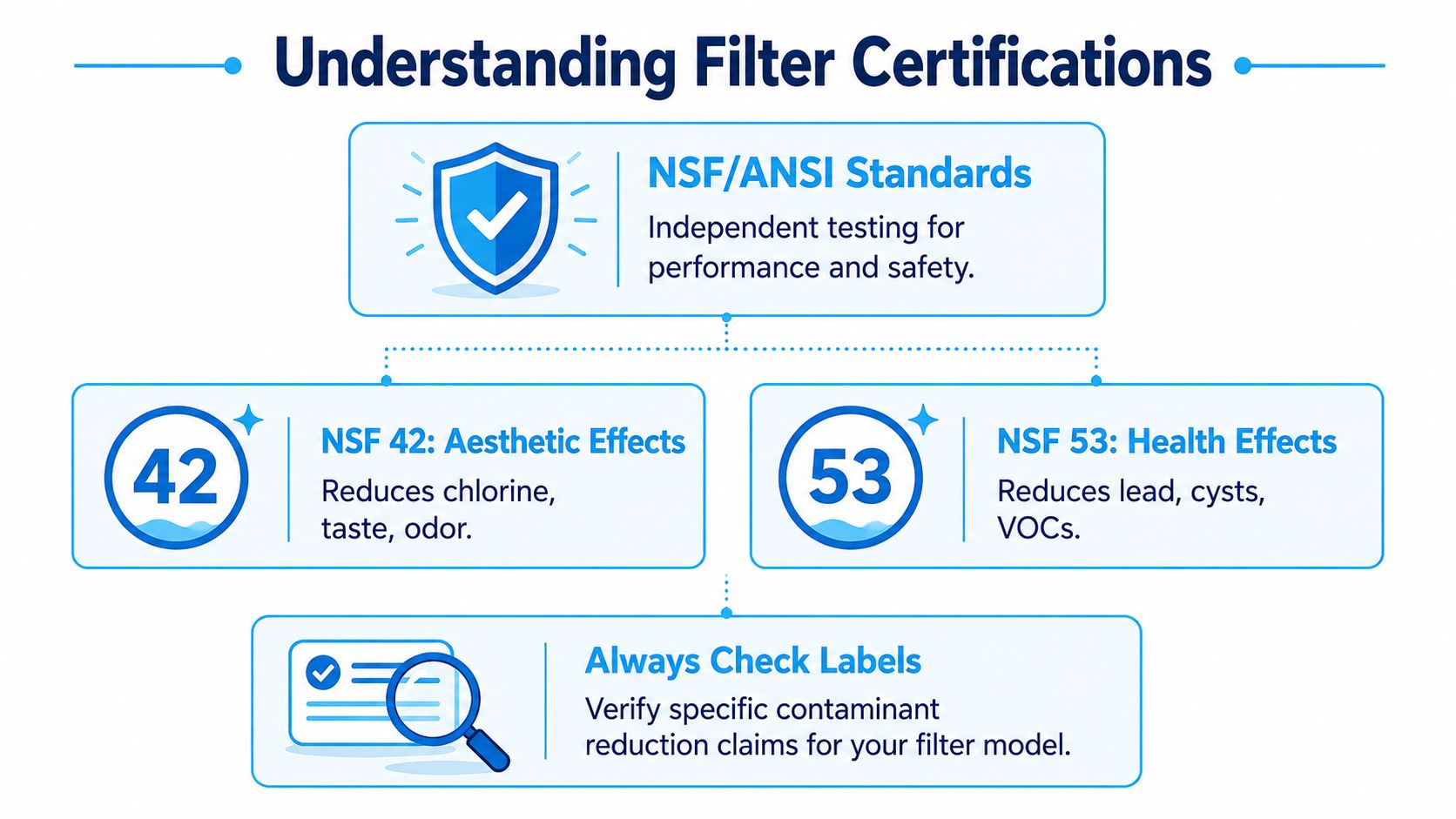
What the key standards mean
NSF/ANSI 42 covers aesthetic effects. Think chlorine taste and odor. If your main complaint is that the water tastes like a swimming pool, this is the certification that speaks directly to that issue.
NSF/ANSI 53 is the one many homeowners should pay closer attention to when they care about health-related contaminants such as lead. This is a more demanding standard than 42.
NSF/ANSI 401 deals with selected emerging contaminants. It can include some pharmaceutical and chemical reduction claims. The key is that the claim has to be explicit for the model in front of you.
NSF also notes that certification does not mean a filter removes every contaminant. It verifies reduction only for the substances named in the certification or performance sheet. That's the core lesson from NSF's explanation of standards for water treatment systems.
What to look for on the box
Don't stop at the standard number alone. Look for the exact contaminant list tied to the exact cartridge model.
A good buyer checklist looks like this:
- Match the problem first: If your concern is taste, look for NSF/42. If your concern is lead, focus on NSF/53.
- Check the exact model number: A brand may sell several similar cartridges with different claims.
- Read the performance sheet: Broad phrases like “advanced filtration” don't tell you enough.
- Watch for newer claims carefully: NSF/401 can be useful, but only when the listed contaminants match your actual concern.
Why this matters more now
Consumer Reports notes that common refrigerator filter certifications can also include NSF/ANSI 372 for lead-free materials, NSF/ANSI P473 covering PFOS and PFOA, and NSF/ANSI 401 for trace pharmaceuticals and chemicals, but those benefits depend on the specific cartridge. In practice, a refrigerator water filtration system starts as a taste-and-odor solution first. Health protection depends on what that exact filter is certified to do.
That's why a vague claim like “removes contaminants” doesn't help much. You don't need broad promises. You need a model-specific receipt.
Installation and Replacement Made Easy
Most refrigerator filter jobs are well within basic DIY range. You don't need fancy tools for an internal cartridge swap, and many inline installs are straightforward if you work carefully and give yourself time.
Start with the simplest rule. Never rush the leak check.
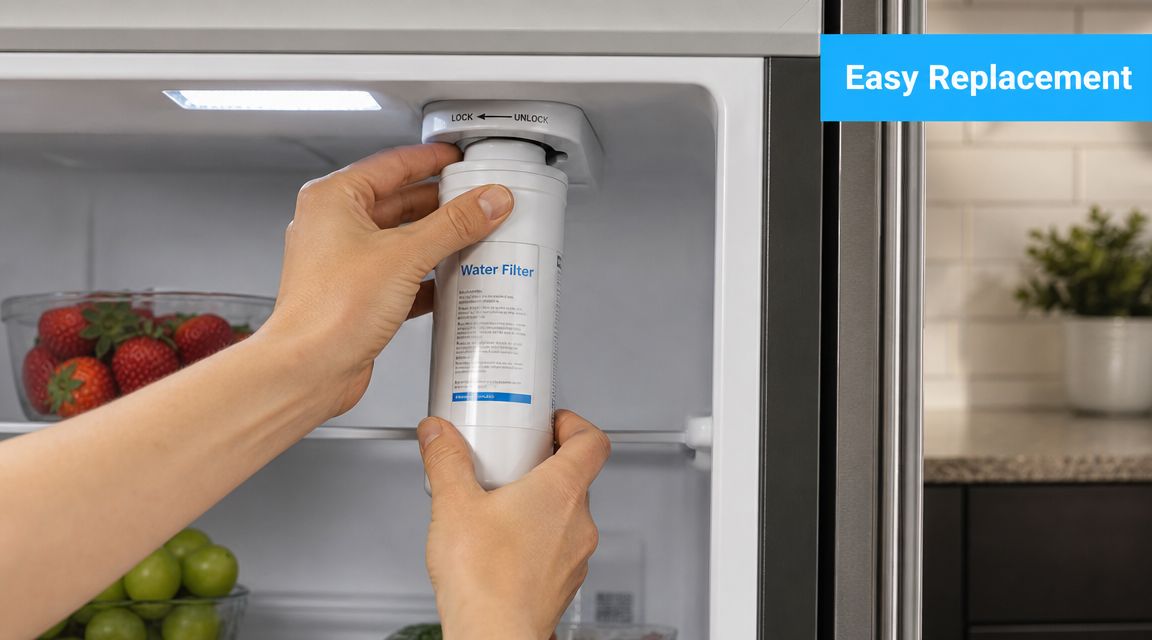
Replacing an internal fridge cartridge
The exact latch or twist pattern depends on the refrigerator brand, but the workflow is usually close to universal.
- Find the cartridge location: It may be inside the fresh-food compartment, in the grille, or behind a small cover.
- Shut off the water if your model or manual calls for it: Some fridges let you swap without shutting off supply, but many homeowners feel better doing it.
- Remove the old filter carefully: Twist, pull, or press release tabs as designed. Don't force it.
- Inspect the O-rings and housing: If something looks pinched, cracked, or dirty, fix that before inserting the new cartridge.
- Install the new filter fully: Most flow problems come from a cartridge that feels seated but isn't locked in place.
- Flush the system: Run enough water to clear carbon fines and trapped air.
- Reset the filter indicator if your refrigerator has one.
A small habit saves headaches later. Write the install date on the cartridge or keep it in your phone notes.
Installing an external inline filter
Inline filters take a little more attention because now you're working on the supply line, not just a cartridge slot.
Before you start, it helps to think like you would with HVAC filters. Air filters and water filters both depend on matching the right restriction level to the equipment. If you've ever compared furnace filters, this overview of MERV rating information is a useful analogy. Better filtration can also mean more resistance if you choose blindly.
For an inline installation:
- Turn off the feed line: Use the shutoff serving the refrigerator line.
- Relieve pressure: Dispense water until the line stops pushing.
- Cut or disconnect the line where the filter will go: Follow the filter's flow direction arrow.
- Use the correct fittings only: Cross-threading and mismatched connectors create most avoidable leaks.
- Mount the filter where you can reach it later: Don't bury a service item where you can't inspect it.
- Turn water back on slowly: That makes leak spotting much easier.
- Flush thoroughly: New carbon media often releases harmless fines at first.
A short visual helps if you're tackling your first swap:
Two mistakes that cause most callback problems
The first is skipping the flush. Fresh carbon cartridges need that initial rinse, and air in the line can make the dispenser sputter or slow down.
The second is ignoring the fridge's bypass expectations. Some refrigerators need the filter compartment set up correctly even if you're feeding the appliance with externally filtered water. If you want deeper brand-by-brand maintenance help, this library of water filter advice is a practical next stop.
Troubleshooting Common Fridge Filter Problems
When a refrigerator water filtration system acts up, the symptom usually points to a short list of causes. Don't start replacing random parts. Start with the last thing that changed.
Slow water flow
If the flow dropped right after a filter replacement, the cartridge may not be fully seated. Remove it, inspect the seals, and reinstall it firmly.
If the filter is seated correctly, trapped air may still be working through the line. Dispense water in longer bursts until the sputtering stops.
Other common causes include:
- A clogged cartridge: This happens faster in homes with sediment or older plumbing.
- A kinked supply line: Check behind the refrigerator after pushing it back.
- An over-restrictive external filter: Some finer filters reduce pressure more than expected.
Water still tastes bad
A new cartridge doesn't instantly solve every taste problem.
Check these basics:
- Flush enough water first: Carbon fines and stale water need to clear.
- Clean the ice bin: Old ice can keep bad taste around even after the filter is fixed.
- Check the source issue: If taste comes from something the cartridge isn't designed to reduce, replacement won't solve it.
- Inspect the water line: Old tubing can add taste on its own.
Bad taste after a filter change often comes from old ice, trapped air, or an unflushed cartridge, not a defective new filter.
Leaks around the filter or housing
Leaks usually come from a bad seal, a crooked cartridge, or a fitting that wasn't tightened correctly after an inline install.
Dry everything first so you can see where the water starts. Then check:
- The O-ring condition
- The cartridge lock position
- Any push-fit or threaded connection on the external line
- Hairline cracks in the housing
The dispenser stops working after a change
This often happens when the fridge doesn't recognize the filter as properly installed, or when the bypass setup isn't correct.
Pull the cartridge back out and confirm it's the right model. If you're using external filtration and bypassing the fridge cartridge, make sure the refrigerator's bypass arrangement matches the manufacturer's design. A perfectly good filter setup can fail if the fridge thinks the filter path is blocked.
Cost Lifecycle and When to Upgrade Your System
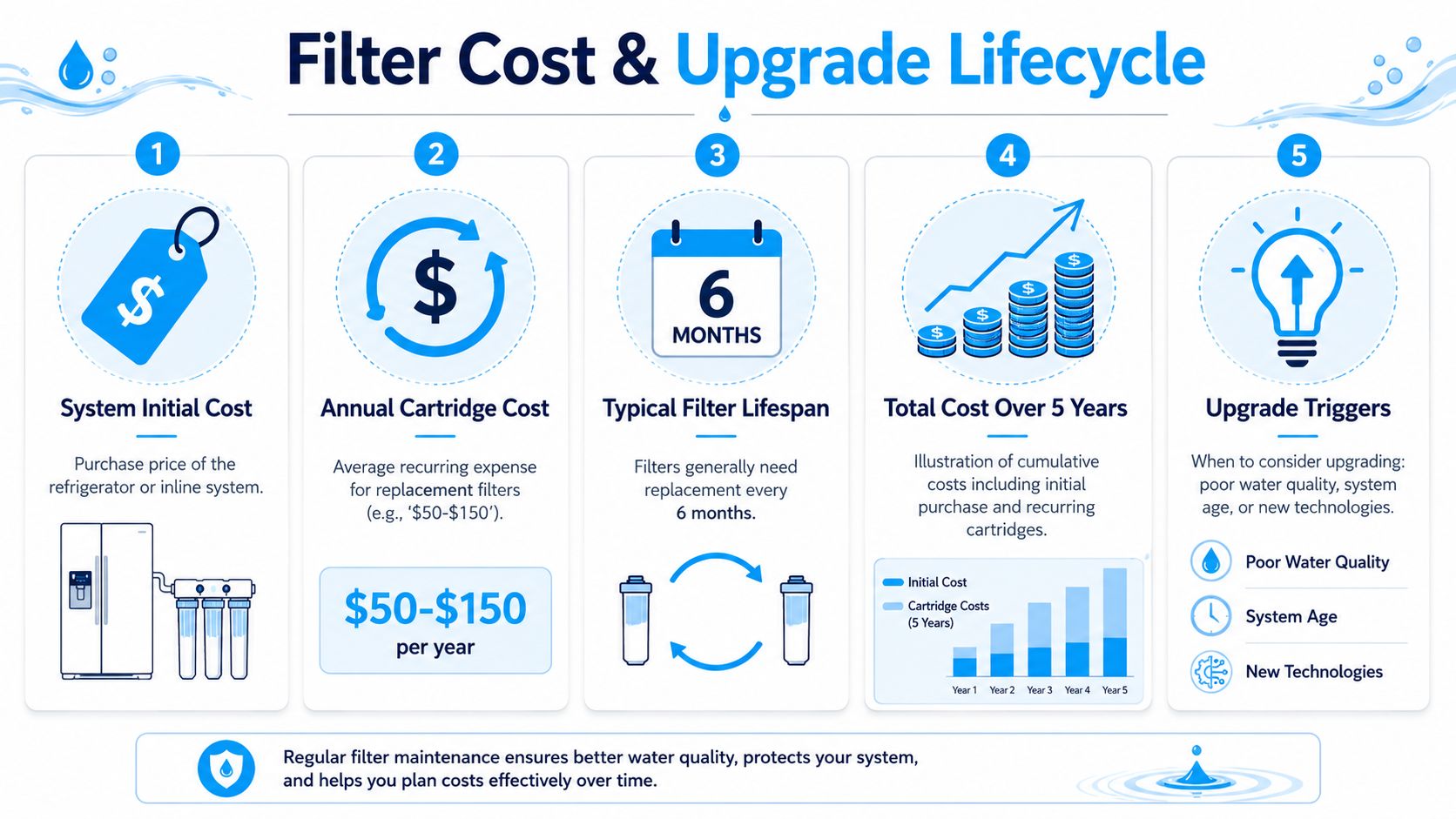
A refrigerator filter often looks cheap at first because the cost is spread out. Then the replacements start stacking up. By year two or three, many homeowners have spent enough on cartridges to justify a better setup.
The market keeps growing because replacement filters create steady repeat sales, not just a one-time appliance add-on. That matters when you compare long-term cost, because the fridge itself is often the inexpensive part of the filtration plan. The cartridges are where the money goes.
When sticking with the fridge filter makes sense
The built-in filter is still a reasonable choice in some homes.
Keep it if your goals are simple and the replacement cycle is predictable:
- Your main complaint is chlorine taste or odor: A standard carbon cartridge can handle that well.
- Your filter is easy to find at a fair price: Convenience has real value.
- Your water use is modest: Lower demand usually means fewer replacements and fewer flow problems.
- Your fridge filter is certified for the contaminants you care about: If the cartridge matches the job, there is no need to complicate it.
When an upgrade is the smarter move
Upgrade when the fridge cartridge starts acting like a bottleneck. That shows up in two places. Cost and performance.
An external inline or under-sink system feeding the refrigerator is often the better answer, especially when a household wants cleaner drinking water and better ice without being locked into proprietary fridge cartridges. I recommend this route often because it solves a problem many people miss. The refrigerator dispenser is only as good as the small filter cavity inside the fridge, and that space limits media volume, contact time, and filter options.
Consider an upgrade if:
- You replace fridge cartridges often enough that the annual cost keeps climbing
- Your filter options are brand-specific, overpriced, or hard to source
- You want filtered water at both the sink and the refrigerator from one system
- Your water has issues beyond basic taste and odor
- Your fridge filter clogs quickly and flow drops before the scheduled replacement date
External filtration offers distinct advantages. A larger inline or under-sink unit can hold more carbon, add specialty media, or use multiple stages. In plain terms, it gives the water more treatment before it reaches the dispenser and ice maker. It also lets you choose a system based on your water problem instead of your refrigerator model number.
That matters for homes dealing with lead concerns, PFAS questions, sediment, or mixed water quality issues. A standard refrigerator filter may reduce some of that, but many do not offer the depth of treatment or cartridge capacity an external system can provide.
The best next step before you spend money
Start with your water, not the appliance. Read your municipal water report or test your well water, then match the filter to the contaminants you need to address.
That simple step prevents two expensive mistakes. Buying a larger system than necessary, or continuing to buy convenient fridge cartridges that were never designed for the problem in your water.
If you want help comparing refrigerator filters, under-sink systems, and maintenance options without getting buried in marketing copy, Water Filter Advisor is a strong place to start. It's built for households that want practical buying guidance, clear explanations of certifications, and real-world advice on choosing a water filtration setup that fits the water you have.
