
Purified vs Filtered Water: Which Is Best for Your Family?
Let's get one thing straight right out of the gate: all purified water is filtered, but not all filtered water is purified. It’s a classic "all squares are rectangles, but not all rectangles are squares" situation, and understanding this little riddle is the key to getting the best water for your home.
The real difference boils down to the level of treatment. Think of filtered water as your friendly neighborhood security guard—it keeps out the obvious troublemakers, making your water taste and smell a whole lot better. Purified water, on the other hand, is like a secret service detail. It goes through an intensive process to strip out at least 99% of all dissolved solids, achieving an exceptional, almost obsessive, level of purity.
Defining The Difference: Purified vs. Filtered Water
When you're staring at bottles in the grocery store or shopping for a home water system, the words "filtered" and "purified" can feel like marketing buzzwords designed to confuse you. They aren't. They represent two very different approaches to water treatment, and knowing the difference is the secret to picking the right one for your home and family.
At its core, the distinction is all about what gets removed from your water. Both methods are designed to give you cleaner, safer water, but they operate on completely different scales of "clean."
What Is Filtered Water?
Filtered water is exactly what it sounds like—tap water that has been passed through a physical filter, usually made of activated carbon. The main goal here is to fix the aesthetics—the taste and smell of your water.
Think of a carbon filter like a bouncer at a club who only turns away the rowdy, obvious troublemakers. It’s fantastic at grabbing things like chlorine, sediment, and certain volatile organic compounds (VOCs) that give water that funky "tap" taste and smell. It’s a huge improvement for most city water and makes every glass more enjoyable.
What it doesn't do is remove most of the microscopic dissolved solids. That means healthy minerals like calcium and magnesium are left behind (a good thing!), but so are potential hidden threats like lead, bacteria, or viruses that are too small for it to catch.
What Is Purified Water?
Purified water takes filtration to a whole new level. To even earn the "purified" label from the pros, water has to meet strict standards set by the U.S. Pharmacopeia (USP), which means it must have fewer than 10 parts per million (PPM) of total dissolved solids (TDS).
Purified water goes through an advanced process like reverse osmosis or distillation to strip away at least 99% of everything that isn’t pure H₂O. This includes salts, minerals, heavy metals like lead and arsenic, bacteria, and viruses.
The result is water that’s incredibly clean and consistent. It offers a much higher degree of protection against a far wider range of contaminants you might find in your home's water source, giving you ultimate peace of mind.
Filtered vs Purified Water at a Glance
To make it even clearer, here’s a quick side-by-side look at the fundamental differences. This table breaks down the main goal, common methods, and what you can expect from each type of water for your home.
| Attribute | Filtered Water | Purified Water |
|---|---|---|
| Primary Goal | Improve taste, odor, and clarity | Remove the maximum amount of all contaminants |
| Purity Level | Varies by filter type | Extremely high (less than 10 PPM of TDS) |
| Common Methods | Activated carbon, sediment filters | Reverse osmosis, distillation, deionization |
| Mineral Content | Healthy minerals are typically retained | Nearly all minerals are removed |
Ultimately, filtered water is about making good water better, while purified water is about creating the purest water possible, regardless of the starting source.
A Deep Dive into Home Water Treatment Technologies
To really get to the bottom of the purified vs. filtered water debate, we need to pop the hood and look at the technologies doing the work. These aren't just vague terms; they're specific processes, and each one has a distinct job in cleaning up your tap water. Some are simple, everyday workhorses, while others are high-performance engines built for maximum purity.
Let's kick things off with the most common player in the filtration camp: activated carbon. You'll find these filters in everything from your basic water pitcher to more complex under-sink systems. They are the undisputed champs of making water taste and smell fantastic.
Think of an activated carbon filter as a super-porous sponge with an incredible amount of surface area. It uses a process called adsorption, where certain contaminants literally stick to the carbon's surface as water passes through. This makes it fantastic at grabbing chlorine, volatile organic compounds (VOCs), and other chemicals that give water that off-putting flavor.
Filtration: The Gatekeepers of Clean Water
Beyond just taste, home filtration systems also act as physical roadblocks. This is where sediment filters come into the picture.
A sediment filter is basically a fine screen that's there to catch physical debris before it gets into your glass or, worse, clogs up more sensitive parts of your plumbing and appliances. Its job is to trap the "big stuff," like:
- Rust flakes from older pipes
- Sand and silt, which is common in well water
- Dirt and other debris that can sneak into the water supply
These filters are usually the first line of defense in any multi-stage home system, making sure larger gunk doesn't mess with the more precise filtration steps that come next.
Purification: The Heavy Hitters
When your goal isn't just better-tasting water but the highest level of purity you can get for your family, the technology gets a lot more serious. This is where purification takes over, and the leading method for homes is Reverse Osmosis (RO).
Reverse Osmosis, or RO, uses your home's water pressure to push water molecules through a semipermeable membrane—a filter with pores so tiny they're hard to imagine. This membrane is so ridiculously fine that it lets water pass through but blocks a huge list of contaminants.
An RO system is like a bouncer at an exclusive club with a VIP list. Only pure water molecules get in. Dissolved salts, heavy metals like lead and arsenic, fluoride, and even viruses are all turned away at the door.
Another powerhouse purification method, though not as common in homes these days, is distillation. This process is just like nature's own water cycle. Water is boiled into steam, leaving almost all contaminants behind. That pure water vapor is then captured and cooled back down into pristine liquid. It takes a lot of energy, but it's incredibly effective at achieving near-total purity. To see how these and other methods stack up, you can explore different water purification methods.
The growing interest in these advanced systems is clear. As more homeowners clue into what's actually in their water, the global demand for water filters keeps climbing. While activated carbon filters made up an estimated 45.6% of the North American market in 2024, it's reverse osmosis systems that hold the majority share in the U.S. That's all thanks to their incredible performance, often removing up to 99% of dissolved contaminants. By understanding these different approaches, you can see that filtration and purification are really built for different tasks, which is the key to picking the right solution for your home.
Comparing Contaminant Removal Capabilities
When you're trying to decide between purified and filtered water for your home, it really all boils down to one question: what's actually being removed? This is where you get past the marketing hype and see the real differences in performance. The answer has a direct impact on your water’s safety, how it tastes, and its overall quality.
Filtered water is fantastic at improving the day-to-day experience of your tap water. Its main workhorse, the activated carbon filter, is incredibly effective at getting rid of the common complaints people have with city water. Think of it as a great quality control step for water that’s already considered safe to drink.
But it's important to know that standard filtration has its limits. While it does a great job with larger particles and specific chemicals, it just isn't built to tackle microscopic threats or things that are fully dissolved in the water. That’s the line in the sand that separates it from true purification.
What Standard Filtration Removes
A typical carbon-based filter, whether it’s in a pitcher or tucked under your sink, is a specialist. It uses a process called adsorption to essentially grab and hold onto certain contaminants as water flows through.
This makes it highly effective against things like:
- Chlorine: This is the main culprit behind that distinct "tap water" smell and aftertaste.
- Sediment: We're talking about physical bits like rust, sand, and silt that can make your water look cloudy.
- Certain Volatile Organic Compounds (VOCs): These can include byproducts from chlorination or industrial solvents that affect taste and odor.
By zeroing in on these issues, a filter gives you water that's much more pleasant to drink. But that's pretty much where its job ends.
The Limits of Basic Filtration
The effectiveness of a standard filter drops off a cliff when it comes up against dissolved solids, heavy metals, and microorganisms. It simply doesn't have the right tools to capture contaminants that are invisibly dissolved in the water or are too tiny for its pores to catch.
This means nasty things like lead, arsenic, fluoride, nitrates, bacteria, and viruses can slip right through most basic filters. If your home water source has these kinds of risks, a simple filter isn't going to give you the protection you need.
Understanding how different filter types work is key. For instance, comparing a HEPA vs Carbon Filter for air purification shows how specific materials target distinct problems—a principle that applies directly to water, where carbon filters are the go-to for chemical removal.
What Purification Systems Remove
Purification is a whole different ballgame. Systems that use methods like reverse osmosis (RO) or distillation are engineered for one purpose: near-total removal of contaminants across a much broader and more serious spectrum.
An RO system, for example, pushes water through a special membrane with pores so incredibly small that almost nothing but pure water molecules can squeeze through. This creates a powerful, physical barrier against a huge list of potential contaminants.
This chart really drives home how much the demand for effective home water solutions has grown, and what technologies people are choosing.
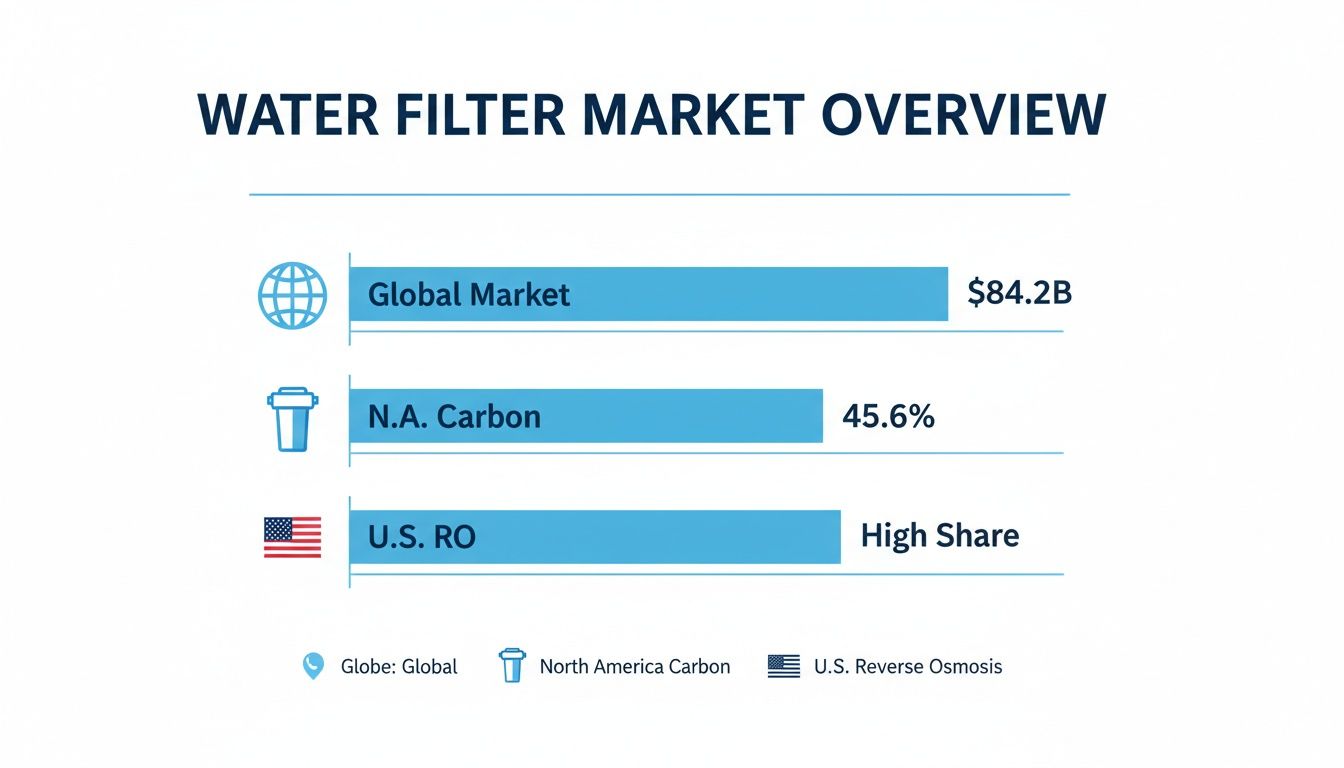
You can see a clear trend in the data. While carbon filters are popular for making water taste better, more and more homeowners are investing in high-performance RO systems when their top priority is comprehensive safety.
Purification excels at removing:
- Total Dissolved Solids (TDS): This covers salts, minerals, and pretty much anything else dissolved in the water.
- Heavy Metals: It's proven to remove dangerous contaminants like lead, arsenic, mercury, and chromium-6.
- Chemicals: Purification systems are highly effective against fluoride and nitrates, which are often found in agricultural runoff.
- Microorganisms: This is your best defense against bacteria, viruses, and parasites like cryptosporidium.
Here's the bottom line: A carbon filter is your best friend for better-tasting water, but only a purification system can give you true peace of mind against a wide range of invisible contaminants.
This all-encompassing removal capability is precisely why purification is the gold standard for anyone with specific health concerns, young children or elderly family members, or those getting their water from less-reliable sources like a private well.
Contaminant Removal Showdown Filtered vs Purified
To really put it all in perspective, let's look at a direct, side-by-side comparison. This table clearly lays out how the different technologies perform against specific, common water contaminants. It makes it easy to see where each system shines—and where it falls short.
| Contaminant | Activated Carbon Filter | Sediment Filter | Reverse Osmosis (Purified) | Distillation (Purified) |
|---|---|---|---|---|
| Chlorine | Excellent | None | Excellent | Excellent |
| Sediment/Rust | Good | Excellent | Excellent | Excellent |
| Lead | Varies (Low to Good) | None | Excellent | Excellent |
| Bacteria/Viruses | None | None | Excellent | Excellent |
| Arsenic/Fluoride | None | None | Excellent | Excellent |
| TDS (Salts/Minerals) | None | None | Excellent | Excellent |
Ultimately, the right choice for your home really hinges on what you're trying to achieve. If your main goal is just to improve the taste and smell of your city water, a high-quality filter is a great, affordable option. But if your water report shows heavy metals, or if you simply want the highest level of protection against the widest range of known and unknown contaminants, a purification system is the only way to get there.
How Water Purity Impacts Health, Taste, And Appliances
Beyond the charts and technical jargon, what does all this mean for your daily life? The choice between purified and filtered water has a real, tangible impact on your family’s health, the flavor of your morning coffee, and even how long your appliances last. Getting a handle on these practical differences is the only way to make a smart decision for your home.
Let's cut to the chase—health is what matters most. Both filtered and purified water are a massive step up from untreated tap water, but they don’t offer the same level of protection. For most homes with a decent municipal supply, a quality filter is a great, cost-effective way to knock out common issues like chlorine taste and odor.
But in certain situations, "good enough" isn't enough. That's where purification comes in. If you have anyone at home with a compromised immune system, have young kids, or live in an area with known risks—like old plumbing that could leach lead—a purification system provides a level of safety that a standard filter just can't touch.
The Great Mineral Debate
The mineral question comes up all the time. Purification methods like reverse osmosis are so aggressive they strip out nearly everything, including beneficial minerals like calcium and magnesium. This makes some folks worry they're missing out on key nutrients.
Here's the reality: while those minerals are good for you, the vast majority of your daily intake comes from your food, not your water. The amount you get from a glass of tap water is tiny compared to what a balanced diet provides.
For most people, the health benefits of removing potentially harmful contaminants far outweigh the negligible loss of minerals from drinking purified water. Some modern RO systems even include a remineralization stage to add a healthy mineral blend back into the water for improved taste.
A Tale of Two Tastes
Taste is personal, but the difference between these two water types is distinct. Filtered water keeps its natural mineral content, giving it a more familiar, crisp flavor that many people associate with bottled spring water. It tastes clean, but it still has character.
Purified water is a whole different ballgame. Stripping out virtually all dissolved solids leaves you with water that's incredibly clean and neutral. Some people find this taste "flat," while others love its absolute purity. Think of it as a blank canvas—it lets the true flavors of your coffee, tea, or soup shine through without any interference from the water itself.
Protecting Your Home Appliances
This isn't just about what you drink. The minerals left behind in tap and filtered water are what cause that ugly, chalky limescale buildup in your appliances. Over time, that mineral scale can do some serious damage.
This buildup forces your machines to work harder, making them less efficient and shortening their lifespan. If you've ever had to descale your coffee maker or seen that white crust form on your humidifier, you know exactly what we're talking about.
This is where purified water really shines for certain household uses:
- Coffee Makers & Kettles: No more scale buildup. Your machine runs better, and your coffee tastes exactly like it should.
- Humidifiers & CPAP Machines: It gets rid of that "white dust" (mineral deposits) that can get into the air and clog up the machine's guts.
- Steam Irons & Garment Steamers: Purified water stops mineral gunk from clogging the steam vents and staining your clothes.
- Baby Formula: It gives you the purest possible base, ensuring you aren't mixing unwanted contaminants or excessive minerals into your baby's food.
For day-to-day drinking and cooking, filtered water is a solid choice. But for any appliance that heats or evaporates water, using purified water is a smart move that will save you a lot of cleaning headaches and replacement costs down the road.
Analyzing The True Cost And Long-Term Value
When you're trying to decide between purified and filtered water systems for your home, the price tag is usually the first thing that catches your eye. But that initial number doesn't tell the whole story. To really get a handle on the long-term value, you have to look at everything: the upfront investment, the ongoing maintenance, and even some of the hidden operational costs.
Take simple filtration systems, like water pitchers. They have an incredibly low entry cost, often less than $50, which makes them a really tempting place to start. The catch? Their small filters need to be replaced constantly—sometimes every month or two—and those replacement costs can really sneak up on you over the course of a year.
Under-sink or faucet-mounted filters are a step up, typically running between $100 to $300. While you're spending more at the outset, their filters last much longer, usually for six months to a year. This means you end up with a lower cost-per-gallon and less time spent fiddling with replacements.
The Financials Of Filtration
The main draw of standard filtration is how easy it is on your wallet upfront. You can get better-tasting water almost right away without having to make a major financial commitment.
But it’s those recurring costs you really need to watch. For a family of four using a pitcher, you could easily spend over $150 a year just on replacement filters. In comparison, an under-sink system might need an annual filter change that costs $60 to $100, which actually offers better long-term savings.
The primary financial trade-off with filtration is pretty clear: you're balancing convenience against cost. Those lower upfront prices often mean you'll be spending more on replacement cartridges over time.
Unpacking The Cost Of Purification
Purification systems, especially reverse osmosis (RO), come with a much higher initial price. They often start around $300 and can go up to $1,000 or more for the really advanced models. That number can feel a bit intimidating, but it's important to see the bigger picture.
While the initial hit is significant, the cost per gallon of purified water is often much, much lower than what you'd get from a pitcher filter. The core of the system, the RO membrane, can last for two to four years, and the pre-filters usually only need to be swapped out once or twice a year. That means fewer trips to the store and less hands-on maintenance.
There is, however, a hidden cost with RO systems you need to be aware of: water waste. For every gallon of pure water it makes, several gallons of "brine" water—the water carrying all the rejected contaminants—gets flushed down the drain. Modern, high-efficiency models have gotten much better at reducing this ratio, but it’s still something that will show up on your water bill.
This growing demand for high-purity solutions at home is part of a huge global trend. The global purified water market was valued at about USD 154.62 billion in 2024 and is expected to hit roughly USD 255.90 billion by 2032. You can find more insights on this trend over at Data Bridge Market Research. It shows a real shift as more families decide to invest in top-tier water treatment.
In the end, it all comes down to balancing your budget with what you need the system to do. Filtration is an affordable way to make your water taste better and get rid of chlorine. Purification is a bigger investment, for sure, but it delivers comprehensive contaminant removal and great long-term value, giving you a level of peace of mind that many people find priceless.
Choosing The Right Water System For Your Home
Trying to decide between purified and filtered water can feel like a chore, but it really just comes down to a simple, three-step process. Once you know what you're dealing with, you can match your needs to the right technology. This straightforward plan will help you find the perfect system for your family.
First things first: you have to know what's actually in your water. You can't fix a problem you haven't identified. If you're on city water, your local utility provider is required to publish an annual Consumer Confidence Report (CCR) that details any tested contaminants.
For those with a private well or anyone wanting a more immediate and precise snapshot of their tap water, a home water test kit is a smart move. These kits can screen for common culprits like chlorine, lead, hardness, and pH levels, giving you a clear picture to start from.
Define Your Primary Goal
Once you have your water quality report in hand, the next step is to decide what you actually want to accomplish. Are you just trying to get rid of that funky taste in your morning coffee, or are you worried about specific health risks lurking in your pipes? Your goal is what will ultimately point you toward either a filtration or a purification system.
Think about these common scenarios:
- Improving Aesthetics: If your water is technically safe but has a strong chlorine taste or a weird smell, your main goal is simply to make it more pleasant to drink.
- Removing Specific Contaminants: If your water test flagged the presence of lead, arsenic, or high levels of nitrates, your goal is targeted removal for health and safety.
- Achieving Maximum Purity: If you have family members with compromised immune systems, young children, or you simply want the absolute cleanest water possible, your goal is comprehensive purification.
By clearly identifying whether your main concern is taste, a specific contaminant, or overall purity, you narrow down your options significantly and avoid paying for a system that doesn't match your needs.
Match The System To Your Situation
Finally, it's time to match your goal with a solution that fits your budget and how much work you want to put into installation. This is where the debate over purified vs. filtered water becomes a personal decision. Armed with the right information, you can find more detailed guides and advice to help you select the best water filter for your home.
Here’s some practical, situational advice to get you started:
- For bad taste and odor in city water: An activated carbon filter, like a simple faucet mount or an under-sink unit, is an affordable and incredibly effective solution. It’s fantastic at knocking out chlorine and improving clarity without a complicated installation.
- For well water or industrial runoff concerns: A reverse osmosis (RO) system is the clear winner here. It offers a much higher level of protection against a whole spectrum of contaminants, including heavy metals, nitrates, and dissolved solids that basic filters just can't touch.
Water Treatment FAQs
We get a lot of questions about the day-to-day realities of purified vs. filtered water. Here are some quick answers to the most common ones we hear.
Taste, Color, and More
Does purified water taste different?
Absolutely. Purified water is stripped of almost everything, including minerals, which gives it a very distinct "clean" or "crisp" taste. Some people, however, find it tastes a bit flat. Filtered water, on the other hand, keeps those healthy minerals in, so it often has a taste closer to what you'd expect from a premium bottled spring water. To bridge this gap, some reverse osmosis systems now include a special remineralization filter to add beneficial minerals back in for better flavor.
Is bottled water typically filtered or purified?
It really comes down to what the label says. If you see "Spring Water," that means it was bottled from an underground source. It's usually filtered just enough to remove sediment while keeping its natural mineral content. But if the bottle is labeled "Purified Drinking Water," it has gone through a rigorous process like reverse osmosis or distillation. The original source could be anything from a spring to your local city tap water.
Choosing Your System
Should I get a whole-house system or a point-of-use filter?
This decision really depends on what you’re trying to fix. A point-of-use system, like a simple filter on your faucet or a more robust unit under your sink, is a great, budget-friendly way to get high-quality water right where you need it for drinking and cooking.
A whole-house (point-of-entry) system treats every drop of water coming into your home. This is a much bigger investment, but it's the right choice if you're dealing with larger problems like hard water minerals or sediment that can wreck your plumbing and appliances over the long haul.
A simple way to think about it: point-of-use is for improving the water you drink and cook with, while a whole-house system protects your entire home infrastructure.
Ready to figure out the perfect water treatment solution for your family? The team at Water Filter Advisor has you covered with in-depth guides, straight-shooting reviews, and practical advice to help you make a choice you can feel good about. Check out our resources and get started on your path to safer, better-tasting water today at https://www.waterfilteradvisor.com.
