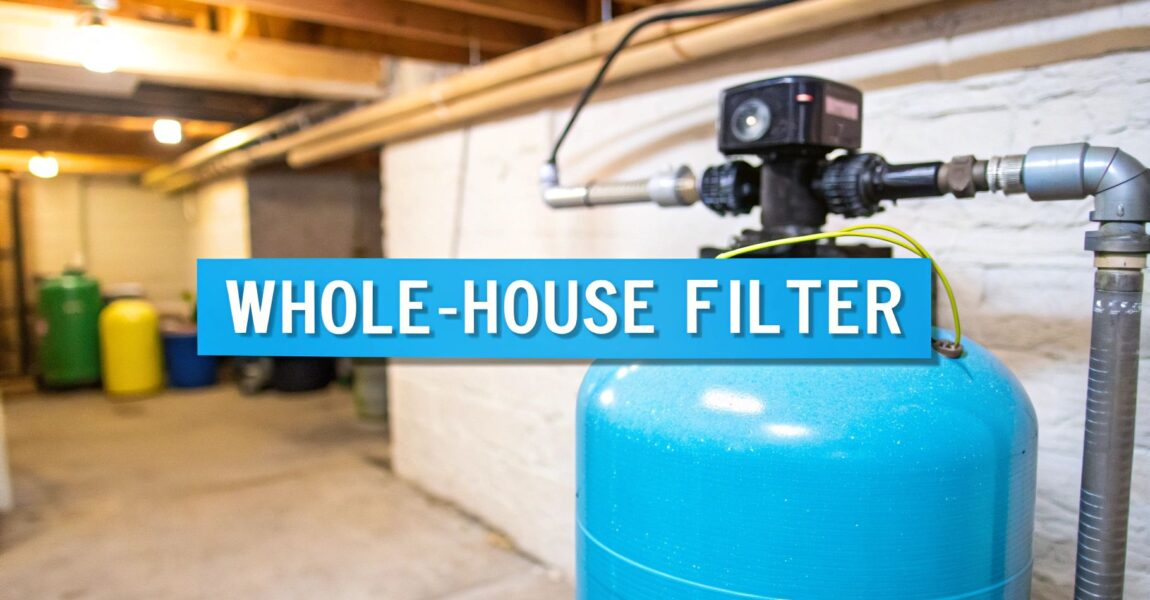
Your Complete Guide to Point of Entry Water Filters
Picture this: you turn on any tap in your house—the kitchen sink for a glass of water, the shower after a long day, the bathroom faucet to brush your teeth—and out comes pure, clean, refreshing water. Every. Single. Time. That isn't a far-off dream; it's the reality a point-of-entry (POE) water filter delivers. Think of it as hiring a top-notch security guard for your home's entire water supply, inspecting and purifying every drop the moment it steps onto your property.
This isn't about slapping a filter onto a single faucet. A POE system is a comprehensive solution that cleans all your water at its source, protecting not just your family's health, but your expensive appliances from a whole rogues' gallery of unwanted contaminants.
What Are Point of Entry Water Filters?
A point-of-entry filter, known in the biz as a whole-house water filter, is a system plumbed directly into your main water line. It's the ultimate gatekeeper. Before a single drop of water can make its way to your shower, washing machine, or that fancy coffee maker, it has to pass inspection through this central filtration fortress.
This setup ensures that every drop you use for bathing, cooking, cleaning, and drinking is purified. Instead of playing whack-a-mole with water quality issues from room to room, a POE system provides one powerful, all-encompassing solution. These systems are true workhorses, built to handle a serious volume of water, easily purifying thousands of gallons a day without ever making your home's water flow skip a beat.
Why Whole-House Filtration Is a Big Deal
The quest for cleaner water is more than just a trend; it's a growing necessity. It's estimated that in the U.S. alone, over 7.1 million Americans fall ill each year from waterborne contaminants. That's a staggering public health issue, and it's prompting more and more homeowners to take a hard look at what's really flowing through their pipes.
This rising awareness is fueling a massive market shift. In fact, the demand for point-of-entry systems is projected to explode into an USD 18.15 billion industry by 2035. You can dive deeper into the data behind this trend over at Spherical Insights & Consulting.
By treating every drop entering your home, these systems solve a wide array of problems that affect your daily life, and the benefits extend far beyond just better-tasting water.
A point of entry system isn't just about purifying drinking water; it's about elevating the quality of life throughout your entire home. It protects your health, preserves your appliances, and enhances your daily routines, from showering to doing laundry.
Key Benefits for Your Home
Installing a point-of-entry water filter in your home brings a cascade of immediate and long-term perks:
- Luxurious Showers and Baths: By removing chlorine and other harsh chemicals, the water becomes gentler on your skin and hair, reducing that annoying dryness and irritation. Hello, spa day at home!
- Appliance Life Support: Sediment, minerals, and chlorine are the arch-nemeses of water-using appliances like dishwashers, washing machines, and water heaters. Filtered water helps them live longer, more efficient lives.
- Better-Tasting Water, Everywhere: Enjoy the peace of mind that comes with clean, delicious water from every single faucet in the house—not just the one in the kitchen.
- Brighter, Softer Laundry: When you eliminate the contaminants that make fabrics feel dingy and stiff, your clothes emerge from the wash brighter, softer, and cleaner than ever.
How a Whole House Filter Actually Works
To truly appreciate what a point-of-entry water filter does, you need to peek inside the tank. Don't imagine a simple screen; picture a highly coordinated team of filtration specialists, each with a specific mission to purify your water. When water flows in from your main line, it isn't just passing through a single barrier. It’s embarking on a journey through several sophisticated layers of filter media.
This multi-stage gauntlet is what makes these systems so formidable. Each layer is engineered to target and eliminate different types of impurities. By the time the water exits the tank, it has been thoroughly scrubbed, ensuring that one system can tackle a huge range of issues, from dirt and chemicals to heavy metals.
This graphic provides a clear visual of how a POE filter acts as the gatekeeper for your home's entire water supply, treating it before it ever reaches your faucets.
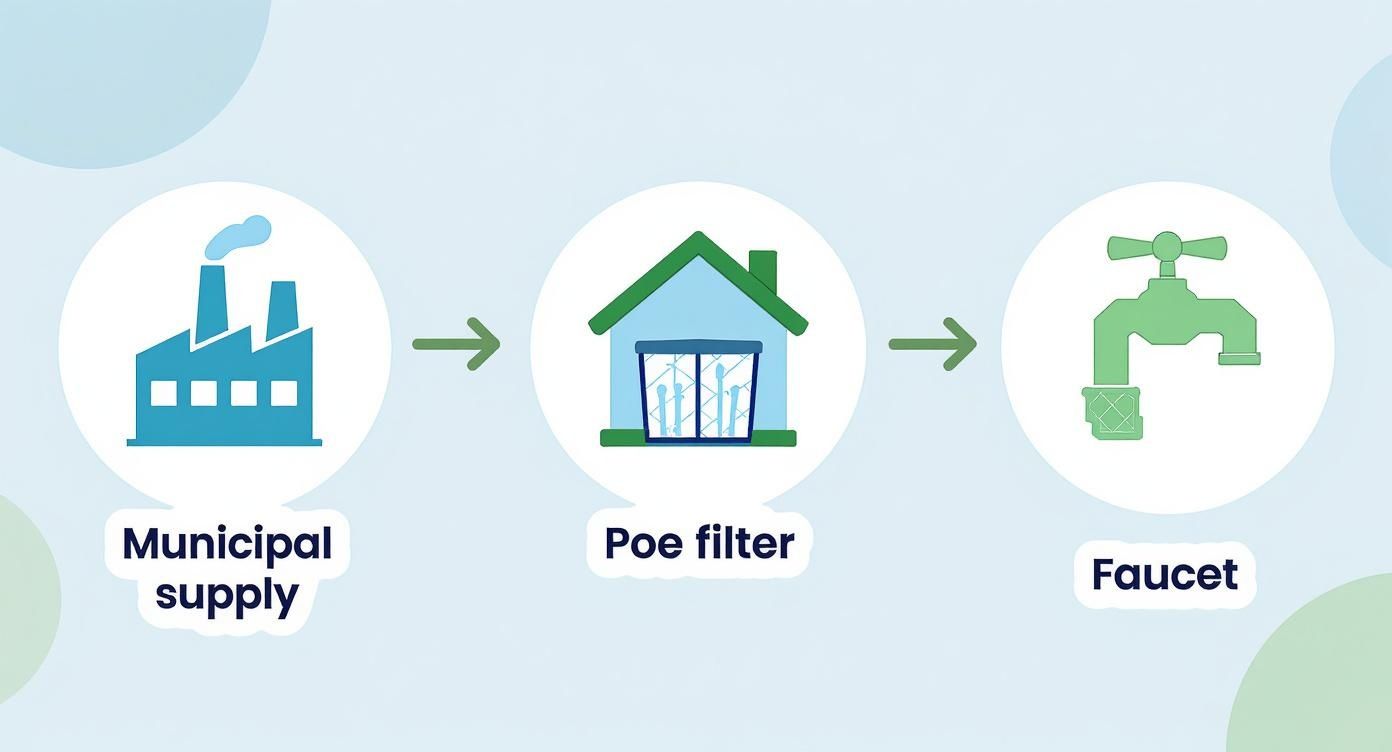
As you can see, the filter is a central checkpoint. It guarantees that every tap—from your kitchen sink to your shower—delivers purified water.
The First Line of Defense: The Sediment Filter
The journey always begins with the sediment filter. Think of it as the bouncer at an exclusive club. Its sole job is to stop the big, obvious troublemakers from getting past the velvet rope. This initial stage snags physical debris like sand, dirt, silt, and rust that can make water cloudy and wreak havoc on your plumbing fixtures over time.
It's essentially a high-tech colander for your water. This simple but absolutely crucial first step prevents larger particles from clogging up the more delicate, specialized filter media that comes next. By clearing the path, the sediment filter protects the rest of the system, helping it perform better and last longer.
The Chemical Sponge: Activated Carbon
Once the water is free of sediment, it moves on to meet the undisputed champion of chemical removal: activated carbon. Now, this isn't the same charcoal you use for grilling. It's an incredibly porous material with a mind-boggling surface area—a single gram can have the surface area of an entire football field.
Activated carbon uses a process called adsorption, where chemical contaminants literally stick to its surface like tiny magnets. It’s a beast at grabbing things like chlorine, pesticides, herbicides, and those nasty volatile organic compounds (VOCs) that give your water weird tastes and smells. This is exactly why it’s a non-negotiable part of nearly every top-tier point-of-entry water filter.
By yanking out chlorine and its byproducts, activated carbon doesn’t just make your water taste and smell fantastic. It also makes it much kinder to your skin and hair when you shower.
The Elite Specialists: Advanced Media for Tough Contaminants
Some homes face water challenges that require more than just the basics. For those dealing with more stubborn or specific contaminants, advanced filtration media provides that next level of protection. These are highly engineered materials designed to tackle the tough stuff that standard carbon filters might miss.
To give you an idea of the available arsenal, we’ve put together a table breaking down the most common types of filter media and their specific targets.
Common Filtration Media and Their Targets
| Filtration Media | Primary Function | Removes Contaminants Like… |
|---|---|---|
| Sediment | Physical Particulate Removal | Sand, silt, rust, dirt, and other suspended solids. |
| Activated Carbon | Adsorption of Chemicals | Chlorine, pesticides, herbicides, VOCs, and improves taste/odor. |
| KDF (Kinetic Degradation Fluxion) | Redox Reactions & Bacteriostatic | Heavy metals (lead, mercury, iron), chlorine, and inhibits bacteria/algae growth. |
| Catalytic Carbon | Catalytic Conversion | Chloramine (a persistent chlorine/ammonia disinfectant), hydrogen sulfide. |
| Oxidation Media (e.g., Manganese Greensand) | Oxidation and Filtration | Iron, manganese, and hydrogen sulfide (rotten egg smell). |
These advanced stages work in concert with the sediment and carbon layers. Each one builds on the last, systematically stripping away impurities until only clean, safe water is left to flow through your home. This teamwork is the real secret behind a truly effective whole-house system.
Choosing the Right System for Your Home

When you're picking out a point-of-entry water filter, it's not about finding the biggest, most expensive unit you can. The best system is the one that fits your home's unique water needs like a glove.
It’s a bit like buying a car. You wouldn't get a tiny two-seater sports car for a family of six, right? And you probably wouldn't commute to the office every day in a massive RV. Your water filter needs to be the right fit for your household, and that comes down to three things: sizing, flow rate, and performance certifications. Nail these, and you'll have clean, reliable water without any headaches.
Sizing Your System for Your Household
First things first, you need a handle on how much water your family actually uses. A system that’s too small will constantly struggle to keep up. You'll end up with clogged filters way too soon and, even worse, a drop in water pressure. On the flip side, an oversized system is just money down the drain.
To get a solid estimate, just look at two key factors:
- Number of People: The classic rule of thumb is that each person uses somewhere between 75 and 100 gallons of water a day. That covers everything from showers and laundry to flushing the toilet.
- Number of Bathrooms: A house with more bathrooms means more fixtures that can all be running at once. Think about those chaotic weekday mornings! A four-bathroom house is going to have a much higher peak demand than a one-bathroom apartment.
So, a family of four in a three-bathroom home has very different needs than a couple living in a two-bathroom condo. Sizing your system correctly ensures it can handle your busiest moments without skipping a beat. For more detailed help, you can find a ton of professional advice over at https://www.waterfilteradvisor.com/advice/.
Understanding Flow Rate and Water Pressure
Ever been enjoying a hot shower when someone flushes a toilet, and suddenly your water pressure tanks? That’s what a poor flow rate feels like. Flow rate is measured in gallons per minute (GPM), and it basically tells you how much water can pass through your filter at one time.
A point of entry water filter's flow rate must be high enough to meet your home's peak demand. This is the amount of water needed when multiple appliances and faucets are running simultaneously, like the shower, dishwasher, and a sink.
A standard shower head uses about 2.5 GPM, a dishwasher needs around 2 GPM, and a kitchen faucet runs at about 1.5 GPM. If your family often has all these going at once, your peak demand could easily be 6 GPM or more. You need to pick a system with a GPM rating that meets—or even better, exceeds—that number to keep the water pressure strong and steady everywhere in the house.
Why Certifications Matter
So, how can you be sure a filter actually does what the box says it does? This is where you look for certifications from independent organizations like the NSF (National Sanitation Foundation) and ANSI (American National Standards Institute). They’re your best friend in this process.
These certifications aren't just clever marketing. They are cold, hard proof that a third-party lab has put the system through its paces to make sure it really removes the contaminants it claims to.
For example, NSF/ANSI 42 certifies that a filter makes your water taste and smell better by reducing chlorine. NSF/ANSI 53, on the other hand, is a much more serious certification confirming it can remove health-related contaminants like lead or cysts. If you're building a new home, it's a good idea to review some essential questions to ask a custom home builder to ensure they plan for plumbing that can accommodate certified filtration systems.
Always check for these certification marks when you're shopping around. They give you an unbiased guarantee of performance and peace of mind that you're making a solid investment in your family's water quality.
Whole House vs Single Faucet Filters
So, you're trying to figure out if you need a big whole-house system or just something small for the kitchen sink. It can feel like a tough choice, but there's a simple way to think about it.
A whole-house filter is like your home's central air conditioning—it treats every single room, providing consistent comfort everywhere. A single-faucet filter, on the other hand, is like a portable window AC unit. It does an amazing job cooling one specific room, but the rest of the house is on its own.
Both are great at what they do. The right one for you really comes down to what you're trying to fix, your budget, and how much of your home you want to cover. Let's break down the differences.
The Point of Entry Advantage: Comprehensive Coverage
A point of entry (POE) system, also known as a whole-house filter, is the ultimate "set it and forget it" solution for your water. It gets installed right where the main water line enters your house, so it filters every single drop of water before it ever reaches a tap.
This means you get filtered water for everything, not just drinking. Think about it:
- Better Showers: Less chlorine and other chemicals means softer skin and hair. No more that dry, itchy feeling after a shower.
- Longer-Lasting Appliances: Your dishwasher, washing machine, and water heater are shielded from sediment and scale buildup that can cause damage over time.
- Cleaner Laundry: Your clothes will feel softer and look brighter without all those harsh minerals and chemicals.
The biggest plus is peace of mind. You never have to wonder which faucet is safe—they all are. The trade-off? These systems have a higher upfront cost and usually need a professional to install them correctly.
The Point of Use Approach: Targeted and Affordable
Point-of-use (POU) filters are the sharpshooters of water filtration. These are your under-sink systems or faucet-mounted units that treat water at a single spot, usually the kitchen sink. They are fantastic for making sure the water you drink and cook with is as pure as possible.
To get a better idea of how these fit in, it helps to understand the various types of kitchen faucets where you'd typically install a POU filter. Their popularity comes from being affordable and pretty easy to install yourself.
In fact, the global water filter market is expected to reach USD 48.2 billion by 2025, and POU systems account for a huge chunk of that—almost 44.8% of total revenue. People love them because they're a low-cost, effective way to get great-tasting water right where they need it most.
The bottom line is this: POE systems give you complete, home-wide protection. POU filters give you high-purity water for drinking and cooking at a much lower cost, but they leave the rest of your home’s water untreated.
To give you a clearer picture, here’s a quick side-by-side comparison of the two approaches.
Whole-House vs. Single-Faucet Filter Comparison
| Feature | Point of Entry (Whole-House) | Point of Use (Single-Faucet) |
|---|---|---|
| Coverage | Treats all water entering the home. | Treats water at a single tap (e.g., kitchen sink). |
| Protection | Protects plumbing and all water-using appliances. | Protects only the specific faucet it's attached to. |
| Installation | Typically requires professional plumbing. | Often a simple DIY installation. |
| Upfront Cost | Higher initial investment ($500 – $3,000+). | Lower initial investment ($50 – $500). |
| Maintenance | Less frequent filter changes (e.g., 6-12 months or longer). | More frequent filter changes (e.g., 2-6 months). |
| Best For | Widespread issues like chlorine, sediment, or hard water. | Targeted removal of contaminants for drinking water. |
This table helps illustrate the core trade-offs. It's not about one being "better," but about which one is the right tool for your specific job.
Finding the Best of Both Worlds
For a lot of homeowners, the perfect setup isn't an "either/or" decision. It’s a "both/and" strategy. You can actually combine both types of systems to create a powerful, multi-layered defense against any water contaminant.
Here’s how it usually works: You install a whole-house carbon filter to take care of the big stuff—chlorine, sediment, and general chemicals—at every tap. Then, you add a specialized POU system, like a reverse osmosis unit, under the kitchen sink to get rid of the really tough contaminants like lead, fluoride, or arsenic.
This hybrid approach gives you the absolute best of both worlds. You get general protection for your appliances, pipes, and skin, plus surgical precision for the water you and your family actually drink. It's a comprehensive solution that leaves no stone unturned.
Installation, Maintenance, and Long-Term Costs
Buying a whole-house water filter is a bit like buying a car. The sticker price is just the beginning. To really understand the investment, you have to factor in the installation, the regular maintenance, and the total cost over its lifetime. Think of it as the fuel, oil changes, and tune-ups that keep it running smoothly for years.
Planning for these things from the start means you’ll get the clean, safe water you paid for without any nasty surprises down the road. It turns a simple purchase into a smart, long-term investment in your home and your family's health.
Getting Your System Up and Running
So, you’ve picked out the perfect point of entry water filter. Now what? The first step is getting it installed, which usually means cutting into your home's main water line. It’s a job that demands a steady hand and a solid understanding of plumbing.
You’ve got two options here: DIY or hire a pro. Going the DIY route can definitely save you some money on labor, but it’s a serious project. One slip-up could lead to leaks, a drop in water pressure, or a system that isn't even filtering properly. For most people, hiring a licensed plumber is the way to go. It ensures the job is done right, meets local codes, and keeps your warranty intact.
Professional installation for a whole house system can run anywhere from $300 to over $1,000, depending on how complex your plumbing is and the going rates in your area. It's an extra cost, sure, but the peace of mind is often worth every penny.
Creating a Clear Maintenance Roadmap
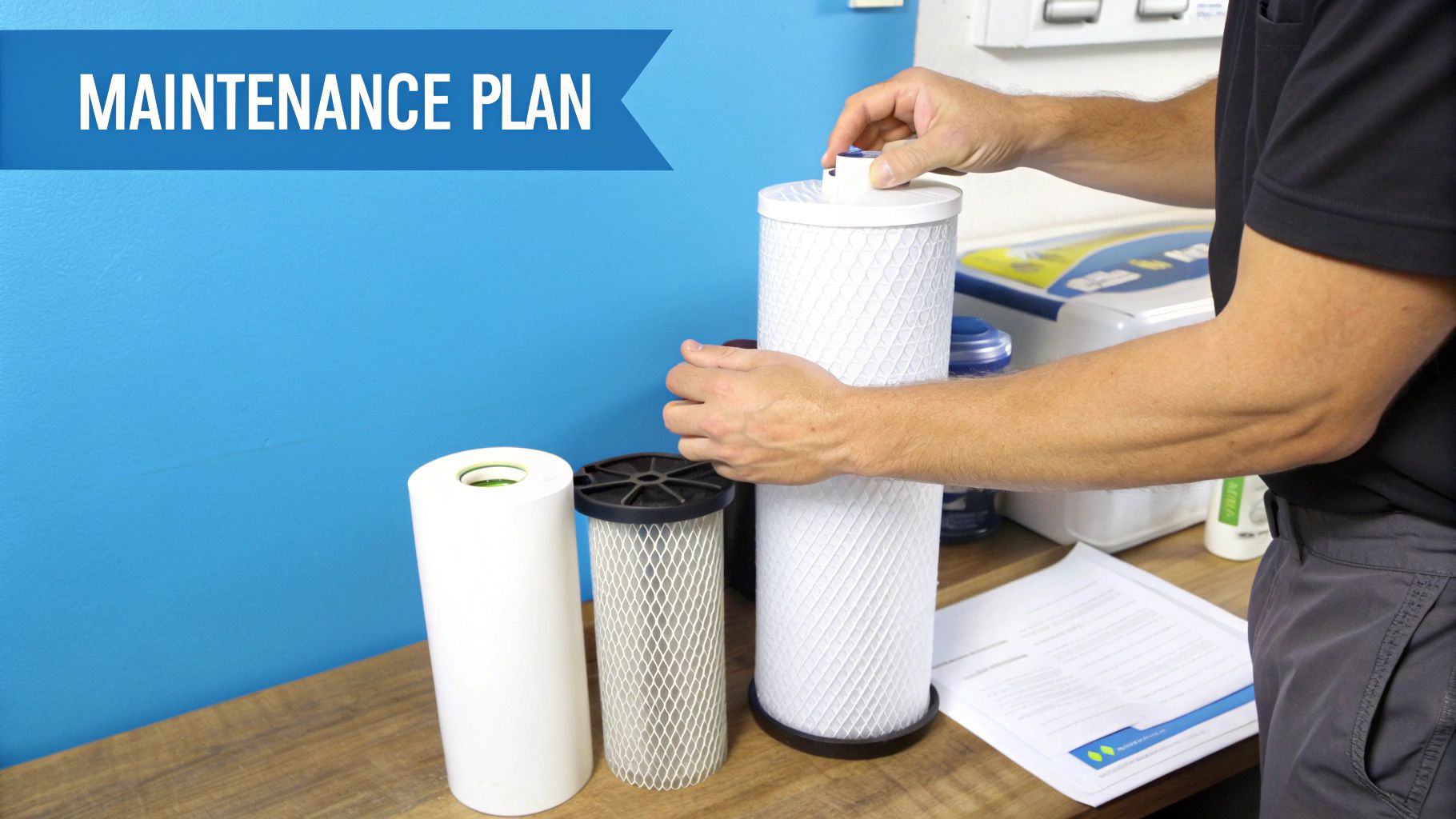
Your whole-house filter is a workhorse, but it’s not a “set it and forget it” appliance. To keep it working at peak performance and maintain strong water pressure, you'll need to do some regular upkeep. The good news is the schedule is predictable and pretty easy to manage.
Maintenance mostly boils down to swapping out the filter media. How often you do this depends on the specific part and just how "gunky" your water is to begin with.
Here’s a general idea of what to expect for a replacement schedule:
- Sediment Pre-filter: This is your first line of defense, and it catches the most stuff. Plan on replacing it every 3 to 12 months.
- Carbon Pre/Post-filter: If your system has separate carbon block filters, they typically last about 6 to 12 months.
- Main Media Bed: This is the heart of the system, where the heavy lifting happens with a big tank of activated carbon or KDF. This core component has a much longer lifespan, usually needing a replacement every 5 to 10 years or after filtering a huge volume of water, like 1,000,000 gallons.
Understanding the Total Cost of Ownership
To budget properly, you need to look past the initial price tag and think about the total cost of ownership over the filter's entire life. This gives you a clear, honest picture of what you'll be spending over time.
Let's break down the costs you can expect with a point of entry water filter:
- Initial System Cost: This is the price of the unit itself, which can be anywhere from $500 for a basic setup to $3,000+ for a beefy, multi-stage system.
- Installation Fee: As we mentioned, getting it installed professionally is a key part of that initial investment.
- Recurring Filter Replacements: This will be your main ongoing expense. You’ll want to budget for the annual sediment and carbon filter changes, plus the big, less frequent main media replacement down the line.
- Operational Costs: Most standard systems don’t use any electricity. However, if you get a model with a UV purifier or an automatic backwashing valve, you’ll see a small bump in your utility bill.
When you add it all up, you get a realistic picture of your investment. A little foresight here means you can enjoy great-tasting, clean water without any financial stress.
Answering Your Top POE Filter Questions
Even after you've got a handle on how these systems work, it's totally normal to have some practical questions pop up. Think of this section as your personal FAQ, where we'll tackle the common worries and head-scratchers we hear about all the time.
We've pulled together the top questions from homeowners just like you. Let's get you some answers.
Will a Whole House Filter Lower My Water Pressure?
This is probably the number one concern we hear, and for good reason. Nobody wants a weak shower. The short answer is no—a properly sized and installed system should have almost no noticeable effect on your home's water pressure.
If you do see a significant drop in pressure, it's a big red flag that something's wrong. The usual suspects are a system that’s too small for your house's needs or, more commonly, a filter cartridge that's clogged and way past its replacement date. Keeping up with the maintenance schedule is the single best way to keep your water flowing strong.
Do I Still Need a Water Softener?
This is a common mix-up. A whole-house water filter and a water softener are two completely different tools for two different jobs. Most POE filters are rockstars at pulling out things like chlorine, sediment, and other chemical contaminants. What they don't do is remove the dissolved minerals—calcium and magnesium—that cause hard water scale and soap scum.
So, the bottom line is yes, if you have hard water, you will likely still need a separate water softener. Many people opt for an integrated setup that combines both filtration and softening into one seamless system. It's the best way to get a complete fix for both water quality and hardness.
The only way to know for sure what's in your water is to test it. A good starting point is your local water utility's annual Consumer Confidence Report, which is free. For a much closer look, you can grab an at-home test kit or send a sample to a certified lab. The results will point you directly to the contaminants you need to address.
What Is the Average Lifespan of a POE System?
A good quality point-of-entry system is a long-term investment. The main tank and valve head—the core hardware—can easily last 10 to 15 years, or even longer if you take care of it.
The part that needs regular replacement is the filter media inside the tank. That's the stuff doing all the heavy lifting, and it eventually gets used up.
Here’s a general idea of the replacement timeline:
- Sediment Pre-filters: These catch the big stuff and take the most abuse. Expect to change them every 3 to 12 months.
- Main Media Bed: This is the big tank of carbon or other specialized media. It will typically last 5 to 10 years, but this can vary a lot based on your water quality and how much you use.
When you look at the system's longevity alongside its maintenance needs, you get a much clearer picture of what you're investing in for the long haul.
At Water Filter Advisor, we're committed to helping you find the perfect water filtration solution for your home. Explore our in-depth guides and unbiased reviews to make a confident decision for your family's health. Learn more at https://www.waterfilteradvisor.com.
