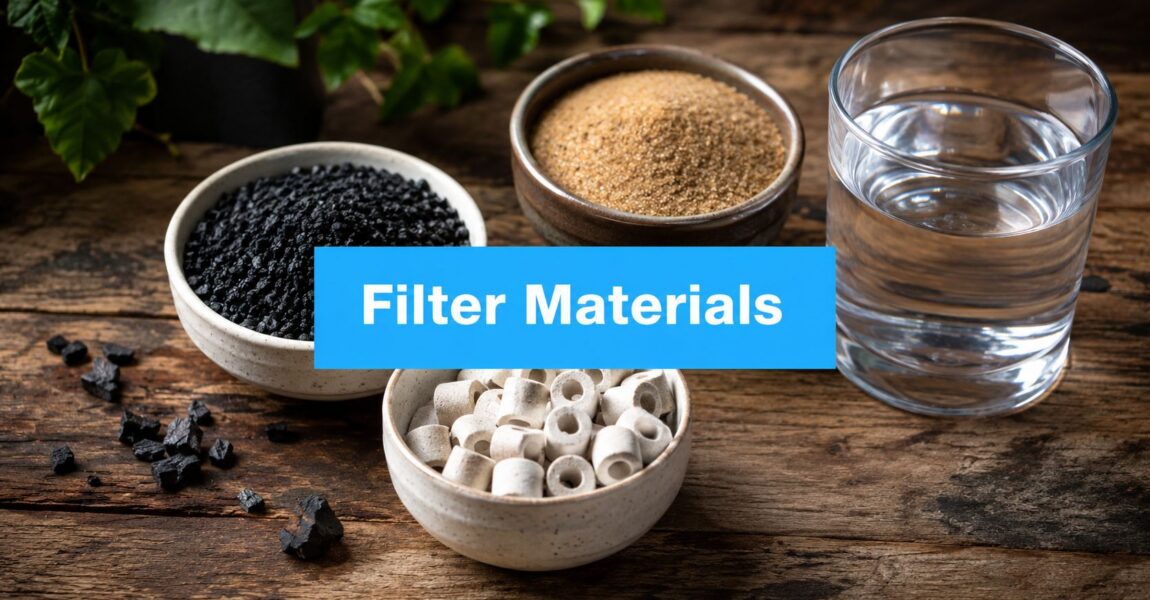
Materials That Filter Water: A Buyer’s Guide
You turn on the kitchen tap, fill a glass, and trust the water will be fine. The tricky part is that a filter can make that water look cleaner long before it makes it safer, and the material inside the cartridge is what decides which of those outcomes you're getting. If you've ever stood in front of a shelf of pitchers, under-sink systems, and replacement cartridges wondering what's doing the work, you're asking the right question.
The answer starts with the materials that filter water, because the media inside the system, not the glossy housing, does the essential job. Some materials strain out particles, some adsorb chemicals, and some are built to catch microbes or dissolved contaminants. If you understand those differences, you can buy with confidence instead of paying for a filter that only fixes taste.
The Hidden World Inside Your Water Filter
The kitchen sink makes this look simple. Water goes in, cleaner water comes out, and the cartridge under the counter or in the pitcher seems almost boring. In reality, that cartridge is a small treatment train, and the material inside it decides whether you're getting sediment removal, chlorine reduction, or real protection against contaminants that matter to your household.
That's why the question isn't just “What brand should I buy?” It's “What media is inside, and what does that media do?” A carbon block, a ceramic barrier, a resin bed, or a membrane all behave differently, even if the box uses the same feel-good language. The difference shows up in your water test, your flow rate, your maintenance schedule, and, in some cases, your health.
Why the material matters more than the label
The history of filtration shows this clearly. Modern public water filtration is usually traced to 1804, when Scottish engineer John Gibb built the first municipal water treatment plant using slow sand filtration in Scotland, and that approach later spread into major cities by the 1820s–1870s. Earlier and later systems used a wide range of media, from cloth, wool, sponge, charcoal, sand, and gravel to more specialized ceramic, porcelain, and carbon block filters. That long timeline is a reminder that filtration has always been about matching the right material to the right problem, not about a single magic cartridge. Historical filtration materials and milestones
One more thing separates the marketing from the plumbing. A filter can improve appearance and still leave serious contamination in place. That's why a homeowner should ask two questions before buying anything. What does the media remove, and what certification or performance evidence backs that claim?
Practical rule: If a seller can't name the media and the target contaminant, you're probably looking at a style of filter, not a treatment solution.
How Water Filtration Materials Work
Think of filtration media the way you'd think about tools in a workshop. A coffee filter catches the grounds, a sponge holds onto spilled water, and a magnet grabs metal shavings. Water filters use the same basic ideas, but each material focuses on a different job, and the wrong tool leaves the problem behind.
Three basic ways media clean water
Physical straining is the most straightforward. Water passes through tiny openings, and particles larger than those openings get left behind. That's the logic behind sand beds, ceramic barriers, and membrane systems with very small pores.
Adsorption works more like a sponge with a very specific personality. Activated carbon has a huge internal pore structure, so chlorine, taste-and-odor compounds, and many organics cling to its surface as water flows past. That's why contact time matters. If water rushes through too quickly, the carbon doesn't get enough time to do its job. A useful benchmark for granular activated carbon is about 3–5 gpm/ft² for chlorine removal and 1–3 gpm/ft² for organic reduction, with 24–36 inches of bed depth and 8–10 gpm/ft² backwash flow. Activated carbon operating limits and NSF context
Ion exchange is the closest thing to the magnet analogy. Special resin beads trade one ion for another, which is why they're used where hardness or certain metals are the issue. They don't just strain debris, they chemically swap what's in the water.
In real systems, design details matter just as much as media name. In rapid sand filtration, the effective grain size is typically 0.35–0.60 mm and the uniformity coefficient should be ≤ 1.7 because a narrow grain-size spread creates more predictable pore spaces and steadier hydraulic behavior. Multilayer beds use different densities on purpose, such as anthracite (0.7–1.7 mm, specific gravity 1.4) over sand (0.3–0.7 mm, 2.6) over garnet (0.4–0.6 mm, 3.8), so backwashing can reorder the bed and keep depth filtration working. Filter media sizing and layering details
A homeowner doesn't need the math on the wall, but the idea matters. Grain size, pore size, and contact time are the levers that decide whether water moves through a filter in a useful way or just rushes past the media.
If you're checking a specialty cartridge for an aquarium or a small water setup, a practical example of very fine filtration is this micron filter for aquariums from Bulls Eye Repair. It's a useful reminder that pore size is not marketing fluff, it's the whole game when you're trying to keep specific particles out.
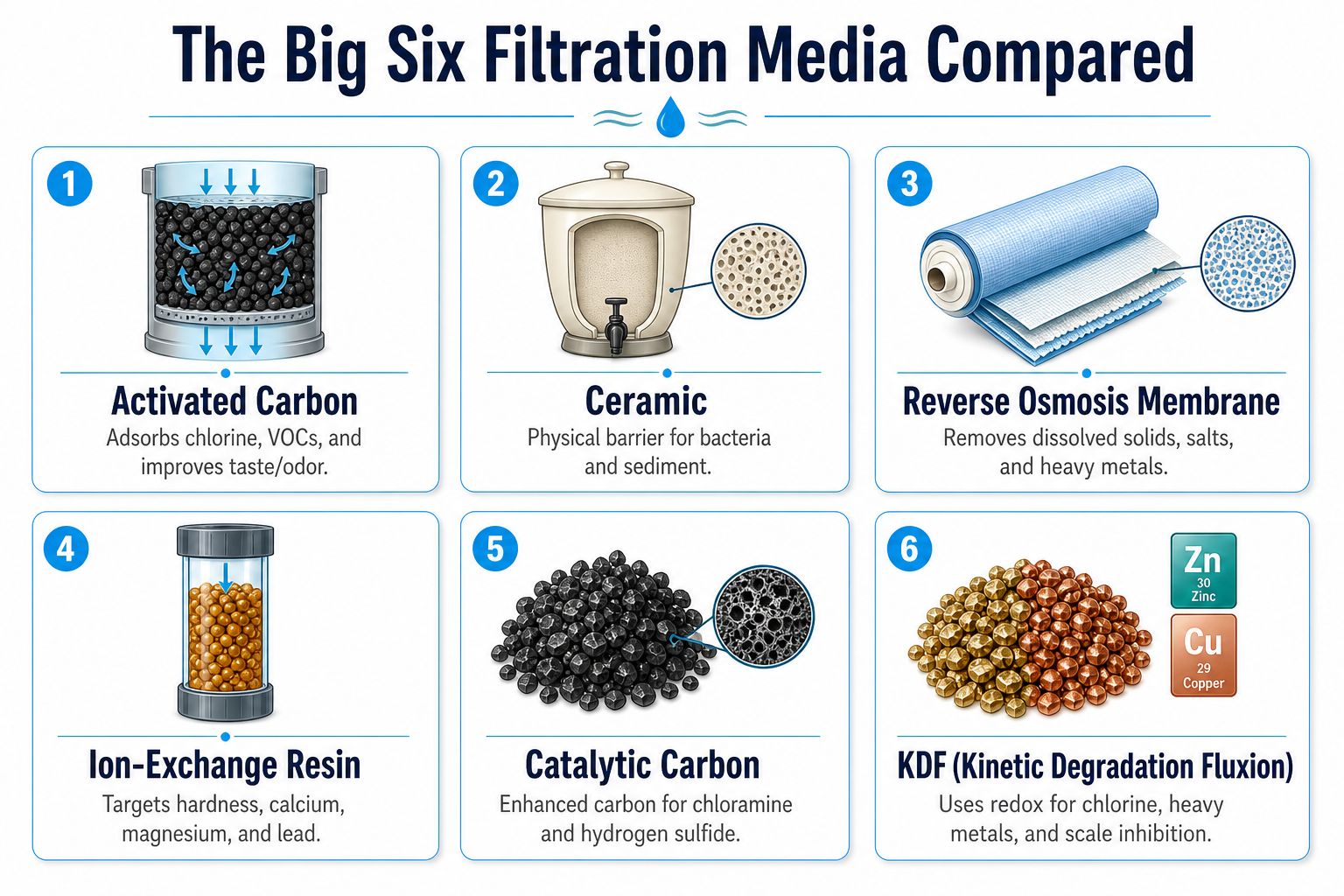
The Big Six Filtration Media Compared
A homeowner standing in the aisle of a hardware store can see why water filters get confusing fast. Two cartridges may look similar on the outside, yet one is built to reduce chlorine taste and another is built to trap fine particles or dissolved minerals. The six home-focused media types below keep appearing because each one handles a different kind of problem, and no single medium solves everything. Sediment, chemicals, hardness, and microbes all behave differently, so a good system often combines more than one stage.
| Filtration Media | Primary Mechanism | Best For | Key Limitation | Typical Application |
|---|---|---|---|---|
| Activated Carbon | Adsorption and chemical reduction | Chlorine, taste, odor, many organics | Doesn't handle everything, and performance depends on contact time | Pitchers, fridge filters, whole-home carbon tanks |
| Ceramic | Physical barrier | Sediment and some bacteria | Slower flow, can clog if water is dirty | Countertop and point-of-use filters |
| Reverse Osmosis Membrane | Fine-pore separation | Dissolved solids, salts, many metals | Needs pressure and waste management | Under-sink drinking water systems |
| Ion-Exchange Resin | Ion swapping | Hardness, calcium, magnesium, some metals | Needs regeneration or replacement | Softeners and targeted treatment |
| Catalytic Carbon | Enhanced adsorption and reaction | Chloramine, hydrogen sulfide, some tougher organics | More specialized than standard carbon | Whole-home and pretreatment systems |
| KDF | Redox reaction | Chlorine, some metals, scale control support | Usually used as part of a blend, not alone | Shower filters and mixed-media units |
Activated carbon and catalytic carbon
Activated carbon is the media many homeowners hear about first. It works by adsorption, which means contaminants cling to the media surface instead of passing through with the water. That makes it a common choice for chlorine, taste, odor, and many organic compounds in pitchers, refrigerator cartridges, and whole-home tanks. NSF standards 42 and 53 are the reference points here, so the core question is whether a product is certified for the contaminant you want removed, not whether it just contains carbon. Carbon media standards and operating guidance
Catalytic carbon is a step beyond standard carbon for certain problems. It is used where regular carbon struggles, especially with chloramine or hydrogen sulfide, and it works by encouraging reactions that plain carbon handles less well. That difference matters because two filters can both be called carbon and still perform very differently in a real house.
Ceramic and porous clay
Ceramic works as a physical barrier, like a very fine sieve. It does not rely on adsorption, so it blocks particles directly and can help reduce microbial exposure when the filter is designed for that purpose. One well-known example is the porous clay filter developed by Dr. Fernando Mazariegos in Guatemala, and a later health study of households using that hand-thrown ceramic-style filter reported a 50% reduction in diarrhea incidence among participating households. That makes the point clearly, the medium can do more than make water look clearer. Ceramic filter history and health study
Reverse osmosis membranes
Reverse osmosis membranes are built for what smaller filters leave behind. They are used when a homeowner wants strong reduction of dissolved solids, salts, and many metals, which are invisible in the glass but still present in the water. The tradeoff is practical, because RO systems need pressure, drain handling, and regular upkeep, unlike a simple carbon cartridge that mainly improves taste.
Ion exchange and KDF
Ion-exchange resin is the workhorse for hardness. It swaps calcium and magnesium ions for other ions, which helps prevent scale on fixtures and inside appliances. KDF uses a redox process instead of simple physical trapping, and it is usually sold as part of a blend where chlorine, some metals, and scale-related support are part of the goal.
A simple way to sort these media is by the kind of problem they address. Carbon improves taste and chemical reduction. Ceramic blocks particles and can help with some microbes. RO handles dissolved contaminants. Resin handles hardness. KDF and catalytic carbon fill narrower roles. That is why good home systems often stack media in stages, because one cartridge is rarely meant to do every job at once.
Matching Material to Your Water Problem
The biggest mistake homeowners make is shopping by filter type instead of by water problem. They buy a sleek pitcher or a nice-looking under-sink unit, then discover later that the system was built for taste, not for the issue in their plumbing or well.
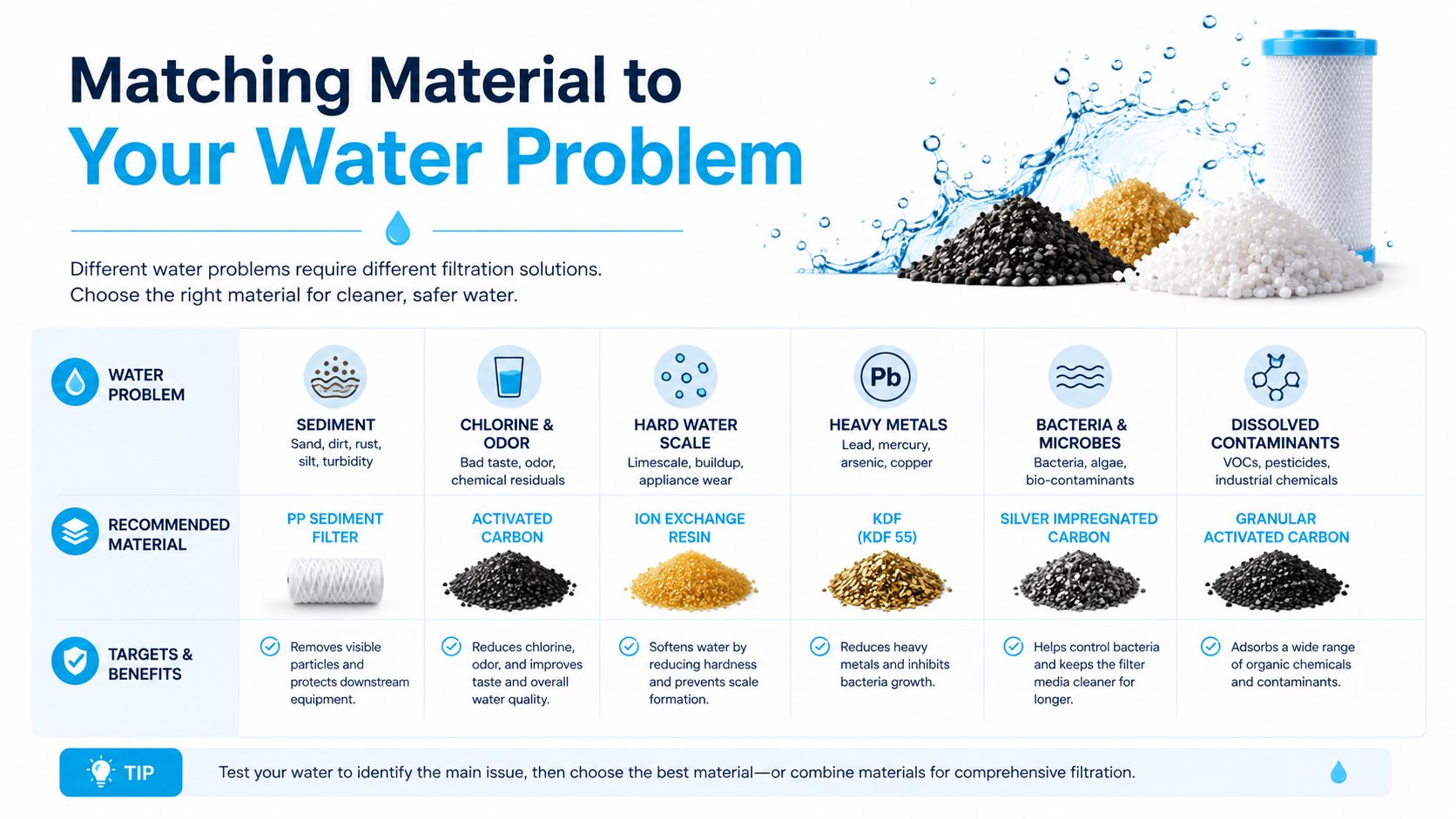
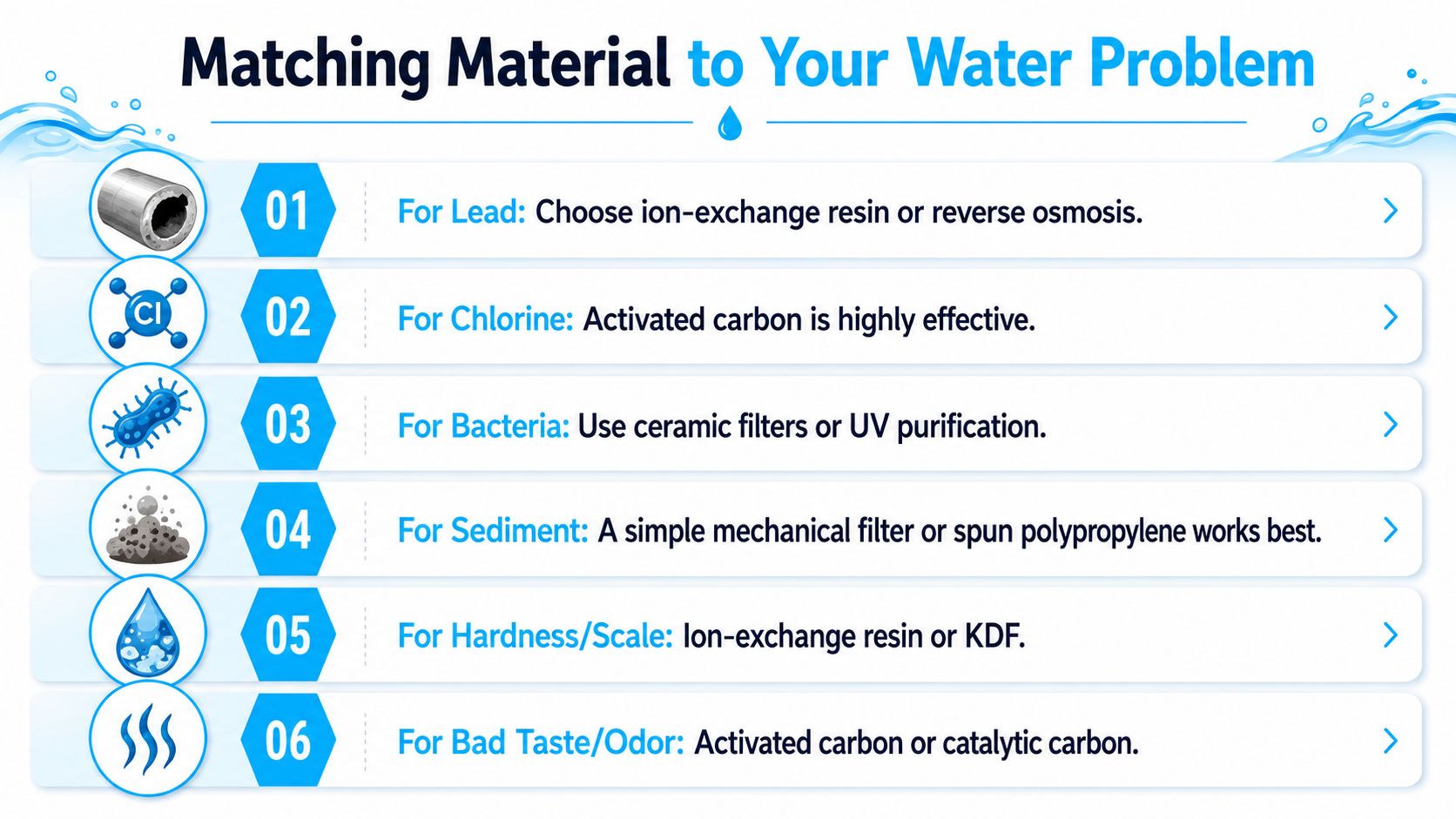
For lead, ion-exchange resin or reverse osmosis is usually where homeowners start looking, because those media are built for dissolved contaminants rather than visible particles. For chlorine, activated carbon is the obvious first stop, and catalytic carbon can help when the disinfectant chemistry is tougher. For bacteria, ceramic barriers or properly designed disinfection systems matter far more than a basic taste filter. For sediment, a simple mechanical filter or spun polypropylene stage handles the job better than a fancy cartridge that was never built for dirt.
The CDC's guidance is especially useful when parasites or amebas are a concern. It says a filter's pore size must be small enough for the contaminant you want to remove, and for parasites and amebas it recommends filters certified to NSF 53 or NSF 58 for cyst reduction, or filters with an absolute pore size of 1 micron or smaller, including microfiltration, nanofiltration, ultrafiltration, or reverse osmosis. CDC guidance on choosing home water filters
A filter that makes cloudy water look better can still leave the real hazard in place.
That's why a water test should drive the purchase, not the packaging. If your report shows hardness and chlorine, you're in one lane. If it shows bacteria risk, you're in another. If it shows dissolved metals, the decision changes again.
For homeowners who want a place to start comparing options and maintenance ideas, the guidance at Water Filter Advisor advice can help you organize the basics without getting buried in product jargon. Use it as a comparison tool, then match the media to the actual contaminant instead of the sales pitch.
Common Misconceptions About Filter Materials
A lot of bad filter advice sounds reasonable at first. It uses familiar household materials, talks about natural solutions, and shows layered jars that look convincing on a countertop. The problem is that water treatment doesn't care whether a material is trendy, rustic, or cheap.
One myth says sand, charcoal, rice husk, coconut husk fiber, gravel, and cloth are basically interchangeable. They're not. A comparative study found burnt rice husk had the highest removal efficiency, while coconut husk performed best on effluent turbidity and run length, which means the “best” material depends on whether you care about clarity, flow, or contaminant removal. Comparative DIY and low-cost media performance
Another myth says clear water equals safe water. It doesn't. The same source world that teaches kids about sand and charcoal also frames homemade residential filters as better suited to rural areas where piped infrastructure is lacking, which is a polite way of saying appearance isn't the same thing as verified treatment. Low-cost ceramic studies show why the gap matters, because some designs can achieve 100% E. coli removal and 80–98% turbidity removal, while flow rates vary wildly from 1.9 to 289 L/h depending on the material and design. Educational and research context on DIY-style filtration
A third myth says activated carbon removes everything. It doesn't. Carbon is excellent for chlorine and many organics, but it isn't the answer for every metal, every microbe, or every hardness problem. If a seller implies otherwise, you're being sold a partial solution with a full-solution price tag.
The homeowner takeaway is simple. Materials are specialized, not generic. If the goal is safety, the media has to match the contaminant, and the test result has to guide the purchase.
Maintenance and Replacement Realities
A filter that hasn't been maintained is just a container with old media in it. Over time, pores clog, adsorption sites fill up, and the flow changes. That's when a system stops performing like the brochure promised and starts behaving like an expensive restriction.
Sand and multilayer systems need backwashing because the bed traps material throughout its depth, not just at the top. Carbon systems need replacement when adsorption sites are exhausted, and that's why flow and contact time matter so much in the first place. Membranes can foul from sediment, scaling, or organic buildup, which is why prefiltration and periodic replacement are part of the design, not optional extras.
What to watch for in the home
- Slower flow: If a faucet or pitcher suddenly slows down, the media may be clogged or packed with captured debris.
- Bad taste returning: When chlorine or odor comes back, carbon may be exhausted.
- Cloudiness or particles: That usually means the prefilter stage isn't doing its job.
- Pressure changes: In under-sink and whole-house systems, pressure loss often points to loading, fouling, or poor sizing.
- Skipped replacement dates: If you can't remember when the last cartridge swap happened, the system probably needs attention.
Practical rule: Replacement isn't a nice-to-have once performance drops. It's part of keeping the filter safe.
Some homeowners also use replacement shopping as a good time to check compatibility and fit. If you're sorting through equipment maintenance in other areas of the house, a straightforward resource like find Ridgid VF3800 replacement from Value Tools Co. shows the same basic principle, match the part to the machine, or performance falls off fast.
For low-cost domestic treatment media, one review found that coconut shell activated carbon and rice husk ash both improved open-well water quality, while rice husk ash was especially strong for lowering pH with maximum reductions of 12.9% to 18.1%, and coconut shell activated carbon was best for turbidity and chlorides. Low-cost domestic water-treatment media review
The maintenance lesson is practical. A filter isn't a one-time purchase. It's a recurring safety item with a lifespan, and ignoring that reality can make the water worse, not better.
Making Your Choice and a Decision Framework
The cleanest way to choose a filter is to start with the problem, then work backward to the media. That keeps you from buying by brand hype or by the prettiest housing on the shelf. A good decision usually comes down to four questions.
First, what's in your water? If you don't know, get a test or read your municipal report carefully. If the issue is chlorine and taste, carbon may be enough. If hardness is leaving scale behind, you're looking at resin or a blended system. If bacteria or parasite risk is part of the picture, pore size and certification move to the top of the list.
Second, what does the media remove? The same word can hide very different performance. Carbon is not a substitute for RO, and a ceramic barrier is not the same thing as an ion-exchange bed. The right match is the one tied to the contaminant, not the one with the widest claims.
Third, how much flow do you need? A whole-house system and a single drinking-water tap have different jobs. A broad, high-flow setup may be fine for bathing and laundry, while a point-of-use system can focus on drinking water. If you force one filter to do both jobs badly, you usually get poor performance and faster replacement.
Fourth, what proof does the product have? Look for the certification that fits the problem. The CDC's pore-size guidance for parasites and amebas, plus NSF-based claims for cyst reduction, are far more useful than vague language about “purity.” Carbon systems should be checked against the target contaminant, not just the presence of black media in the housing.
A simple homeowner framework looks like this.
- Identify the contaminant. Use a water test, a report, or a clear symptom like scale, chlorine taste, or sediment.
- Match the contaminant to the media. Carbon for chlorine and odor, resin for hardness, ceramic or membrane systems for fine particle and microbial concerns, RO for dissolved contaminants.
- Check flow and maintenance. Make sure the system can handle your household use and that you're ready for cartridge changes, backwashing, or membrane care.
- Verify certification and fit. Don't buy a claim, buy a standard and a cartridge that matches the system you already have.
A homeowner who follows that sequence usually spends less over time because the first system is closer to the actual need. That's the point of understanding materials that filter water. You stop guessing, and the filter finally matches the problem in your house.
If you want a practical next step, visit Water Filter Advisor and use it to compare filter types, replacement cartridges, and certification basics in plain language. It's a useful place to narrow your options before you buy, especially if you want your water filter to solve the actual problem, not just look impressive under the sink.
