Faucet Water Filter for Lead: A Practical Buyer’s Guide
You turn on the kitchen tap to fill a glass, then notice the lab report still sitting beside the sink. The result says 14 ppb of lead. Suddenly, the small white filter attached to the faucet looks less like a convenience and more like a decision about what your family drinks every day.
A faucet-mounted filter can be a practical first response, especially for renters, older homes, and households that need filtered water at one kitchen fixture. It can also be the wrong answer if the home has unusually high lead levels, an unknown cartridge history, or plumbing that continues releasing lead after the filter has reached its limit. The useful question isn't whether a faucet water filter for lead “works.” It's whether the specific model is certified for lead, installed correctly, maintained within its rated capacity, and matched to the conditions in your home.
Why a Faucet Filter and Why Lead
Lead can enter tap water from plumbing rather than from the water leaving the treatment plant. Corroding service lines, old solder, brass fittings, and faucets can all contribute, which means a household can have a reassuring utility report and still need to investigate the water at its own tap.
A homeowner in an older house may discover lead after testing the first glass of water in the morning. Another household may become concerned after a renovation disturbs an old pipe. A renter may not be able to replace a service line or open a wall at all. In each situation, a faucet filter offers a limited but useful form of control, it treats the water used for drinking and cooking without requiring a permanent plumbing project.
Practical perspective: A faucet filter treats exposure at the point where you fill the glass. It doesn't repair a lead service line or remove lead from every outlet in the home.
The U.S. EPA action level for lead is 15 ppb, but an action level isn't a guarantee that an individual tap contains no lead. A household result near or above that level deserves careful follow-up, particularly in a home built before the federal ban on new lead plumbing installations in 1986, or where infants or pregnant people live. The health goal for lead in drinking water is zero, as described in the EPA consumer guidance on lead filters.
A faucet-mounted unit is attractive because it's removable, relatively simple to install, and focused on the tap that matters most. But the badge on the box matters more than the shape of the device. A filter marketed for chlorine taste or sediment isn't automatically a lead filter, and a cartridge that has exceeded its capacity may no longer provide verified performance.
The rest of the buying decision comes down to four questions: what certification covers lead, what enters the filter, how long the cartridge lasts, and when a faucet unit is no longer enough.
How Lead Gets Into Tap Water and How Filters Trap It
Lead usually reaches a glass through one of two plumbing routes. A lead service line can carry water from the municipal main toward the house, while lead-based solder, brass fittings, and older faucet components can add lead inside the building. Corrosion releases lead into the water, sometimes as dissolved metal and sometimes as particles that move when water flow changes.
Lead doesn't announce itself with a smell or unusual color. A clear glass can still contain it. Flushing may reduce stagnant water, but it can't guarantee that particles won't detach later or that the plumbing won't continue contributing lead.
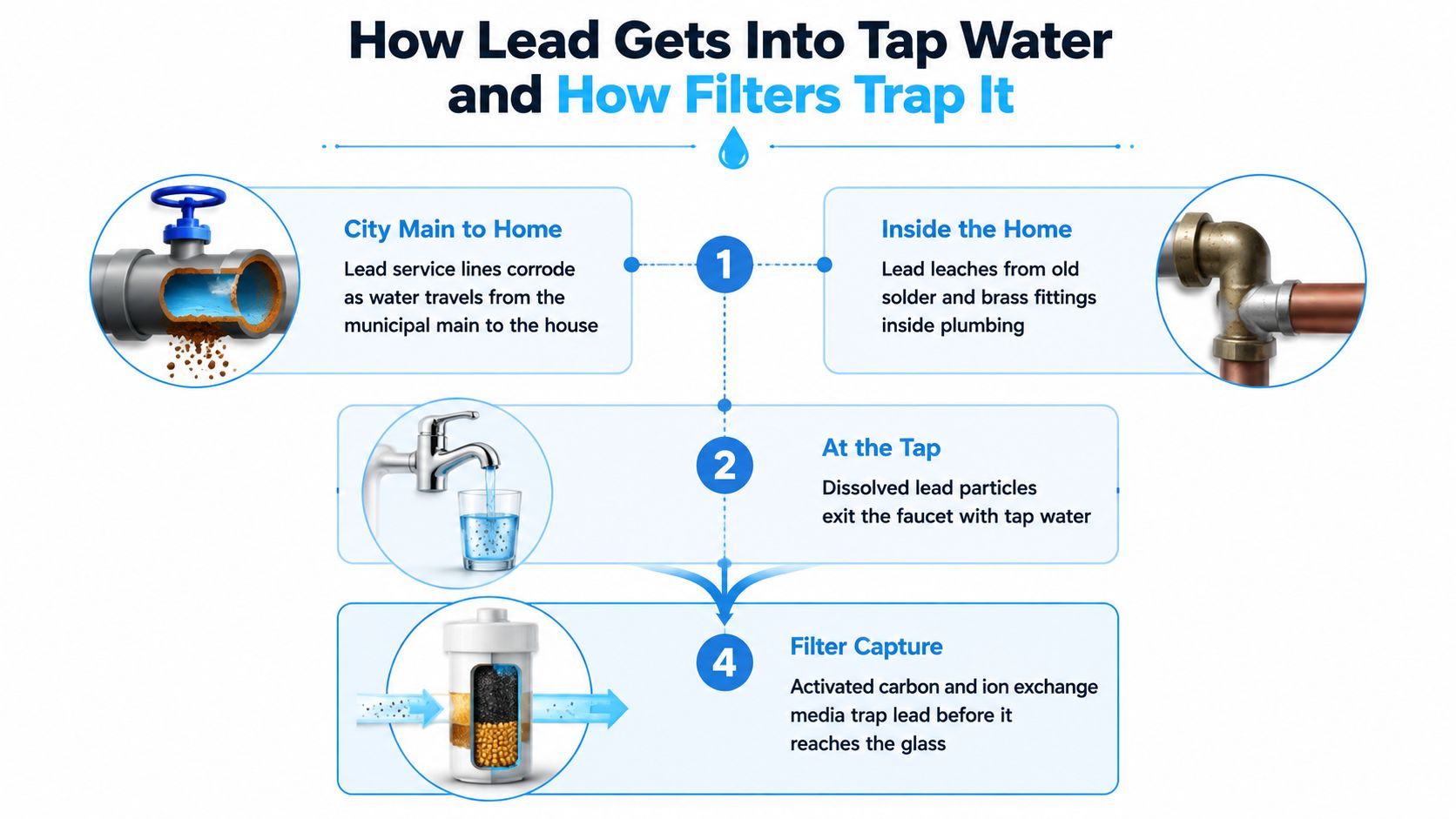
What the cartridge is doing
Inside a certified cartridge, the media performs more than one job.
- Activated carbon: Think of it as a porous, sticky sponge. It attracts and holds certain dissolved contaminants, including lead when the cartridge has been designed and certified for that reduction.
- KDF-55 media: This media uses a redox reaction that changes soluble lead into a less soluble form, which the filter bed can retain. The chemistry matters because ordinary carbon intended only for taste and odor isn't automatically designed for lead.
- Mechanical filtration: A fine pre-filter can catch particles that break away from pipe walls. This stage is important when lead travels as particulate matter rather than only as dissolved metal.
A basic carbon cartridge can improve chlorine taste and odor while doing little or nothing that has been verified for lead. That's why the claim on the package must identify lead reduction, not just “carbon,” “metal reduction,” or “NSF components.”
For readers comparing broader filtration equipment, Allied Drinks Systems filter options can help explain how different media and cartridge designs are used in water-treatment applications. The same principle applies at a kitchen faucet: the media must match the contaminant and the testing claim.
The filter also needs the right flow conditions. Water moving too quickly may not contact the media long enough, while an exhausted cartridge may allow contaminants through even if the original cartridge passed its certification test.
Here's a short visual explanation of the process:
NSF and ANSI 53 Standards and What the 5 ppb Benchmark Really Means
A certification badge is useful only when you read the words attached to it. NSF/ANSI 53 is the main benchmark for health-related contaminant reduction in drinking-water treatment units, including lead-reduction claims for faucet-mounted filters.
NSF explains that certified lead-reduction devices are challenged with water containing 150 ppb lead, which is 10 times the U.S. EPA action level of 15 ppb. Under the updated requirement, treated water must be at or below 5 ppb, a 50% tightening from the previous 10 ppb limit. The stricter requirement became effective immediately for new products after the 2022 update, according to the NSF certified lead-reduction listings.
That test setup gives shoppers a meaningful performance ceiling. A device challenged at 150 ppb and required to finish at 5 ppb or below must achieve at least a 96.7% reduction from the test influent. NSF also states that performance isn't evaluated above 150 ppb, so a home with an unusually high result needs testing and professional advice rather than a generic faucet-filter recommendation.
The labels that cause confusion
NSF/ANSI 42 generally relates to aesthetic issues such as chlorine taste, odor, and sediment. It doesn't, by itself, establish a lead-reduction claim. A package saying “NSF tested components” also isn't the same as a complete product certified under NSF/ANSI 53 for lead.
| Standard | Influent Challenge | Max Permissible Effluent | What It Means for You |
|---|---|---|---|
| NSF/ANSI 53, current lead criterion | 150 ppb lead | 5 ppb or less | A stricter current benchmark for certified lead reduction |
| NSF/ANSI 53, previous lead criterion | 150 ppb lead | 10 ppb or less | The earlier benchmark used for older certifications |
| NSF/ANSI 42 | Not a lead certification challenge | Not a lead limit | Useful for taste, odor, and particulate claims, but not proof of lead reduction |
The EPA consumer tool for point-of-use filters is aimed at products certified to reduce drinking-water lead to 5 ppb or less. Before buying, search the manufacturer's exact model number in the NSF database and confirm that the listing names lead reduction. Don't rely on a logo printed beside broad language.
Field evidence supports the value of verified certification. A review of 1,528 NSF/ANSI 53-certified filters found that 99% reduced lead to the applicable certification benchmarks in the reviewed field studies, as summarized in this Environmental Science & Technology Letters evidence review. That result reflects certified products used correctly, not every carbon filter sold for a kitchen faucet.
Faucet Mount Versus Pitcher Versus Under Sink for Lead
The best format depends on how much water your household uses, how much plumbing you can change, and how closely you need to control lead at one fixture. A pitcher is easy to move, a faucet mount provides water on demand, and under-sink reverse osmosis offers a more involved installation with deeper treatment.
| Feature | Faucet Mount | Pitcher | Under Sink (RO) |
|---|---|---|---|
| Lead certification | Look for NSF/ANSI 53 specifically listing lead | Look for the same contaminant-specific certification | Verify the applicable lead and RO certifications |
| Daily capacity | Convenient for drinking and cooking at one tap | Batch-based and slower to refill | Dedicated filtered faucet with stored or on-demand production |
| Countertop footprint | Small device attached to the faucet | Takes refrigerator or counter space | Hidden inside the cabinet |
| Installation complexity | Usually simple and reversible | None | Requires a cold-water connection and dedicated faucet |
| Cartridge cost | Recurring cartridge expense | Recurring pitcher cartridge expense | Multiple filters and membrane maintenance |
| Best fit | Renters, smaller kitchens, one primary drinking tap | Backup water or modest household demand | Homes needing more extensive treatment or higher volume |
Faucet mounts
A faucet unit is often the sensible starting point when the concern is limited to drinking and cooking water. It avoids drilling and usually switches between filtered and unfiltered flow, so washing dishes doesn't consume the lead cartridge. Its limitation is scope. It protects the connected fixture, not bathroom taps, ice makers, or the plumbing itself.
Pitchers
Pitchers work when the household can plan ahead. They're useful for filling a refrigerator container or keeping a backup supply, but their slower flow and small batch size become irritating when everyone is drinking filtered water and cooking with it. Certification still matters. A pitcher labeled for chlorine isn't automatically suitable for lead.
Under-sink reverse osmosis
Under-sink RO hides the equipment and uses a dedicated faucet, which keeps the main kitchen faucet available for ordinary tasks. It typically involves more installation, replacement parts, and maintenance than a faucet mount. Choose it when testing suggests the faucet unit's performance ceiling isn't appropriate, when the household needs broader dissolved-contaminant reduction, or when the plumbing condition calls for a more controlled point-of-use setup.
If lead repeatedly appears at levels that concern you, the long-term remedy may be service-line or pipe replacement, not a larger cartridge. A filter is an exposure-control measure. It isn't a structural repair.
Compatibility and Installation Tips That Actually Matter
Many faucet filters fail before the first cartridge is exhausted because the device never fit the tap properly. Start by removing the faucet aerator and checking the thread. Many U.S. faucets use a 55/64-inch female thread, but pull-down faucets, sprayers, and decorative or non-standard fittings may require an adapter or may not accept a faucet-mounted unit at all.
Tool-free models can replace the aerator quickly, while threaded models may need a wrench and plumber's tape. Don't force a plastic adapter onto a metal thread. Cross-threading can damage the fitting and create a leak that looks like a cartridge problem.
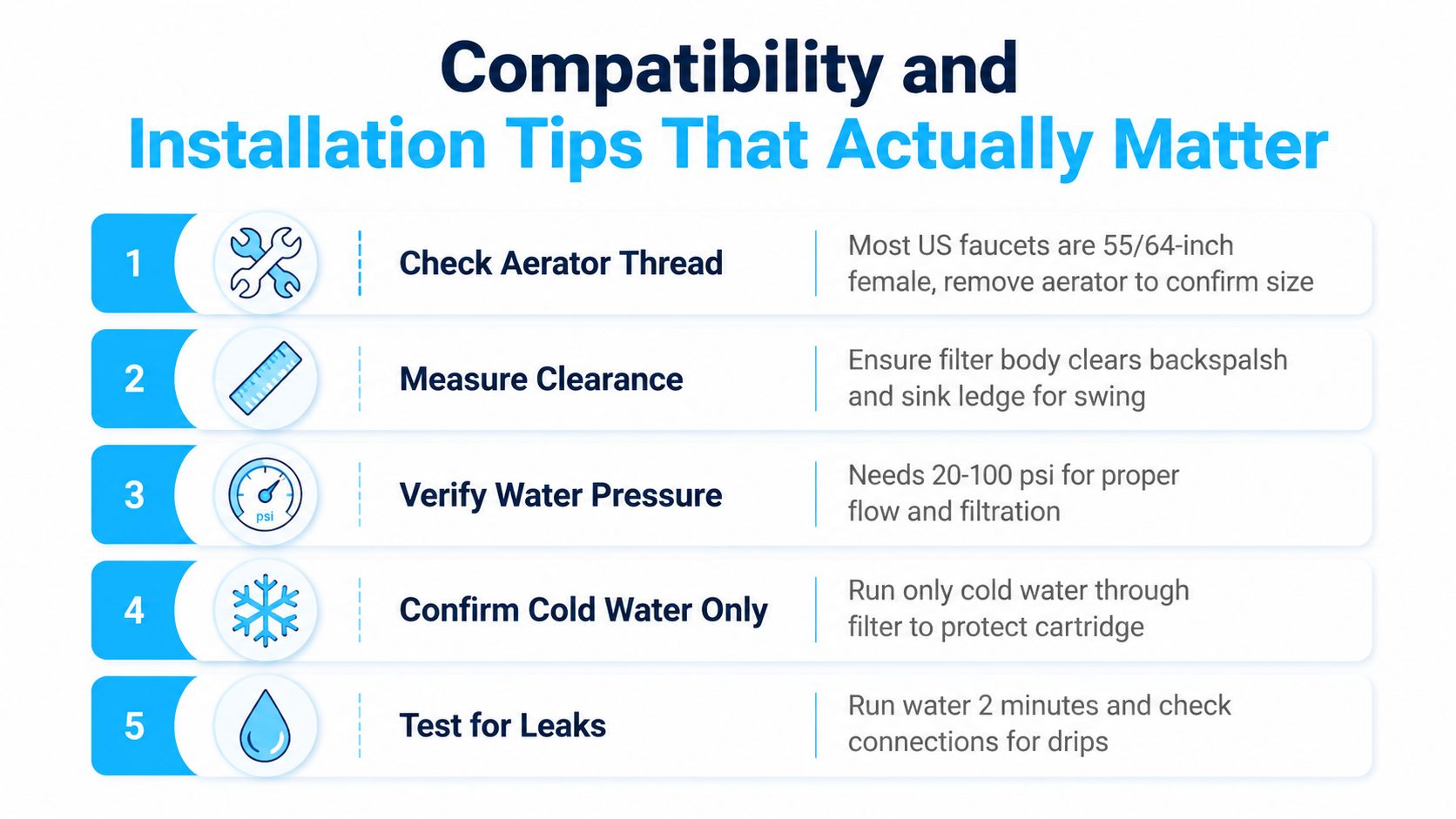
A cleaner installation sequence
- Check the faucet: Remove the aerator, identify the thread, and confirm that the manufacturer supplies the needed adapter.
- Measure the space: Make sure the filter body clears the backsplash, sink ledge, and tall pots. A unit that blocks the faucet's swing will become a daily nuisance.
- Use cold water only: Hot water can damage the cartridge and may carry more lead from plumbing. Use the unfiltered setting for hot water.
- Flush the cartridge: Run the specified amount of cold water through a new cartridge before drinking it. Manufacturing dust and loose carbon fines need to leave the media bed.
- Inspect the bypass: If the diverter hose kinks or the selector remains in bypass, you may fill glasses with unfiltered water while assuming the filter is active.
A pull-down or sprayer faucet may leave no practical space for a mounted cartridge. In that case, consider a countertop unit with a diverter, or a dedicated drinking-water faucet connected to an under-sink system. The objective isn't to force a particular format onto an unsuitable tap. It's to preserve a clear, reliable path between the cold-water supply and the filtered glass.
Replacement Timing, Maintenance, and Simple At Home Testing
A lead cartridge has a working life, and the calendar alone doesn't define it. Capacity depends on the cartridge's rated gallons, household use, water quality, and the amount of sediment entering the media. Many faucet cartridges are rated around 100 to 150 gallons, while the plan notes for a family of four translate that into roughly two to four months of use. Treat those figures as a planning range, not permission to exceed the model's printed rating.
A drop in flow is a useful warning, but it isn't a certification test. Gray discoloration, returning chlorine taste, or visible sediment also justify inspection and replacement. If the cartridge has reached its rated capacity, replace it even if the water still tastes fine.
A simple household routine
- At installation: Flush the new cartridge according to its instructions and record the date.
- Each week: Wipe and clean the diverter, outlet, and visible housing. This keeps grime from entering the clean-water path.
- Each month: Flush the unit after a long period without use, and inspect connections for leaks or buildup.
- At the capacity limit: Replace the cartridge rather than stretching its life because flow still seems acceptable.
- After replacement: Test again if lead is a known concern, and compare the result with the previous sample.
At-home lead kits can provide a screening signal, but they don't replace a laboratory analysis. Compare a first-draw sample with water collected after the faucet filter has been flushed and operated normally. Follow the kit instructions precisely, and use a certified laboratory when results are high, inconsistent, or important to a medical or renovation decision. For help with understanding your lead test results, focus on the sample method as well as the number.
The Water Filter Advisor advice library can also help you keep a written record of cartridge changes, test dates, and fixture locations. That record is valuable when several people use the kitchen or when a filter serves as temporary protection during plumbing work.
Cost, Cartridges, and the Real Price of Ownership
The purchase price is only the first line on the receipt. A low-cost faucet body with expensive, frequent cartridges may cost more over time than a sturdier unit with a slower replacement cycle. NSF/ANSI 53-certified cartridges generally cost more than basic taste-and-odor replacements because the manufacturer must support a specific contaminant claim and testing scope.
Consider two hypothetical buying patterns. A $30 faucet unit with $50 quarterly cartridges has a different ownership profile from a $50 unit with $30 cartridges replaced every six months. The second model may have a higher starting price but a lower recurring burden. These examples illustrate the arithmetic, not typical market pricing.
| Filter Tier | Unit Cost | Cartridge Cost | Replacements Per Year | Annual Total |
|---|---|---|---|---|
| Basic taste and odor | Varies by model | Lower than certified lead cartridges | Depends on use | Unit plus cartridge purchases |
| Certified lead faucet unit | Varies by model | Often higher than basic replacements | Based on gallon capacity | Unit plus certified cartridge purchases |
| Higher-capacity point-of-use system | Higher initial cost possible | Multiple stages or higher-priced cartridges | Based on rated capacity | Unit, cartridges, and any adapters |
A practical comparison method is to amortize the unit over three years and add the cost of four to six cartridges to estimate ownership. That formula helps expose models that look inexpensive at checkout but require frequent replacements.
Don't forget accessory costs. Non-standard faucet threads may require an adapter kit. A household may keep a pitcher available while a cartridge is being changed, and low-flow models may increase the time the tap runs, adding water use without improving lead protection.
Pay extra for verified lead-reduction certification, a clear cartridge indicator or timer, and a design that fits the tap securely. Decorative finishes, novelty mineral-infusion cartridges, and appearance upgrades don't add lead protection unless the product documentation supports a relevant certification.
Choosing the Right Faucet Water Filter for Lead
Start with the water result, not the product category. If a certified tap test shows lead above 5 ppb, treat a faucet filter as a stopgap while you investigate under-sink RO, plumbing repairs, service-line replacement, or additional laboratory testing. The 5 ppb threshold reflects the current NSF lead-reduction benchmark for certified products, not a promise that every home with a higher result can be handled safely by any faucet cartridge. See the NSF lead-reduction requirements for the test ceiling and limitations.
For a household at or below the EPA action level, the buying checklist becomes more focused:
- Verify lead certification: Find NSF/ANSI 53 certification that specifically names lead reduction. NSF/ANSI 42 alone isn't enough.
- Match the capacity: Choose a cartridge with a stated gallon rating, then compare it with your actual drinking and cooking habits.
- Confirm the fit: Measure the faucet thread, check whether an adapter is included, and leave room for the filter to swing.
- Control replacement timing: Prefer an indicator light, timer, or an easy way to record the installation date.
- Plan for testing: Retest when plumbing changes, the cartridge reaches its limit, or the household's risk profile changes.
A slower certified flow is preferable to a fast stream that bypasses the cartridge or comes from a model with no verified lead claim. Flow rate is a comfort feature. Certification, capacity, and correct installation are performance features.
Water Filter Advisor publishes comparison and maintenance guidance for faucet, under-sink, and other household filtration formats, including certification-focused buying criteria. Use that kind of documentation to compare the exact model number, cartridge life, replacement price, and fixture compatibility rather than choosing from a broad “lead removal” label.
The final decision should fit the home's actual risk. A renter with one tested kitchen tap may need a certified faucet mount. A family with recurring high results or a damaged service line may need a more controlled under-sink system and a plumbing plan. A household facing an unusually high lead result should prioritize laboratory confirmation and professional guidance before relying on a generic faucet cartridge.
If you're comparing a faucet water filter for lead, visit Water Filter Advisor for practical guides on certifications, cartridge replacement, installation, and water testing. Use the site's comparisons to match the filter format and maintenance plan to your tap results, plumbing, and daily household use.
