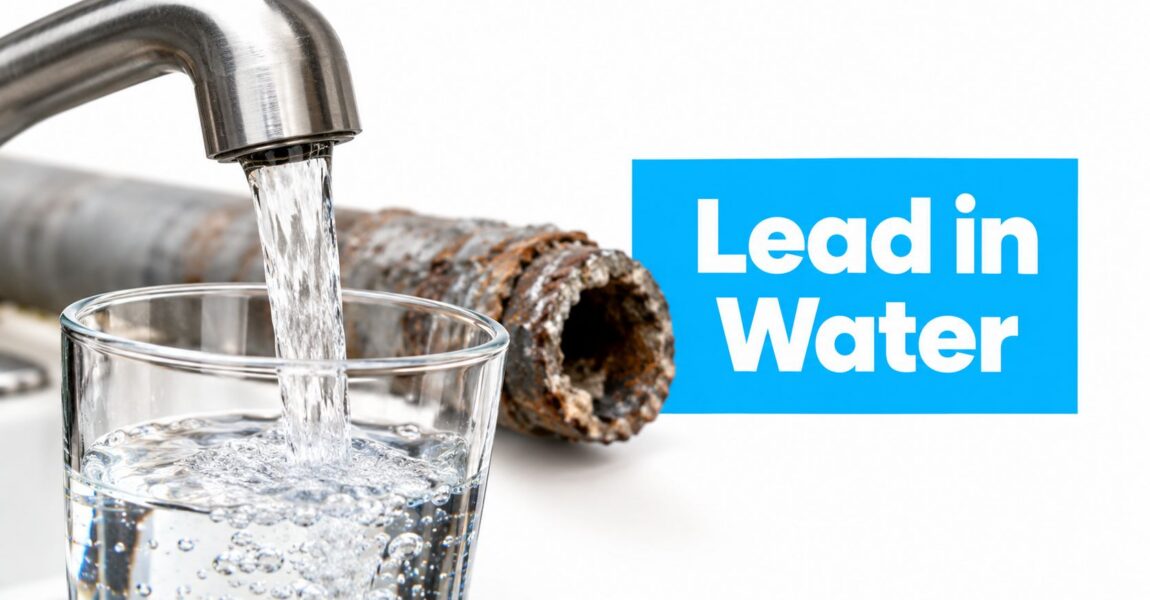
Health Effects of Lead in Drinking Water
The most popular advice about lead in drinking water is also the least reassuring: check your city's annual water report and assume your glass is covered. That report describes the utility's water and its regulatory sampling program. It doesn't guarantee that water arriving through an aging service line, brass fitting, solder joint, or faucet is free of lead by the time you drink it.
Lead is a household plumbing problem as much as a municipal treatment problem. The practical response is to test at the tap, filter the water you consume, and maintain that filter without excuses. A passing utility result can coexist with exposure inside your home, while a properly certified point-of-use system gives you control over the water used for drinking, cooking, and infant formula.
The Hidden Threat Behind Your Kitchen Tap
Your water utility can treat source water effectively, control corrosion in the distribution system, and still have limited control over what happens inside your property. Water travels from the main through a service line, enters household plumbing, passes through fittings and valves, and finally sits in contact with the faucet before it reaches your glass. Each transition creates another opportunity for lead to enter the water.
The EPA's explanation of lead in drinking water makes the health concern clear: there's no known safe level of lead in a child's blood, and even low exposure can contribute to behavior and learning problems, lower IQ, hyperactivity, slowed growth, hearing problems, and anemia. Children are more vulnerable because these effects can occur at lower exposure levels than in adults.
The gap between the main and the faucet
A utility report is useful, but it's not a substitute for a household sample. Public systems test selected locations under defined procedures. Your home may have different plumbing materials, different water-use patterns, and a different amount of time during which water stands in the pipes.
Lead can come from service lines, older solder, brass components, and fixtures. A faucet can look modern while older plumbing behind the wall remains untouched. Even a property without a lead service line can have contamination introduced by interior fittings or particles collected in an aerator.
Practical rule: Treat the water at the point where your family drinks it, not only at the point where the utility manages it.
Why filtration belongs at the kitchen
A whole-home system can reduce exposure at multiple outlets, but drinking water deserves special attention because it goes directly into the body and is also used for cooking. An under-sink reverse osmosis system or a certified lead-reduction carbon block filter can provide a dedicated barrier at the kitchen tap. A certified faucet-mounted filter can serve renters who can't alter plumbing.
Use filtered cold water for drinking, cooking, and formula. Don't assume a shower filter protects the kitchen, and don't assume a general-purpose pitcher removes lead unless its certification specifically includes lead reduction. The city report tells you about the system. A tested filter protects the glass in front of you.
How Lead Enters Your Home Water Supply
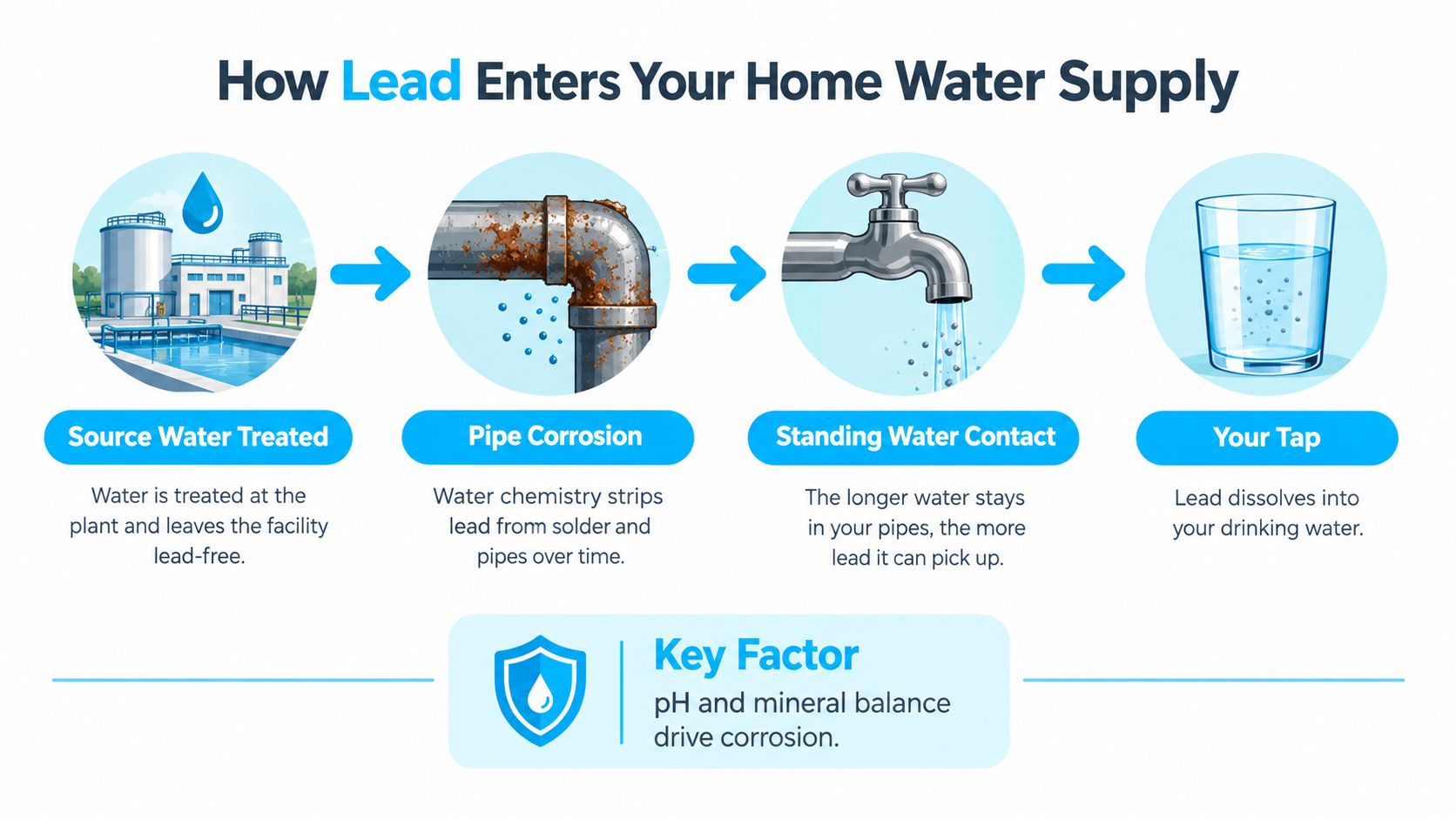
Lead usually reaches household water through contact, not because a treatment plant intentionally sends lead into the distribution network. Water sits against a service line, solder joint, fitting, or fixture. If the chemistry allows corrosion, small amounts of lead can dissolve into the water or detach as particles.
Think of the water as a liquid moving through a metal pathway. Stable water leaves that pathway relatively undisturbed. More corrosive water acts like a slow solvent, wearing away susceptible materials over time. pH and mineral balance influence how aggressively water interacts with plumbing, which is why the same type of fitting can behave differently in different water systems.
The contact points that matter
Start with the route into your house. A lead service line can connect the street main to the building. Inside, older solder can join copper pipes, while brass valves, faucets, and fittings can contribute lead under some conditions. A property's age can provide clues, but it can't replace a water test because renovations and replacements often create mixed plumbing systems.
Standing time matters too. Water that remains motionless in a pipe has more opportunity to interact with the pipe wall and fittings. The first water from a morning tap can therefore tell you more about overnight contact than water collected after extensive flushing.
What to do with this information
Don't try to identify risk from appearance alone. Lead plumbing can be hidden, and a clean-looking faucet says nothing about the service line beneath the property. Ask the utility about service-line materials, inspect accessible plumbing with a qualified professional, and test water from the faucet used for drinking.
Until you've tested and installed an appropriate filter, use cold tap water for consumption. Hot water can dissolve lead more readily, and boiling doesn't remove lead. A filter must be installed on the water path your household uses, with the cartridge replaced on the manufacturer's schedule.
For a visual explanation of corrosion, contact time, and household exposure, use this lead contamination process video as a companion to your plumbing inspection.
Health Effects of Lead Exposure Across Different Ages
Lead doesn't affect every household member in the same way, but no family should treat exposure as harmless. The strongest evidence concerns neurodevelopmental harm in children and fetuses. The World Health Organization's lead background document identifies children up to age 6, the fetus, and pregnant women as especially susceptible groups, while also connecting lead exposure with impaired kidney function, hypertension, adverse pregnancy outcomes, and reduced fertility.
Infants and pregnancy require the strictest control
Formula preparation makes water filtration particularly important during infancy. A pediatric research review cited by the European scientific committee estimated that drinking water accounts for about 20% of total lead exposure in the United States, with the share reaching as high as 60% in infants because formula is often mixed with tap water. Those figures appear in the European scientific committee's review of lead exposure and health effects.
That makes an unfiltered kitchen tap a poor place to take chances. Pregnant people should use a certified lead-reduction filter for drinking and cooking water, and families preparing formula should use properly filtered cold water. If a child may have been exposed, discuss blood testing with a healthcare professional. Filtration prevents further intake, but it can't diagnose or reverse an existing health effect.
Children face developmental and behavioral consequences
The same European review cited a 3 to 4 point IQ loss for each 10 µg/dL increase in children's blood lead and reported measurable IQ declines and attention or behavior problems below 5 µg/dL. These are blood-lead findings, not a direct conversion from a tap-water result, so homeowners shouldn't use them to calculate personal risk from a single sample. They do show why “low” exposure deserves serious attention.
A family may notice no immediate symptom while exposure still affects development. For adults who want background on nonspecific concerns such as fatigue brain fog heavy metal signs, a medical resource can help organize questions for a clinician, but symptoms alone cannot identify lead from water.
Adults are part of the risk picture
Adults can experience kidney problems and raised blood pressure from lead exposure. WHO also identifies cardiovascular and reproductive effects, which means the filtration decision shouldn't focus only on babies. Older adults and people already managing hypertension or kidney disease deserve a conservative household approach.
A filter is not a luxury upgrade when vulnerable people drink the water. It's an exposure-control measure.
Install a certified lead filter at the kitchen tap first. If lead may be present throughout the building, or if household members consume water from several outlets, evaluate whole-home treatment while preserving dedicated point-of-use protection for drinking and cooking.
Understanding EPA Action Levels and Compliance Gaps
An action level is a regulatory trigger, not proof that water below it is harmless. Under the U.S. Lead and Copper Rule, public water systems must take additional corrosion-control measures if more than 10% of sampled taps exceed 15 parts per billion, or 0.015 mg/L, as described in the EPA's lead drinking water guidance. The rule measures system performance through sampling. It does not establish a safe amount of lead for every person or household.
The EPA has scheduled a revised lead action level of 0.010 mg/L to take effect on November 1, 2027. That is a future regulatory benchmark, not a present household guarantee. Regulatory thresholds can change as health protections and measurement practices receive further review.
Compliance is not the same as zero exposure
A water system can meet its action level while an individual tap still contains lead. Utility sampling covers selected homes and locations, while your plumbing may use different materials or face different corrosion conditions. Water can also change after it leaves the utility's monitored network.
The Michigan EGLE press release on Flint's tenth year of lead-testing compliance illustrates the communication problem. Flint's water tested below both Michigan's tighter 12 ppb standard and the federal 15 ppb action level in 2025–2026, yet experts continued to emphasize that no level of lead is safe. The Michigan EGLE update on Flint's lead-testing compliance shows why compliance should not end a homeowner's questions.
Use compliance data as a starting point
Read the utility report, ask about your service line, and request available sampling information. Then control exposure at home with filtration. A certified filter protects the water your household uses, while municipal compliance data describes a broader system.
- Choose point-of-use treatment: Protect the kitchen tap used for drinking, cooking, and formula preparation.
- Consider whole-home treatment: Use it when multiple outlets matter or plumbing conditions indicate broader exposure.
- Keep testing: A result can guide filter selection, but plumbing changes and filter exhaustion can reduce protection over time.
If your test shows lead, install filtration without waiting for a regulatory violation. The practical question is whether the water your family drinks contains a contaminant health authorities recognize as harmful. Use compliance reports for context, then rely on point-of-use or whole-home treatment to address the risks inside your own plumbing.
Testing Your Home Water for Lead Contamination
A city water report cannot show what happens inside your house. Test the water at the tap your family uses, then choose filtration based on that result rather than a generic product claim or a color-changing strip. Laboratory testing gives you a sound basis for deciding filter placement, capacity, and treatment technology.
Follow a first-draw sampling routine
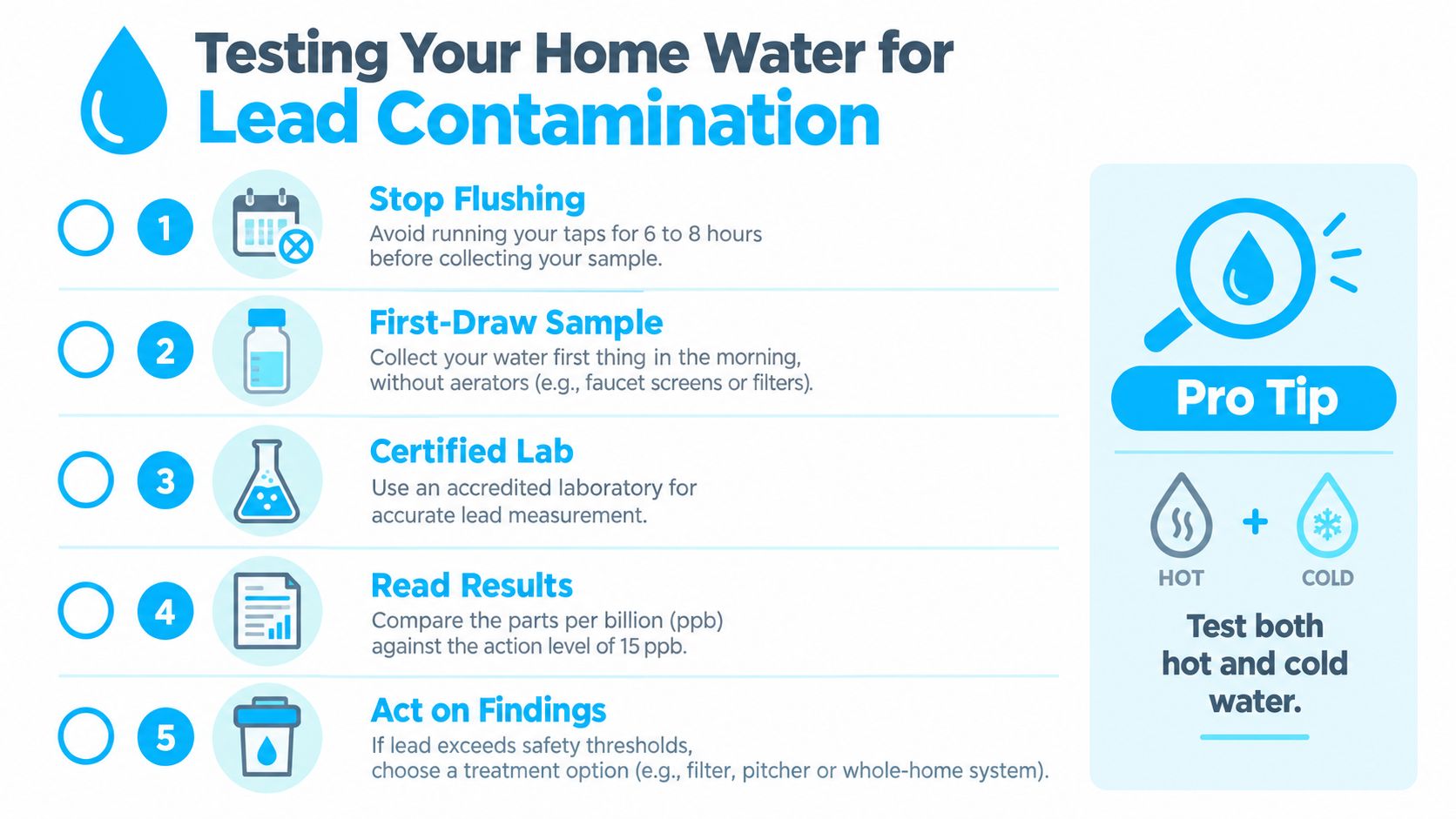
First-draw sampling measures water that has remained in contact with household plumbing. Use the drinking-water faucet, remove its aerator if the kit instructs you to, and do not run the tap before collecting the sample. Most accredited lead sampling kits require 6 to 8 hours of no tap use before collection. Check the kit's instructions and follow the laboratory's exact timing instead of estimating.
Use this sequence:
- Stop flushing: Leave the water undisturbed for the period specified by the sampling kit.
- Collect the first draw: Fill the laboratory bottle directly from the cold tap before running any other water.
- Use an accredited laboratory: Select a laboratory qualified to measure lead in drinking water accurately.
- Read the result: Review the reported parts per billion and compare it with the applicable action-level context, including the federal 15 ppb benchmark discussed earlier.
- Act on the finding: Select a certified filter and install it at the outlet used for drinking and cooking.
Test strategically, not randomly
Test cold and hot water when investigating household plumbing, but never use hot tap water for drinking or cooking. Sample other drinking outlets if your home has multiple kitchens, an accessory dwelling, or a long plumbing run. Ask the laboratory whether it also wants a flushed sample. First-draw and flushed samples answer different questions about plumbing-related exposure.
DIY strips can flag a concern, but laboratory measurement should guide treatment decisions for infants, pregnancy, or known plumbing risks. Keep the laboratory report with your filter records. It establishes a baseline for checking whether the installed system continues to perform as expected. If the result shows lead, treat the affected tap rather than waiting for a municipal report to resolve the household risk.
Choosing the Right Home Water Filtration System for Lead
Lead filtration starts with the certification, not the shape of the device. A pitcher, faucet filter, under-sink cartridge, or whole-home unit can be useful only if the specific model is tested and certified for lead reduction under its stated conditions.
NSF-certified lead-reduction filters are evaluated with water containing 150 ppb of lead, 10 times the EPA's maximum allowable level in drinking water. That challenge demonstrates performance against severe contamination rather than marginal exposure, as shown in the NSF listing for certified lead-reduction filters.
Compare the main options
| Filter Type | Installation Point | Lead Reduction Capability | Best For |
|---|---|---|---|
| Activated carbon block | Pitcher, faucet, or under-sink | Can reduce lead when the exact product carries lead-reduction certification | Renters and households wanting targeted kitchen protection |
| Reverse osmosis | Usually under-sink, with a dedicated faucet | Strong lead-reduction option when the system is certified for lead and maintained correctly | Families seeking robust drinking and cooking-water treatment |
| Distillation | Countertop or dedicated appliance | Can separate lead from water, but output and operating practicality vary by device | Households willing to manage slower, batch-style treatment |
| Whole-home treatment | Main entry point | Can address water used throughout the property when the system is certified and correctly sized | Homes with broad outlet exposure or uncertain plumbing risks |
Activated carbon blocks are compact and convenient, but certification must name lead, not merely chlorine or taste. Reverse osmosis usually demands more installation space and maintenance, yet it's a strong candidate for a dedicated drinking-water line. Distillation treats batches rather than every faucet, so it may not suit households that need continuous kitchen supply.
Match placement to the exposure
A pitcher is easy to install but protects only the water you pour through it. An under-sink system offers higher convenience for cooking and filling bottles, while a faucet-mounted filter is practical where plumbing changes aren't allowed. Whole-home treatment can reduce exposure at multiple outlets, but it shouldn't replace a certified point-of-use system when drinking-water protection is the priority.
Review Water Filter Advisor's home filtration guidance alongside the laboratory result, plumbing layout, and manufacturer data. Look for a clear lead-reduction claim, an independent certification, replacement instructions, and a rated cartridge life. Avoid relying on vague wording such as “purifies water” or “improves quality.”
Buy the certification claim you need, not the marketing category you recognize.
Maintaining Your Filter and Long-Term Prevention Strategy
A lead filter is a controlled treatment device, not a permanent shield. The cartridge captures or reduces contaminants only while water passes through a functioning system within its rated conditions. Once capacity is exhausted, performance can decline, and a neglected housing can create its own hygiene problems.
Write the installation date on the cartridge or filter housing. Set a calendar reminder based on the manufacturer's replacement schedule, then replace the cartridge earlier if flow drops sharply, taste changes, the filter reaches its rated capacity, or testing shows the system isn't delivering the expected result. Never stretch a cartridge just because the water still looks clear. Lead is invisible.
Build a maintenance routine
Use a short checklist that every household member can follow:
- Replace on schedule: Keep spare certified cartridges available so replacement doesn't get delayed.
- Inspect the housing: Look for leaks, cracks, loose connections, or unusual discoloration.
- Sanitize as directed: Follow the manufacturer's cleaning instructions during cartridge changes.
- Keep hot water out: Use the filter with cold water unless the system is specifically designed and certified for another condition.
- Record test results: Compare occasional post-filter samples with the original baseline.
Clean faucet aerators regularly. Sediment and particles can collect in the screen, and cleaning removes a place where contamination may accumulate. Also flush stagnant water before drinking after extended periods of nonuse, following local utility guidance where available.
Treat prevention as a layered system
Filtration is the central defense, but it works better alongside plumbing awareness. Ask whether the service line is lead, identify older solder and fixtures, and replace suspect components through a qualified plumber. If the utility confirms a lead service line, point-of-use filtration should remain in place while replacement or other corrective work is evaluated.
Don't use boiling as a lead-control method. Boiling can reduce microbes in appropriate circumstances, but it doesn't remove lead from water. Don't use untested filters, and don't let a whole-home softener or sediment cartridge create false confidence. Each device needs a contaminant-specific performance claim.
The health effects of lead in drinking water justify a strict routine because the risk is preventable at the household tap. Test first, install a certified lead-reduction system, use filtered cold water for consumption, and replace the cartridge before performance becomes uncertain.
Water Filter Advisor offers practical comparisons and maintenance guidance for under-sink, faucet, whole-home, and portable filtration systems, including advice on lead-reduction technologies and certifications. Visit Water Filter Advisor to compare a treatment setup that fits your plumbing, household needs, and testing results.
