Ultra Filtration Systems: Your Home Water’s Ultimate Bouncer

Ever wondered what it would be like to have a VIP bouncer for your tap water? That's exactly what an ultra filtration system is. It's the ultimate gatekeeper for your home's water supply, using a high-tech membrane riddled with microscopic pores to physically block nasty intruders like bacteria and viruses from crashing your party. It’s a seriously powerful way to get exceptionally pure water right from your faucet, and it does it all using your home's regular water pressure—no chemicals or funny business required.

How Ultra Filtration Magically Cleans Your Water

You know how a coffee filter lets that beautiful dark liquid through but holds back the gritty grounds? Ultra filtration works on the exact same principle, just on a ridiculously small scale. It's a straightforward but incredibly effective mechanical filtering process that's pure genius in its simplicity.

The real MVP of any ultra filtration (UF) system is its hollow fiber membrane. This isn't just a flat sheet; it's a dense bundle of thousands of tiny, hollow tubes, like a fistful of microscopic straws. The walls of these straws are peppered with pores typically between 0.01 and 0.1 microns wide. To put that in perspective, a single human hair is about 70 microns thick. These pores are so small they act as an impenetrable wall against most waterborne baddies.

The Mechanical Gatekeeper at Work

When tap water enters the UF system, your home's water pressure shoves it against the outside of these hollow fibers. The tiny water molecules are small enough to do the limbo, squeezing through the pores and into the hollow center of the tubes. They emerge on the other side as sparkling, purified water.

But anything larger gets left behind, physically denied entry. This includes a whole rogue's gallery of things you don't want in your glass:

  • Bacteria and Viruses: Most of these troublemakers are bigger than 0.02 microns, so the UF membrane stops them cold.
  • Sediment and Silt: All those fine particles that make water look like it has a secret are blocked.
  • Cysts: Microscopic parasites like Giardia and Cryptosporidium are easily shown the door.
  • Some Plastics: The membrane can even snag certain microplastics floating around in your water.

The beauty of ultra filtration is its brute-force elegance. It's not a complex chemical reaction. It's a physical barrier that separates pure water from the gunk, just like a sieve separates flour from lumps—only on a much, much finer level.

This all happens in real-time, giving you clean water whenever you turn on the faucet without needing a bulky storage tank. And since it runs on normal water pressure, it's about as energy-efficient as it gets.

A Growing Solution for Modern Water Woes

This effective and efficient technology is really catching on. While it's long been a workhorse in large-scale municipal water treatment, it's becoming the go-to hero for homes and businesses. The global market for these systems shows just how reliable they are, projected to jump from USD 1,987 million in 2025 to USD 3,146 million by 2034. This trend highlights a growing demand for water purification that is both powerful and sustainable. You can discover more insights about this growing market and its applications.

At the end of the day, what's happening inside an ultra filtration system is beautifully simple. It’s a solid physical barrier making sure that what comes out of your tap is just clean, safe water, ready for drinking, cooking, and enjoying.

Ultra Filtration vs. The Other Guys: A Filter Showdown

Trying to pick the right water filter for your home can feel like you've stumbled into the wrong aisle at the hardware store. You're bombarded with technical jargon and a ton of competing claims. To get it right, you need a clear, no-nonsense comparison of how these different technologies actually stack up.

Ultra filtration (UF) systems hold a really unique sweet spot in the world of water purification. They offer a fantastic balance of powerful filtration, efficiency, and health benefits that makes them stand out from the other filters you see on the shelf.

This diagram gives you a quick visual of how it works. Contaminated water goes in, gets squeezed through the UF membrane, and comes out pure. Simple as that.

Diagram illustrating the ultrafiltration water purification process, showing contaminated water passing through a UF membrane to yield pure, clean water.

As you can see, the membrane is a physical gatekeeper. It literally blocks the bad stuff while letting the good, clean water molecules flow right through.

Now, let's break down how UF throws down against the competition.

It's easy to get lost in the specs, so here's a quick cheat sheet comparing the most common filter types you'll find for your home.

How Ultra Filtration Compares to Other Filters

Filtration Method Removes Bacteria & Viruses Keeps Healthy Minerals Wastes Water Best Use Case
Ultra Filtration Yes Yes No Whole-home or POU for comprehensive microbiological safety without removing minerals.
Reverse Osmosis Yes No Yes POU for removing the widest possible range of contaminants, including salts and minerals.
Carbon Filter No Yes No Improving taste and odor by removing chlorine and chemicals; often used with other filters.
Microfiltration Bacteria Only Yes No Basic microbiological protection, good for sediment and larger bacteria like Giardia.

This table makes it pretty clear—each filter has its own superpower. The right choice really depends on what's lurking in your water and what you want to kick out.

Ultra Filtration vs. Reverse Osmosis

Think of Reverse Osmosis (RO) as the heavyweight champion of water purification. It's incredibly powerful. RO systems use intense pressure to force water through a membrane with pores so tiny—we're talking 0.0001 microns—that almost nothing else gets through. This process strips out bacteria, viruses, heavy metals, and even dissolved salts.

But that raw power comes with a couple of big downsides for the average home. First, RO wastes a lot of water. To make one gallon of pure water, it might send several gallons of wastewater right down the drain. Second, because the filter is so strict, it also removes beneficial minerals like calcium and magnesium, which give water its taste and have health benefits.

Ultra filtration, with its 0.01 micron pores, strikes a much better balance. It’s small enough to block all the nasty microbiological threats—bacteria, protozoa, and even tiny viruses—but it lets those healthy, dissolved minerals pass right on through. You get water that’s safe from pathogens but still has its natural, healthy mineral content, all without the wasteful habits of an RO system.

Ultra Filtration vs. Carbon Filters

Activated carbon filters are everywhere, and for good reason. Imagine a carbon filter as a powerful magnet for chemicals. It works through a process called adsorption, where things like chlorine, pesticides, and VOCs (volatile organic compounds) get stuck to the carbon’s massive surface area. This is why carbon filters are rockstars at making your water taste and smell amazing.

But here’s the catch: they do next to nothing for microbiological safety. A typical carbon filter in a pitcher or on your faucet just can't physically stop bacteria or viruses. The pores are simply too big.

This is where ultra filtration really shines. The UF membrane is a physical barrier that those tiny pathogens simply can't squeeze through. In fact, the best UF systems actually include carbon filters as part of their dream team. This combo gives you the best of both worlds: the carbon removes chemicals and improves taste, while the UF membrane ensures the water is completely free of dangerous microorganisms.

For a homeowner, the goal isn't just to pick one filter type over another. It's about finding a system that combines the right technologies for complete protection. A UF system with carbon stages is a far more robust solution than either one on its own.

Ultra Filtration vs. Microfiltration

Microfiltration (MF) is UF's closest relative. It also uses a physical membrane to block contaminants, but the pores are a bit bigger, usually around 0.1 microns. That's plenty small enough to stop protozoa like Giardia and Cryptosporidium, and it gets most bacteria, too.

The critical difference comes down to viruses. Viruses are so small they can often slip right through a microfiltration membrane. An ultra filtration system, with pores that are ten times smaller, offers a much more reliable defense against viral threats. For families with small children, elderly members, or anyone with a compromised immune system, that extra layer of protection is absolutely essential.

Choosing the Right Ultra Filtration System for Your Home

So, you’ve decided that an ultra filtration system is the right move for safer, cleaner water. Fantastic choice! Now comes the fun part: which one is the right fit for your home? The choice really boils down to one simple question—are you looking to purify water for a single tap, or do you want to give the entire house the VIP treatment?

Under-sink water filtration systems, including a blue and two white tanks, with POU or POE text overlay.

This isn't just about where the filter goes; it’s about tailoring the solution to your family’s needs and your water quality goals. The two main types of residential ultra filtration systems are Point-of-Use (POU) and Point-of-Entry (POE), and they each play a very different role.

Point-of-Use (POU) Systems: The Kitchen Sink Specialist

Think of a Point-of-Use (POU) system as a precision instrument. It’s designed to deliver highly purified water to one specific spot, which is almost always the kitchen sink. These are compact units that tuck away neatly under the sink and connect to their own dedicated faucet.

The big win with a POU system is getting targeted, top-quality filtration exactly where you need it most—for the water you drink and cook with.

  • Cost-Effective: POU systems are much friendlier on the wallet to buy and install compared to their whole-house cousins.
  • Easy Installation: Most under-sink models are simple enough for a confident DIY-er to install over a weekend.
  • Focused Power: They concentrate their filtering muscle on a single tap, so you're not wasting filtration capacity on water for flushing toilets or washing socks.

This makes POU systems a fantastic choice for renters, smaller households, or anyone whose main mission is to purify their drinking water from nasty microbiological contaminants.

Point-of-Entry (POE) Systems: The Whole-House Guardian

A Point-of-Entry (POE) system, also known as a whole-house system, is your home's comprehensive bodyguard. It’s installed right where the main water line enters your house, treating every last drop of water that flows through your pipes. That means clean water from the kitchen tap, the showers, the dishwasher, and the washing machine.

Going with a POE system brings the benefits of purified water to every room. This is a game-changer for families dealing with sensitive skin, as it strips out the irritants that can cause problems. To see how these stack up against other options, it's worth comparing them with other whole home water filtration systems.

A POE system offers total peace of mind. It creates a complete barrier that stops contaminants from ever entering your home's plumbing. This isn't just about protecting your health; it's about protecting your pipes and appliances from sediment and other gunk, too.

With a POE system, you're not just drinking clean water—you're bathing in it, washing your clothes in it, and truly living in it.

Decoding the Specs: Flow Rate and Filter Life

Once you've decided between POU and POE, you need to look at a couple of key numbers to make sure the system can keep up with your household's daily life.

Flow Rate (GPM): This is measured in Gallons Per Minute and tells you how much filtered water the system can kick out at once. For a POU system at your kitchen sink, a flow rate of 0.5 to 1 GPM is typically plenty. But for a POE system, you'll need a much beefier rate—think 10 to 20 GPM—to run a shower and the dishwasher at the same time without your water pressure dropping to a sad trickle.

Filter Lifespan: This tells you how long the filter cartridges will last before you need to swap them out. Keep in mind, this can vary a lot based on how much water you use and how gunky your local supply is. Always check the cost of replacement filters and factor that into your long-term budget.

The good news is that the market for these filters is booming. The global ultrafiltration market is expected to jump from USD 56.63 billion in 2025 to USD 87.21 billion by 2030. That means more innovation and better prices are on the way for you. Once you've weighed these factors, you can invest with confidence, knowing you've picked the perfect guardian for your home's water. If you're looking for more guidance, check out our page to get more expert water filter advice.

Installation and Maintenance You Can Actually Handle

So you've decided an ultra filtration system is the right move for your home's water. Great call. But even the best system in the world won't do you much good if it's not installed correctly and looked after properly.

The awesome news? Keeping these systems running in tip-top shape is surprisingly straightforward. You don't need a plumbing degree to get pure, clean water flowing from your tap.

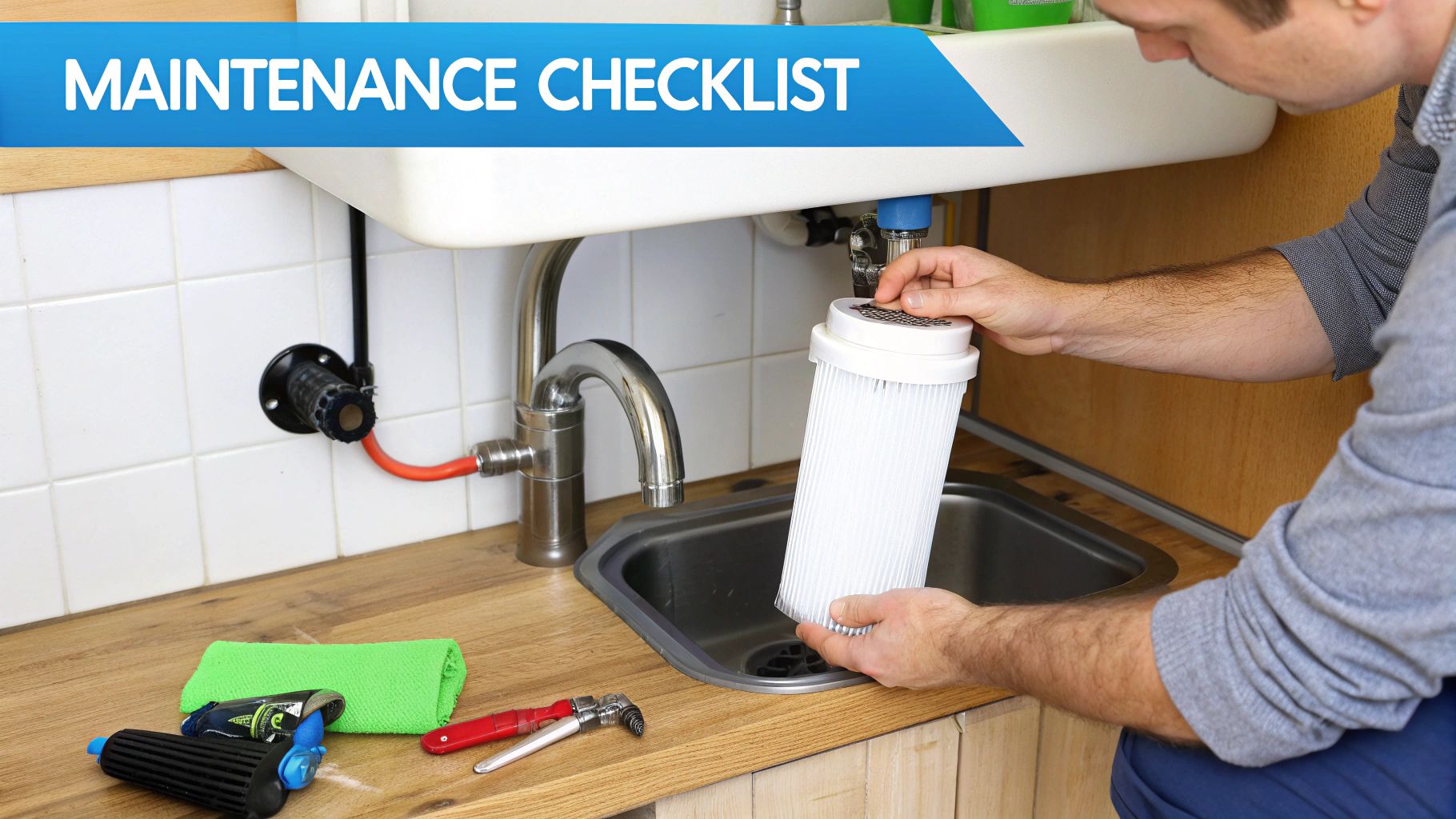
A person's hands replacing a white water filter under a kitchen sink, emphasizing easy maintenance.

Whether you're looking at a small under-sink setup or a full whole-house unit, getting a handle on the setup and upkeep is key. It’s what ensures you’ll get great-tasting, safe water for years to come.

DIY vs. Professional Installation

One of the first things people ask is, "Can I really install this myself?" It really boils down to two things: which system you bought and how friendly you are with a wrench.

  • Under-Sink (POU) Systems: These are practically made for the weekend warrior. Most of the time, you're just mounting the unit under the sink, tapping into the cold water line with some simple push-to-connect fittings, and drilling a hole for a dedicated faucet. If you can follow instructions and aren't afraid of a little plumbing, you can knock this out in an afternoon.

  • Whole-House (POE) Systems: This is a different beast entirely. A whole-house system ties directly into your home's main water line. One wrong move here can mean a serious leak and thousands in water damage. For this reason, we almost always tell people to hire a licensed plumber. It's just not worth the risk.

Let’s be real: while an under-sink system is a perfect DIY project, the peace of mind you get from a pro installing your whole-house system is worth every single penny. You know it’s done right from the start.

Your Simple Maintenance Checklist

When it comes to long-term care, ultra filtration systems are wonderfully low-drama. It’s all about simple, routine check-ups, not complicated repairs. Being proactive here is what keeps your water pure and your system happy. Think of it as a little Planned Preventive Maintenance for your water.

Here’s what a typical schedule looks like:

  1. Sediment & Carbon Pre-Filters (Every 6-12 Months): These guys are the first line of defense, catching big gunk and chlorine before they can reach the main UF membrane. Swapping them out is critical and usually just involves unscrewing the filter housing and popping in a new cartridge. If your water has a lot of sediment, you might be doing this closer to the 6-month mark.

  2. UF Membrane (Every 2-5 Years): The hollow fiber membrane is the heart of the system, and it's built to last. Most systems have a backwashing feature—either automatic or manual—that flushes out the gunk that builds up on the membrane. This self-cleaning process is why the membrane can go for years, often needing replacement only every 2 to 5 years.

  3. System Sanitization (Annually): Once a year, when you're already changing filters, it's a smart idea to sanitize the system. This is a quick step that prevents any nasty bacteria from setting up shop inside the filter housings and keeps your water as fresh as possible.

Stick to this simple routine, and you'll sidestep problems like low water pressure or reduced flow. It's a small bit of effort for a huge payoff: knowing your family’s water is always clean and safe.

Decoding Certifications and Performance Claims

When you’re shopping for an ultrafiltration system, the packaging can be a real headache. It’s usually covered in labels, percentages, and acronyms that make you feel like you need a chemistry degree just to figure out what you’re buying.

But cutting through that marketing noise is the single best way to know if a filter will actually walk the walk. The key is to look for independent, third-party certifications.

Think of a certification as a report card from an unbiased expert. These organizations put the filter through its paces under tough, standardized conditions to verify the manufacturer’s claims. The most respected name in the water filtration game is NSF/ANSI (National Sanitation Foundation/American National Standards Institute).

The Key Certifications to Know

Not all NSF/ANSI certifications are created equal. For home water filters, you’ll mainly see two standards, and they test for completely different things. Knowing the difference is critical.

  • NSF/ANSI 42 – The "Looks and Tastes Better" Standard: If a filter has this stamp of approval, it’s been proven to improve the aesthetics of your water—its look, taste, and smell. This standard focuses on non-health-related issues, like reducing chlorine or particulates that make water cloudy.

  • NSF/ANSI 53 – The "Health and Safety" Standard: This is the big one. A system certified to NSF/ANSI 53 has passed rigorous testing for its ability to reduce specific health-related contaminants like lead, cysts (such as Giardia), asbestos, and certain chemicals.

Any ultrafiltration system built for microbiological safety should, at a bare minimum, have performance data showing it can remove tiny living organisms, which is often validated under protocols similar to NSF/ANSI 53.

Understanding "Log Reduction"

You'll often see performance claims like “99.99% reduction of bacteria.” In scientific terms, this is called a "log reduction," which is just a simple way to talk about really, really big numbers.

A "log reduction" is a measurement of how thoroughly a filter removes contaminants. Each "log" represents a 90% reduction. So, a 1-log reduction is 90%, a 2-log reduction is 99%, a 3-log is 99.9%, and a 4-log is 99.99%.

When a UF system claims a 4-log reduction of bacteria, it means for every 10,000 bacteria that went into the filter, only one made it out the other side. That’s the kind of proven, high-level performance you need when you’re dealing with microscopic threats.

The quality of the filter membrane is what makes this possible. Today, polymeric ultrafiltration membranes are the industry standard, making up 65.0% of the market because they're both durable and affordable. This technology is a huge deal in the water treatment sector, which itself made up 41.7% of all membrane filtration revenue in 2025. You can find more details about membrane filtration technology and see why it's becoming so important.

By looking for these specific, third-party-verified numbers and certifications, you can confidently choose a system. You're no longer just taking a company's word for it—you're relying on proven, scientific data to protect your home's water.

Your Ultra Filtration Questions, Answered

Even after getting the full scoop on ultra filtration, you probably have a few practical questions kicking around. That's perfectly normal. When you're thinking about an investment in your home's water, you want to be sure about the day-to-day details.

We’ve rounded up the most common questions homeowners ask before taking the plunge. Let's get you some clear, straightforward answers.

Will My Water Taste and Smell Better?

On its own, a UF membrane is a physical barrier—it stops particles, not the dissolved stuff like chlorine that can make water taste like a swimming pool.

That's why you'll almost always find high-quality UF systems paired with activated carbon filters. The carbon acts like a sponge for bad tastes and odors, soaking up chlorine and other chemical flavors. The UF membrane handles the germs, but it’s the carbon that delivers that crisp, clean taste.

Is My Water Pressure Going to Drop?

Any filter will add a little bit of resistance, but a properly sized UF system shouldn't cause a noticeable drop in your water pressure. If your shower suddenly feels weak after installation, it's usually a red flag for one of two things.

First, your filter cartridges might just be clogged and screaming for a change. The second possibility is that the system's flow rate isn't high enough for your home's demand. Whole-house systems are built for high flow, but sticking to the maintenance schedule is key to keeping that pressure strong and steady.

How Often Do I Need to Change UF Filters and What’s the Cost?

Filter life really depends on your water quality and how much you use, but here’s a good rule of thumb for budgeting. The main ultra filtration membrane is the workhorse and can last anywhere from 2 to 5 years.

The sediment and carbon pre-filters that protect that main membrane need more frequent swaps, typically every 6 to 12 months.

As for cost, you could be looking at around $50 for a set of under-sink pre-filters or up to a few hundred dollars for a whole-house UF membrane replacement. It’s smart to factor these ongoing costs into your decision to see the true long-term price tag.

When comparing systems, look at the total cost of ownership—the upfront price plus the filter replacements over time. A slightly pricier unit with longer-lasting filters might actually be the better deal in the long run.

Are Ultra Filtration Systems a Good Choice for Well Water?

Absolutely. UF systems are a fantastic line of defense for well water, especially against microbiological threats like bacteria (think E. coli) and general cloudiness from sediment. The membrane is a physical wall these contaminants just can't get through.

But well water can be tricky. It often comes with other issues like hardness minerals, iron, or sulfur that UF won’t touch. That's why getting a comprehensive water test done first is non-negotiable.

More often than not, the best setup for a well is a multi-stage approach—like putting a water softener or an iron filter in front of the UF system. This protects the membrane and tackles all of your water problems at once.

What's the Difference Between UF and UV?

This one trips a lot of people up since both deal with microbiological safety. The main difference is how they do their job.

  • Ultra Filtration (UF) is a physical barrier. It removes contaminants by blocking them with a fine membrane and flushing them away.

  • Ultraviolet (UV) Purification is a disinfection process. It uses a special light to inactivate microorganisms, scrambling their DNA so they can't make you sick.

UF also pulls out physical gunk like silt, making the water clearer. UV, on the other hand, only zaps germs and needs other filters to handle anything else.

Does Ultra Filtration Remove PFAS or "Forever Chemicals"?

This is a huge question right now. A standard UF membrane by itself is not effective against PFAS. These "forever chemicals" are dissolved in water and the molecules are just too small to get caught in the UF membrane's pores.

However, top-tier ultra filtration systems solve this by adding other filtration stages.

  • Activated Carbon: This is the go-to for reducing PFAS in homes. More advanced catalytic carbon is even better at it.
  • Reverse Osmosis (RO): If you want the highest level of removal, RO is the answer. It can eliminate up to 99% of PFAS.
  • Specialty Resins: Some systems use special media designed specifically to grab onto PFAS molecules.

Bottom line: If a water test shows you have PFAS, make sure the system you choose specifically includes one of these technologies. The UF membrane alone won't get the job done.


Choosing the right water filtration system is a significant step toward a healthier home. At Water Filter Advisor, we are committed to providing the clear, research-driven guidance you need to make the best choice for your family.

Explore our in-depth guides and expert reviews at Water Filter Advisor
Nanofiltration Water Filters: The Ultimate Guide to Cleaner, Healthier Home Water

Ever wonder if you could have a water filter smart enough to kick out tiny threats like viruses and lead, but cool enough to leave in the healthy minerals your body actually needs? That’s the magic of nanofiltration water filters. They act like a microscopic bouncer for your water supply, catching all the unwanted party-crashers while waving the good stuff, like calcium and magnesium, right on through. It's a total game-changer for anyone wanting seriously pure, great-tasting water right from the tap.

How Nanofiltration Water Filters Actually Work

Clear display model of water filtration through soil layers, with 'How Nanofiltration Works' on a screen.

The heart of any nanofiltration (NF) system is a high-tech material called a semipermeable membrane. The best way to picture it is like a bouncer at a very exclusive nightclub. Only the most desirable guests—in this case, water molecules and beneficial minerals—get past the velvet rope.

How does it pull this off? The membrane is peppered with incredibly tiny pores, typically between 1 and 10 nanometers wide. To put that in perspective, a single human hair is about 80,000 nanometers thick. These minuscule openings are just big enough for water molecules to squeeze through but small enough to physically block a huge range of unwanted contaminants.

The Power of Pressure and Selectivity

For any of this to happen, the system uses your home’s existing water pressure to push water against the membrane. This force squeezes the clean water through the tiny pores, leaving all the larger gunk behind. That leftover stream of concentrated contaminants gets flushed down the drain, so only purified water ends up at your faucet.

But what really sets nanofiltration apart is its selective nature, which works in two clever ways:

  • Size Exclusion: This one’s pretty simple. If a contaminant particle—think a virus, a pesticide molecule, or a heavy metal ion—is physically bigger than the membrane’s pores, it gets blocked. End of story.
  • Electrostatic Repulsion: Here's where it gets really smart. Many NF membranes have a slight negative charge. Since a lot of dissolved contaminants (like sulfates and phosphates) are also negatively charged, the membrane actively repels them, like two magnets pushing each other away.

This one-two punch allows nanofiltration to do something pretty remarkable: it targets harmful dissolved contaminants that simpler filters can't touch, all while keeping the beneficial minerals like calcium and magnesium that more aggressive systems strip out.

This unique ability is why the technology has taken off. The global market for nanofiltration membranes shot up from $89.1 million in 2006 to over $738 million by 2022, and North America makes up over 32% of that. It’s a testament to how effective these systems are. If you want to dive deeper, you can explore more about the nanofiltration market trends and growth projections. It's this precise, intelligent approach that's making nanofiltration a go-to choice for so many families.

What Contaminants Does Nanofiltration Actually Remove?

When you buy a water filter, you're not just buying a piece of hardware. You're buying the peace of mind that your family is protected from the invisible junk in your tap water. This is where nanofiltration systems really shine, acting as a fine-tuned guardian against a surprisingly wide range of contaminants.

The magic is in the membrane's incredibly tiny pores, typically just 1 to 2 nanometers wide. This isn't just a filter; it's a nearly impenetrable physical barrier. That kind of precision is what makes nanofiltration such a workhorse for keeping your home's water safe.

Tackling Heavy Metals and Industrial Chemicals

A major worry for any homeowner is heavy metals, which can leach from old pipes or find their way into the water supply from industrial runoff. Nanofiltration is exceptionally good at kicking these out.

The membrane is designed to block divalent ions—a science-y term for ions with a double positive charge. This group just happens to include some of the worst offenders:

  • Lead: A powerful neurotoxin that's especially dangerous for kids.
  • Arsenic: A common headache for well water users, linked to serious health problems.
  • Mercury: Often finds its way into water from industrial pollution.
  • Cadmium: Another industrial byproduct you don't want accumulating in your body.

But it's not just about metals. These systems are also a formidable defense against a whole host of man-made chemicals. They do a great job removing pesticides, herbicides, and other volatile organic compounds (VOCs) that can show up in both city and well water. This makes them a critical safety net, especially if you live in an agricultural or industrial area.

Here's a quick rundown of what a typical home nanofiltration system can handle.

Nanofiltration Contaminant Removal Spectrum

This table gives you a general idea of the removal efficiency you can expect from a home nanofiltration system for common contaminants.

Contaminant Category Examples Typical Removal Rate
Heavy Metals Lead, Arsenic, Mercury, Cadmium, Copper 90% – 98%+
Hardness Minerals Calcium, Magnesium 50% – 90%+
Microbiological Bacteria, Viruses, Cysts (Giardia, Crypto) 99%+
"Forever Chemicals" PFOA, PFOS, and other PFAS compounds 90% – 99%
Pesticides/Herbicides Atrazine, Glyphosate 90% – 99%+
Disinfection Byproducts Trihalomethanes (THMs) 85% – 95%
Dissolved Solids (TDS) Sulfates, Nitrates, Chlorides 50% – 80%

Keep in mind that exact performance can vary based on your specific water chemistry and the system you choose, but this shows just how versatile these filters are.

The Modern Solution for Water Hardness

Sick of that chalky white scale building up on your faucets and inside your coffee maker? That’s hard water, caused by too much calcium and magnesium. For years, the only fix was a salt-based water softener that swaps those hardness minerals for sodium.

Nanofiltration offers a smarter, salt-free alternative. Because calcium and magnesium are also divalent ions, the NF membrane catches and removes a big chunk of them—usually 50% to 90%. This "membrane softening" gives you all the perks of softer water, like better soap lather and longer-lasting appliances, without dumping extra salt into your drinking water.

Think of it as a two-for-one deal: you get top-tier purification from harmful contaminants and a built-in, chemical-free water softener. It’s a cleaner way to protect both your health and your home.

Emerging Threats and Microbiological Dangers

Water quality issues are always changing, and one of the biggest headlines today is about PFAS, the infamous "forever chemicals." These things are notoriously tough to get rid of, but nanofiltration is up to the task. Studies have shown NF membranes can achieve 90-99% removal rates for many types of PFAS by physically blocking their large, complex molecules.

Nanofiltration also provides a strong defense against microbiological threats. The pores are small enough to stop:

  • Viruses
  • Bacteria
  • Cysts like Giardia and Cryptosporidium

This is a huge plus for anyone on well water, where biological contamination is a bigger risk. It’s this all-around effectiveness that has made the technology so dominant. In fact, nanofiltration water filters have become a major player, making up 76% of the global water and wastewater treatment market in 2023. They hit the sweet spot of removing micropollutants, ions, and pathogens while letting beneficial minerals pass through—a game-changer for families who want truly reliable, high-quality water. You can read the full research on nanofiltration's market impact and performance to dive deeper.

Nanofiltration Versus Reverse Osmosis and Ultrafiltration

Trying to pick a home water filtration system can feel like navigating a maze. You’ve probably seen terms like Reverse Osmosis, Ultrafiltration, and Nanofiltration floating around, and it’s tough to know which one is right for your kitchen. Let's break down these three powerhouse membrane technologies so you can see exactly how they stack up.

Think of it like sorting things in your kitchen. Ultrafiltration (UF) is your colander—perfect for catching big stuff like pasta, but smaller things like salt slip right through. Reverse Osmosis (RO) is more like a high-end espresso filter; it stops almost everything, letting only pure water pass.

Nanofiltration (NF) hits that perfect "just right" spot in the middle. It's like a fine-mesh tea strainer. It’s tight enough to catch all the unwanted, bitter tea leaves (dissolved contaminants) but loose enough to let the rich flavor of the brew (healthy minerals) flow into your cup. That simple picture is the key to understanding the difference.

A Closer Look at Ultrafiltration

Ultrafiltration systems use a membrane with fairly large pores, measuring around 0.01 to 0.1 microns. This size is great for physically blocking larger particles. We're talking suspended solids, sediment, and pesky microbiological threats like bacteria and protozoa.

The downside? UF can't touch dissolved contaminants. Because its pores are bigger, things like heavy metals, salts, pesticides, and hardness minerals sail right on through. That makes UF a solid choice if your main worry is biological safety from well water, but it won't do much for chemical contamination or hard water problems.

Reverse Osmosis: The Purification Powerhouse

On the complete opposite end, you have Reverse Osmosis. RO uses an incredibly tight membrane with pores as tiny as 0.0001 microns. This lets it remove an almost unbelievable range of contaminants—we're talking up to 99% of all total dissolved solids (TDS).

But that extreme purity comes with a couple of trade-offs. First, RO systems strip out just about everything, including beneficial minerals like calcium and magnesium. This can leave the water tasting flat or "empty." Second, the process can be inefficient. Older RO systems were notorious for wasting up to 4 gallons of water for every single gallon they purified.

Reverse Osmosis gives you the absolute highest level of purity, but you sacrifice mineral content and water efficiency to get it. It’s the ultimate purification tool, but it's often overkill unless you truly need sterile-grade water.

Nanofiltration: The Balanced Solution

This is exactly where nanofiltration water filters shine. With a pore size of about 0.001 microns, an NF membrane is perfectly wedged between UF and RO. It’s small enough to remove the vast majority of harmful dissolved contaminants that UF simply can't catch.

This diagram gives you a great visual of what nanofiltration is designed to remove, from heavy metals all the way down to microscopic organisms.

Diagram illustrating nanofiltration's effectiveness in removing heavy metals, chemicals, and organisms from water.

As you can see, NF acts as a powerful, multi-layered shield against a huge range of common household water pollutants.

But what really makes nanofiltration special is what it leaves in. The pores are engineered to let healthy monovalent ions, like calcium and magnesium, pass right through. You get the peace of mind that comes with near-RO level purification while keeping the beneficial minerals that make water taste great and support your health.

To make it even clearer, let's put these three technologies head-to-head.

Comparing Home Water Filtration Membranes

This table breaks down the key differences between Nanofiltration, Reverse Osmosis, and Ultrafiltration at a glance.

Feature Nanofiltration (NF) Reverse Osmosis (RO) Ultrafiltration (UF)
Pore Size ~0.001 micron ~0.0001 micron ~0.01 micron
Operating Pressure Moderate (100-300 PSI) High (150-600 PSI) Low (30-100 PSI)
Contaminant Removal Heavy metals, PFAS, viruses, hardness, pesticides Nearly all TDS, including minerals, salts, and chemicals Bacteria, sediment, viruses, protozoa
Mineral Retention Yes, retains beneficial minerals like calcium and magnesium. No, removes nearly all minerals, resulting in demineralized water. Yes, all dissolved minerals pass through freely.
Water Efficiency Good (80-95% recovery) Fair (50-75% recovery) Excellent (nearly 100% recovery)

The comparison really highlights why nanofiltration is often seen as the ideal compromise. It’s far more water-efficient than RO, with some systems boasting an impressive 80-95% water recovery rate. It also runs on lower pressure, which can mean lower energy bills over time.

For most homeowners, nanofiltration offers robust protection against today's biggest water threats—from lead and PFAS to viruses and hardness minerals—all without the downsides of demineralized water or excessive waste. It’s a smart, balanced approach to getting clean, healthy, and great-tasting water for your entire home.

How To Choose the Right Nanofiltration System for Your Home

Deciding to bring a nanofiltration system into your home is a fantastic step toward cleaner, safer water. But once you start shopping, it's easy to feel a little overwhelmed by the options. The secret is to match the system to your home’s unique needs, and that all starts with one simple question: where do you need the filtered water?

Generally, you’ll find nanofiltration water filters fall into two main camps: point-of-use and point-of-entry. They’re each built for a completely different job.

Point-of-Use vs. Point-of-Entry Systems

A Point-of-Use (POU) system is your specialist. Think of it as a precision tool. These are typically compact units that get installed right under your kitchen sink to feed a single, dedicated faucet. They’re perfect for delivering that ultra-pure water right where you need it for drinking, cooking, and filling up your water bottle.

On the other hand, a Point-of-Entry (POE) system is the guardian of your entire home. Often called a "whole-house" filter, this much larger unit is installed at the main water line where it first enters your house. This means every single tap—from the kitchen and bathrooms to your shower and washing machine—gets treated, nanofiltered water.

Here’s a quick way to figure out which is for you:

  • Choose Point-of-Use if: Your main concern is top-quality drinking and cooking water, and you’re okay with your existing water for things like showering and laundry.
  • Choose Point-of-Entry if: You want the benefits of softened, purified water everywhere. This is the way to go if you want to protect your plumbing and appliances from scale and reduce your family's exposure to contaminants in the shower.

Your Practical Buying Checklist

Once you’ve settled on POU vs. POE, it’s time to get into the nitty-gritty. This checklist will help you narrow the field and find a system that’s the right fit, so you don't end up overspending or, worse, buying a filter that doesn't solve your problem.

  1. Test Your Water First: This is non-negotiable. You can't fix a problem you haven't identified. A good lab test reveals exactly what’s lurking in your water—hardness minerals, specific heavy metals, bacteria, or chemicals like PFAS. These results are your roadmap to choosing a filter certified to remove your specific contaminants.

  2. Calculate Your Daily Water Use: How much water does your family go through? A small POU system might be fine for a couple, but a bigger family will likely need a whole-house unit with a higher flow rate. Flow rate is measured in gallons per minute (GPM) and is especially critical for POE systems. You need enough GPM to run a shower and a load of laundry at the same time without the water pressure dropping to a trickle.

  3. Scope Out Your Plumbing and Space: Before you click "buy," take a look under your sink or in your utility closet. Do you have enough space for a POU system under the kitchen sink? For a whole-house POE system, you'll need a decent amount of room near your main water line, usually in a basement, garage, or utility room. Also, be honest about your DIY skills—most POE systems require a professional plumber for installation.

  4. Budget for Maintenance and Filters: The upfront price is just the beginning. You need to investigate the cost and replacement schedule for the pre-filters and the main nanofiltration membrane. A system with affordable, long-lasting filters can save you a ton of money over its lifespan. For more general advice on picking the right system, our water filtration advice and guides can be a big help.

The Importance of Certifications

In the world of water filtration, anyone can make a claim. Proof is what really counts. That’s where independent certifications from organizations like the NSF (National Sanitation Foundation) and the ANSI (American National Standards Institute) become so important.

An NSF/ANSI certification isn't just a fancy sticker on the box; it's a guarantee. It means the system has been put through its paces by an independent third party to confirm it meets strict standards for material safety and its ability to actually remove the contaminants it claims to.

When you're shopping, look for specific standards that align with your water test results. For instance, NSF/ANSI 58 is a key certification for systems that remove dissolved solids and certain health-related contaminants. NSF/ANSI 42, on the other hand, deals with aesthetic issues like the taste and smell of chlorine. Choosing a certified system is your best assurance that you're getting a product that will do what it promises.

Installation, Maintenance, and Long-Term Costs

A person's hand adjusting an under-sink water filter, with a 'MAINTENANCE SCHEDULE' text overlay.

A great nanofiltration water filter isn't just a one-time purchase. It's an investment in your home and your health, and understanding what comes after you get it home is crucial for making sure it runs smoothly for years. We'll walk through everything from installation day to routine filter changes so you know exactly what to expect.

Getting your system up and running is the first step, and the process really depends on whether you've chosen a smaller under-sink unit or a whole-house system.

If you have a point-of-use (POU) system that goes under your kitchen sink, there's a good chance you can handle the installation yourself. Most kits come with clear instructions and all the fittings you need to hook into your cold water line and add a separate faucet. If you're comfortable with basic plumbing, you can probably get it done in a couple of hours.

Whole-house, or point-of-entry (POE), systems are a different beast entirely. These units connect right where your main water line enters your home, which usually means cutting and fitting pipes. Unless you've got serious plumbing experience, this is a job for a professional. They'll make sure it's installed correctly and up to local code.

A Smart Maintenance Schedule is Key

Once your filter is installed, regular maintenance is the single most important thing you can do to keep it working properly. It’s just like changing the oil in your car—if you skip it, you’re eventually going to have problems. A typical nanofiltration system has a few different stages, and each one needs attention at different times.

Here’s what a typical maintenance calendar looks like:

  • Pre-Filters (Sediment and Carbon): Think of these as the bodyguards for your system. They catch the big stuff like dirt, rust, and chlorine before it can damage the more delicate NF membrane. They take the most abuse, so you'll need to replace them every 6 to 12 months.
  • Nanofiltration Membrane: This is the heart of the whole operation. Because the pre-filters do such a good job protecting it, the membrane lasts a lot longer. Expect to replace it every 2 to 4 years, depending on your water quality and how much you use it.

Sticking to this schedule is non-negotiable. If your pre-filters get clogged, water pressure will drop and the membrane will have to work overtime, wearing it out faster. If the membrane itself gets fouled, it won’t remove contaminants effectively, defeating the whole purpose of the filter. It's a good idea to get familiar with filter changes in general—even learning how to change a Maytag refrigerator water filter gives you a better sense of the upkeep involved with water purification.

Here's a pro tip: Set reminders on your phone or calendar for your filter changes. It's a simple habit that takes the guesswork out of maintenance and ensures your system is always delivering the clean, safe water you paid for.

The True Cost of Owning an NF System

To really understand the cost, you have to look past the sticker price. The true cost of ownership includes the initial purchase and the ongoing cost of replacement filters. While prices vary, we can map out a pretty realistic budget.

Let's break down the typical five-year costs for a quality under-sink nanofiltration system:

Cost Component Year 1 Years 2-5 (Annual Average) Total 5-Year Cost
Initial System Purchase $300 – $600 $0 $300 – $600
Annual Pre-Filter Set $50 – $100 $50 – $100 $250 – $500
NF Membrane (Replaced Once) $0 $25 – $40 (prorated) $100 – $160
Total Estimated Cost $350 – $700 $75 – $140 $650 – $1,260

As you can see, after that first year, a good system can cost as little as $75 to $140 a year to keep running. Knowing these numbers upfront helps you plan and avoid any financial surprises. By investing in regular maintenance, you're not just taking care of your filter—you're guaranteeing your family has access to pure, healthy water for the long haul.

Frequently Asked Questions About Nanofiltration

Diving into the world of advanced water filtration can bring up a lot of questions. We get it. This last section tackles the most common things homeowners ask us about nanofiltration water filters. Let's get you some clear, straightforward answers so you can feel good about your decision.

Is Nanofiltration Better Than a Water Softener?

Think of nanofiltration as the modern, salt-free evolution of a traditional water softener. There's a reason it's often called "membrane softening." Instead of just swapping hardness minerals for sodium, it physically blocks and removes a huge chunk of the calcium and magnesium in your water.

This gives you all the perks of soft water—no more scale in your pipes, appliances that last longer, and soap that actually lathers up—without adding any salt. If you're dealing with both hard water and other headaches like heavy metals or pesticides, a nanofiltration system is a much more complete, all-in-one solution than a standard softener could ever be.

Do Nanofiltration Systems Waste Water?

Yes, like reverse osmosis, nanofiltration systems have to flush away the contaminants they catch, creating a stream of wastewater. The good news? They are designed to be way more efficient.

Older RO systems were notorious for wasting three or even four gallons for every single gallon of pure water they made. Modern nanofiltration systems have seriously improved recovery rates. Many top-tier home systems now run close to a 1-to-1 ratio. That means you're only sending about one gallon of water down the drain for every gallon of pure water you get. It's a much more water-conscious choice for anyone wanting serious purification without the guilt.

A huge plus for nanofiltration is its high water recovery. Systems can hit 80-95% water recovery, making them a more sustainable choice than typical RO units, which often top out around 50-75%.

Will Nanofiltration Lower My Water Pressure?

Anytime you add a filter to your plumbing, you can expect a slight drop in water pressure—the water just has to push through more stuff. But don't worry, modern whole-house nanofiltration systems are built specifically to keep this from being an issue.

To make sure you don't notice a difference, many of these point-of-entry systems come with a booster pump. This little workhorse keeps your pressure strong and steady for everything from a powerful shower to running the washing machine. As long as the system is sized correctly for your home and installed by a pro, any pressure change is usually so small you'll never even notice it. And for a simple under-sink system that just feeds one faucet? The impact on your home's overall pressure is practically zero.

Can I Use a Nanofiltration Filter with Well Water?

Absolutely. In fact, nanofiltration is a fantastic solution for well water. It's a powerhouse that tackles a whole range of common well water problems at once, giving you a solid defense against whatever might be lurking in your private well.

A single NF system can handle:

  • Hardness: It knocks down the high levels of calcium and magnesium that are so common in well water.
  • Microbiological Threats: The membrane's tiny pores are a physical barrier against bacteria, viruses, and cysts.
  • Agricultural Runoff: It’s great at pulling out nitrates, pesticides, and herbicides.
  • Heavy Metals: It removes iron and other dissolved metals that stain your fixtures and make water taste bad.

The secret to success with well water is proper pre-treatment. Wells often kick up a lot of sediment, iron, and other gunk that can clog up and ruin a delicate nanofiltration membrane in no time. Installing a good sediment filter—and sometimes an iron filter or water conditioner—before the NF unit is a must. It's the smart move to protect your investment and ensure your system pumps out pure, safe water for years to come.


At Water Filter Advisor, our mission is to give you the clear, practical guidance you need to find the perfect water filtration solution for your home. We turn complex data into simple advice so you can protect your family with confidence. To continue your journey toward cleaner, better-tasting water, explore our comprehensive guides and reviews at https://www.waterfilteradvisor.com.

A Homeowner’s Guide to Block Carbon Filter Water Systems

Imagine turning on your kitchen tap and getting water that’s not just safe, but tastes crisp, clean, and refreshing every single time. That’s the magic of a block carbon filter, a quiet hero in the world of home water purification. It's the ultimate fix for common annoyances, like that swimming pool scent in your morning coffee or the invisible chemicals you'd rather not be drinking.

Your Guide to Purer Water

Think of a carbon block as a microscopic maze with magnetic walls. As water flows through, the maze physically traps gunk like sediment and rust. At the same time, the carbon's massive internal surface area acts like a chemical super-magnet, pulling nasty contaminants out of the water and holding onto them through a process called adsorption. It’s a simple concept with seriously powerful results for your home.

This guide will walk you through everything you need to know about this essential home upgrade. We'll cover:

  • How these impressive filters are actually made and the science behind how they work.
  • The specific contaminants they target to protect your family's health.
  • How to choose the perfect system for your home, whether you own or rent.

The Growing Demand for Clean Water

The rising popularity of carbon block filters isn’t just a trend; it's a direct response to growing concerns about what’s really in our tap water. Families everywhere are deciding they want more control over their water quality, looking for reliable ways to remove chlorine, volatile organic compounds (VOCs), and funky odors. It’s a smart investment in your family's well-being. A high-quality filtration system delivers immediate benefits, from better-tasting food and drinks to protecting your home’s appliances from sediment buildup.

By removing impurities right at the source, a block carbon filter provides peace of mind with every glass. It transforms your tap water from a source of uncertainty into a reliable foundation for a healthier household.

Ready to take the next step? For more expert insights and comparisons, check out our comprehensive water filter advice to find the perfect solution for your needs. This guide will give you the practical knowledge you need to make a confident choice.

How a Block Carbon Filter Purifies Your Water

It might surprise you to learn that a carbon block filter starts out as something pretty basic, like coconut shells or coal. These raw materials are super-heated in a low-oxygen chamber, which transforms them into a fine powder called activated carbon. But this isn't your average powder—it's incredibly porous, with millions of microscopic nooks and crannies.

That activated carbon powder is then mixed with a food-grade binder and squished under extreme pressure, forming a solid, dense block. The final product looks simple, but it’s hiding an incredible secret: a massive internal surface area. In fact, a single gram of this material can have more surface area than an entire football field.

The Two-Stage Purification Powerhouse

When tap water passes through a carbon block, it gets cleaned in two distinct ways. This dual-action approach is what makes these filters so incredibly effective, using a one-two punch of physical blocking and chemical attraction.

First up is mechanical filtration. Think of the filter as an extremely fine screen. As water is forced through its tightly packed structure, the filter physically traps and holds onto larger particles.

  • Silt and Sediment: This is the stuff that makes water look cloudy or murky.
  • Rust Flakes: Flakes from older pipes get caught before they can get into your glass.
  • Organic Debris: Tiny bits of sand, dirt, and other gunk are strained out.

This first step clears up the water, but the real magic happens next, at a level you can't even see.

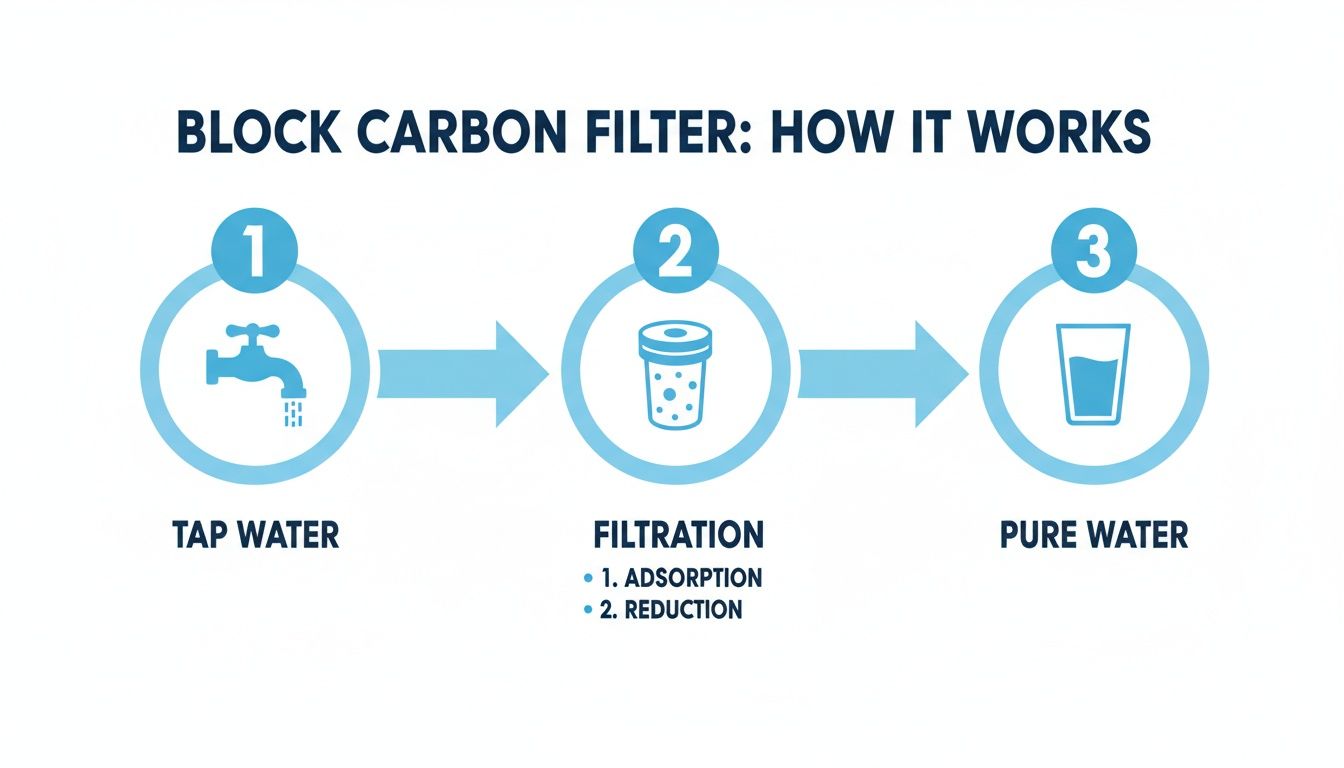
This infographic shows the simple yet effective journey your water takes through a block carbon filter system.

Infographic showing the three steps of block carbon water filtration: tap, filtration, pure water.

As you can see, the process efficiently turns standard tap water into purified drinking water just by passing it through the specialized carbon block.

Adsorption: The Chemical Magnet

The second, and more powerful, stage is called adsorption. Now, it’s easy to mix this up with absorption, but they're totally different. A sponge absorbs water by soaking it all up. Adsorption is more like static cling or a chemical magnet.

As the water snakes its way through the filter's maze-like interior, dissolved chemical contaminants are attracted to the carbon's surface and literally stick to it. This chemical bond yanks them right out of the water, locking them inside the filter for good.

Think of the carbon block's vast internal surface as a massive parking lot for contaminants. Adsorption is the process that directs unwanted chemicals like chlorine and pesticides into parking spots, where they remain locked away, allowing only clean water molecules to drive past.

This unique ability to grab and hold onto impurities is what allows a block carbon filter to make such a dramatic difference in your water's taste and smell, all while targeting specific chemicals that are a concern for your health.

Preventing a Common Filter Flaw

One of the biggest wins for the solid block design is that it prevents a problem called channeling. In looser filter media, like some granular activated carbon (GAC) filters, water can carve out little tunnels—the path of least resistance—and flow right through without being properly treated.

When that happens, a good chunk of the water bypasses the filtration media entirely. The solid, compressed structure of a carbon block makes that impossible. Every single drop of water is forced to take the long, scenic route through the dense carbon, which guarantees maximum contact time and ensures no contaminant gets a free pass. It’s this reliability that makes block filters a go-to choice for anyone wanting consistently clean water.

What Contaminants Do Carbon Block Filters Actually Remove?

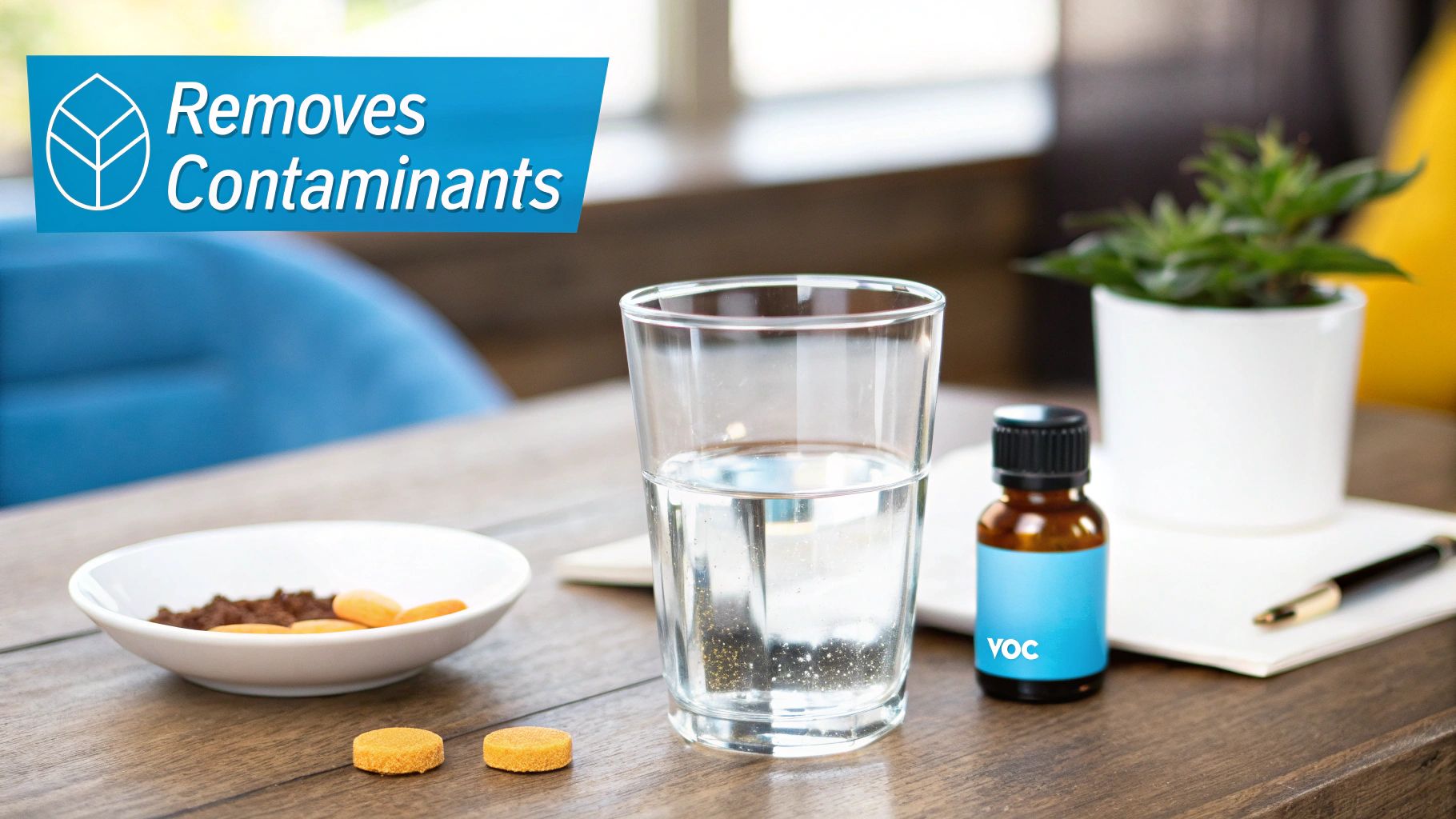
A clear glass of water, supplements, and a 'VOC' bottle on a wooden table, emphasizing contaminant removal.

Alright, now that we've pulled back the curtain on how a block carbon filter works its magic, let's get into the nitty-gritty. What is this little powerhouse actually pulling out of your tap water?

Knowing what a filter is designed to target—and just as importantly, what it leaves behind—is the absolute key to choosing the right one for your home and feeling confident about it. We can group the stuff a carbon block filter grabs into three main categories.

Better Taste and Smell

This is where you'll notice the most immediate difference. If your tap water tastes a bit "off" or has a funky chemical smell, a carbon block filter is your new best friend. It’s fantastic at grabbing the compounds that cause these common annoyances.

  • Chlorine: This is the big one. Your city uses chlorine to keep the water supply safe, which we want, but nobody loves that swimming pool taste and smell it leaves behind. Carbon filters are champs at removing chlorine, completely changing your water's flavor for the better.
  • Hydrogen Sulfide: Ever turn on the tap and get that "rotten egg" smell? That's hydrogen sulfide. Carbon filters do a great job of reducing it, making your water much more pleasant to be around.

If you want to dig deeper into why that chlorine taste is so common, it’s worth understanding the ugly truth about chlorine in your tap water and why getting rid of it is a win for both taste and health.

Health-Critical Contaminants

This is where a quality carbon block filter really earns its keep. It's not just about making water taste good; it’s about creating a crucial line of defense against a whole host of potentially nasty chemicals.

These filters are especially good at adsorbing organic, carbon-based chemicals that you can't see, smell, or taste.

  • Volatile Organic Compounds (VOCs): This is a huge category of chemicals that includes industrial solvents and components of gasoline that can unfortunately find their way into groundwater. A solid carbon block is highly effective at trapping many of them.
  • Pesticides and Herbicides: Agricultural runoff can taint water supplies with these chemicals, but activated carbon is proven to reduce them significantly.
  • Trihalomethanes (TTHMs): These are sneaky disinfection byproducts that form when chlorine mixes with organic matter in the water. They are a genuine health concern, and certified carbon filters are specifically tested to remove them.

The ability to remove these invisible contaminants is what elevates a block carbon filter from a simple taste-improver to an essential health-focused appliance in your home. It’s the protection you can't see that often matters most.

Grabbing Physical Gunk

Finally, that dense, tightly packed structure we talked about makes a carbon block a fantastic mechanical filter. It physically blocks and traps tiny particles that make water look cloudy or murky.

This includes common culprits like:

  • Sediment and Silt
  • Sand and Dirt
  • Rust Flakes from old pipes

By straining out this grit, the filter doesn't just make your water clearer. It also protects your coffee maker, ice machine, and other appliances from getting clogged up.

Carbon Block Filter Contaminant Removal Guide

To make it even clearer, here’s a quick-reference table that lays out what carbon block filters are great at removing and what they typically leave behind.

Contaminant Category Specific Examples Effectively Removed by Carbon Block? Notes for Homeowners
Aesthetic Contaminants Chlorine, Hydrogen Sulfide (rotten egg smell), Chloramines Yes This is the primary reason many people install them—for dramatically better taste and odor.
Organic Chemicals Pesticides, Herbicides, VOCs, TTHMs Yes Carbon's porous structure is ideal for adsorbing these carbon-based compounds.
Physical Particulates Sediment, Silt, Sand, Rust Flakes Yes The dense block acts as a sieve, physically trapping particles down to its micron rating.
Heavy Metals Lead, Mercury, Arsenic Sometimes Standard carbon blocks are not effective. Specialized "catalytic" or modified blocks can reduce lead, but always check for specific NSF certifications.
Dissolved Minerals Calcium, Magnesium, Potassium, Fluoride, Salts No These healthy minerals pass right through, which is generally a good thing. Carbon filters do not soften water.
Microorganisms Bacteria, Viruses, Cysts (like Giardia) No (Typically) Standard carbon filters don't remove these. You need a sub-micron filter (e.g., 0.5 microns for cysts) or a dedicated UV purification system.

This table shows that while carbon block filters are incredibly versatile, they aren't a silver bullet. Understanding their specific strengths helps you build the right water treatment plan for your home.

What Carbon Filters Don't Remove

It’s crucial to be realistic about what a carbon filter can't do. Think of it as a specialized tool, not a cure-all for every possible water problem.

Here are a few things they generally won't touch:

  • Beneficial Minerals: Healthy stuff like calcium, magnesium, and potassium flows right through. This is good! These minerals are great for you and give water a pleasant taste.
  • Dissolved Solids: This includes salts, which means a carbon filter won't fix hard water.
  • Most Microorganisms: Standard carbon blocks are not designed to remove bacteria or viruses. For that, you need a specialized system like a UV purifier.
  • Fluoride: This is another dissolved mineral that carbon adsorption doesn't capture.
  • Heavy Metals: While some high-end carbon blocks are treated to reduce lead, your average filter isn't going to reliably remove things like lead, arsenic, or mercury.

Knowing these limitations is powerful. For many homes, a carbon block filter is the perfect all-in-one solution. But if you have more complex water issues, it serves as a critical first step in a more comprehensive multi-stage filtration system.

Choosing the Right Carbon Block Filter for Your Home

Finding the perfect carbon block filter for your home isn’t about grabbing the most expensive one off the shelf. It's about matching the right technology to what you actually need.

Whether you're a homeowner dreaming of a whole-house solution or a renter who just needs something simple for the kitchen sink, understanding a few key specs will help you see past the marketing hype and make a choice you can feel good about. Let's break down the technical jargon into practical terms.

Decoding the Tech Specs

When you start comparing filters, you’ll see a few numbers pop up again and again: micron rating, flow rate, and capacity. Getting a handle on these makes the whole process a lot less intimidating.

  • Micron Rating: This is all about how fine the filter's mesh is. A micron is a microscopic unit of measurement, so this number tells you the size of the smallest particle the filter can reliably trap. A 5-micron filter is great for catching sediment, but a super-dense 0.5-micron filter is what you need to capture tiny cysts like Giardia.
  • Flow Rate: Measured in gallons per minute (GPM), this tells you how fast water can actually move through the filter. A low flow rate might be fine for a single kitchen tap, but for a whole-house system, you'll want a much higher GPM to avoid weak showers and slow-filling washing machines.
  • Capacity: This is the filter's lifespan, measured in gallons. It’s an estimate of how much water it can purify before it gets clogged with contaminants and needs to be replaced.

Finding Your Perfect System Type

Carbon block filters are the powerful engine inside many different types of water purification systems. The best setup for you really depends on your budget, your living situation, and how much of your home's water you want to treat.

Here are the most common ways they're packaged:

  • Faucet-Mounted Filters: These little guys attach directly to your kitchen tap. They're incredibly easy to install, which makes them a go-to for renters or anyone wanting a quick, targeted fix for their drinking and cooking water.
  • Refrigerator Filters: If your fridge has a water and ice dispenser, it's almost certainly using a small carbon block filter. These are awesome for convenience but only treat the water coming from that one appliance.
  • Under-Sink Systems: Installed out of sight beneath the kitchen sink, these systems feed filtered water to a dedicated, smaller faucet. They strike a great balance between performance and convenience, usually offering a much higher capacity than the faucet-mounted options.
  • Whole-House Systems: This is the most comprehensive solution you can get. Installed where the main water line enters your home, a whole-house system treats every single drop of water you use—for drinking, cooking, showering, and doing laundry.

The Gold Standard: NSF Certifications

So, how do you really know if a filter does what it claims? You look for the seal of approval from NSF International (formerly the National Sanitation Foundation). These independent, third-party tests are the only way to be sure you're getting what you pay for.

Think of NSF/ANSI certifications as a trusted report card for your filter. They prove a product has been rigorously tested and meets strict standards for contaminant removal, so you know you're getting the protection you expect.

Two certifications are particularly important for carbon block filters:

  1. NSF/ANSI 42: This standard focuses on aesthetic effects, like removing that chlorine taste and smell from city water. If you're mainly after better-tasting water, this is the seal to look for.
  2. NSF/ANSI 53: This one is all about health effects. Filters with this certification are proven to reduce specific health-related contaminants like lead, certain VOCs, and cysts.

Which Carbon Filter System Is Right For You?

This table breaks down the most popular home water filter systems that rely on carbon blocks. Use it to compare options based on installation, cost, and how much of your home’s water they cover.

Filter System Type Best For Typical Installation Pros Cons
Faucet-Mounted Renters, budget-conscious individuals, quick kitchen fix DIY, screws onto existing faucet in minutes Very affordable, easy to install/remove, targets drinking water Slower flow, frequent filter changes, may not fit all faucets
Refrigerator Convenience, filtered ice and water from the fridge DIY, usually involves twisting or pushing in a cartridge Extremely convenient, improves taste of water/ice Only filters fridge water, proprietary and can be expensive
Under-Sink Homeowners wanting dedicated filtered tap Moderate DIY or plumber-assisted High capacity, out of sight, excellent performance Requires under-sink space, may need a hole drilled for a new faucet
Whole-House Homeowners wanting comprehensive filtration Professional installation recommended Filters all water in the house, protects plumbing/appliances Higher upfront cost, larger footprint, more involved installation

Ultimately, choosing the right system comes down to your primary goals. If it's just better-tasting drinking water, an under-sink or faucet model is perfect. If you want to protect your whole home, a whole-house system is the way to go.

By focusing on certified performance and the right system for your lifestyle, you can find a filter that delivers pure, great-tasting water for years to come. To get a wider view, you might find it helpful for understanding carbon filter technology in a broader context and seeing how it stacks up against other methods.

Putting Your Filter to Work: Installation and Upkeep

Alright, you've picked out the perfect block carbon filter. Now for the important part: getting it installed and keeping it running smoothly. Proper setup and a little routine care are all it takes to get that clean, tasty water you're after.

The very first thing you need to do with a new carbon filter is also the one most people skip. You have to flush it. New filters often have some loose carbon dust, or "fines," which is just harmless residue from the manufacturing line.

Running cold water through the filter for a few minutes before you start drinking from it washes all that dust away. This simple step prevents any cloudy water or little black specks from showing up in your glass and gets your system started on the right foot.

Quick Tips for a Smooth Installation

Putting in a water filter can feel like a big job, but most systems made for homes are pretty simple. Whether you've got an under-sink model or a whole-house unit, these tips will help you avoid the most common pitfalls.

  1. Read the Manual: I know, I know. But seriously, taking five minutes to scan the manufacturer's instructions can save you an hour of headaches.
  2. Shut Off the Water: Before you loosen a single connection, find the shut-off valve for the line you're working on and turn it off. It's the only way to guarantee you won't flood your kitchen.
  3. Do a Leak Check: After everything is hooked up, turn the water back on slowly. Then, meticulously check every connection point for drips. Even a tiny, slow leak can cause a world of damage if it goes unnoticed.

Knowing When It's Time for a Change

So, how do you know when your filter is spent? Manufacturers give you a ballpark timeframe, like every six months, but the real answer depends on your water and how much of it you use. The best way to know for sure is to just pay attention.

There are two dead giveaways that your filter needs to be replaced:

  • Your Water Pressure Drops: This is the most obvious sign. As the filter catches more and more gunk, it gets clogged, and the water has a harder time getting through. If your faucet flow has slowed to a trickle, the filter is full.
  • Bad Tastes and Smells Come Back: Remember that chlorine smell you wanted to get rid of? If you start tasting it again, it means the carbon is maxed out. Its contaminant "parking lot" is full, and new stuff is just passing right through.

Forget the calendar. The best way to maintain your water quality is to watch for these two clues—slower flow and returning tastes. That way, you're changing the filter based on its actual condition, not just a date.

Why You Can't Just Wash and Reuse a Carbon Filter

It's a logical question: can't I just give the filter a good rinse and pop it back in? With a block carbon filter, the answer is a hard no, and here's why. The filter works through adsorption, a process where contaminants get chemically stuck to the carbon's massive internal surface.

Once those microscopic pores are filled up, they're full for good. There's no way for a homeowner to scrub or flush those trapped chemicals out. Trying to clean it won't work, and you'll probably damage the filter's solid structure, which could let unfiltered water sneak right through.

Think of it like a dead battery. Once it's used up, you can't just shake it back to life. The filter did its job protecting you, and the only way to get that protection back is to put in a fresh cartridge. A little bit of simple maintenance goes a long way in guaranteeing you'll have pure, healthy water for years.

Your Top Questions About Block Carbon Filters

When you start digging into water filtration, a lot of questions pop up. It's totally normal. You're trying to figure out which technology is best, how it will actually affect your home, and how to get the most bang for your buck. Let's tackle some of the most common questions we hear about the workhorse of water filtration: the block carbon filter.

Are Block Carbon Filters Actually Better Than Granular Filters?

This is a great question because it gets right to the core of how these filters work. Think of it this way: a Granular Activated Carbon (GAC) filter is like a big jar of marbles. Water can find little gaps and channels to zip through, sometimes missing a lot of the filtration media.

A block carbon filter, on the other hand, is like a solid brick of compressed sand. Water has no choice but to slowly and methodically work its way through the entire dense structure. This forced contact is what makes all the difference.

That's why a certified carbon block is almost always the better pick for removing serious health-related contaminants like lead or VOCs in your home. For consistent and reliable filtration, the block design is simply superior because it eliminates "channeling," where water takes the easy way out.

Will a Block Carbon Filter Kill My Water Pressure?

Yes, any filter will cause a small drop in pressure, but it's usually so minor you won't even notice. The real factor here is the filter's micron rating. A filter with a very fine 0.5-micron rating has much smaller pores than a standard 5-micron one, so it will restrict the flow a bit more.

For a single faucet at your kitchen sink, this is rarely an issue. But for a whole-house system, you absolutely need to pay attention to this. Make sure the system you choose is properly sized for your home's plumbing. Always check the gallons per minute (GPM) flow rate to ensure it can keep up with your showers and appliances.

How Do I Really Know When to Replace the Filter?

Forget the calendar. While manufacturers give you a ballpark estimate like "every six months," your water and your house will give you much clearer signals.

Here are the two dead giveaways that it's time for a new filter:

  1. Your Water Pressure Drops Noticeably: This is the most obvious sign. As the filter does its job trapping gunk and sediment, it slowly gets clogged. When your faucet flow turns into a sad trickle, it's begging for a replacement.
  2. Bad Tastes and Smells Come Back: Remember that chlorine smell your water used to have? If it starts creeping back in, the carbon is maxed out. Think of it like a parking lot—once all the spots are full, new contaminants have nowhere to go and just drive right on through.

Trust these real-world signs. It’s always better to change a filter a bit early than to wait until it’s not doing its job anymore.

Can I Use a Block Carbon Filter for My Well Water?

You bet, but it should never be the only thing you use. A block carbon filter is fantastic for handling the organic stuff often found in well water, like pesticides or herbicides, that can make it taste and smell funky.

The thing is, well water usually has other baggage that carbon can't handle alone, such as:

  • Heavy Sediment: Sand and silt will clog a carbon filter in no time.
  • Bacteria/Viruses: Carbon filters trap things; they don't kill microorganisms.
  • Iron & Manganese: These minerals cause those lovely orange stains and need special filters.

A smart well water setup will almost always have a sediment pre-filter before the carbon block to protect it, and often a UV purifier after it to zap any bacteria. The first step, no matter what, is to get your well water tested so you know exactly what you're up against.


At Water Filter Advisor, our goal is to cut through the confusion and help you find the right filtration solution for your home. Check out our guides and reviews to make a smart decision for your family. Visit us at https://www.waterfilteradvisor.com to get started on your path to cleaner, safer water.

Will Reverse Osmosis Remove Bacteria? Let’s Find Out If Your Tap Water Is Safe

In a word: Absolutely. When your reverse osmosis (RO) system is running as it should, it's one of the most powerful shields you can have against bacteria in your drinking water.

The secret sauce is its semipermeable membrane. This isn't just a simple strainer; it's a high-tech barrier with microscopic pores so ridiculously small that bacteria are stopped cold. Think of it as an elite bouncer for your water line—only the pure H₂O molecules get on the guest list.

Why Reverse Osmosis Is a Powerhouse Against Bacteria

When you're after truly pure water straight from your tap, few things offer the peace of mind of a reverse osmosis system. It’s more than just another filter; it’s a physical barricade that operates at a microscopic level, creating a formidable defense against all sorts of nasty waterborne germs. It doesn't just filter—it actively rejects the contaminants that could make your family sick.

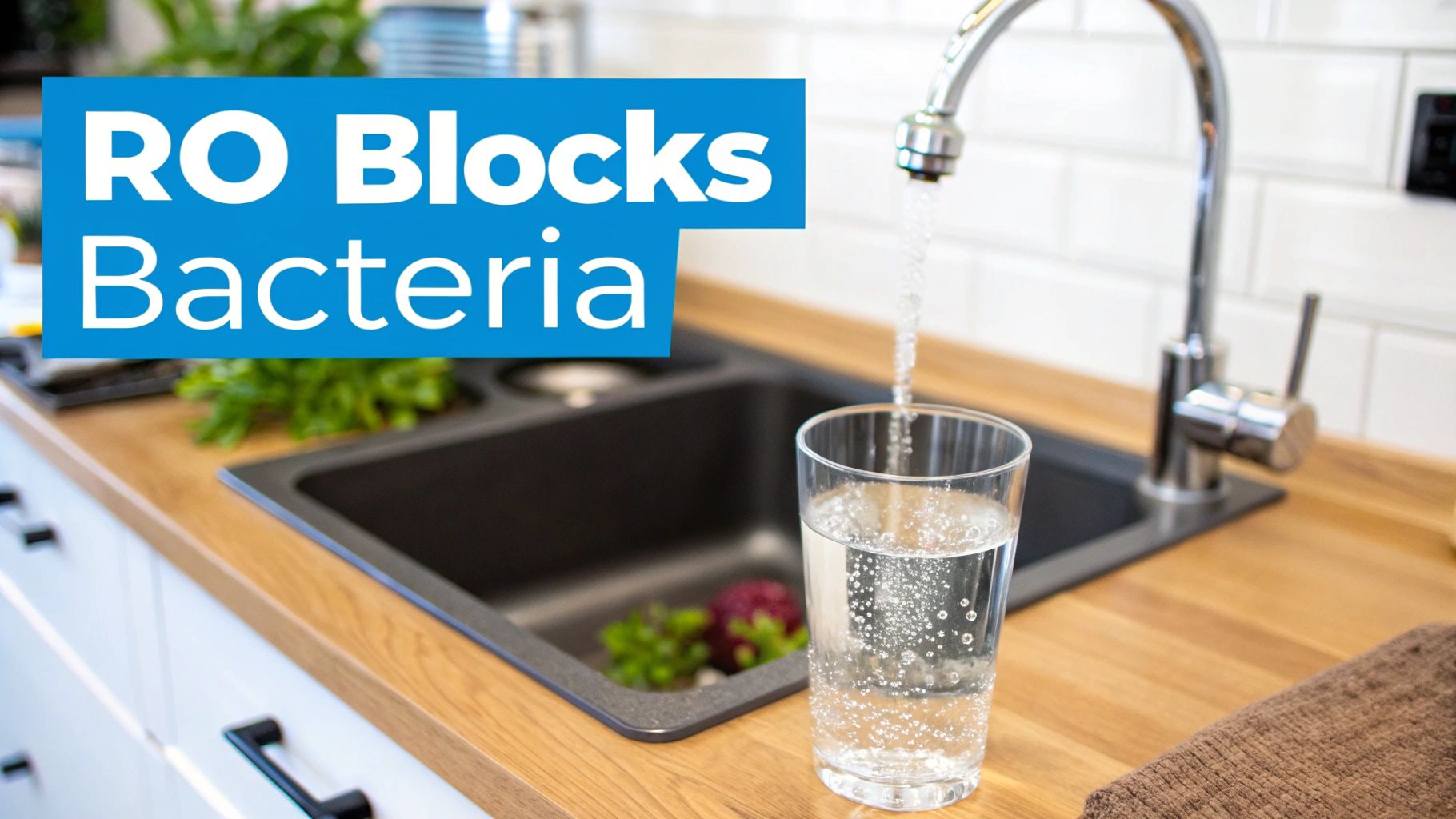
A glass of fresh water being filled from a modern kitchen faucet, with text 'RO Blocks Bacteria'.

The secret is simple: size matters. The pores in an RO membrane are a minuscule 0.0001 microns. Common household bacteria are literally thousands of times bigger than that.

A reverse osmosis membrane acts like a high-security checkpoint for your water. Only the smallest, purest water molecules are granted entry, while larger intruders, including virtually all bacteria, are turned away.

Comparing RO Pore Size to Bacteria

To really appreciate why RO is so dependable, you have to get a feel for this massive size difference. Let’s put it into perspective for your home.

A quick look at how the tiny pores of an RO membrane stack up against common waterborne bacteria, showing exactly why it's so effective.

Reverse Osmosis vs Common Household Bacteria

Item Typical Size (in microns) Can it Pass Through an RO Membrane?
RO Membrane Pore 0.0001 N/A
E. coli Bacterium 0.25 to 1.0 No Way
Salmonella Bacterium 0.7 to 1.5 Not a Chance
Legionella Bacterium 0.5 to 1.0 Absolutely Not
Campylobacter Bacterium 0.2 to 0.9 Nope

As you can see, bacteria like E. coli or Salmonella are absolute giants next to the openings in an RO membrane. It's physically impossible for them to squeeze through. This simple principle is what makes RO technology a cornerstone of water purification for homes everywhere.

And this isn’t just theory; its effectiveness is well-proven. Scientific studies consistently show RO systems are superior at removing bacteria. In fact, comprehensive reviews have found that RO can slash bacterial counts by about 99.997 percent—a stunning figure that highlights just how well it safeguards your water. Even the CDC ranks it as having the highest efficiency for pathogen reduction among home systems. You can learn more about the research on RO performance if you want to dig into the data.

This incredible removal rate is why so many people trust RO, especially if they’re on well water or just don’t trust their city’s supply. It’s not just about making water taste better; it’s about having a reliable shield against threats you can’t even see.

How Reverse Osmosis Physically Blocks Bacteria

So, how does a reverse osmosis (RO) system actually stop something you can't even see? It's not magic, it’s a brilliant but straightforward process that all comes down to a simple principle: size matters. At its heart, an RO system is like an ultra-strict bouncer, and its secret weapon is the semipermeable membrane.

Scientific illustration of a multi-layered membrane barrier filtering particles from liquid.

Think of it like a high-security door with a mail slot. A tiny water molecule is like a thin sheet of paper—it slips right through without a problem. But a bacterium? That's a bulky package that gets stopped dead in its tracks. It's a game of force and size, and only the smallest get through.

Let's break down the science behind this, starting with that all-important membrane and its unbelievably small pores.

The Microscopic Gatekeeper: The Semipermeable Membrane

The real hero in any RO system is its semipermeable membrane, a true feat of material science. This isn't your average filter screen. It’s a specialized sheet of synthetic material, tightly wound and engineered with pores of a specific, microscopic size.

Just how small are we talking? These pores measure around 0.0001 microns. To give you some perspective, a single human hair is about 75 microns thick. That means the pores in an RO membrane are a staggering 750,000 times smaller. This incredible scale is what makes the system an absolute fortress against bacteria.

Now, let's compare that pore size to some common waterborne bacteria:

  • E. coli is typically between 0.25 to 1.0 microns in size.
  • Salmonella is even bigger, usually measuring 0.7 to 1.5 microns.
  • Legionella, the culprit behind Legionnaires' disease, is around 0.5 to 1.0 microns.

It’s pretty clear from these numbers—even the tiniest bacteria are hundreds, if not thousands, of times larger than the membrane's pores. They simply can't squeeze through. It's a physical impossibility.

The whole process is mechanical, not chemical. The membrane doesn’t kill the bacteria; it just physically blocks them, much like a window screen keeps bugs out of your house. The bacteria and other rejected gunk are then simply flushed down the drain.

The Power of Pressure: Forcing Water Through

Of course, a high-tech membrane is only half the story. To get the pure water molecules to separate from all the contaminants, you need a driving force. That's where your home's water pressure steps in.

The name "reverse osmosis" clues you into how it works. In nature, osmosis is the tendency for water to move from a less concentrated solution to a more concentrated one to find balance. An RO system does the exact opposite—it reverses that natural process.

Using your household water pressure (usually 40 to 60 PSI), the system shoves the untreated water up against the semipermeable membrane. This pressure is just right to force the tiny water molecules through those microscopic pores, leaving the much larger bacteria, viruses, salts, and other impurities behind. This stream of concentrated contaminants is then washed away as wastewater.

What you get on the other side is exceptionally pure water. It's a constant battle of pressure against a microscopic barrier, ensuring only the good stuff makes it into your glass. Understanding this one-two punch—the ultra-fine membrane and steady pressure—makes it easy to see why reverse osmosis is one of the most trusted ways to get bacteria-free water at home.

Why the Whole System is a Big Deal

The reverse osmosis membrane might be the star player, but it can't win the game alone. A great RO system is more like a well-drilled team, where every filter works together to deliver pure, safe water. If you want to know if RO can really keep bacteria out for the long haul, you have to look at the entire setup.

Think of the RO membrane as a world-class surgeon. You wouldn't want them operating in a filthy room without any nurses or anesthesiologists, right? The other filters in the system are that essential support crew, prepping the water so the membrane can do its job perfectly.

The Unsung Heroes: Pre-Filters

Before water even gets a chance to meet the delicate RO membrane, it first has to get past a couple of tough "bodyguards" called pre-filters. These initial stages are absolutely critical for protecting the membrane and ensuring the system can block bacteria day in and day out. Without them, the whole operation falls apart.

The most common pre-filters you'll find in a home system are:

  • A Sediment Filter: This is your first line of defense. Its one and only job is to snag bigger particles like sand, rust, silt, and general gunk. It’s a simple filter, but it prevents the more advanced filters—and especially the RO membrane—from getting clogged up and overwhelmed.
  • A Carbon Block Filter: Think of this stage as the chemical cleanup crew. Its main target is chlorine, which your city uses to disinfect the water supply. Chlorine is great for killing germs in the pipes, but it’s a killer for RO membranes. It basically corrodes the delicate surface and can destroy the microscopic pores, making the membrane's bacterial barrier totally useless.

By taking out these big threats first, the pre-filters are the gatekeepers that make sure the RO membrane gets water that's clean enough for it to work its magic on a microscopic level. Skipping pre-filter maintenance is like firing the security detail—you're leaving your most valuable asset completely exposed.

Protecting the Core Bacterial Barrier

The health of your pre-filters is directly tied to the RO membrane's ability to stop bacteria. A clogged-up sediment filter can choke off water pressure, which makes the whole reverse osmosis process sluggish and less effective. Even worse, if you let the carbon filter get old and used up, chlorine will slip right through and literally eat holes in the membrane, creating openings big enough for bacteria to cruise on through.

"An RO system is a chain of trust. Every stage, from the first sediment filter to the final polishing filter, has a job to do. If one stage fails, the whole system is compromised, and that reliable barrier you counted on is gone."

This is exactly why sticking to a regular filter replacement schedule is so non-negotiable. It’s not just about making the water taste good; it’s about making sure the physical barrier that stops bacteria stays strong and intact. When the pre-filters are doing their job, the RO membrane can focus on what it does best: kicking out those microscopic contaminants.

The Final Polish: Post-Filtration

After the water is squeezed through the RO membrane and purified, it usually hangs out in a small storage tank under your sink before it gets to your faucet. The very last step on its journey is often a post-filter, which is typically another carbon filter.

This final filter isn't really involved in removing bacteria, but it's key to making sure the water tastes crisp and clean. Since purified water sits in that tank, it can sometimes pick up a flat or stale taste. The post-filter gives the water one last "polish," scrubbing away any lingering tastes or odors before it fills your glass. It’s the finishing touch that guarantees every sip is as refreshing as it is safe.

Common RO System Weaknesses and How to Fix Them

A reverse osmosis system is incredibly reliable, but like any piece of equipment in your home, its performance depends on every single part doing its job. Think of it as a fortress—the walls might be impenetrable, but a small, unguarded gate can compromise the entire structure.

Knowing where these potential weak points are isn't meant to scare you. It’s all about empowering you to keep your system running in top condition. The RO membrane is the heart of the whole operation, but tiny issues elsewhere can create a bypass for contaminants. A worn-out O-ring or a tiny crack in a filter housing is all it takes for untreated water to sneak past the filters and mix right back in with your purified water.

Tiny Leaks, Big Problems

It’s easy to get hung up on the high-tech membrane, but often it's the simplest parts that need the most attention. Those little rubber O-rings create the watertight seals between the filter housings and caps, and they can get brittle and degrade over time. If one fails, it creates an invisible channel for unfiltered water to slip right past the membrane.

Likewise, the plastic housings that hold your filters can develop hairline cracks. This usually happens from over-tightening or just from years of wear and tear. Even a crack you can barely see is more than big enough for bacteria to get through, completely defeating the purpose of the system.

The most common points of failure in a home RO system aren't the advanced components; they're the basic seals and connectors. Regular visual checks are your first line of defense against a system that looks fine but isn't providing the protection you expect.

This diagram shows the typical path water takes through an RO system, highlighting how each stage builds on the last.

Diagram illustrating the three stages of RO filtration: pre-filters, RO membrane, and post-filter.

As you can see, if a seal fails before or after that central RO membrane, contaminants can get right back into the water stream, bypassing the whole purification process.

The Challenge of Biofouling

Another potential issue to watch for is something called biofouling. While the RO membrane is fantastic at blocking bacteria, it doesn't actually kill them. Over time, bacteria and other gunk from your source water can build up on the surface of the membrane, creating a slimy layer known as a biofilm.

This biofilm can cause a few headaches in your home system:

  • It clogs the membrane's pores, which slows down your water flow and makes the system less efficient.
  • In really bad cases, the biofilm can start to degrade the membrane material itself.
  • Most importantly, if the system isn't maintained, bacteria from that biofilm could find a way into the clean water side, especially if there are any pressure changes.

Biofouling is more common if you're on well water or if the pre-filters aren't being changed on schedule. Regularly sanitizing your system, just like the manufacturer recommends, is the best way to prevent this slimy buildup.

Simple Fixes for a Secure System

The good news? Preventing these problems is pretty straightforward. You don't need to be a professional plumber to keep your RO system secure. A few simple checks as part of your regular home maintenance will keep that bacterial barrier strong.

Here are the key things to do:

  1. Do Regular Visual Checks: Once a month, grab a flashlight and take a quick look under your sink. Check for any drips or moisture around the filter housings and all the connections.
  2. Replace O-Rings with Your Filters: When you change your pre-filters, swap out the O-rings, too. Most filter replacement kits come with new ones for exactly this reason. A fresh, lubricated O-ring makes a perfect seal.
  3. Don't Overtighten the Housings: When you put the housings back on, tighten them until they're snug, but don't crank on them with all your might. Hand-tight is usually all you need. Overtightening is the number one cause of cracked housings.
  4. Stick to the Sanitization Schedule: Mark your calendar for the manufacturer's recommended sanitizing interval—usually about once every 12 months. This quick process kills any microbial growth inside the system and keeps everything fresh.

Your Guide to Keeping Your RO System in Top Shape

Think of your reverse osmosis system less like a household appliance and more like a high-performance engine for your water. Just like any engine, it needs regular tune-ups to keep running smoothly. If you want that bacterial barrier to stay strong, consistent maintenance isn't just a suggestion—it's absolutely essential.

Maintenance tools, an air filter, and a checklist on a wooden desk with a green plant.

The good news? This isn't some complex plumbing job. It’s really just about following a simple schedule. By staying on top of filter changes and the occasional deep clean, you ensure that the answer to "will reverse osmosis remove bacteria?" is always a confident "yes."

Your Maintenance Playbook

The user manual that came with your system is always the best place to start, but most residential RO units follow a pretty standard filter replacement schedule. It's critical to stick to this timeline. Why? Because old, exhausted filters don't just stop working—they can actually become a problem, either turning into a breeding ground for bacteria or letting chlorine slip through and wreck the delicate RO membrane.

We recommend setting calendar reminders so you never miss a swap.

Consistent upkeep is the single most important factor in maintaining your RO system’s microbiological safety. A neglected system is an unreliable one, plain and simple.

Here’s a general schedule for a typical under-sink system you might have in your kitchen.

Typical RO Filter Replacement Schedule

Following a regular replacement plan ensures every part of your system is working to protect the all-important RO membrane, which does the heavy lifting of blocking bacteria.

Filter Type Typical Replacement Frequency Primary Function
Sediment Pre-Filter Every 6-12 months Protects other filters from sand, rust, and silt.
Carbon Pre-Filter(s) Every 6-12 months Removes chlorine to protect the RO membrane.
RO Membrane Every 2-4 years The core filter that physically blocks bacteria and dissolved solids.
Carbon Post-Filter Every 12 months Polishes the water for taste and odor after storage.

Sticking to this routine is the best way to guarantee performance. For more detailed guides on different systems, you can find a ton of practical advice on filter maintenance and replacement.

Don't Forget to Sanitize the System

Swapping filters is only half the battle. It's also vital to sanitize the entire system every so often. Remember, while the RO membrane removes bacteria, it doesn't actually kill it. Over time, a slimy biofilm can start to build up on the "dirty" side of the membrane and even inside the storage tank or water lines.

Sanitizing your system—usually about once every 12 months—is a simple process. It involves running a special sanitizing solution through the whole unit, which kills off any microbial growth and keeps the internal pathways clean. This is your best defense against re-contamination, and most manufacturers sell easy-to-use kits for this exact job.

A Special Note for Well Water Users

If your home's water comes from a private well, you'll want to be extra diligent with your maintenance routine. Unlike city water, well water isn't treated with disinfectants, which means the type and amount of bacteria can change, especially after heavy rain.

For well owners, getting your water tested periodically is a smart move. An affordable water test accomplishes two critical things:

  1. It Verifies Performance: The test confirms your RO system is doing its job and effectively removing bacteria and any other contaminants unique to your well.
  2. It Gives You Peace of Mind: You get documented proof that your family's drinking water is safe, taking all the guesswork out of the equation.

By combining a consistent maintenance schedule with occasional testing, you create a powerful defense. This proactive approach ensures your RO system delivers on its promise of safe, bacteria-free water for years to come.

Adding UV Purification for Ultimate Protection

Think of a top-tier reverse osmosis system as a fortress for your water. If that’s the case, then adding an Ultraviolet (UV) purifier is like posting elite guards at the final gate. While a well-maintained RO system is incredible at physically blocking bacteria, a UV sterilizer provides a powerful second line of defense, creating a nearly foolproof barrier against anything living in your water.

This combination gives you the ultimate peace of mind, especially if you can’t afford any risk of contamination. The two technologies are a perfect match. The RO system strips out sediments and chemicals, which makes the water crystal clear and allows the UV light to do its job with maximum impact.

How UV Light Zaps Bacteria

Unlike an RO membrane that acts like a physical wall, a UV purifier is more of an assassin. It doesn't actually remove anything. Instead, it blasts the water with a specific wavelength of ultraviolet light (UV-C at 254 nanometers) that completely scrambles the DNA and RNA of microorganisms like bacteria, viruses, and cysts.

It's like taking the blueprint for a building and running it through a shredder. The genetic code that tells bacteria how to reproduce and make you sick is rendered totally useless. The microbes are still technically there, but they’re zombified—completely neutralized and harmless.

The whole process is lightning-fast and incredibly effective, all without adding a single chemical to your water. You won't notice any change in taste, smell, or color—just the silent, reliable deactivation of any pathogens that might have slipped through the cracks.

Adding a UV stage transforms a great filtration system into a comprehensive purification solution. It addresses the RO system’s one minor limitation—that it only blocks, not kills, microorganisms—providing a final, definitive kill step.

When Is a UV Add-On a Smart Move?

Not every home absolutely needs a UV system, but it's a fantastic upgrade in certain situations. It’s an investment in certainty, making sure your water is safe even when the source is questionable.

You should seriously consider adding UV protection to your home system if any of these sound familiar:

  • You Use Well Water: Private wells don't get the municipal treatment and are far more vulnerable to bacterial contamination from things like farm runoff or a neighbor's failing septic system. UV gives you that critical protection against unpredictable water quality.
  • You Live in an Area with Boil Water Advisories: If your town frequently issues boil alerts because of water main breaks or other failures, a UV sterilizer is your reliable in-home safeguard.
  • You Have Vulnerable Family Members: For households with infants, the elderly, or anyone with a compromised immune system, you want the highest level of defense possible against waterborne pathogens.

By pairing these two powerful technologies, you create a multi-barrier system that tackles just about every common water contaminant. The RO system handles the physical and chemical purification, and the UV sterilizer makes sure the water is microbiologically sterile. The result is complete confidence in every single drop you drink.

Common Questions About RO and Bacteria

When you're digging into water filtration for your home, a lot of questions pop up. Let's get you some clear, no-nonsense answers to the things homeowners wonder about most when it comes to reverse osmosis and bacteria.

Can I Rely on RO Alone for Bacteria-Free Water?

A reverse osmosis system that's working right and properly maintained is phenomenal at blocking bacteria. The pores in the membrane are a microscopic 0.0001 microns—far too small for bacteria to squeeze through.

That said, if you want absolute peace of mind, especially if you're on well water, teaming it up with a UV purifier is the ultimate one-two punch. The UV light neutralizes anything that could potentially slip through, giving you a bulletproof defense.

What's the Difference Between RO and a UV Purifier?

Here’s a simple way to think about it. Reverse osmosis is like a bouncer at a club, physically stopping unwanted guests (bacteria, chemicals, sediment) from getting inside.

A UV purifier is more like an invisible security field. It doesn't remove anything, but it zaps any microorganisms with a special light, scrambling their DNA and making them totally harmless.

Reverse Osmosis physically removes contaminants by blocking them. A UV Purifier neutralizes microbes like bacteria and viruses but leaves them in the water.

Does Reverse Osmosis Get Rid of Viruses Too?

Yes, it does, and for the exact same reason it nabs bacteria: size. Viruses are even tinier than bacteria, but the vast majority are still too big to get past the RO membrane.

A typical virus measures between 0.02 and 0.4 microns. The RO membrane's pores are just 0.0001 microns. It's a simple case of not being able to fit a basketball through a keyhole. If you want to get into the nitty-gritty, you can learn about the fundamental differences between bacteria and viruses.

What Happens to the Bacteria the RO System Catches?

They don't just pile up on the membrane. The RO system is constantly working. As it pushes clean water through, it uses another stream of water to flush the "dirty" side of the membrane.

This process washes all the rejected stuff—bacteria, dissolved salts, chemicals—straight down the drain. It’s a self-cleaning mechanism that’s vital for keeping the system running efficiently for years.


At Water Filter Advisor, we're here to help you find the right, research-backed solution for your home's water. Check out our in-depth guides and reviews to choose with confidence for your family's health at https://www.waterfilteradvisor.com.

Your Guide to Choosing the Right Coliform Water Filter for Home

So, you've discovered you might have uninvited guests—bacteria—in your home's water. Your first thought might be to just boil your water, but that's like putting a band-aid on a broken pipe. For a permanent fix, a good coliform water filter is your champion. It’s the ultimate security system for your tap, working 24/7 to ensure every drop is safe, giving you that priceless peace of mind.

The Hidden Dangers in Your Drinking Water

Ever seen a "boil water" alert flash across the local news or gotten a troubling test result back from your well? It’s a jarring moment. Suddenly, the water you and your family use every single day for drinking, cooking, and even brushing your teeth feels like a bit of a gamble. This guide is here to help you take back control and turn your tap water from a source of worry into a source of pure, safe hydration.

A glass of clear water and a small water testing bottle on a kitchen counter with a 'TEST YOUR WATER' banner.

Why Coliforms Are a Critical Warning Sign

Think of coliform bacteria as the 'canary in the coal mine' for your water supply. Here’s the surprising part: most types of coliforms won't actually make you sick. Their presence, however, signals a breach in your water's defenses—a potential pathway for much nastier pathogens to sneak in. They are an indicator, a bright red flag that something is wrong with your water system.

A positive coliform test means your water source or plumbing has a vulnerability. It’s a clear signal that disease-causing organisms like bacteria, viruses, and protozoa could get into your water.

Ignoring this warning is like leaving your front door unlocked; it leaves your family exposed to contaminants that can lead to nasty gastrointestinal illnesses and other health problems.

Taking Proactive Control of Your Water Safety

Instead of living in reaction mode, waiting for the next contamination scare, installing a high-quality coliform water filter is a permanent, proactive power move. More and more homeowners are making water safety a top priority, which is why the global water filters market is booming. It was valued at over USD 15 billion in 2024, and all that growth is pushing innovation and making top-tier filtration systems more affordable for everyday homeowners. If you're curious, you can explore more about market trends and growth projections to see how this shift in consumer awareness is shaping the industry.

Here's our game plan to get you from worried to wonderfully prepared:

  • Understanding the Problem: We’ll demystify the science and explain what coliforms really are and the risks they signal.
  • Testing Your Water: You'll learn how to play detective and test your water the right way to get results you can trust.
  • Choosing a Solution: We’ll break down the best filtration technologies on the market so you can pick the perfect system for your home with total confidence.

Understanding Coliforms From Warning Signs to Real Threats

Getting a water test result that flags "coliforms present" can be pretty unnerving. What does it even mean? Let's use an analogy: think of it like seeing a puff of smoke on the horizon. This is your first warning, and in the water world, we call this total coliforms.

Total coliforms are a huge family of bacteria found just about everywhere in the environment—in soil, on plants, and in rivers. Most of them are harmless, but finding them in your drinking water is a red flag. It means there might be a crack in your water system's armor, a potential opening for more dangerous microbes to get into your pipes.

From General Warnings to Specific Dangers

Now, what if that puff of smoke on the horizon turns into a dark, billowing cloud? The threat just got more serious. This is what happens when your test finds fecal coliforms. This is a smaller, more specific group of bacteria that comes directly from the gut and waste of humans and animals. Finding them is a much stronger indicator that your water has been contaminated by sewage or animal droppings.

And if you finally see flames licking through that smoke? That’s E. coli (Escherichia coli). As a specific type of fecal coliform, E. coli is the smoking gun—it’s definitive proof of recent fecal contamination and an immediate health risk. The U.S. Environmental Protection Agency (EPA) has a zero-tolerance policy for E. coli in drinking water. A single positive sample is a serious problem that demands immediate action.

The presence of coliforms, especially E. coli, is a direct warning that your water may contain disease-causing pathogens. These can include other bacteria, viruses, and protozoa that travel the same contamination pathways.

This tiered system—from total coliforms to E. coli—is how water quality pros help homeowners figure out the level of risk and how to fight back.

The Real Health Risks Involved

The idea of bacteria in your water is gross, but the health consequences are what truly matter. Drinking water contaminated with these pathogens can lead to a whole range of nasty gastrointestinal illnesses, with symptoms often mistaken for a bad case of food poisoning.

These symptoms can include:

  • Nausea and vomiting
  • Stomach cramps and abdominal pain
  • Diarrhea
  • Headaches and fever

For most healthy adults, these illnesses are temporary, though intensely unpleasant. But for vulnerable people—young children, the elderly, and anyone with a compromised immune system—the stakes are much higher, with risks of severe, even life-threatening complications. This is exactly why a reliable coliform water filter is a non-negotiable shield for any home with confirmed contamination.

This isn't just a niche concern; it's a global driver for better home water purification. Documented public health crises and stricter regulations are creating huge demand for filters that can tackle coliforms. For example, the Asia-Pacific region accounts for over 40% of market revenue due to widespread contamination, while concerns over aging infrastructure in North America and Europe are pushing homeowners toward advanced point-of-use systems. You can explore the full market analysis on Mordor Intelligence to see how these trends connect.

At the end of the day, "coliforms" are more than just a word on a lab report. They’re a critical signal tied directly to the health and safety of your family, and they demand your full attention.

How to Test Your Home Water for Bacteria

You can't see, smell, or taste coliform bacteria, which makes them particularly sneaky. When your family's health is on the line, guessing just won't cut it. Before you even think about buying a water filter to tackle bacteria, you need to know for sure what you're dealing with.

Confirming the problem is your first and most critical mission. You have two main ways to get the answers you need: sending a sample to a professional lab or using a do-it-yourself kit at home. The best choice really boils down to whether you need CSI-level accuracy or just a quick, initial check-up.

The Gold Standard: Professional Lab Testing

For results you can bet the house on, nothing beats sending a water sample to a state-certified laboratory. This is the only way to get a definitive, legally defensible answer and a precise count of any bacteria in your water. That information is crucial for picking the right filtration system to solve the problem for good.

Finding a lab is easier than you might think. Your local health department or the Environmental Protection Agency (EPA) website can point you to a list of certified labs nearby. Once you choose one, they'll send you a sterile collection bottle and a very specific set of instructions. Follow these directions to the letter—it's the key to avoiding a contaminated sample and a false positive result.

Key Steps for a Pure Sample:

  • Use the Right Tap: Pick a simple, cold water faucet without a screen or fancy swivel attachment. A basic utility sink or an outdoor spigot is perfect.
  • Sterilize the Faucet: Wipe down the end of the faucet with an alcohol pad or a bit of diluted bleach to kill any bacteria hanging out on the surface.
  • Run the Water: Let the cold water run for a good 3-5 minutes. This flushes out any stagnant water sitting in your pipes, giving you a fresh sample.
  • Collect Carefully: Open the sterile bottle without touching the inside of the cap or the bottle's rim. Fill it to the indicated line, and seal it up right away.
  • Deliver Promptly: Time is of the essence. Most labs require you to return the sample within 24-48 hours to ensure the results are accurate.

Your lab report will usually give you a "present/absent" result for total coliforms and E. coli. If bacteria are found, many reports will also provide a count in Colony Forming Units per 100 milliliters (CFU/100 mL), which gives you a much clearer idea of the scale of the contamination.

The Convenient Alternative: DIY Home Kits

Want a quick check without the hassle of sending a sample off to a lab? A DIY home testing kit can be a great place to start. You can find these kits easily online or at most hardware stores, and they offer a simple way to screen your water fast.

Most DIY kits are pretty straightforward. You add your water to a small vial that contains a special nutrient powder. If coliform bacteria are present, they'll feast on the nutrients and cause the water to change color—often from clear to a distinct yellow or blue-green—within 24 to 48 hours.

It’s important to know their limits, though. These kits are generally less sensitive than a professional lab test and are more prone to user error, which can skew the results. Think of a DIY kit as a preliminary screening tool, not a final verdict. If you get a positive result, your very next step should be to confirm it with a professional lab test before you invest in a filtration system.

Choosing Your Coliform Removal Technology

Once you’ve confirmed that coliform bacteria have crashed your water party, it’s time to pick your defense. This is where you match the right technology to the problem. When it comes to eliminating microscopic threats like bacteria, not just any filter will do. You need a system built specifically for microbiological purification.

Let's walk through the three heavy hitters that act as your home’s personal security detail against bacteria. Each one has a unique way of neutralizing the threat, and understanding how they work is the key to choosing the best fit for your home.

The Microscopic Bodyguard: UV Disinfection

Picture a microscopic security guard armed with a germ-zapping ray gun. That's essentially what an Ultraviolet (UV) disinfection system is. It doesn't actually remove bacteria from the water. Instead, it blasts them with a powerful dose of UV-C light, which scrambles their DNA, making it impossible for them to reproduce and cause illness.

Water simply flows through a chamber containing a special UV lamp. In a matter of seconds, any living microorganisms are rendered completely harmless. It’s a clean, chemical-free solution that won't change your water's taste or smell, and it’s incredibly effective against bacteria, viruses, and other pathogens.

The only catch? UV light needs a clear line of sight to work its magic. If your water is cloudy or has a lot of sediment, those tiny particles can act like little bodyguards for the bacteria, shielding them from the UV rays. That’s why UV systems are almost always paired with a sediment pre-filter to ensure the light can reach and zap every last microbe.

The Physical Gatekeeper: Ultrafiltration

Think of Ultrafiltration (UF) as a bouncer at an exclusive nightclub with a very strict door policy. A UF system uses a membrane made of hollow fibers, which are covered in microscopic pores—typically around 0.02 microns in size. As water is pushed through, water molecules pass through easily, but bacteria, viruses, and protozoa are simply too big to get through the tiny openings.

They get stopped at the door and flushed away, leaving only pure, clean water to flow to your tap. UF is a fantastic physical barrier that works without chemicals or electricity (beyond what's needed for normal water pressure). It’s a great choice if your primary target is microbiological contaminants.

A major plus is that UF leaves all the healthy, beneficial minerals in your water, so it won't affect the taste. The only real maintenance is that, like any physical filter, the membrane will eventually get clogged with all the contaminants it catches. It will need to be cleaned or replaced periodically to keep it working effectively.

The Ultimate Sieve: Reverse Osmosis

If UF is a bouncer, then Reverse Osmosis (RO) is the Fort Knox of water purification. It uses your home's water pressure to force water through an even more advanced membrane with pores as tiny as 0.0001 microns. This process is so thorough that it removes not only bacteria and viruses but also an extensive list of other contaminants.

Reverse Osmosis is one of the most comprehensive filtration methods available for home use. It effectively reduces dissolved solids, heavy metals like lead and arsenic, nitrates, and even salt, in addition to providing a powerful defense against coliforms.

This all-in-one purification makes RO a top choice for anyone dealing with multiple water quality issues beyond just bacteria. The trade-off? The membrane is so fine that it also strips out healthy minerals, which can make the water taste a bit flat. Many modern RO systems solve this by including a special remineralization filter to add those good minerals back in. RO systems also create some wastewater in the process, which is something to consider if water conservation is a priority.

Before picking a system, you need to know what you're up against. This flowchart is a great tool for figuring out the best way to test your water.

A water testing decision guide flowchart compares lab tests (accurate, high cost) with DIY kits (quick, low cost).

As you can see, a quick DIY kit can give you a hint, but a professional lab test gives you the solid answers you need to choose your filtration system with confidence.

Comparing Coliform Removal Technologies for Home Use

With three solid options on the table, how do you decide? The best choice really comes down to your water test results, your budget, and how much maintenance you’re willing to do. This table lays it all out to help you compare. For commercial kitchens, it’s a whole different ballgame; this ultimate guide to water filtration systems for restaurants has specialized advice for those settings.

Technology How It Works Effectiveness on Coliforms Pros Cons Best For
UV Disinfection Zaps bacteria DNA with UV-C light, making them harmless. Excellent No chemicals, low maintenance, doesn't alter water taste. Needs clear water to work (pre-filter often required), uses electricity. Homes with clear water targeting just bacteria & viruses.
Ultrafiltration (UF) A fine physical membrane blocks microbes from passing through. Excellent Physically removes bacteria, keeps healthy minerals, no electricity needed. Can clog over time, doesn't remove dissolved chemicals. Well water or city water where the main concern is microbes.
Reverse Osmosis (RO) Pushes water through an ultra-fine membrane to strip out nearly everything. Excellent Removes the widest range of contaminants, including heavy metals. Produces wastewater, removes healthy minerals (can affect taste). Water with multiple issues beyond just bacteria (e.g., chemicals, lead).

These powerful technologies are a big reason why the market for home water treatment is booming. Point-of-use systems, where you’ll find most of these filters, made up a market worth between USD 31.9–34.5 billion in 2024. That number is expected to jump to over USD 53 billion by 2030, mostly because systems like UV, UF, and RO give people peace of mind against microbial threats like coliforms. This steady growth means we'll keep seeing better and more affordable solutions for keeping our water safe at home.

Installation and Maintenance for Lasting Protection

Picking out a powerful coliform water filter is a huge win for your home's water safety, but the job isn't quite done when you unbox it. A top-tier system is only as good as its upkeep. Sticking to a consistent maintenance schedule ensures your investment remains a rock-solid barrier against bacteria, protecting your family for years.

A man replaces a water filter cartridge under a kitchen sink, with tools on the counter.

Before we get into the nuts and bolts of maintenance, it helps to know where your system is going to live. You've got two main choices—whole-house or under-sink—and that decision shapes both the installation and the long-term care.

Whole-House vs. Under-Sink Systems

A whole-house system, sometimes called a Point-of-Entry (POE) system, gets plumbed in right where your main water line enters the house. It’s like having a security guard at the front door, screening every single drop of water before it heads to your showers, faucets, and appliances. This is the ultimate solution for total, comprehensive protection, especially if you have a private well where contamination could affect your entire home.

Then you have the under-sink system, or Point-of-Use (POU) system. As the name implies, it’s installed right where you use the water, usually under the kitchen sink. This gives you highly purified water for drinking and cooking from a dedicated faucet. It's often a more budget-friendly and less invasive setup, perfect for homeowners or renters who are mainly focused on ensuring their drinking water is perfectly safe.

Your Essential Maintenance Checklist

Once your system is up and running, a simple maintenance routine is all it takes to keep it performing at its best. Skipping these steps is like buying a state-of-the-art security system and then leaving the front door unlocked—it defeats the purpose. Think of your filter’s manual as your playbook; follow the manufacturer's directions to the letter.

Here’s a straightforward checklist to keep everything in prime condition:

  • Change Sediment Pre-Filters: These are your system's first line of defense, catching dirt, sand, and rust. They typically need replacing every 6 to 12 months to prevent clogs and ensure your main filter or UV system can do its job effectively.
  • Replace UV Lamps Annually: A UV bulb loses its germ-killing power over time, even if the light still turns on. Swapping it out once a year is critical to ensuring it’s delivering a knockout punch to any bacteria.
  • Sanitize System Components: Whenever you change a filter or lamp, it's a smart move to clean and sanitize the filter housings or the UV chamber. This prevents any potential bacterial growth within the system itself.
  • Check Seals and Connections: Give your system a quick visual inspection every now and then for any leaks or drips. A tiny leak can lower your water pressure and, worse, create an opening for contaminants to bypass the filter.

Don't forget that your filter is just one part of the equation. Keeping all your water-related equipment clean is crucial for true protection. For instance, following the best practices for cleaning a water dispenser makes sure your purified water stays that way until you're ready to drink it.

Verifying Performance with Periodic Re-Testing

So, how do you know your system is still working perfectly a year or two down the road? Simple: test your water again. It's a step people often forget, but it provides incredible peace of mind.

Periodic re-testing is like a performance review for your water filter. It confirms that your maintenance routine is effective and that your barrier against coliform bacteria remains strong and secure.

If your home is on a private well, getting your water tested for bacteria every year is a wise move. For those on a city supply, re-testing every couple of years or after any major plumbing work is a great habit to get into. This simple check confirms that your coliform water filter is working as advertised, so you know every glass of water is just as safe as it was on day one.

How to Make a Confident and Smart Purchase

With all the different options out there, how can you possibly pick a coliform water filter you can actually trust? The trick is to ignore the marketing hype and focus on what really matters: proof that the system works. That proof comes from certifications from independent, third-party organizations.

Think of a certification as a seal of approval from an unbiased expert. It verifies that the filter performs exactly as the company claims. When you're dealing with something as serious as bacterial contamination, this kind of guarantee isn't just nice to have—it's essential.

Decoding the Most Important Certifications

The gold standard in the water filtration world is NSF/ANSI. This is an independent group that sets public health standards and runs certification programs to help protect our food, water, and consumer products. For coliform, there are two certifications you really need to know about.

  • NSF/ANSI 55 (Class A): This is the one you absolutely must look for on any UV disinfection system. Class A certification confirms the system delivers a strong enough dose of UV light to kill or inactivate nasty microorganisms like bacteria, viruses, and cysts. It’s your guarantee of microbiological safety.

  • NSF/ANSI 53: While this standard isn't exclusively for bacteria, it certifies that a filter can reduce specific health-related contaminants, which can include cysts like Giardia. If you’re leaning toward a physical filter like an ultrafiltration or reverse osmosis system, keep an eye out for this one.

A product that is "NSF Certified" has gone through a tough series of tests. These checks make sure it meets strict standards for performance, material safety, and structural integrity. It means you can be confident the system will do its job when it counts.

Critical Questions to Ask Before You Buy

Once you’ve got a shortlist of certified products, it's time to dig into the details. Asking the right questions now will save you from headaches and buyer's remorse later. For more helpful tips on water treatment, you can also check out our general water filter advice section.

Your Pre-Purchase Checklist:

  1. What is the system’s flow rate? You need to make sure the Gallons Per Minute (GPM) rating can handle your family's needs, especially during peak times like morning showers. Otherwise, you'll notice a frustrating drop in water pressure.
  2. What are the annual maintenance costs? Don't just look at the upfront price. Add up the cost of replacement UV lamps, filter cartridges, and any other parts you'll need to buy each year to get the true cost of ownership.
  3. What does the warranty cover? A good, solid warranty is a great sign that the company stands behind its product. Find out exactly which parts are covered and for how long.

Frequently Asked Questions About Coliform Filters

Navigating the world of water filtration can bring up a lot of questions, especially when you're dealing with something as serious as bacteria. We've put together some straight answers to the most common things homeowners ask when choosing and using a coliform water filter so you can feel confident you're making the right call for your home.

Will a Standard Brita Pitcher Filter Remove Coliform Bacteria?

This is a big one, and the answer is a simple, firm no. Your standard pitcher filters, like a Brita or a Pur, use activated carbon. Their main job is to improve your water's taste and smell, primarily by removing things like chlorine.

They simply aren't designed to stop microscopic organisms like bacteria. For true microbial safety, you absolutely need a system that is specifically certified for microbiological purification. That means a technology like UV disinfection, ultrafiltration, or reverse osmosis. Think of pitcher filters as a quick flavor fix, not a health shield.

Is City Water Safe from Coliform Contamination?

For the most part, yes. Municipal water treatment plants are under strict regulations and do an excellent job of disinfecting water before it ever leaves the facility. The catch? It's a long journey from that plant to your kitchen sink, and things can go wrong along the way.

What could happen?

  • Aging Infrastructure: Old city water mains can develop cracks or leaks, creating a perfect entry point for contaminants to get into the "clean" water supply.
  • Water Main Breaks: When a main breaks, the sudden pressure drop can actually suck untreated groundwater and bacteria directly into the pipes.
  • Local Plumbing Issues: Sometimes the problem isn't with the city's pipes, but with the plumbing inside your own home.

While you can generally trust your city's water, a home filtration system acts as that final, critical line of defense. It ensures that anything that might have snuck in after treatment gets eliminated before it ever reaches your glass.

How Often Should I Retest My Water After Installing a Filter?

Installing a filter is a huge step, but you need to verify it's actually doing its job. It's a best practice to test your water again shortly after your new system is up and running. This first re-test simply confirms that the installation was successful and the system is working as expected.

After that, how often you test really depends on your water source. If you have a private well, you should plan on testing for bacteria annually. Well water quality can change with the seasons, so it's smart to stay on top of it.

If you're on a municipal supply, re-testing every 2-3 years is a good rule of thumb. You should also get a test done anytime you notice a sudden change in your water's taste, smell, or appearance. It's a simple habit that ensures your system is still working correctly and your family is protected.


Here at Water Filter Advisor, our mission is to give you the clear, straightforward information you need to choose what's best for your family’s health. Check out our in-depth guides and reviews to find the perfect setup for safe, great-tasting water in your home.

Find Your Ideal Water Filter on WaterFilterAdvisor.com