How to Banish Hard Water for Good: Your Guide to Removing Calcium

If you’re waging a never-ending war against crusty white buildup on your faucets and fixtures, you've met the villain of this story: calcium. The two most powerful heroes in the fight against hard water are a whole-house water softener or a targeted reverse osmosis (RO) system. Think of them as the ultimate tag team for stopping that chalky limescale from ever showing up to the party.

Your Quick Guide to Solving Hard Water Nightmares

Let's be real—if your shower doors look permanently cloudy and your soap stubbornly refuses to lather, you’ve got hard water. The culprit is an excess of dissolved calcium, and it’s more than just an eyesore. Over time, that scaly buildup is like cholesterol for your home's arteries, choking the life out of your appliances and clogging your pipes.

It's a frustrating, soap-scum-covered problem, but you don't have to live with it. I've seen countless homeowners reclaim their homes from the clutches of calcium by choosing the right filtration strategy. And it almost always boils down to one of two battle plans.

Choosing Your Filtration Strategy

The first, and most comprehensive, fix is a whole-house water softener. This bad boy gets installed right where your main water line enters your house, treating every single drop you use. It works through a clever bit of chemistry called ion exchange, where it essentially tricks the "hard" calcium and magnesium ions into swapping places with "soft" sodium ions. This protects your entire plumbing infrastructure—from the water heater you never see to the coffee maker you use every morning.

Now, if your main headache is the funky taste of your tap water or the film on your cooked veggies, a point-of-use system like reverse osmosis is a fantastic option. These are typically installed right under the kitchen sink. An RO system is the overachiever of water filters, pushing water through a special membrane that strips out a ridiculously high percentage of contaminants—calcium included. For more in-depth info, you can find tons of professional advice on water filtration to help you weigh your options.

The decision often comes down to this: Are you looking to protect your entire home's plumbing and appliances, or do you crave ultra-pure water at a specific tap for drinking and cooking?

This simple decision tree can help you visualize which path is right for your home.
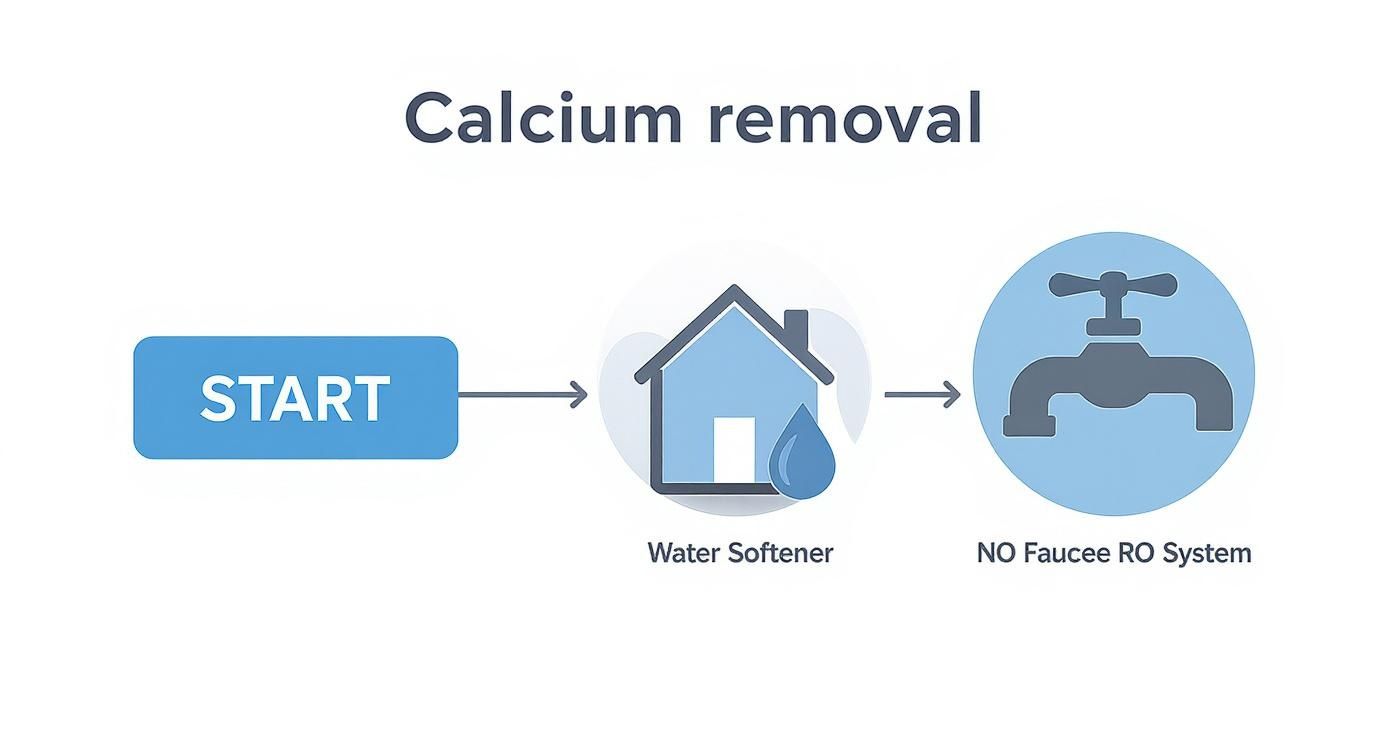
A flowchart showing the process of calcium removal from water, involving a water softener.

As you can see, the scope of your problem—whether it’s a house-wide menace or a kitchen-specific annoyance—points you directly to the most logical solution. While these systems prevent future issues, if you're already dealing with existing spots on your glass surfaces, a good guide on how to get hard water spots off windows can help you clean up the existing mess.

Comparing Calcium Removal Methods at a Glance

To make things even clearer, I put together a quick table comparing the top methods for kicking calcium to the curb. It breaks down what each is best for, the typical cost you can expect, and the main benefit you'll get.

Method Best For Typical Cost Range Primary Benefit
Water Softener Whole-house protection for all pipes and appliances $800 – $3,000+ Prevents limescale buildup everywhere in the home
Reverse Osmosis Purifying drinking and cooking water at a single tap $250 – $900 Removes up to 99% of all dissolved solids for pure taste

This table gives you a solid starting point. Think about your budget and your biggest hard water frustration, and the right choice should become pretty clear.

Pinpointing Your Home's Hard Water Severity

Before you can declare war on hard water, you need to know the strength of your enemy. Guessing at your water’s hardness is like trying to bake a cake without a recipe—you might end up with something edible, but it’s definitely not going to be perfect. Nailing down the specifics is the essential first step to choosing the right filtration system for your home.

The good news? You don't need a Ph.D. in chemistry to figure this out. A simple at-home test can give you a pretty good idea of what's going on with your water, confirming your suspicions before you commit to a solution.
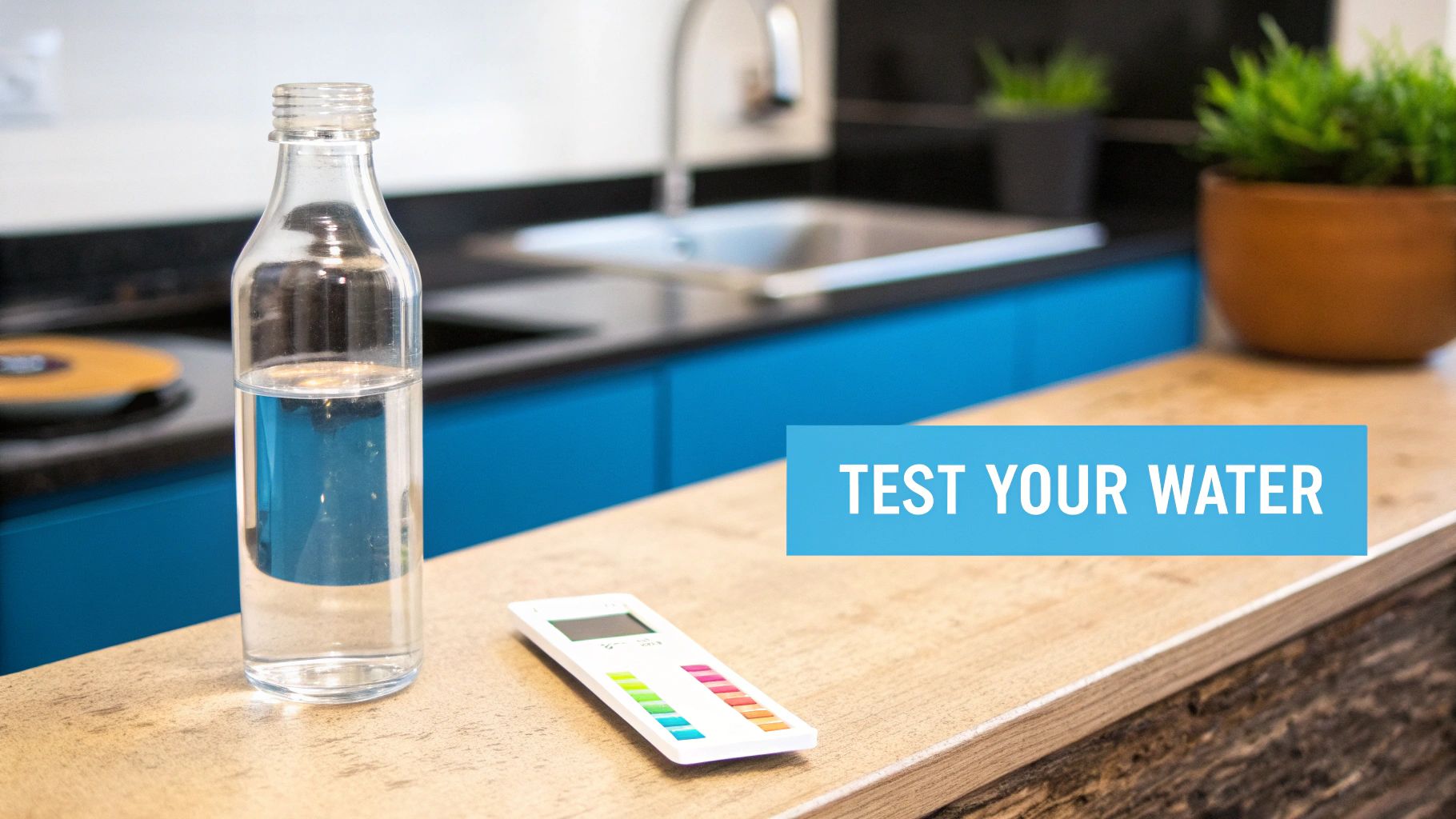
A water bottle and a testing strip on a kitchen counter with a 'Test Your Water' banner.

The Simple Soap Suds Test

Think of this as your five-minute hard water detective work. It's not perfectly scientific, but it’s a surprisingly good indicator that can tell you if you're on the right track.

Here's how to do it:

  1. Grab a clean, clear water bottle with a cap that seals tightly.
  2. Fill it about one-third of the way with your cold tap water.
  3. Add 10 drops of a pure liquid soap, like a basic Castile soap. Don't use detergents; many are designed to create suds even in the hardest water.
  4. Shake it like you mean it for about 15 seconds.

Now, observe the results. If the bottle is brimming with fluffy, rich suds and the water underneath is clear, congratulations—you likely have soft water. But if you’re looking at a sad, scummy film with just a few pathetic bubbles and cloudy water, you've got hard water. The soap has reacted with the calcium to create gross soap scum instead of a luxurious lather.

Getting a Precise Reading with Test Kits

The soap test tells you there's a problem, but it doesn't tell you the scale of it. To properly size a water softener or select the right filter, you need an actual number. That’s where water hardness test kits come in—they’re cheap, easy to find, and even simpler to use.

Most kits come with test strips that you just dip into a sample of your tap water. After a moment, the strip changes color. You then match that color to a chart to get a specific measurement of your water's hardness.

Pro Tip: For the most accurate reading, test cold water straight from a faucet that has no existing filtration. Your outdoor spigot or a utility sink is perfect. This gives you a true baseline of the water coming into your house before it's been treated in any way.

Understanding the Numbers: GPG vs PPM

Your test kit will show results in one of two units: grains per gallon (GPG) or parts per million (PPM). Don't let the terms intimidate you; they're just different ways of measuring the exact same thing.

  • Parts Per Million (PPM): This is the same as milligrams per liter (mg/L). It simply tells you how many milligrams of calcium carbonate are present in one liter of water.
  • Grains Per Gallon (GPG): This is the industry standard for water softeners in the U.S. For context, one GPG is equal to 17.1 PPM.

If your kit only shows a PPM reading, just divide that number by 17.1 to get your GPG. That GPG number is the golden ticket you'll need when you start shopping for a water softener.

The U.S. Geological Survey uses these numbers to classify water hardness, giving us a clear set of benchmarks.

Water Hardness Level Grains Per Gallon (GPG) Parts Per Million (PPM)
Soft 0 – 3.5 0 – 60
Moderately Hard 3.5 – 7.0 61 – 120
Hard 7.0 – 10.5 121 – 180
Very Hard Over 10.5 Over 180

Once you have your GPG, you’ve got the most critical piece of the puzzle. Generally, if your water tests at 7 GPG or higher, investing in a system to remove calcium is going to make a noticeable, life-improving difference in your home.

Whole-House Water Softeners: The Ultimate Calcium Defense

If you're sick of fighting a losing battle against hard water in every single room, it's time to stop playing defense and bring in the heavy artillery. For a truly comprehensive, set-it-and-forget-it solution, nothing beats a whole-house water softener. This is the undisputed champion of hard water treatment, installed right where your main water line enters your home to shield every pipe, faucet, and appliance from the tyranny of scale buildup.

Think of it as a bouncer for your entire plumbing system. Its one job is to catch the troublemakers—calcium and magnesium ions—and swap them out for something far more civilized before they can cause any problems. This process is called ion exchange, and it's the gold standard for a reason.
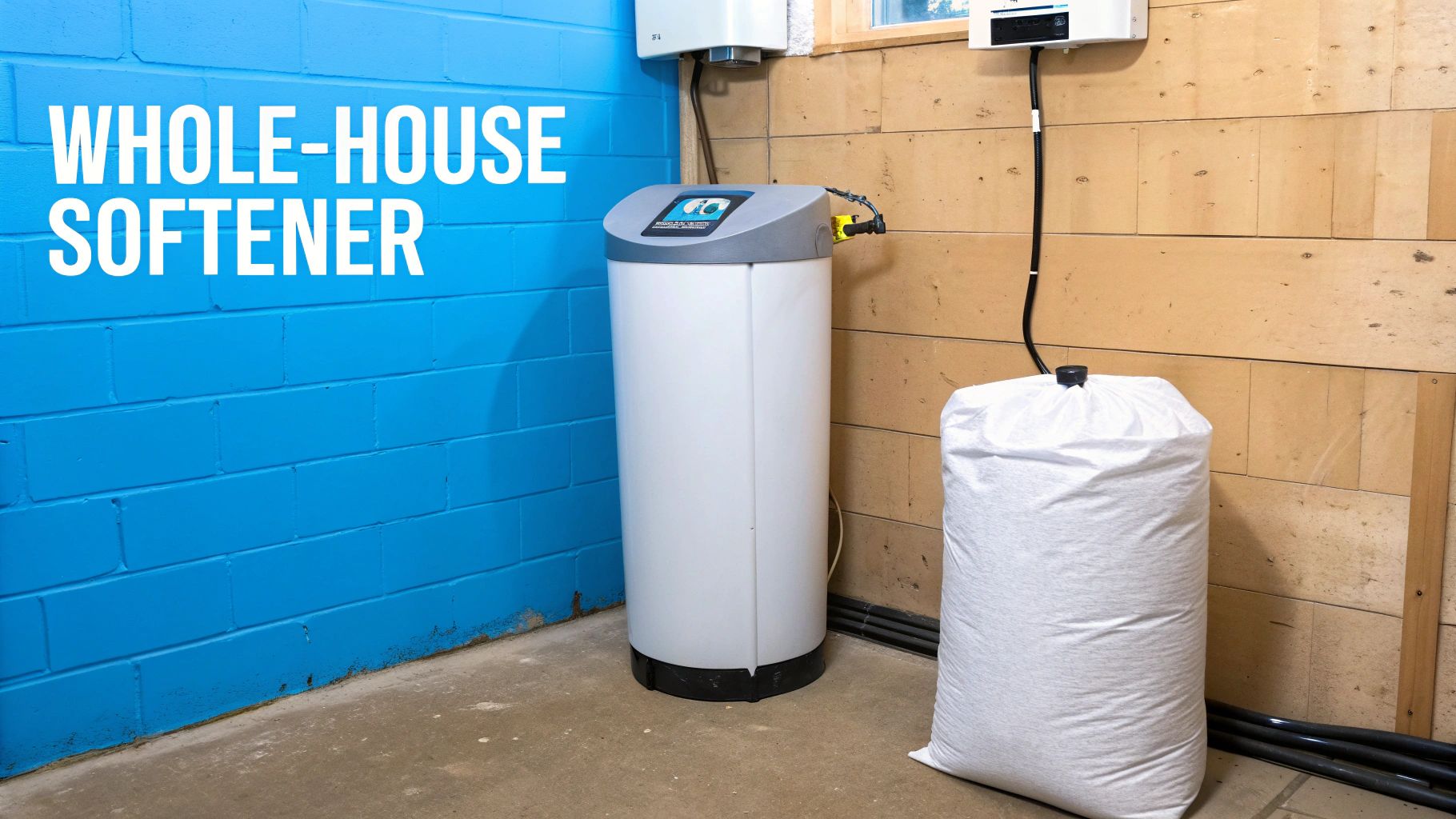
A water softener and salt bag in a basement with blue concrete block walls and wood paneling.

So, How Does This Ion Exchange Magic Work?

Inside every salt-based water softener is a tank packed with thousands of tiny resin beads. These beads come pre-loaded with harmless sodium ions. As your hard water flows through this tank, the calcium and magnesium ions—which carry a stronger positive charge—are magnetically drawn to the resin beads.

They literally kick the sodium ions off the beads and take their place. The newly "softened" water, now carrying the sodium ions, flows right on into your house. It’s a simple, elegant trade that happens millions of times as water passes through the system.

This process continues until the resin beads are completely saturated with calcium and magnesium, with no more sodium left to trade. At that point, the softener kicks into a self-cleaning mode called regeneration.

The Regeneration Cycle: What to Expect

Regeneration is just the softener’s way of hitting the reset button. The system automatically flushes the resin tank with a brine solution—a mix of salt and water from a separate tank. This concentrated saltwater bath washes away all the captured calcium and magnesium, sending them harmlessly down the drain.

This process recharges the beads with a fresh supply of sodium ions, getting them ready to soften more water. It’s usually programmed to happen in the middle of the night, based on your water hardness and how much water your family uses.

Your only job? Keep the brine tank topped up with water softener salt. Depending on your system and water quality, you might only need to add a new bag of salt every month or two. It’s a tiny bit of maintenance for total home protection.

Sizing Your System for Peak Performance

Picking the right size softener is absolutely critical. If it’s too small, it will constantly be regenerating, wasting salt and water. If it's too big, you’ve overspent, and it can lead to other issues.

Sizing boils down to two key numbers:

  • Your Water Hardness: Measured in grains per gallon (GPG), which you found with your water test.
  • Your Daily Water Usage: A solid estimate is 75 gallons per person, per day. A family of four would use about 300 gallons daily.

To figure out your daily softening needs, just multiply those two numbers.

Here’s a quick example:
Let's say a family of four has water with 15 GPG of hardness.
4 people x 75 gallons/person = 300 gallons per day
300 gallons x 15 GPG = 4,500 grains of hardness to remove daily.

This number tells you how much work the softener has to do each day. Softeners are rated by their grain capacity (e.g., 32,000-grain), which is how many grains they can remove before needing to regenerate. A perfectly sized system should only need to regenerate about once a week.

Investing in a whole-house system is a big move, but it provides a definitive answer to the hard water problem. For those wanting to dig deeper, exploring guides on the best whole house water filtration system for your home can provide even more context. A properly chosen softener will protect your home, save you money on appliance repairs, and improve your daily life—from softer skin to cleaner, brighter clothes.

Targeted Purity with Point-of-Use Filtration

What if your biggest headache isn't protecting your entire plumbing system, but just getting a great-tasting, clean glass of water from the kitchen sink? Maybe you're renting and can't install a big whole-house system, or perhaps you just don't see the point in treating the water you use to flush toilets.

This is exactly where point-of-use (POU) filtration shines.

Instead of a broad, house-wide approach, POU systems are like sharpshooters. They focus on a single faucet—usually in the kitchen—to give you exceptionally pure water right where you need it for drinking and cooking. When the goal is specifically how to remove calcium from water you're going to consume, the hands-down winner is a reverse osmosis system.
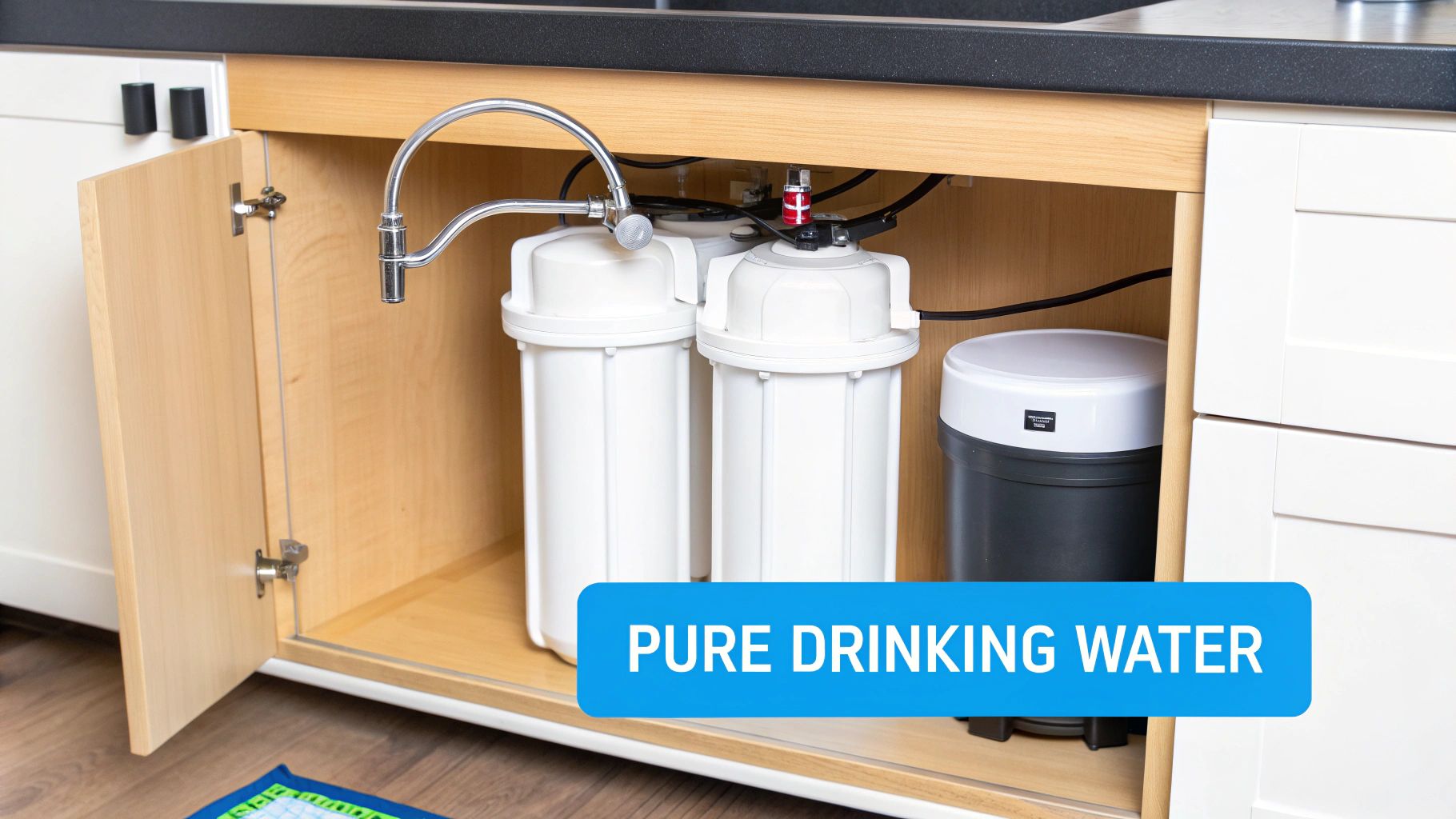
An under-sink water filtration system provides pure drinking water from a chrome faucet in a kitchen cabinet.

Reverse Osmosis: The Under-Sink Powerhouse

A reverse osmosis (RO) system is a multi-stage workhorse that typically lives in the cabinet right under your kitchen sink. This isn't your average pitcher filter; it's in a whole different league.

The magic happens at its semi-permeable membrane. Think of it as a microscopic bouncer at an exclusive club—the pores are so tiny that only water molecules are on the VIP list.

When your tap water is pushed against this membrane, the water molecules squeeze through to the clean side. Everything else—calcium, magnesium, lead, chlorine, and a whole host of other dissolved solids—gets rejected and washed down the drain. The result is stunningly pure water, with up to 99% of all contaminants stripped away.

Reverse osmosis doesn't just soften water; it purifies it. A water softener simply swaps calcium ions for sodium ions. An RO system physically removes the calcium completely, along with nearly everything else.

This makes RO the perfect fix if your goal is bigger than just fighting limescale. You get water that's not only free from hardness minerals but also tastes incredibly crisp and clean because all the other gunk affecting flavor and odor is gone, too.

How an RO System Works Under Your Sink

It helps to know what's going on inside the unit to appreciate its power. A typical under-sink RO system follows a few key steps:

  • Pre-Filters: Before the water even gets near the main membrane, it flows through sediment and carbon pre-filters. These are the bodyguards, catching big stuff like rust, dirt, and chlorine, which protects the delicate RO membrane from getting clogged or damaged.
  • The RO Membrane: This is where the real heavy lifting happens. Water pressure forces H₂O molecules through the membrane, leaving the calcium ions and other impurities behind to be flushed away.
  • Storage Tank: The RO process is slow and steady, so the purified water collects in a small pressurized tank. This gives you a ready supply of clean water the moment you open the tap.
  • Post-Filter: As a final touch, water from the tank passes through one last carbon filter on its way to your glass. This "polishing" filter removes any potential lingering tastes or odors from the tank.

All of this is hooked up to a sleek, dedicated faucet right on your sink. It’s the perfect setup for filling a water bottle, making coffee, or cooking pasta with water you know is as clean as it gets.

What About Water Distillers?

Another POU method that gets rid of calcium is distillation. A water distiller works by boiling water into steam, which leaves all the minerals and contaminants behind. The steam is then cooled and condensed back into pure liquid water.

Distillation is incredibly effective—it produces some of the purest water you can get. For day-to-day use in a home, though, distillers have some real-world drawbacks compared to RO systems.

Feature Reverse Osmosis (RO) Water Distiller
Speed Instant access from a tap Slow; takes hours to make a gallon
Convenience On-demand water Batch process; you have to fill it
Energy Use Uses water pressure Needs electricity to boil water
Installation Under-sink plumbing Sits on your countertop

While distillation is a great technology, its slow, batch-by-batch process just isn't practical for a busy kitchen that needs clean water now. For most homeowners who want to remove calcium for drinking and cooking, the on-demand convenience of a quality RO system makes it the obvious choice.

Getting It Installed and Keeping It Running

Choosing your water filtration system is the first big win, but the job isn't done yet. Proper installation and a little bit of upkeep are what will give you years of hassle-free, calcium-free water. It's like buying a fantastic new car; you still have to change the oil to keep it running smoothly.

This is your game plan for getting everything set up correctly and keeping it in top shape, whether you're a weekend DIY warrior or you'd rather hand the job to a pro. A little effort now saves you from major headaches down the road.

Setting Up Your Water Softener

A whole-house water softener is a serious piece of equipment, and its installation is more involved than, say, a new toaster. It needs to be plumbed directly into your main water line, usually between your water meter and your water heater. This is key because it ensures every drop of water entering your home gets treated.

If you've got solid plumbing skills, you can definitely tackle this yourself. But if you're even a little hesitant, call a plumber. A pro can get it done in a few hours, guaranteeing no leaks and a perfect setup from the start.

Once it's in, your most important job is to program the regeneration schedule. This is the automatic cleaning cycle where the system flushes out the collected minerals and recharges itself. Most modern softeners have a simple digital interface where you'll enter two numbers:

  • Your Water Hardness (GPG): That number you got from your water test.
  • The Number of People in Your Home: This helps the system estimate your daily water use.

With that info, the softener figures out the best time to regenerate—usually in the dead of night. Nailing this setting is critical for efficiency. It keeps the system from wasting salt and water by regenerating too often, or worse, not regenerating enough and letting hard water sneak through.

The Simple Routine of Softener Upkeep

After that initial setup, you’ll be pleasantly surprised by how low-maintenance a water softener is. Your main responsibility is just keeping the brine tank topped up with the right kind of salt.

  • Check Salt Levels: Once a month, just pop the lid and take a peek. As a rule of thumb, you always want the salt level to be higher than the water level.
  • Watch for "Salt Bridges": Every now and then, a hard crust can form over the top of the salt pile. This "bridge" stops the salt from dissolving into the water below. If the salt level hasn't budged in a while, give the side of the tank a gentle whack or use a broom handle to break up the crust.

And that’s about it. A well-maintained softener can easily last 15 years or more, quietly protecting your pipes and appliances from the shadows.

Pro Tip: Check your softener’s manual for its preferred salt type. Some newer high-efficiency models work best with purer salt pellets, while others are perfectly happy with the less expensive salt crystals.

Installing and Maintaining an RO System

Putting in an under-sink reverse osmosis (RO) system is a much more common DIY project. The kits usually come with everything you need and clear instructions. You’ll be tapping into your cold water line, drilling a small hole in your countertop for the dedicated RO faucet, and connecting the various filter housings and the storage tank.

The most important part of owning an RO system is sticking to the filter replacement schedule. An RO system is only as good as its filters, and if they get clogged, performance will plummet.

Filter Type Typical Replacement Schedule What It Does
Sediment Pre-Filter Every 6-12 months Catches the big stuff like rust, sand, and dirt.
Carbon Pre-Filter Every 6-12 months Removes chlorine, which can destroy the RO membrane.
RO Membrane Every 2-4 years This is the heart of the system; it removes the calcium.
Carbon Post-Filter Every 12 months Gives the water a final "polish" for a clean taste.

Put these dates on your calendar or set a reminder on your phone. Swapping filters on time is the number one thing you can do to ensure your RO system keeps delivering pure, great-tasting water. If you notice the water pressure from your RO faucet starting to drop, that's a classic sign a filter change is overdue.

Got Questions About Getting Rid of Calcium? We've Got Answers.

Even after doing your research, a few questions can still bubble up. That’s completely normal. When you’re dealing with something as vital as your home’s water, you want to be 100% sure you're making the right call. Let's tackle some of the most common things homeowners ask when they're figuring out how to remove calcium from their water.

Getting straight answers now means you won't have any surprises later. You can move forward feeling confident you’ve picked the best solution for your house and family.

Will a Water Softener Make My Water Taste Salty?

This is probably the number one concern we hear, but the short answer is no. The ion-exchange process adds a very small amount of sodium, not table salt (sodium chloride). The amount is directly tied to your water's hardness—the harder the water, the more sodium is needed to soften it.

Honestly, for most people, the amount of sodium is less than what’s in a single slice of white bread. The vast majority of people never even notice a change in taste.

Worried because you're on a strict low-sodium diet? You've got options. You can use potassium chloride pellets instead of sodium chloride. Another popular route is to pair your softener with an under-sink reverse osmosis system for drinking and cooking water, which will remove that added sodium anyway.

Can I Just Use a Standard Water Filter Pitcher to Remove Calcium?

It’s a great question, but unfortunately, those popular fridge pitchers are the wrong tool for this job. They typically use activated carbon filters, which are fantastic for making water taste and smell better by removing things like chlorine.

But they do absolutely nothing to remove dissolved hard minerals like calcium and magnesium. To really get rid of the minerals causing that crusty limescale, you need a system specifically designed for it, like an ion-exchange water softener or a reverse osmosis filter.

Is It Bad for Me to Drink Hard Water with Calcium in It?

Health-wise, drinking hard water is perfectly safe. In fact, your body needs essential minerals like calcium and magnesium to function properly. The whole reason for removing calcium from water has nothing to do with health—it's all about protecting your home and making your life easier.

The real problems caused by hard water are mechanical and cosmetic:

  • Limescale buildup that ruins appliances and clogs up your pipes.
  • Annoying spots and a filmy residue on your dishes, shower doors, and faucets.
  • Dry, itchy skin and hair that feels dull and brittle because of soap scum.

At the end of the day, people install these systems to stop expensive damage to their homes and to make daily tasks like cleaning and showering a whole lot more enjoyable.


Figuring out the world of water filtration can seem like a lot, but Water Filter Advisor is here to keep it simple. We create clear, research-backed guides to help you land on the perfect solution for your home's unique water needs. Check out our in-depth reviews and expert advice at https://www.waterfilteradvisor.com to get safer, better-tasting water today.
Your Guide to Winning the War on Limescale

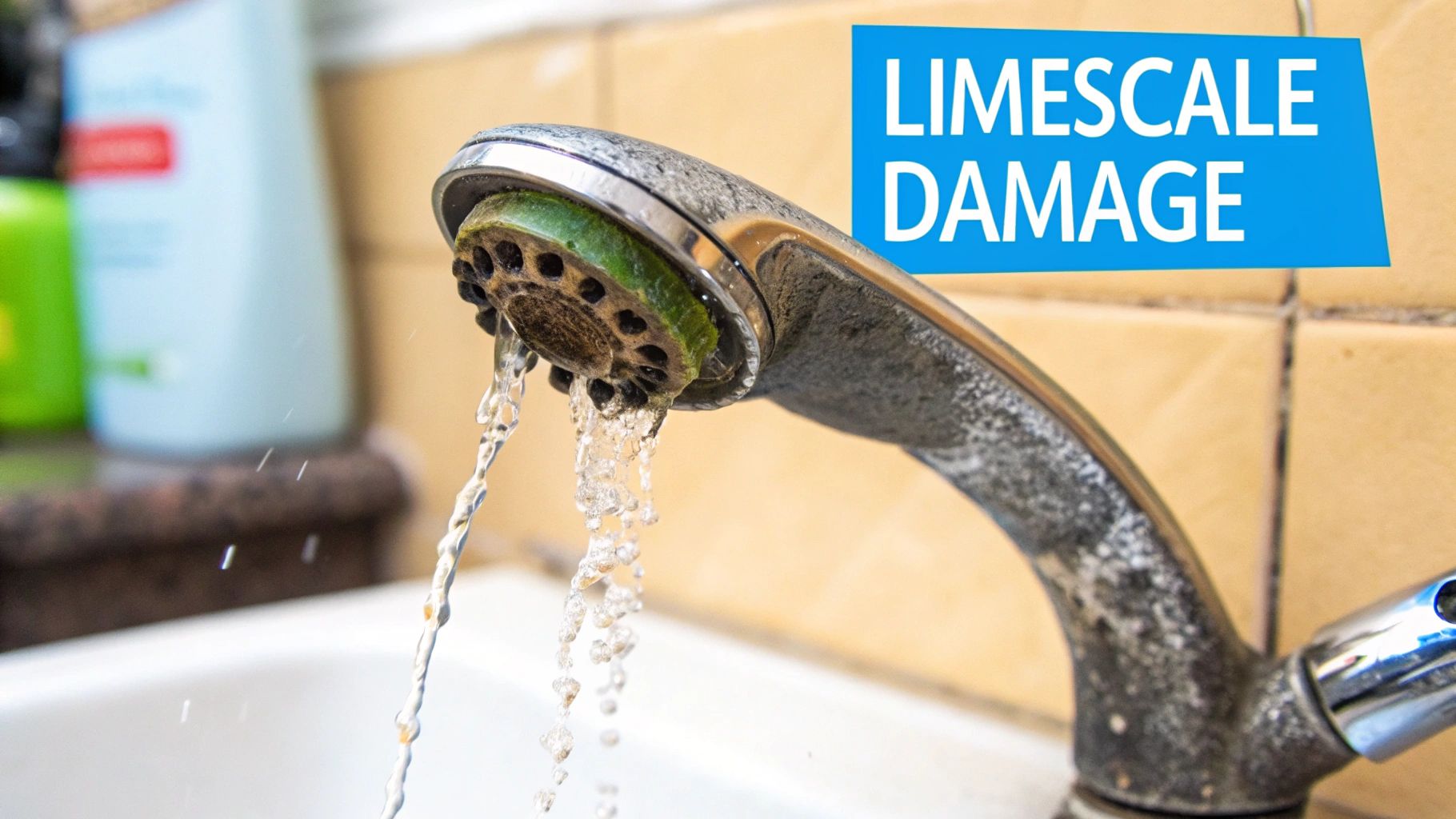
That chalky white gunk on your showerhead? It’s just the tip of the iceberg—the most visible sign of a much bigger, more expensive problem lurking in your pipes. To truly defeat the limescale dragon, you need a whole-house system that treats the water before it ever has a chance to cause chaos. The best water filters for limescale typically use ion exchange (the classic water softener) or template-assisted crystallization (a modern, salt-free conditioner).

This guide will walk you through everything you need to know to find the right solution and protect your home from the costly damage caused by hard water.

The Hidden Damage Limescale Causes in Your Home

Close-up of a faucet covered in white, chalky limescale buildup.

If you’ve ever pulled a supposedly clean glass from the dishwasher only to find it covered in cloudy spots, you've seen limescale in action. This chalky substance is the silent villain that comes with hard water, slowly but surely wrecking things from the inside out. It's the real reason your coffee maker sputters to a stop or your shower pressure weakens to a sad little trickle.

These daily frustrations are warning signs of a deeper issue. Limescale is just the hardened deposits of minerals—mainly calcium and magnesium—that are naturally in your water. When that hard water gets heated or simply evaporates, these minerals get left behind, baking into a rock-hard coating on any surface they touch.

More Than Just a Cleaning Nuisance

Sure, visible scale on your faucets is ugly and annoying, but the real trouble is the damage you can't see. Limescale is relentlessly building up inside your pipes and appliances, setting off a chain reaction of expensive and frustrating problems.

This internal buildup forces your home's most important equipment to work way harder than it should. Picture your water heater trying to heat water through a thick layer of mineral scale; it's like trying to cook with a pan coated in cement. The result is a ton of wasted energy and a much higher utility bill. In fact, just a quarter-inch of scale can crank up a water heater's energy use by a shocking 40%.

"Limescale can make your coffee taste flat and reduce the lifespan of your coffee and steam equipment. If you don’t keep it out of your equipment, it causes problems such as inconsistent temperatures and premature breakdown."

Ignoring limescale has some serious consequences. This mineral buildup can lead to:

  • Reduced Appliance Efficiency: Everything from your dishwasher to your washing machine has to fight against scale, leading to poor performance and, eventually, total failure.
  • Clogged Pipes: Over time, scale can literally narrow your pipes, strangling your water flow and killing the pressure throughout your house.
  • Higher Energy Bills: Your water heater and other appliances have to burn more electricity or gas just to do their basic job.
  • Costly Repairs: The delicate internal parts of appliances like espresso machines and washing machines are especially vulnerable. Unfiltered hard water is a primary cause of leaks and breakdowns.

The good news is, you don't have to put up with it. Understanding what limescale is doing to your home is the first step. The next is figuring out how the right water filter for limescale can protect your investments, save you money, and bring back some peace of mind. This guide will show you exactly how.

So, What Exactly Is Limescale and Where Does It Come From?

Before you can tackle a problem, you’ve got to know what you’re dealing with. When it comes to hard water, the science behind that frustrating, chalky gunk is actually pretty straightforward.

Think about what happens when you dissolve a spoonful of sugar in hot tea. If you let the tea evaporate, you'd find a sticky layer of sugar crystals left behind in the cup. Limescale works on a very similar principle.

Your home’s water naturally contains dissolved minerals, mostly calcium and magnesium. When this "hard water" gets heated up in your boiler or evaporates off a surface like your shower door, the water leaves, but the minerals stay. They then crystallize and fuse together, creating that tough, crusty deposit we all know as limescale.

This is just basic water chemistry in action, but the havoc it wreaks on your home is anything but harmless. The scale you can see on your faucets is just the tip of the iceberg—the real damage is happening where you can't see it.

The Hidden Costs of Mineral Buildup

Limescale isn't just ugly; it’s an expensive pest that slowly but surely destroys your home’s plumbing and appliances. The mineral buildup acts like a layer of insulation, forcing your water heater and other appliances to work much harder just to do their job. That inefficiency hits you right where it hurts: your utility bills.

Even worse, this constant strain can cause major—and sometimes catastrophic—damage over time.

  • Skyrocketing Energy Bills: Your water heater has to burn way more energy to push heat through a thick layer of mineral scale. A buildup of just 1/4 inch can jack up a boiler's energy consumption by a shocking 40%.
  • Shorter Appliance Lifespan: The guts of your dishwasher, washing machine, and coffee maker get clogged and corroded. This leads to premature breakdowns and unexpected replacement costs.
  • Clogged Pipes and Weak Water Pressure: Over the years, limescale can choke the life out of your pipes, narrowing their diameter and leading to frustratingly low water pressure throughout your house.
  • Poor Performance: You'll start to notice your dishwasher leaves cloudy spots on glasses and your washing machine just doesn't get clothes as clean. Even your morning coffee can taste flat because the water can't properly extract the flavor from the beans.

Limescale acts as a barrier, forcing the boiler to work harder to heat the water. This leads to premature aging of the equipment and, eventually, breakdown.

How to Spot the Signs of Hard Water

Before picking the right water filter for limescale, you need to be sure you actually have a problem. Luckily, hard water usually leaves plenty of clues. If you see any of these signs, you’re almost certainly dealing with limescale.

  • White, chalky residue on faucets, showerheads, and around drains.
  • Soap scum that seems to instantly reappear on shower doors, tubs, and sinks.
  • Cloudy spots on your dishes and glassware right after they come out of the dishwasher.
  • Stiff, scratchy laundry and faded clothes, since mineral deposits get trapped in the fabric.
  • Dry skin and dull, lifeless hair from the residue left behind after you shower.

It's no surprise that the market for effective solutions is booming. Filters designed to fight limescale are a huge part of the global water filters market, which hit a value of USD 16.16 billion in 2024 and is expected to more than double by 2033. This growth is happening because more and more people are realizing how much damage hard water does to their homes. You can explore more data on this market trend to see just how big the issue is.

Comparing The Different Types of Limescale Filters

Trying to figure out the world of limescale solutions can feel a bit like learning a new language. You’ll hear terms like softeners, conditioners, and descalers thrown around, each promising to put an end to your hard water headaches. The secret to picking the right water filter for limescale is really just understanding what’s happening behind the scenes.

The main difference comes down to how each system deals with the hard minerals in your water. Some straight-up remove them, while others just change their behavior so they can’t build up and cause problems. Let's dig into the three main players in the fight against scale.

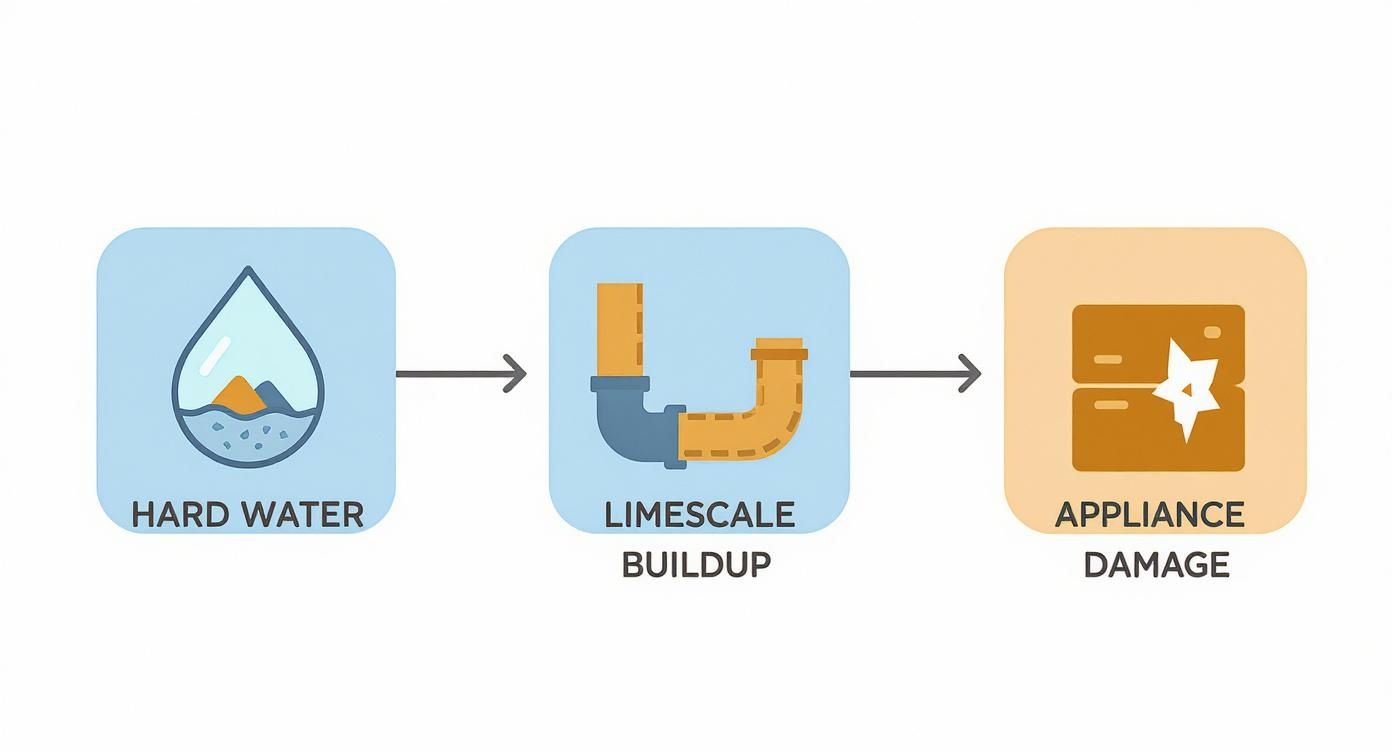
To really see what these filters are up against, just look at the journey from hard water to a broken appliance.

Infographic about water filter for limescale

This pretty much sums it up: untreated hard water leads directly to that crusty limescale, which eventually causes some pretty expensive damage to your home’s most important appliances.

Salt-Based Water Softeners: The Mineral Swap

This is the old-school, traditional workhorse of limescale treatment. A salt-based water softener works using a process called ion exchange, which is basically a swap meet for minerals.

Think of your hard water as a stream full of clingy little calcium and magnesium particles. Inside the softener tank, there are thousands of tiny resin beads covered in sodium ions. As the water rushes past, the calcium and magnesium—which are like stronger magnets—bump the sodium ions out of the way and grab onto the beads instead. The sodium gets released into your water, and the hard minerals get trapped. Simple as that.

This is the only method that actually removes the hardness minerals, giving you truly soft water. It’s the reason you get that slick, slippery feeling in the shower—there are no minerals left to form that annoying soap scum.

  • How It Works: Uses ion exchange to swap hardness minerals (calcium and magnesium) for sodium ions.
  • The Result: Genuinely soft water without any of the minerals that form scale.
  • Maintenance: You'll need to regularly top up the brine tank with salt pellets so the system can "regenerate" and clean off the resin beads.

Salt-Free Water Conditioners: The Non-Stick Shield

If you’re looking for a solution that doesn’t add any salt to your water, a salt-free water conditioner is a great way to go. These systems don't technically "soften" the water or pull any minerals out. What they do is change the physical structure of the minerals so they can't stick together and form scale.

Imagine coating a sticky piece of candy with a fine, non-stick powder. The candy’s still there, but it won’t clump up or stick to anything. That’s essentially what Template Assisted Crystallization (TAC) does. The media inside the tank grabs the hardness minerals and forces them into tiny, stable crystals that just float on by.

These microscopic crystals are harmless and flow right through your plumbing without clinging to pipes or heating elements. You get to keep the healthy calcium and magnesium in your water, but without the destructive scale.

It's important to remember that salt-free systems prevent scale; they don't remove hardness. Your water will still test as "hard," but it will act like soft water where it counts.

Electronic and Magnetic Descalers: The Structural Shake-Up

The third category is electronic or magnetic water descalers. You’ll usually see these devices clamped or wrapped around the outside of your main water pipe, never actually touching the water itself.

The idea here is that they generate a magnetic or electronic field that passes through the pipe. This field is meant to shake up the calcium and magnesium minerals, changing their crystal structure. Much like TAC systems, the goal is to make the minerals less sticky and less likely to build up on surfaces.

These are often the easiest systems to install and have zero ongoing maintenance. That said, their effectiveness is a hot topic of debate. Results can vary a lot depending on your home’s specific water chemistry and flow rate, so they're generally seen as a scale prevention tool, not a complete fix.

It's no surprise that all these technologies are gaining traction. The global water filter market, which covers everything from limescale to microbes, was valued at around US$48.2 billion in 2025. It’s expected to shoot up to US$84.2 billion by 2032, largely because people are more aware of water quality and want to protect their homes. You can get more details on water filter market growth from Persistence Market Research.

To make the choice a little easier, here’s a quick rundown to help you compare the different approaches.

Comparing Limescale Filtration Technologies

This table breaks down the key differences between the main limescale treatment methods, giving you a clear side-by-side look at what each one offers.

Technology Type How It Works Best For Key Advantage Main Disadvantage
Salt-Based Softener Ion Exchange: Swaps calcium/magnesium for sodium. Homes with very hard water needing total mineral removal. Completely removes hardness, eliminating soap scum and scale. Adds sodium to water; requires ongoing salt refills.
Salt-Free Conditioner Template Assisted Crystallization (TAC): Crystallizes minerals. Eco-conscious homes wanting scale prevention without salt. Prevents scale buildup while preserving healthy minerals. Does not technically "soften" water or reduce soap scum.
Electronic Descaler Magnetic/Electronic Field: Alters mineral structure. Renters or those seeking a low-maintenance, non-invasive option. Easy DIY installation and zero ongoing maintenance. Effectiveness can be inconsistent and is debated.

Hopefully, this gives you a better handle on which technology might be the best fit for your home and your water.

How to Choose the Right Limescale Filter for Your Home

Alright, now that we've covered the different technologies, let's move from theory to practice. Choosing the right water filter for limescale isn't about finding some mythical "best" filter—it’s about finding the best one for your home and your water.

A few key factors will help you narrow down the choices and pick a solution you can be confident in. Before you can choose your weapon, you need to know the size of the dragon you're fighting.

Assess Your Water Hardness Level

First things first: you absolutely need to know how hard your water is. This is the single most important piece of the puzzle, as it dictates how aggressive your solution needs to be. You can easily grab a DIY water hardness test kit online or from any big-box home improvement store.

These kits measure hardness in Grains Per Gallon (GPG). Here’s a quick breakdown of what the numbers mean:

  • Slightly Hard: 1 to 3.5 GPG
  • Moderately Hard: 3.5 to 7 GPG
  • Hard: 7 to 10.5 GPG
  • Very Hard: Over 10.5 GPG

If your test results come back in the "Hard" or "Very Hard" range, a salt-based water softener is almost always your best bet. It’s the only way to truly remove the minerals causing all the trouble. For moderately hard water, a salt-free conditioner can be a fantastic, low-maintenance alternative.

Whole House Protection vs. Targeted Treatment

Next up, you need to decide on the scope of your protection. Are you looking to protect your entire home's plumbing and every appliance, or are you just trying to fix a specific problem? This is the classic battle between Point-of-Entry and Point-of-Use systems.

Point-of-Entry (POE) systems, often called whole-house filters, are installed right where the main water line enters your home. This means every single drop of water—for your shower, washing machine, dishwasher, and faucets—gets treated. It’s the ultimate defense for your entire plumbing system.

Point-of-Use (POU) systems are much smaller and treat water right where you use it. Think of a dedicated showerhead filter or a little inline filter you’d hook up to your coffee machine. These are perfect for renters or for tackling a single problem without the cost and installation of a whole-house unit. For more general filtration guidance, you can find a ton of helpful advice on our site.

It's no surprise that more and more people are looking for comprehensive solutions. The whole-house water treatment market was valued at a whopping USD 10.17 billion in 2024 and is expected to climb to USD 13.42 billion by 2030. This boom shows just how many people are realizing the importance of tackling hard water at its source. You can dig into more market insights over at Grand View Research.

The choice between POE and POU really boils down to your main goal. Are you protecting your home's infrastructure, or just trying to stop a pesky, scale-clogged showerhead?

Matching the Filter to Your Lifestyle

Let's get practical. Your family size, living situation, and what you care about most will steer you toward the perfect limescale filter.

Scenario 1: The Family Homeowner

  • The Problem: A family of four owns a house in a very hard water area (12 GPG). They’re fed up with spotty dishes, crunchy laundry, and have already paid to replace one water heater.
  • The Solution: A whole-house, salt-based water softener (POE) is the clear winner here. It will completely eliminate the hardness minerals, protecting their expensive appliances and making daily life so much easier. The long-term savings on repairs and energy bills will more than pay for the initial investment.

Scenario 2: The Apartment Renter

  • The Problem: A couple rents an apartment where the water is moderately hard (6 GPG). They can't make any permanent changes to the plumbing but want to stop the scale buildup on their showerhead and get rid of that slimy soap scum.
  • The Solution: A high-quality Point-of-Use (POU) showerhead filter is the perfect fit. It’s a breeze to install and remove, doesn't require a plumber, and directly solves their biggest annoyance. They could even add another POU filter for their kitchen sink if they wanted to.

By working through these steps—testing your water, deciding on scope, and thinking about your lifestyle—you can confidently pick a limescale filter that actually fits your needs, budget, and home.

Installing and Maintaining Your Limescale Filter

A plumber works on installing a whole-house water filtration system in a home's utility room.

You’ve done the research and picked out the perfect water filter for limescale. That’s a huge step, but the job isn't quite done. A filter is only as good as its installation and upkeep, and getting this part right ensures your system runs like a dream for years to come.

Some systems are genuinely plug-and-play. Point-of-use filters, like a descaling showerhead, are often designed for anyone to install. You can usually just screw it on by hand in a few minutes, no tools needed. It's a fantastic, targeted fix.

Whole-house systems, though? That's a different league. Whether it's a salt-based softener or a salt-free conditioner, you're looking at a proper plumbing job. It means shutting off your home's main water supply and cutting into the primary pipe. For that kind of work, calling a licensed plumber is nearly always the smartest, safest move.

What a Typical Installation Involves

Even if you hire a pro, it helps to know what to expect. While every house is a little different, the general playbook for a whole-house system is pretty standard.

  1. Find the Right Spot: The unit needs to go near your main water shut-off valve, usually tucked away in a garage, basement, or utility closet. It needs a level floor and, for softeners, access to a drain.
  2. Turn Off the Water: First things first, the main water supply to the house gets shut off. The plumber will then drain the pipes to release any pressure.
  3. Cut the Main Line: This is the point of no return. A section of the main water line is carefully cut out to make room for the new system.
  4. Install the Bypass Valve: A bypass valve is a must-have. This clever bit of plumbing lets you shut off water to the filter for maintenance without turning your whole house into a desert.
  5. Connect the System: The filter tanks are then connected to the bypass valve. A secure, leak-proof fit is absolutely critical here.
  6. Set Up the Drain Line: For water softeners, a drain line has to be run from the control valve to a nearby drain, like a laundry sink or standpipe. This is for the regeneration cycle.
  7. Fire It Up: With everything connected, the water is slowly turned back on. The plumber will meticulously check for leaks and run the system through its first cycles to make sure it's working perfectly.

Creating a Maintenance Routine

Once your filter is humming along, a simple maintenance schedule is your ticket to long-term success. What you need to do really depends on the type of system you chose.

A well-maintained limescale filter doesn't just protect your pipes and appliances; it guarantees you're getting the best quality water your system can deliver. Think of it as an investment in your home and your daily comfort.

Here’s a quick rundown of what to expect for each type:

  • Salt-Based Water Softeners: These are the most hands-on. You'll need to check the salt level in the brine tank at least once a month and top it off as needed. While modern systems are pretty efficient, plan on adding a 40-pound bag of salt every couple of months.
  • Salt-Free Water Conditioners: The beauty of these systems is how little they ask of you. The internal media that conditions the water has a long lifespan, typically only needing a replacement every 3 to 6 years. No salt bags, no fuss.
  • Electronic Descalers: This is the true "set it and forget it" option. Once it's clamped onto your pipe and plugged in, there is virtually zero maintenance.

Don't forget your appliances! Regular cleaning is key to tackling any scale that built up before your filter was installed. For example, learning how to clean your washing machine to remove limescale can boost its performance and help it last longer. A clear schedule for both your filter and your appliances ensures you get every bit of value from your investment.

Putting an End to Limescale for Good

Limescale can feel like a never-ending battle, but it’s one you can absolutely win. Now that you’ve seen how it forms, the sneaky damage it does, and the different technologies out there to fight it, you have everything you need to pick the right water filter for limescale for your home.

You know the difference between a water softener that gets rid of hard minerals and a conditioner that just stops them from sticking. That's the key to choosing a system that fits your water, your family's size, and what you want to spend.

This isn't just about getting rid of those annoying white spots. It's about protecting your expensive appliances, cutting down your energy bills, and getting better, cleaner water from every tap in your house.

So, what's the first step? It's simple: test your water. You can't find the right solution if you don't know exactly what problem you're solving. As you get started, it might also be helpful to look into other home water treatment solutions to see the full picture.

Don't wait for the problem to get worse. You can start today and finally free your home from the expensive headaches limescale causes.

Limescale Filter FAQs

Even after getting the rundown on the tech, you probably still have a few questions floating around. That’s perfectly normal. Here are some quick, straightforward answers to the questions we hear most often.

Will a Limescale Filter Make My Water Safer to Drink?

Not really. Think of limescale filters as specialists. Their one and only job is to go after the minerals that make your water hard—not things like bacteria, lead, or chlorine. The water that comes out is perfectly fine to drink, but it hasn't been "purified."

If you want to improve the actual safety and taste of your drinking water, you'll need to pair your limescale system with a dedicated drinking water filter. A reverse osmosis system, for instance, is fantastic for purification and plays very nicely with a whole-house softener or conditioner.

How Long Does a Limescale Filter Last?

This completely depends on the type of system you choose. The lifespan can vary wildly, so it’s a huge factor when you're thinking about long-term costs and upkeep.

  • Salt-Based Water Softeners: The resin tank is the workhorse of these systems. With good care, it can easily last 10 to 20 years.
  • Salt-Free Conditioners: These are pretty low-maintenance, but the internal media that handles the crystallization will need to be swapped out, usually every 3 to 6 years.
  • Electronic Descalers: Since nothing inside actually touches the water, these gadgets can last for ages with literally zero maintenance.
  • Point-of-Use Filters: Smaller filters, like the one on your showerhead, have a much shorter run. Expect to change the cartridge every 3 to 6 months.

When you're looking at a system's lifespan, don't just focus on the sticker price. You have to consider the total cost of ownership over its entire life. A more durable system often ends up being the better value.

Can I Install a Whole-House Limescale Filter Myself?

This one comes down to your own comfort level with plumbing. If you're a seasoned DIYer, you could probably tackle a simple inline system. But for most whole-house softeners and conditioners, it's really a job for a pro.

These installations mean cutting into your home's main water line. It's the kind of job where a tiny mistake can lead to some seriously big leaks and water damage. Bringing in a licensed plumber just makes sure it's done right, meets local codes, and lets you sleep at night.


Ready to find the perfect solution for your home? The team at Water Filter Advisor has done the research for you, with in-depth reviews and practical guides to help you choose with confidence. Explore our expert advice and product comparisons at https://www.waterfilteradvisor.com.