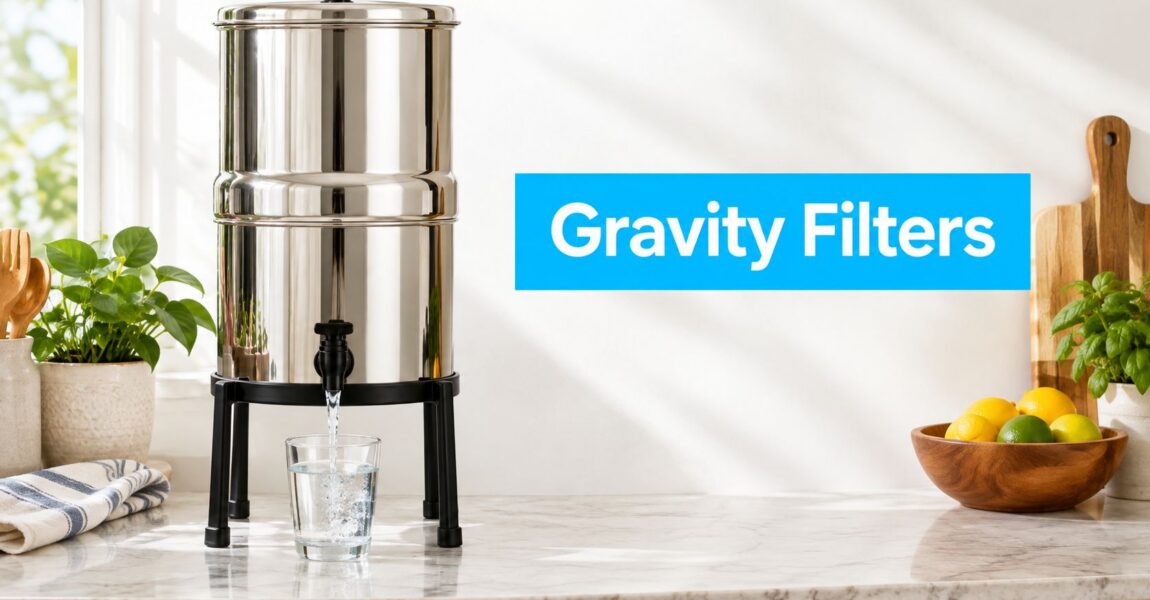
Gravity Water Filters for Home
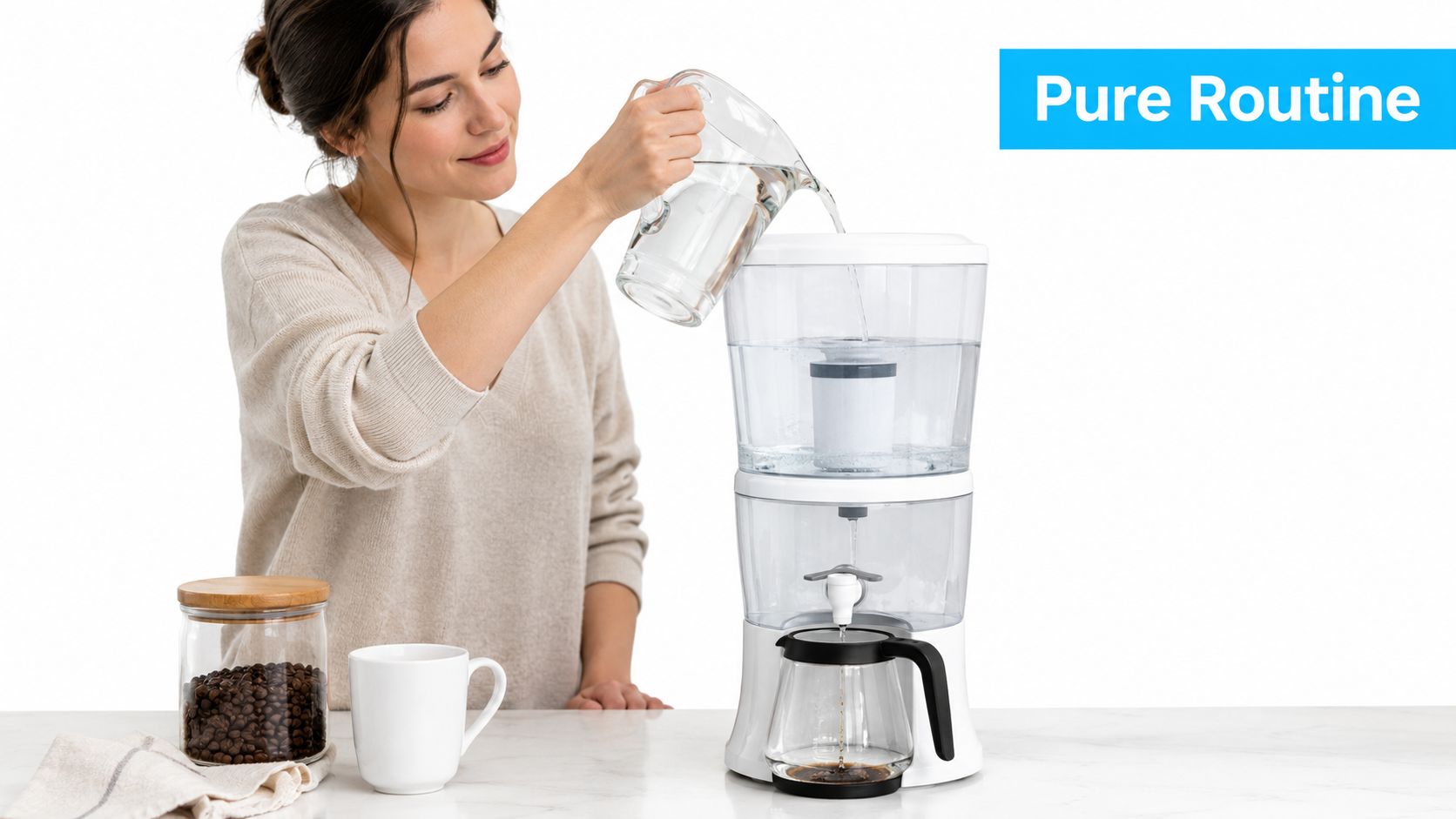
You fill the upper chamber before making coffee, then watch the water take its time. Drop by drop, it passes through a cartridge and gathers in the lower vessel, ready for drinking, cooking, or the kettle. There's no pump humming under the sink and no plumbing project waiting for the weekend.
That simple countertop ritual uses an idea with surprisingly old roots. Gravity water filtration developed from porous stone, sand, and ceramic vessels into modern systems that combine ceramic, activated carbon, and ion-exchange media. The important question isn't whether a filter sounds powerful. It's whether its media and certification match the problem in your water, from microbes to chlorine taste or dissolved metals.
A Morning Pour That Solves a Centuries-Old Problem
A homeowner with a two-bucket countertop unit might pour water into the upper stainless-steel chamber while the coffee maker heats. The water doesn't rush. It moves through one or more filter elements, collects below, and waits behind a small spigot. The arrangement resembles a plant pot with drainage layers. Soil holds back larger particles, a finer layer catches smaller material, and the opening underneath controls how quickly water leaves.
Modern gravity water filters refine that same basic sequence. Instead of relying only on loose sand, manufacturers shape ceramic into a controlled barrier and add carbon or other media for chemical reduction. A ceramic-carbon cartridge can therefore address different categories of contaminants in one slow pass, though its actual performance depends on testing and the specific claims attached to that model.
The idea has a long public-health history. John Doulton is credited with creating an early gravity-fed ceramic filter in London in 1835, during a period marked by cholera and typhoid outbreaks. Henry Doulton introduced an improved carbon medium in 1862, and by 1901 the company's ceramic filtration work was widely used in hospitals, laboratories, and homes worldwide, according to this history of gravity filtration.
That progression took gravity filtration from a local response to unsafe water toward a household and institutional technology. The broader method is even older. A UNCTAD document on gravity filters and plastics reduction describes gravity-based techniques as having been used for millennia, including in China, India, Egypt, Greece, and Rome. The same document cites an industry estimate placing the global ceramic filter market at about USD 1.3 billion in 2021, with gravity filters representing roughly 11% of total water-filtration trade.
Practical rule: Treat a countertop gravity unit as a daily appliance, not automatically as an emergency purifier. The cartridge must be suited to the water source and the contaminant you care about.
That distinction shapes everything that follows, including speed, maintenance, replacement cost, and whether a gravity system is a better fit than a pitcher or under-sink reverse osmosis unit.
How Gravity Pressure Actually Pushes Water Through
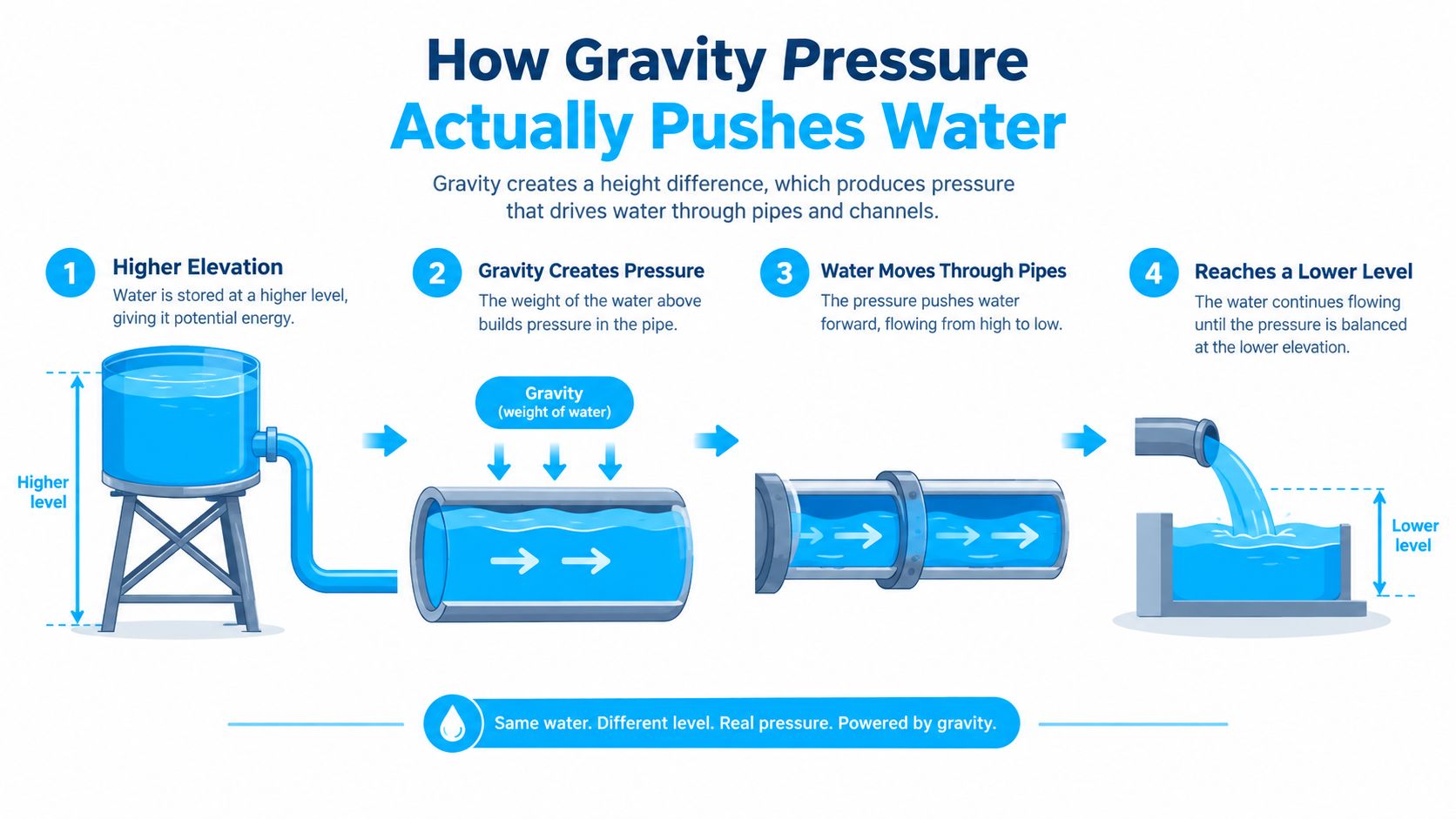
Gravity filtration starts with a height difference. The upper reservoir sits above the lower one, so the water column creates a small pressure head at the filter surface. Water moves because it has somewhere lower to go, not because a motor pushes it through.
The pathway is simple:
- The upper chamber stores untreated water.
- The water contacts the outer filter surface, where sediment and larger particles meet the first resistance.
- The water moves through deeper media, such as fine ceramic pores, carbon, or resin.
- The treated water collects below, where the spigot releases it for use.
The result resembles a slow pour-over coffee. A coarse bed lets water pass readily. A finer grind, deeper coffee bed, or clogged paper filter makes the stream slow. A gravity cartridge behaves in much the same way. Media with greater resistance can improve contact time or separation, but it also limits delivery.
The Water Technologies filtration handbook explains the underlying relationship clearly. Flow depends on the pressure head, the resistance of the filtration media, and the available surface area. As sediment accumulates, hydraulic resistance rises. Industrial gravity-fed filters often use backwashing to remove accumulated solids and restore flow, which is the same cause-and-effect relationship found in smaller countertop units.
Why the drip slows
Three common changes reduce output:
- Sediment loading: Fine particles cover the active surface and leave fewer open pathways.
- Mineral scaling: Dissolved minerals can build deposits that narrow those pathways.
- Biological fouling: Neglected surfaces can collect organic material and biofilm.
A new cartridge may produce a useful stream, then become a trickle as its surface loads. Manufacturers manage that decline by adjusting two main design variables: effective filter area and media depth. More surface area spreads the incoming water over a larger region. Greater depth gives the water more treatment material, but can also add resistance.
This is why a large, wide ceramic element may outperform a narrow one in daily use even if both carry similar-sounding filtration language. The filter isn't only a barrier. It's also a hydraulic pathway, and every layer affects how much water reaches your glass.
Ceramic, Carbon, and Combination Filters Explained
Choosing media is easier if you separate two jobs. One job is physical removal, where a barrier catches particles or microorganisms. The other is chemical reduction, where a material holds or exchanges dissolved substances. No single medium excels at every task.
| Media Type | Primary Mechanism | Removes | Does Not Remove |
|---|---|---|---|
| Ceramic | Physical straining through fine pores | Bacteria, protozoa, cysts, and sediment, when the element is designed and tested for those claims | Many dissolved chemicals, salts, and taste compounds |
| Activated carbon | Adsorption onto a large internal surface | Chlorine, taste, odor, and some organic compounds | Pathogens reliably without a validated microbiological claim |
| Ceramic-carbon combination | Physical barrier plus adsorption | A broader mix of microbes, sediment, chlorine, taste, odor, and selected chemicals | Contaminants not covered by the cartridge's test data |
| Ion-exchange resin | Exchange of charged ions | Selected dissolved metals and hardness minerals | Pathogens, unless another stage provides a barrier |
Ceramic as the physical gate
Ceramic shells use fine pores to strain particles. Some gravity elements use sub-micron porosity in the approximate range of 0.2 to 0.9 microns, allowing water and many naturally occurring minerals to pass while holding back sediment, bacteria, and protozoan cysts when the product's design supports those claims. The gravity filter review and testing overview describes systems that combine ceramic, carbon, and ion exchange, with some reported to remove 99.9% of bacteria and protozoa while also reducing chlorine and heavy metals.
Ceramic alone is less useful for chemical taste. A ceramic candle can make cloudy water clearer, but it generally won't adsorb chlorine the way carbon does.
Carbon for taste and chemistry
Activated carbon may appear as loose granules or a dense carbon block. Its internal surface attracts and holds many compounds responsible for chlorine taste, odor, and some organic chemical concerns. Carbon can make a noticeable difference in a glass of chlorinated tap water, but carbon alone shouldn't be treated as a reliable pathogen barrier unless a specific microbiological standard and claim support it.
Resin for dissolved contaminants
Ion-exchange resin works differently. It swaps charged ions in the water for ions held on the resin, which can help target selected metals or hardness minerals. It doesn't replace ceramic or another pathogen barrier. A cartridge that uses resin without a suitable physical stage may improve chemistry while leaving biological risks unaddressed.
The right question isn't “How many stages does this filter have?” It's “Which stage is tested for the contaminant I need to reduce?”
Combination cartridges make sense when the source has more than one concern. A ceramic exterior can address particles and some microorganisms, while an inner carbon section works on chlorine and odor. Still, the product's certification sheet matters more than the number of layers shown in a product photograph.
Real Flow Rates and What NSF Certification Really Means
A filter's rated capacity and its delivery speed describe different things. A cartridge can carry a large capacity claim yet deliver water slowly enough to frustrate a household that expects a full reservoir at breakfast. Capacity tells you how long the media may last under stated conditions. Flow rate tells you how quickly the appliance serves water today.
An independent MIT course report categorized home gravity-filter flow rates of 8 to 10 liters per hour as excellent, 6 to 8 L/hour as very good, 4 to 6 L/hour as good, and 2 to 4 L/hour as fair. Rates below that were categorized as poor or unacceptable in the report's framework, described in this gravity filter flow-rate review.
A separate manufacturer FAQ records how performance can change as ceramic filters load. A new pair reportedly produces 12 to 16 L/hour, declining to about 10 to 12 L/hour after 750 liters, around 8 L/hour after 1,500 liters, 5 to 6 L/hour after 2,500 liters, and roughly 4 L/hour near 3,000 liters, as shown in this ceramic filter performance explanation. Treat those figures as an example of decline, not a universal promise.
| NSF/ANSI Standard | What It Tests | Claim Type | Common in Gravity Filters? |
|---|---|---|---|
| NSF/ANSI 42 | Aesthetic effects such as chlorine, taste, and odor | Appearance, taste, and odor improvement | Yes, for some models |
| NSF/ANSI 53 | Health-related contaminant reduction | Specific health-effect claims | Available on some certified systems |
| NSF/ANSI 401 | Selected emerging contaminants | Reduction of specified emerging compounds | Available on some systems |
| NSF/ANSI/CAN 372 | Lead content in materials | Lead-free material compliance | Used by some manufacturers |
The NSF certification explanation for gravity filters separates these standards by purpose. A claim under NSF/ANSI 42 doesn't automatically establish a health-related claim under NSF/ANSI 53. NSF/ANSI/CAN 372 addresses lead content in materials, while NSF/ANSI 401 concerns selected emerging contaminants.
Think of certification like a fuel-economy sticker. It gives you a standardized lab result under defined conditions, but your household is the true road. Dirty source water, cold temperatures, clogged media, and repeated refills can change the experience. Before buying, find the exact contaminant claim, test protocol, cartridge model, and replacement element covered by the certificate.
Words such as “purify,” “advanced,” and “absolute 0.2 micron” need context. They may describe design intent, but they don't replace a verified contaminant-specific result.
What Gravity Filters Do and Do Not Remove
“Purified” sounds complete, but water problems aren't complete or interchangeable. A household may be worried about bacteria in untreated well water, chlorine taste in municipal water, or hardness that leaves scale on a kettle. Those concerns require different media.
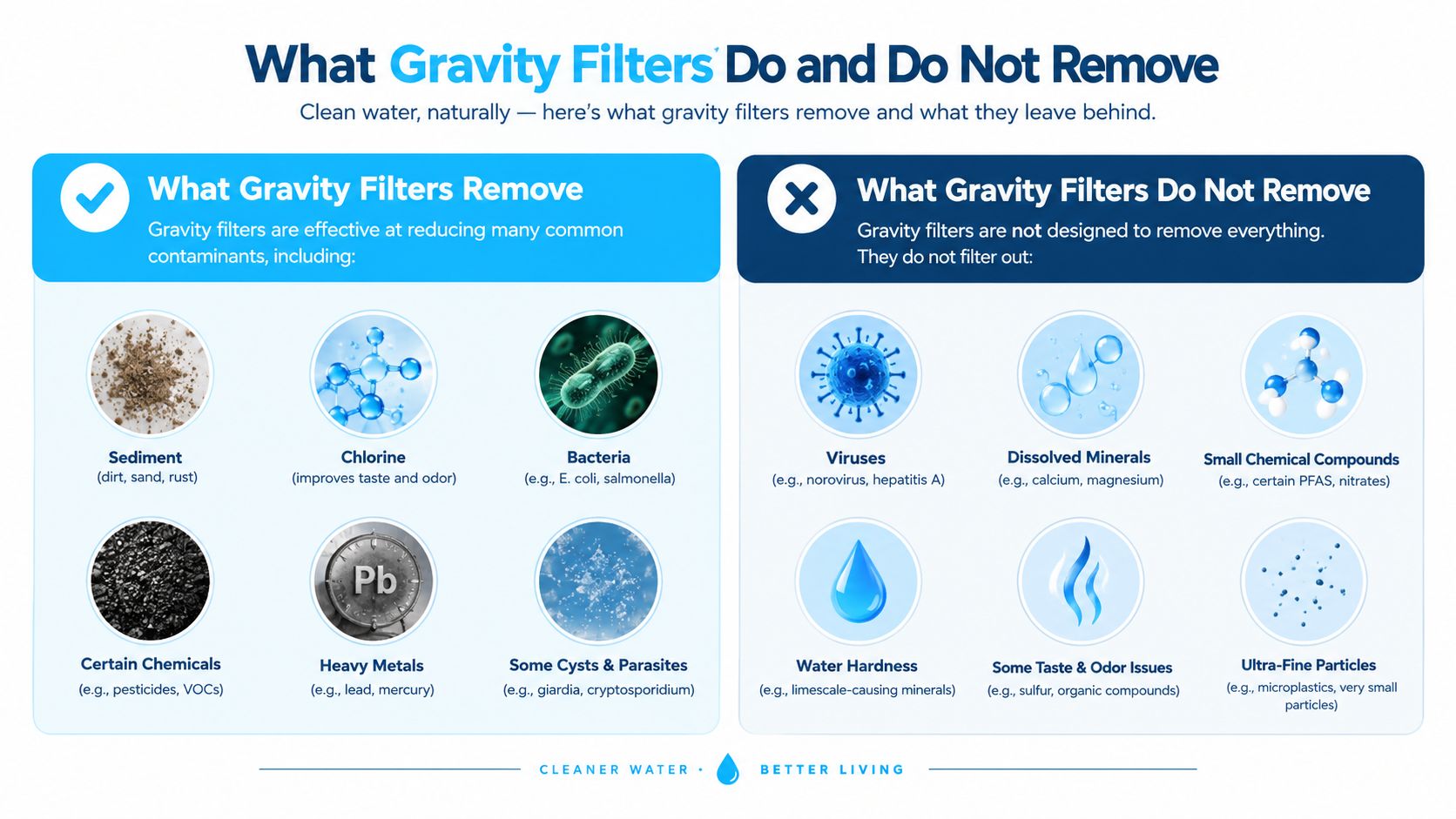
A well-designed ceramic-carbon system may physically retain bacteria, protozoan cysts, and sediment, while carbon reduces chlorine, odor, and selected organic compounds. Some certified gravity systems also address lead, PFAS, microplastics, or other chemical targets. The independent gravity-filter comparison emphasizes that performance varies by model, and reports that some systems are certified for chlorine, lead, PFAS, and microplastics while others are intended only for bacteria and protozoa.
The same review makes an important limitation clear. Some gravity systems don't remove metals, chemicals, salts, or viruses, and no gravity filter surveyed in that review was certified for virus removal from untreated water. That doesn't make every gravity unit unsuitable. It means the word purification cannot carry the decision by itself.
Match the media to the problem
Use the source and concern as your starting point:
- Cloudy well water: Begin with sediment and biological testing. A ceramic stage may help with particles and selected microorganisms, but you need a verified claim for the specific risk.
- Chlorinated city water: Activated carbon is the logical first place to look for chlorine, taste, and odor reduction. Add health-related stages only when the test data covers your target.
- Rainwater harvesting: Treat the source as potentially variable. Sediment, microbes, and chemical contamination need separate attention, and untreated water shouldn't be assumed safe because it looks clear.
- Hard or salty water: Gravity carbon and ceramic elements generally aren't substitutes for treatment designed for dissolved salts or hardness minerals. Ion exchange or another specialized process may be needed.
Fluoride, arsenic, dissolved salts, hardness minerals, and viruses deserve particular caution. A gravity format doesn't automatically address them, and a ceramic shell doesn't turn every source into drinking water.
Decision cue: Identify whether your priority is biological safety, taste and odor, dissolved chemistry, or some combination. Then choose media and certification for that priority.
A performance sheet can show how wide the range becomes when a system is tested. One published sheet reports more than 99.999% reduction for bacteria and Cryptosporidium cysts, more than 99.9% for rotavirus, more than 99% for PFOA and PFOS, and 99.9% for chlorine and lead under its stated test conditions. The same sheet lists 94.0% lead reduction in a separate heavy-metals table, as presented in this gravity filtration performance guide. Those results illustrate why the exact test and contaminant claim matter.
Maintenance, Cleaning, and the Real Cost of Ownership
A gravity filter is easy to install because it transfers more responsibility to the owner. You refill the upper chamber, protect the media from fouling, watch the output, and replace cartridges when their performance or service interval says it's time.
Start with the filter element itself. Ceramic candles can usually be scrubbed gently with a soft brush or suitable abrasive pad, but follow the manufacturer's instructions and don't use soap on a porous element unless the maker explicitly allows it. Scrubbing removes the surface layer that slows flow. Backflushing with clean water can help restore pathways in compatible cartridges.
A practical care routine
- After heavy sediment exposure: Clean the ceramic surface when output falls or visible loading appears. Don't wait for a complete blockage.
- After installing carbon: Run the new cartridge and discard or recycle the first batches according to the manufacturer's directions. Some guidance calls for cycling two to three batches, as described in this gravity-filter maintenance FAQ.
- During storage: Keep the unit away from direct sunlight. Light and warmth can encourage unwanted growth in standing water.
- With hollow-fiber media: Follow the backflush schedule closely. The same FAQ content notes that extremely dirty water may require backflushing as often as every 10 gallons, and freezing can permanently damage performance.
- At replacement time: Use the cartridge's stated service guidance, but shorten it when your source is unusually dirty or flow has deteriorated.
Think of the routine like caring for a coffee maker or a sourdough starter. A few small habits prevent a bigger problem. If you leave stagnant water in a warm, bright unit and ignore a collapsing flow rate, the appliance may stop behaving like the clean, predictable system you bought.
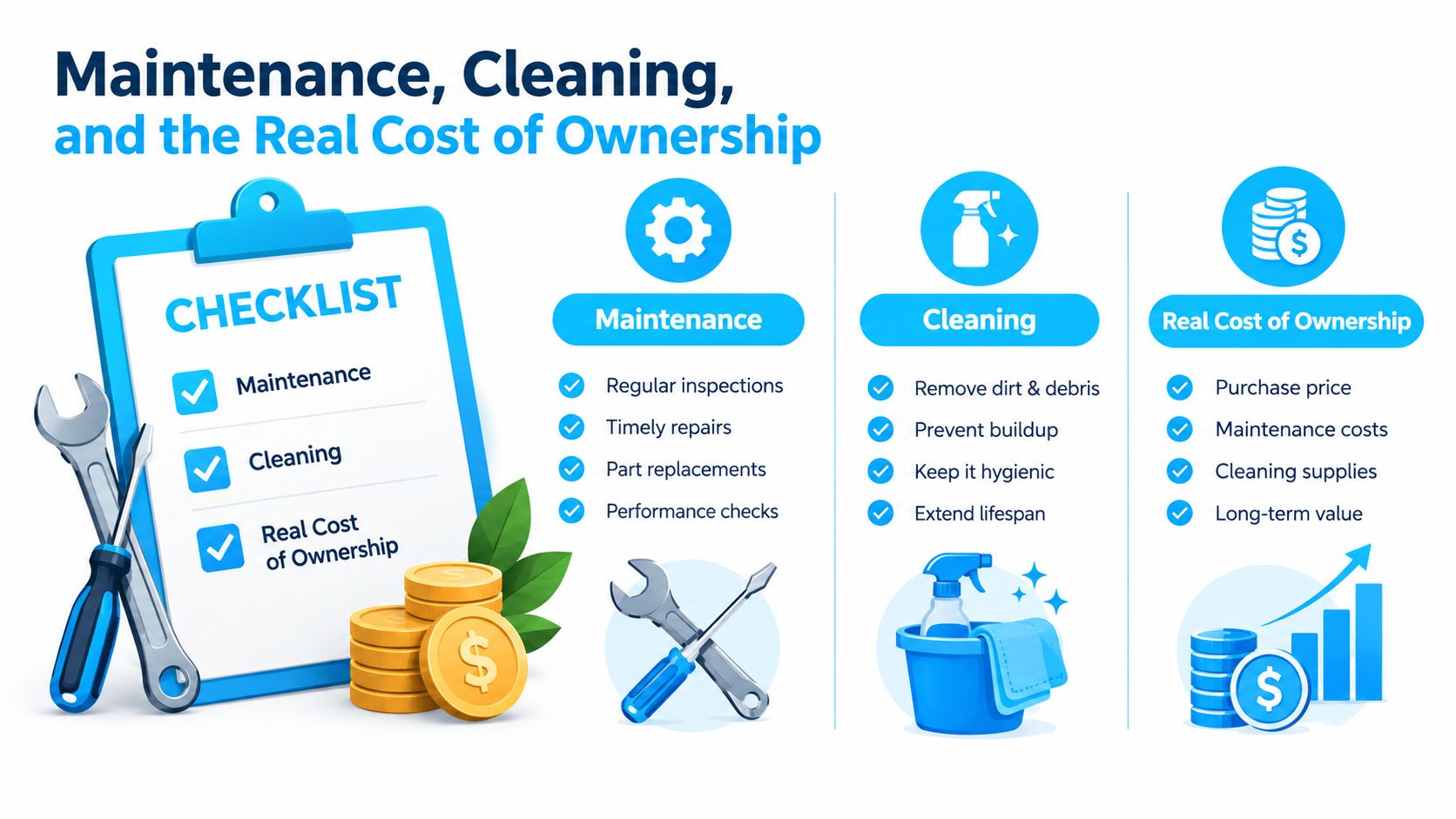
Actual ownership cost includes more than replacement cartridges. It includes discarded water used for priming, cleaning time, replacement washers and spigots, and the counter space occupied by a batch reservoir. A cartridge that lasts longer but becomes painfully slow may cost less on paper and more in daily frustration.
For broader guidance on replacement planning, media selection, and household filtration maintenance, consult this water filtration advice resource.
Choosing the Right Setup for Home, Travel, or Emergency
The best gravity setup depends on how much water you need and what danger you're trying to control. A countertop appliance for daily tap water has different priorities from a lightweight travel filter or an off-grid cabin where replacement elements are difficult to obtain.
| Use Case | Recommended Filter Type | Typical Flow Rate | Best For |
|---|---|---|---|
| Daily home use | Large two-reservoir ceramic-carbon unit | About 1 to 2 gallons per hour for suitable countertop designs | Drinking and cooking for a small household |
| Travel or RV use | Compact single-cavity carbon or combination filter | Lower, variable output suited to batches | Hotel rooms, road trips, and limited counter space |
| Off-grid cabin | Durable ceramic element with accessible replacements | Dependent on source cleanliness and element condition | Long-term use where power and supply access are limited |
| Emergency backup | Pre-treated water with a certified health-effect element | Dependent on preparation and cartridge condition | Backup drinking water when the source may be compromised |
A large two-bucket system can work well as a deliberate daily appliance. It needs counter space, but it provides a visible batch of treated water without electricity or permanent installation. A compact unit suits travel better, though small reservoirs and slower output can become irritating when several people need water at once.
For an off-grid cabin, cartridge availability matters as much as filtration claims. A durable ceramic element is useful only if you can clean it correctly and obtain replacements. Emergency use demands even more caution. Pre-treat visibly dirty water, verify that the cartridge has a microbiological claim if pathogens are the concern, and don't assume a chemical-polishing filter can make untreated surface water safe.
Reverse osmosis still makes more sense when you need high-volume pressurized treatment or specialized dissolved-contaminant reduction at a fixed sink. It requires installation and can produce wastewater, while gravity systems trade speed for portability and simplicity.
Choose gravity for independence and modest daily volume. Choose a pressurized system when the household needs continuous, high-demand delivery.
Countertop systems, including Berkey-style designs, should be compared by batch size, counter footprint, filter media, test documentation, and maintenance rather than appearance alone. If you're comparing the ongoing expense of gravity, under-sink, and whole-house options, this guide to costs of water filter systems provides useful context before you calculate cartridge and installation needs.
Your Next Step Toward Better Tasting, Safer Water
Start with the water, not the product page. A municipal supplier may provide a water quality report, while a private laboratory can test a well or other source. Select a panel that reflects your concern, such as bacteria, lead, chlorine, volatile organic compounds, or hardness.
Then narrow the problem to the top two or three contaminants that matter in your home. A family on treated city water may care most about chlorine taste and lead risk. A well owner may need to investigate bacteria, metals, hardness, or sediment. A rainwater user needs a source-specific assessment rather than a general assumption that clear water is safe.
A four-step buying check
- Test the source. Use available municipal information or arrange private laboratory testing for a private supply.
- Rank the concerns. Separate biological risks from taste, odor, dissolved metals, salts, and hardness.
- Match the media. Look for ceramic or another validated physical barrier for relevant pathogen claims, carbon for chlorine and organic taste compounds, and ion exchange or specialized stages for selected dissolved contaminants.
- Verify the paperwork. Shortlist two or three units, identify the exact cartridge model, and confirm the claimed NSF/ANSI 42, 53, 401, or 372 status in the NSF database.
A certification only helps when it covers the contaminant you care about. NSF/ANSI 42 may support an aesthetic claim, while NSF/ANSI 53 addresses specified health effects. NSF/ANSI 401 concerns selected emerging contaminants, and NSF/ANSI/CAN 372 addresses lead content in materials. None of those labels should be treated as a universal guarantee for every contaminant.
Set a refill habit, record when cartridges go into service, and watch the flow rate. A gravity water filter becomes a dependable daily appliance when testing, cleaning, and replacement happen on schedule. Without those habits, even a well-designed unit can become a forgotten container with an increasingly slow drip.
Water Filter Advisor offers practical guidance for comparing gravity, ceramic, under-sink, whole-house, and portable filtration systems, including maintenance and certification questions. Visit Water Filter Advisor to match a filter to your water source, check replacement needs, and make a more informed choice for better-tasting, safer water at home.
