Your Epic Guide to Installing a Home Water Filtration System

Tired of your glassware looking like it was washed in milk? Fed up with laundry that feels like sandpaper and faucets coated in a ghostly white film? You're not just imagining it—you're living the hard water nightmare. Let's embark on a weekend quest to install a water softener system and totally transform your home's water from a villain into a hero. This isn't just a DIY project; it's a guide to reclaiming your home, protecting your appliances, and maybe even saving some cash along the way.

Why Silky-Smooth Water is the Ultimate Home Upgrade

Fresh water pouring from a kitchen faucet into a clear glass, with a 'Soft Water Benefits' banner.

Before you even dream of picking up a wrench, let's talk about the incredible payoff. Deciding to install a water softener is more than a home improvement chore; it’s an investment in your castle and your family's daily comfort.

Hard water isn't a rare beast; it plagues over 85% of households in the U.S. alone. This makes installing a top-notch water filtration system a true game-changer for millions. Making this one upgrade can extend the lifespan of your water-loving appliances like your water heater by up to 50%. You can get a better sense of why this is becoming so common by reading the latest water softener market analysis.

Vanquish the Evil Limescale Monster

The most glaring villain of hard water is limescale. It’s that chalky, white crud that encrusts your shower doors, faucets, coffee maker, and dishes, forcing you into a never-ending battle with harsh chemicals just to keep things looking decent.

Soft water filtration kicks out the minerals that create this scaly horror show. What does that mean for you? Your fixtures stay gleaming, your glassware emerges from the dishwasher looking like crystal, and you spend far less of your precious time scrubbing. It’s a simple fix that makes your kitchen and bathrooms look like they have a professional cleaning crew on retainer.

The most immediate victory homeowners report is the vanishing act of scale. It feels less like a home improvement project and more like liberating yourself from the shackles of endless cleaning.

Become the Hero Your Plumbing and Appliances Deserve

That mineral gunk you see on the outside? It’s also staging a hostile takeover inside your pipes and appliances. This internal scale buildup forces your water heater, washing machine, and dishwasher to work harder, leading to higher bills and a tragically short lifespan. It’s the silent assassin that costs a fortune in the long run.

A water softener acts like an invisible force field for your home's vital systems by intercepting those damaging minerals. Your appliances will operate at peak efficiency, which means lower energy bills and fewer distress calls to the repairman. It's a proactive move that truly pays for itself over time.

Unlock Next-Level Comfort and Savings

The benefits don't stop with your hardware; they extend to your personal care and your bank account. The minerals in hard water are notorious for sabotaging soap and shampoo, preventing them from creating a rich lather and leaving a sticky residue on your skin and hair.

Once you install your water filtration system, the difference is legendary:

  • Luxurious Skin and Hair: Your skin feels baby-soft, and your hair becomes shinier and more manageable because your soaps can finally rinse away completely.
  • Use Way Less Soap: You’ll be shocked at how little soap, shampoo, and detergent you need—often up to 50% less.
  • Brighter, Softer Laundry: Your clothes and towels will emerge from the wash feeling cloud-soft and looking vibrant, since there are no more mineral deposits trapping dirt and dulling the fabrics.

Mission Prep: Scouting the Location & Assembling Your Arsenal

I’ve seen it a hundred times—the difference between a smooth weekend victory and a soul-crushing saga of endless hardware store trips boils down to one thing: preparation. Nail this part, and the rest is a cakewalk. It’s all about finding the perfect HQ for your new filtration system and having every single tool and part at the ready before you make the first cut.

Let's start by finding a home for your new appliance. Your water softener has three basic needs: it must connect to your main water line, it requires a standard electrical outlet, and it needs a place to drain.

Scouting the Perfect Installation Location

Finding a spot that checks all three boxes can feel like a bit of a treasure hunt, but most homes have a few obvious places to look first.

  • The Lair (Basements): This is usually the best-case scenario. You get direct access to the main water supply right where it enters the house. Basements almost always have plenty of space, a floor drain, and outlets. The only real drawback? Hauling 40-pound bags of salt downstairs.
  • The Command Center (Garages): A close second, and the go-to for homes without basements. Your main water line might already run through there, and you’ve got a concrete floor, power, and easy access for loading salt. Just make sure the unit won't freeze if you live in a colder climate.
  • The Nook (Utility Closets): If your water heater lives in a dedicated closet, that can be a great spot. The plumbing is all in one place. The only catch is that these spaces can be tight, so you'll need to measure with surgical precision.

Before you commit to a location, grab a tape measure. Mark out the softener's footprint on the floor. You need to leave at least a foot of clear space around it for future maintenance, plus enough headroom to comfortably pour those heavy salt bags into the brine tank.

Your Complete Tool and Materials Checklist

Once you've picked your spot, it's time to gear up. Assembling your arsenal now means you won't have to make a panicked run to the store with your water shut off.

Your exact shopping list will vary depending on your home's plumbing—whether you have copper, PEX, or CPVC pipes. But the core set of tools you’ll need is pretty much the same for any mission.

Essential Tools for the Job:

  • Pipe Cutter: Don't even think about using a hacksaw. A dedicated tubing cutter gives you the clean, straight cuts you need for a leak-proof seal.
  • Two Adjustable Wrenches: One to hold fittings in place, the other to do the tightening.
  • Tape Measure: Absolutely critical for getting your pipe cuts right.
  • Bucket and Towels: For capturing the water that will inevitably try to escape when you cut into the line.
  • Deburring Tool: This cheap little gadget cleans the rough edges off cut pipe, which is essential for a perfect connection.

Core Materials You'll Likely Need:

  • Plumber's Tape (Teflon Tape): Use this on every threaded fitting. No exceptions. It’s your best defense against insidious slow drips.
  • Flexible Water Lines: Get two of these. They connect your plumbing to the softener's bypass valve and make lining everything up way less of a headache.
  • Pipe Fittings: This is where you need to know your pipe type. Push-to-connect fittings (like SharkBite) are a popular DIY choice, but you might need compression or sweat fittings for copper.
  • Drain Tubing: Your kit should come with this, but always double-check that it’s long enough to reach your drain without being stretched tight.

Here's the most common rookie mistake: buying the wrong size fittings. Before you go anywhere, confirm the diameter of your main water pipe. It’s almost always ¾-inch or 1-inch. Getting this right the first time will save you a world of frustration.

Alright, this is where the adventure truly begins. We're about to get hands-on and tap directly into your main water line to connect the softener. It’s the most critical part of the job, but don't sweat it. We’ll walk through it step-by-step.

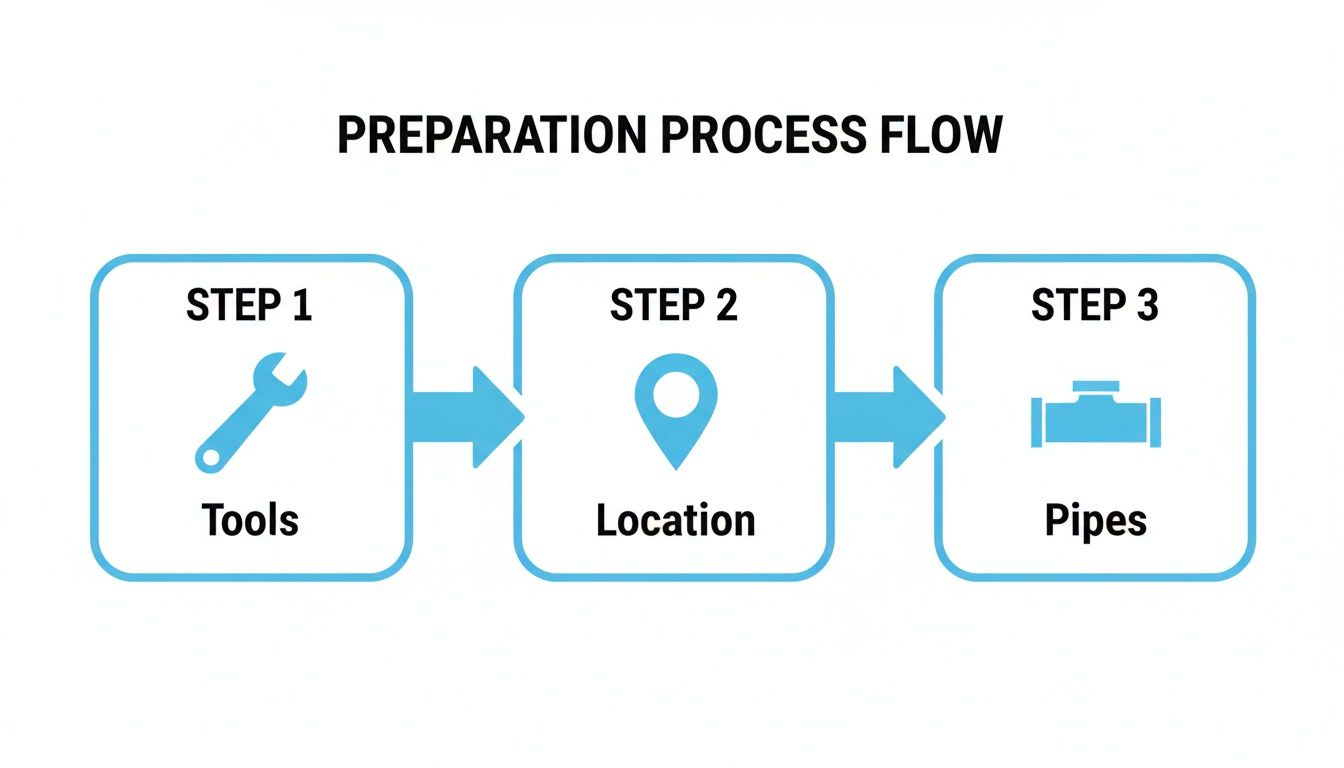
Before you even think about cutting a pipe, there’s some essential prep work. This infographic lays out the groundwork perfectly.

Infographic outlining the water softener preparation process with three steps: choose location, gather tools, and prepare space.

As you can see, getting the location right, gathering your tools, and prepping the space are the first three things you need to nail down before moving on.

Shutting Down the Water Supply Safely

First things first: shut off the water to the entire house. You’ll find the main shut-off valve where the water line enters your home—usually in the basement, a utility closet, or the garage. Crank it all the way to the "off" position.

Next, you need to drain the pipes. Open the faucet at the lowest point in your house (like a basement sink) and the highest one (maybe an upstairs shower). This lets air in and drains the remaining water out, which will save you from a surprise shower when you make your first cut. Still, keep a bucket and a few old towels nearby. There’s always a little water left behind.

Here's a tip I’ve learned the hard way: after you think the water is off, try turning on a faucet. If you get more than a slow drip, your main valve isn't sealing properly. You'll want to get that fixed before you go any further.

Making the Cut and Installing the Bypass Valve

Time to make the cut. Carefully measure the section of your main water line where the new bypass valve assembly will go. This valve is your best friend—it lets you send water around the softener for maintenance without turning off the water to the whole house.

Double-check your measurements, then grab your pipe cutter and make two clean, straight cuts. A good, square cut is everything for getting a leak-free seal. Once that piece of pipe is out, use a deburring tool to clean up the inside and outside edges of the pipes. It’s a small step, but it protects the O-rings in your new fittings from getting sliced up.

Now, you’ll install the bypass valve. How you do this depends on your pipes:

  • Push-to-Connect Fittings: These are the gold standard for DIY. You just push them onto the pipe until they click into place. No soldering, no glue. It’s that simple.
  • Soldering Copper Pipes: This is the old-school method. It creates a rock-solid bond but definitely requires practice with a torch, flux, and solder.
  • Compression Fittings: A great middle-ground option. These use a nut and a small brass ring to create a seal as you tighten them with a wrench.

Understanding Inlet and Outlet Connections

Pay close attention here. Your bypass valve will have a marked inlet and an outlet. This isn't a suggestion—it's mandatory. The inlet must connect to the pipe coming from your water supply, and the outlet connects to the pipe feeding the rest of your house.

If you get this backward, the softener simply won't work, and you risk damaging the unit. Most valves have big arrows molded right into the plastic to make it almost foolproof. Water has to flow in, through the resin beads to get softened, and then back out to your faucets.

Practical Examples for Common Plumbing Setups

Most homes use one of three types of pipe, and your connection method will change for each.

  • Copper Plumbing: If you’re not a pro at soldering, just use push-to-connect fittings made for copper. They are incredibly reliable and will save you a ton of headache.
  • PEX Tubing: This flexible plastic is a dream to work with. While crimp rings are common, push-to-connect fittings are easily the fastest way to get the job done for a DIY install water softener system.
  • CPVC Pipe: This rigid plastic requires a specific primer and solvent cement. It’s not hard, but it's unforgiving—once that glue sets, the joint is permanent.

A full DIY setup can be knocked out in an afternoon, letting you bypass plumber fees that can easily run from $500 to $1,500. As the team at Water Filter Advisor often points out, always look for systems certified to NSF/ANSI 44 standards to ensure they actually do what they claim. To see what's popular, you can even check out a market analysis of home water softeners and see how these systems are trending.

Connecting the Drain and Brine Tank

With the main plumbing connections behind you, the toughest part of the job is done. Now it's time to hook up the drain and brine lines so the softener can flush out the hardness minerals it collects and regenerate itself.

Think of it this way: your filtration system traps minerals, and during its cleaning cycle (regeneration), it needs to dump that mineral-rich water somewhere. That's the drain line's job. The brine tank provides the salt solution needed for that cleaning process.

Setting Up the Drain Line Correctly

Your system comes with a flexible drain tube that runs from the control valve to a suitable drain. The destination you choose is important for a safe, reliable setup.

You have a few solid options here:

  • Utility Sink: The simplest choice if one is close by. Just run the tube over the sink's edge and secure it so it won't pop out during the regeneration cycle.
  • Floor Drain: Ideal for basement or garage installations.
  • Standpipe: This is a dedicated drain pipe, much like the one your washing machine uses, and provides a very clean, professional look.

No matter which option you choose, you absolutely must include an air gap. This is a physical space of about 1.5 to 2 inches between the end of your drain tube and the drain opening itself.

An air gap is a non-negotiable safety measure. It prevents contaminated drain water from ever being siphoned back into your home's clean water supply. Never seal the drain line directly into a pipe—it's a serious health hazard and a plumbing code violation.

Make sure you secure the tubing with a clamp or zip tie. The water comes out with a surprising amount of force during the backwash cycle, and a loose hose can make a huge mess.

Connecting the Brine Tank

The brine tank is the shorter, wider tank that holds the salt. Your task here is to connect the small brine line from the softener's control valve to the safety float assembly inside this tank.

That safety float is a clever little mechanism. It works just like the float in your toilet, shutting off the water when the tank is full to prevent a salty, messy overflow.

Connecting it is straightforward. The brine tank itself is a tough plastic container; if you want some general tips on handling this kind of material, this guide on how to install a polyethylene tank can be helpful.

Simply run the thin brine tube from the control valve over to the fitting on the safety float. Most systems use simple compression fittings that you can just tighten by hand.

Finally, connect the overflow tube. This is a larger emergency hose that attaches to a port near the top of the brine tank. If the safety float ever fails, this tube will direct any excess water to your floor drain instead of all over the floor. Route this tube to the same drain you're using for the main unit, making sure its end sits lower than the softener's main drain connection.

Final Setup and Bringing Your System Online

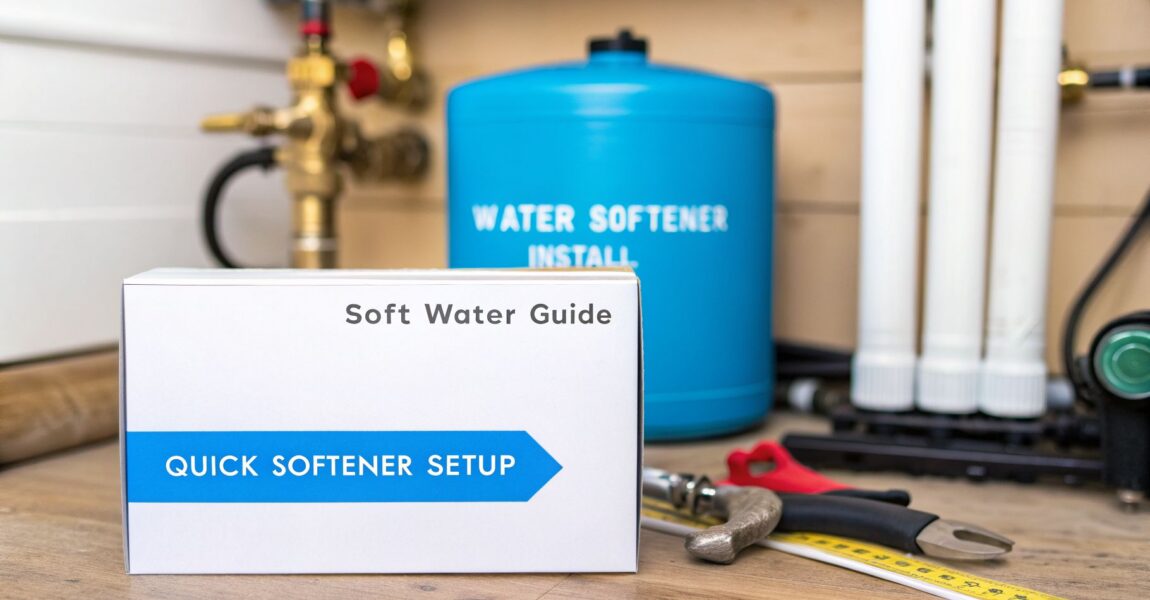
Man installing a water softening system, connecting pipes to a blue tank in a utility room.

Alright, the heavy lifting is over and all your pipes are connected. You’re in the home stretch now, turning this plumbing project into a fully functional home water filtration system. There are just a few key things left to do: get the salt ready, program the brains of the operation, and run a test cycle.

First up, let’s deal with the brine tank. Grab a bucket and pour about three to four gallons of water right into the tank itself. This initial water is essential—it’s what the softener will use to mix up the very first batch of brine for its first regeneration cycle.

Now for the salt. Go ahead and fill the brine tank with your water softener salt pellets. A good rule of thumb is to stop about four to six inches from the top. Don’t be tempted to fill it to the brim; overfilling can lead to “salt bridging,” which is a nasty, hard crust of salt that forms inside and stops your system from working right.

With the salt and water sorted, plug the control valve into a standard electrical outlet. You should see the display light up, which means you're ready to get programming.

Programming the Control Valve

The control valve is the command center for your entire system, and getting the settings right is what makes it all run on autopilot. Don’t let the digital display and buttons intimidate you—it’s actually pretty straightforward.

Your user manual is going to be your best guide here, but virtually all modern softeners need the same three pieces of information:

  • Water Hardness: This is the big one. You’ll need to input your water’s hardness level, which is measured in grains per gallon (GPG). If you don’t have this number, you can find it with a simple home test kit or by checking your local water utility’s annual report online.

  • Current Time: Just like any other clock, set it to the current time of day. This is crucial for making sure the regeneration cycle runs when you want it to.

  • Regeneration Time: The softener needs to clean itself every so often, and you want this to happen when no one is using water. The factory default is usually 2:00 a.m., and honestly, that’s the perfect time for most homes.

Getting the hardness level right is critical. If you set it too low, your water won't be fully softened. Set it too high, and you'll just be wasting salt and water by regenerating more often than you need to. If you’re not sure, it’s always better to round up slightly.

Running a Manual Regeneration Cycle

Once it's programmed, you'll want to kick off a manual regeneration cycle right away. This initial run does two important things: it purges all the air out of the resin tank and gives you a chance to confirm everything is working perfectly before you let soft water flow into your home.

Look for a button labeled "Regen" or "Regenerate" on the control valve. You'll probably need to press and hold it for a few seconds. You'll hear the motor start to turn as the valve clicks through its cycles—backwash, brine draw, rinse, and so on.

This is your moment to play inspector. Listen and watch as the unit runs. Make sure you see water flowing out of the drain line during the backwash and rinse cycles. It's also a great time to double-check that brine line connection for any sneaky leaks.

More and more homeowners are taking on this project themselves. In fact, after 2020, nearly 70% of U.S. owners chose whole-house units. While hiring a pro can cost anywhere from $800 to $2,000, a quality DIY kit can slash that bill in half. For many, it's a simple valve swap that only takes a few hours. You can dig into more industry stats by checking out the global market for water softeners.

Introducing Soft Water to Your Home

After that first regeneration cycle finishes, you’re ready for the grand finale. Head back to the bypass valve you installed earlier. Now, slowly—and I mean slowly—turn the handle to let water back into your home’s main supply line.

Going slowly is key to preventing "water hammer," which is a loud, jarring bang in your pipes that can cause real damage. Once the valve is all the way open, walk to the faucet closest to the softener and turn on the cold water. Let it run for a few minutes until the stream is clear and you don’t see any more air bubbles. Then, do the same with a hot water faucet to clear the air out of your water heater.

Do one final walk-around, meticulously checking every connection point for drips. That’s it! Your install water softener system project is officially a wrap. Your home is now set to enjoy all the benefits of soft water.

Common Questions About Your New Water Filtration System

Even after you've tightened the last fitting and checked for leaks, it’s totally normal to have a few questions pop up. Getting used to a new water softener takes a little time. Let's walk through some of the most common things people ask right after they install a water softener system.

What Hardness Level Should I Program Into My New Softener?

Getting this setting right is everything for your softener's efficiency. You have to tell the system exactly how hard your water is so it knows when to run a cleaning cycle, or "regenerate." The most accurate way to find this number is by using a water test kit, which measures hardness in grains per gallon (GPG).

No test kit? No problem. Check the annual water quality report from your local water utility. Most municipalities post these online, and you can usually find the hardness level listed there. Nailing this number prevents you from wasting salt or, even worse, letting hard water sneak back into your pipes.

Think of it like a recipe. If you don’t measure the main ingredient correctly, the final dish won't turn out right. Setting the hardness too low results in partially softened water, while setting it too high causes the system to regenerate too often, wasting salt and water.

So, if your test comes back at 15 GPG, that's the number you'll punch into your control valve. For anyone on a private well, testing is non-negotiable since hardness levels can change over time.

How Often Will I Need To Add Salt?

How often you'll be lugging those heavy bags depends on two things: how hard your water is and how much of it you use. For a typical family of four dealing with moderately hard water, you might find yourself adding a 40-pound bag of salt every month or two.

This is where a modern, high-efficiency softener really shines. These units use what's called "demand-initiated regeneration." In simple terms, they only clean themselves after a set amount of water has been used, not just on a timer. This smart feature can slash your salt use by up to 50% compared to older, timer-based models.

Get into the habit of peeking inside the brine tank once a month. You just want to make sure the salt level is always a few inches above the water line. Whatever you do, don't let it run completely dry.

Is A Water Softener A Good Idea For A Well Water System?

Absolutely, but there’s often an extra step involved. Well water is notorious for containing more than just hardness minerals like calcium and magnesium; it can also be high in iron and sediment.

A standard water softener can handle small amounts of iron—usually around 1-3 parts per million (PPM). Anything more than that can clog up the resin beads and eventually wreck the control valve.

If your well has significant iron, the best practice is to install a dedicated iron filter before the water softener. This pre-treatment step acts as a bodyguard for your softener, protecting your investment and letting it do what it does best: fight hardness. For more on this, you can find a ton of expert advice on our blog.

Should I Also Soften The Water For My Garden Hoses?

That’s a common question, and the answer is almost always a firm "no." There’s really no upside to watering your lawn, washing your car, or filling the kiddie pool with softened water. In fact, the sodium a softener adds can actually harm your plants over the long haul.

For this exact reason, most professional plumbers will set up the system to bypass your outdoor spigots completely. The whole point is to soften the water inside your house—the water that runs through your appliances, showers, and faucets.

Your Ultimate Guide to the Water Softener Installation Diagram

Think of your water softener installation diagram as your project's command center—your treasure map to pure, soft water. It's the sacred scroll that transforms a potentially confusing plumbing saga into a straightforward, follow-the-arrows quest. This diagram is your secret weapon, laying out exactly how water will journey from your main line, through the magical resin tank, and then out to every faucet in your home. It clearly flags the inlet, outlet, bypass valve, and other key landmarks, making the entire home water filtration process completely manageable.

Decoding Your Water Softener Blueprint

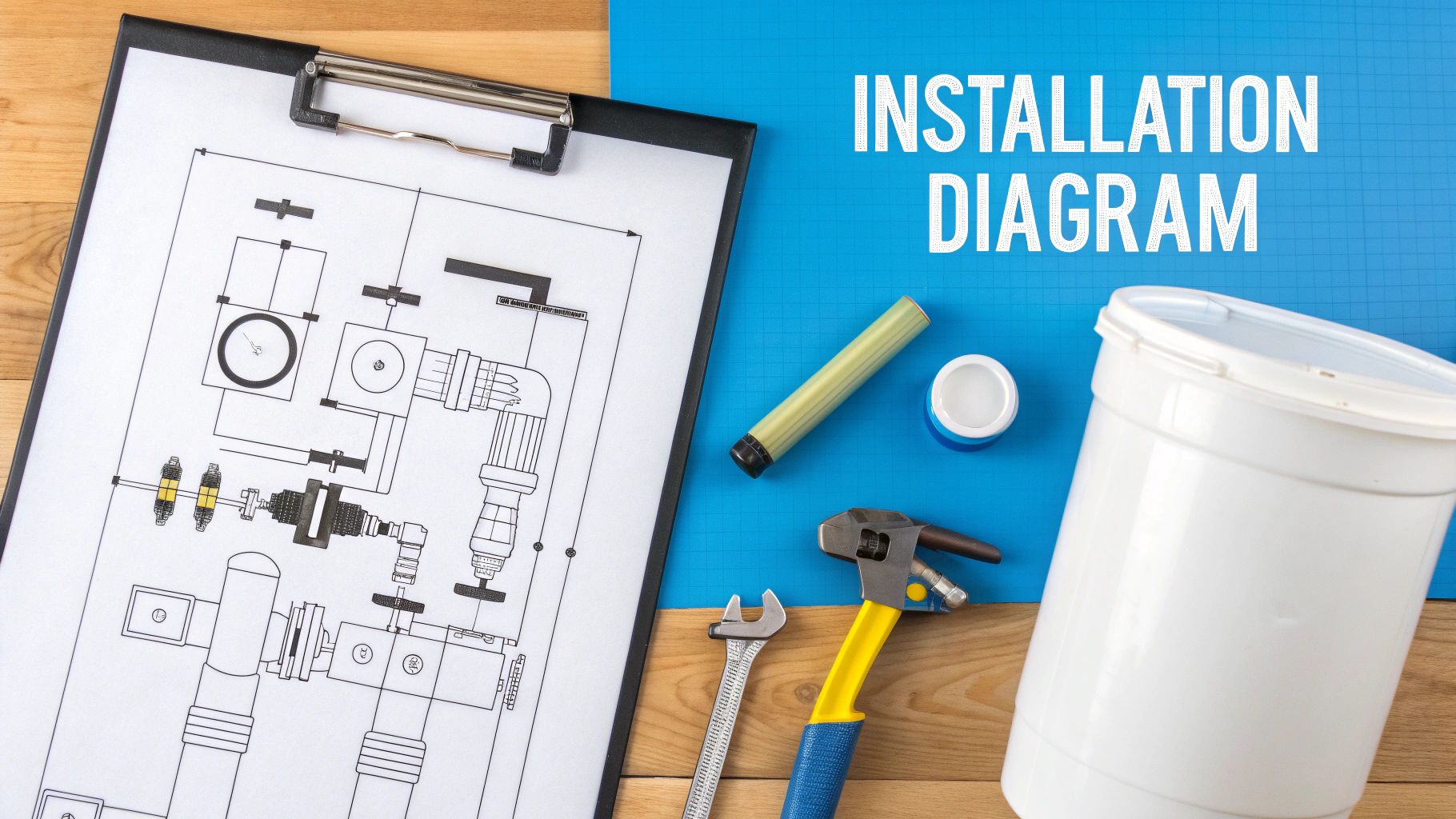
A detailed installation diagram on a clipboard with plumbing tools and a large white bucket, on a blue grid background.

Before you even dream of cutting a pipe, take a few minutes to get intimate with your installation diagram. Don't see it as a complex schematic; view it as a storybook for your plumbing. This visual guide demystifies the whole setup, showing you precisely how every piece fits together to create a fortress against hard water.

When you trace the path of the water on paper first, you're building the confidence you'll need when you're actually holding the tools. The diagram illustrates the entire pilgrimage your water will take, starting right at your main supply line. This is where you'll tap into your home's water circulatory system to route it into the softener. From there, it’s just a matter of following the lines to victory.

Key Components on Your Installation Diagram

To truly master the diagram, you need to know the cast of characters. Each part plays a vital role in the water filtration drama. This table breaks down the essentials you'll find on almost any water softener diagram.

Component Name What It Does Installation Tip
Inlet Port Welcomes hard water from the main supply into the softener. This must connect to the pipe coming from your water meter or well. No exceptions!
Outlet Port Sends the newly purified, soft water to the rest of your house. This pipe will feed all your hot and cold water lines (but not your garden hose!).
Bypass Valve Lets you temporarily shut off water to the softener for maintenance. Always install this. It’s your “get out of jail free” card for maintenance without a household water shutdown.
Brine Line A small tube that sips saltwater from the brine tank. Ensure the connection is airtight to prevent hiccups during the regeneration cycle.
Drain Line Carries the captured hard minerals and waste water away to a drain. Make sure there's an air gap between the tube and the drain to prevent gross back-siphoning.
Overflow Tube A safety line on the brine tank that acts as a flood warden. This is your insurance policy. Route it to the same drain as the main drain line.

Getting familiar with these parts on paper first makes the hands-on work feel less like brain surgery and more like building with LEGOs.

Tracing the Flow of Water

The first thing to find on your diagram is the inlet port on the control head. This is the gateway where hard water enters the filtration system. Follow the lines, and you'll see the water travel down into the resin tank. That tank is where the real magic happens—it’s filled with tiny resin beads that act like magnets, grabbing onto hard water minerals like calcium and magnesium through a process called ion exchange.

Once the water is purified, it flows back up and out through the outlet port. This is the pipeline that delivers silky-smooth, soft water to your showers, sinks, and washing machine. Getting the inlet and outlet pipes hooked up correctly is the most critical part of the job. It’s a common DIY mistake to reverse them, and if you do, the softener simply won't work.

Key Takeaway: The arrows on your diagram and the labels on the control valve are your best friends. Double- and triple-check that the "IN" port is connected to your main water supply and the "OUT" port is feeding the rest of your house.

Identifying Critical Connections

Your diagram will also highlight a few other essential connections that are just as important as the main water lines. These allow the softener to clean itself and operate safely, ensuring your home filtration system runs smoothly.

You'll need to locate:

  • The Bypass Valve: A lifesaver for any future maintenance. The diagram shows how this valve fits onto the inlet and outlet, giving you a way to isolate the softener without turning off your home's water.
  • The Brine Line: Look for the smaller-diameter tube connecting the control head to the salt tank. This line is responsible for sucking the saltwater solution into the resin tank to "recharge" the beads during a regeneration cycle.
  • The Drain Line: This line runs from the control head to a nearby floor drain or utility sink. It’s where all the hard minerals and salty rinse water get flushed out.
  • The Overflow Tube: This is a crucial safety feature. It’s a secondary tube on the brine tank that prevents a salty flood if the tank ever overfills due to a malfunction.

More and more homeowners are taking control of their water quality, and it shows in the market. The global water softeners market was valued at USD 3.35 billion in 2024 and is on track to hit USD 5.57 billion by 2032. This growth comes from people in areas with hard water, especially in North America, who are seeing the value in DIY-friendly solutions. Learning to read a simple installation diagram is your first step to joining them. You can find more insights about the growing water softener market and its drivers here.

Gathering Your Tools and Finding the Perfect Spot

Any good DIY quest starts with assembling your gear, and a water softener install is no exception. Before you even glance at a water softener installation diagram, you need to have every tool and part laid out and ready. Nothing kills your momentum faster than a mid-project run to the hardware store for a fitting you forgot.

Think of yourself as a surgeon for your home's water filtration system. You wouldn't start an operation without your instruments neatly arranged, right? For this procedure, you’ll need a few key items on your "surgical tray."

Your Essential Installation Checklist

You're going to need more than just a single wrench for this job. The type of plumbing you have—copper, PEX, or CPVC—will determine some of the specifics, but this list is a solid starting point for almost any setup.

  • Pipe Cutters: Make sure you have the right kind for your pipes (copper, PEX, etc.).
  • Two Adjustable Wrenches: Your go-to tools for tightening down fittings and connecting hoses.
  • Measuring Tape: You get one shot when cutting your main water line. Measure twice, cut once.
  • Teflon Tape: A plumber’s best friend for a reason. Use it to create a leak-proof seal on any threaded connections.
  • Bucket and Towels: When you cut that pipe, water is coming out. Be ready for it.

Beyond these basics, you’ll need the right fittings. Modern push-to-connect fittings (like SharkBites) are a game-changer for DIYers because they don't require any soldering. If you're more old-school and comfortable with sweat soldering on copper pipes, that'll give you a permanent, rock-solid bond.

Choosing the Right Battleground for Your Softener

Where you install your water filtration system is just as critical as how you install it. The wrong spot can lead to poor performance, a major headache during maintenance, or even expensive water damage. You're looking for a spot that checks a few very important boxes.

The perfect location is as close as possible to where your main water line enters the house, and before it tees off to the water heater. This setup ensures that all the water in your home, both hot and cold, gets treated. Before you cut any pipes, it's also a good idea to confirm you have good flow; learning how to address low water pressure can be a crucial first step.

Pro Tip: Never, ever install a water softener after your water heater. The high temperatures will absolutely destroy the delicate resin beads inside the tank, rendering your entire filtration unit useless.

Your chosen spot also needs easy access to a power outlet and a drain. The control head needs electricity to run the regeneration cycles, and the system needs that drain to flush out all the hard minerals it captures.

Finally, keep your investment safe from the elements. A garage, basement, or utility closet is ideal. Steer clear of any spot where temperatures might drop below freezing—a frozen, cracked tank is a costly disaster you don't want to deal with. For more expert guidance on a variety of home water systems, be sure to visit Water Filter Advisor and check out these tips for various water filtration needs. Nailing the location from the start will save you a world of trouble and keep your system running at its best for years.

Bringing Your Installation Diagram to Life

Alright, you've got your tools laid out and the perfect spot picked. Now for the main event. This is where we turn that water softener installation diagram from a piece of paper into a hard-working piece of equipment for your home. We're going from blueprint to reality, and it all starts with one critical, non-negotiable step.

First things first: shut off the main water supply to your house. Find your main shutoff valve—it's usually where the water line first enters your home—and turn it completely off. To drain the pipes, open the lowest faucet you have (like in the basement or an outside spigot) and the highest one (maybe an upstairs bathroom sink). This simple step is the difference between a smooth installation and a frantic, soggy call to a plumber.

This quick visual guide sums up the prep work we've covered, from grabbing your tools to prepping the pipes.

A three-step preparation process flow diagram showing tools, location, and pipes.

Think of it this way: good prep work is the foundation for a successful install. It makes sure you have everything you need before you make a single cut.

Making the Cut and Installing the Bypass

Here we go—the point of no return. It’s time to cut into your main water line. Carefully measure the space you'll need for the bypass valve assembly that came with your softener. Remember the old rule: measure twice, cut once. It definitely applies here. Use a pipe cutter for a clean, straight cut and keep a bucket handy to catch any leftover water.

With that section of pipe removed, you can install the bypass valve. This little piece is a lifesaver, letting you shut off water to the softener for maintenance without turning off water to the whole house. Most modern systems are pretty DIY-friendly, using push-to-connect or threaded fittings. Just make sure the arrows on the valve are pointing in the direction of the water flow—away from the main and toward the rest of your home's plumbing.

Connecting to the Control Valve

Now that the bypass is in, it's time to connect it to the softener's control valve. This is the brain of the whole filtration operation. It tells the water where to go and manages the cleaning (regeneration) cycle. Your kit should have flexible connector hoses or fittings for this.

Hand-tighten the connections first, then give them a gentle quarter-turn with a wrench. A classic rookie mistake is cranking down on these fittings, especially the plastic ones. Overtightening can create tiny cracks that turn into slow, disastrous leaks over time. You’re looking for a snug, watertight seal, not a new world record in grip strength.

To really nail your install, it helps to understand the bigger picture of plumbing. For a deeper dive, check out this complete plumbing installation guide.

Securing the Brine and Drain Lines

Your diagram also shows two smaller lines coming from the control valve. Don't overlook them—the brine line and drain line are essential for the softener to actually do its job and recharge itself.

  • The Brine Line: This is the thin tube running from the control valve to the salt tank. It pulls the saltwater solution into the resin tank during the regeneration cycle. Make sure the compression fittings on both ends are tight enough to keep air from getting sucked in, which can mess up the whole process.
  • The Drain Line: This line gets rid of all the hard minerals and wastewater after the regeneration cycle. You'll run it from the control valve to a suitable drain—a floor drain or utility sink works great. Be sure to secure it so it doesn't pop out and start spraying funky water all over your basement.

Critical Safety Note: The drain line needs an air gap. This means the end of the drain tube must hang at least 1.5 inches above the top of the drain. This gap prevents nasty wastewater from being siphoned back into your clean water supply. It's not just a suggestion; it's a mandatory plumbing code in most places.

Getting these connections right is what empowers you to tap into a growing trend. The residential water softener market, guided by these same principles, was worth USD 1.12 billion back in 2018 and has seen a 25% yearly installation surge. With hard water affecting 80% of urban supplies, a good DIY install doesn't just save you a plumber's fee—it protects your appliances from about $300 in yearly damage.

Final Checks Before Powering On

Before you even think about turning that main valve back on, do one last sweep. Go over every single connection you made. Run your hand over the fittings on the bypass valve, the control head, and that tiny nut on the brine line. Double-check that everything feels solid and matches your water softener installation diagram.

This final check is your best defense against leaks. A couple of minutes of inspection right now can save you hours of cleanup and a massive headache later. Once you’re confident everything is buttoned up, you're ready for the final stage: turning on the water and programming your new system.

Powering Up and Programming Your System

The pipes are all connected, and your setup is finally starting to look like the installation diagram. But the wrench-turning is only half the battle. Now it’s time for the crucial final phase: the initial startup and programming. This is where you breathe life into your water filtration system and teach it how to protect your home.

The very first thing you’ll do is turn the water back on—but slowly and methodically. Make sure your water softener is still in the bypass position, then just crack open the main water shutoff valve. You want water to trickle back into your plumbing, not blast through like a fire hose.

This gentle repressurization gives you a chance to meticulously inspect every single connection you made for drips. I like to use a dry paper towel and touch it to each fitting; the slightest hint of moisture means you need to shut the water off and give that connection another quarter-turn. Once you're absolutely certain everything is bone-dry and watertight, you can fully open the main valve.

Opening the Gates to Soft Water

With your connections leak-free, it’s time for the moment of truth. Slowly open the bypass valve to let water flow into the softener for the first time. You’ll hear some gurgling and hissing as air gets purged from the resin tank and pushed out through your pipes. Don't worry, this is completely normal.

Just head to the faucet farthest from your softener (like a second-floor bathroom sink) and open the cold water tap. Let it run until the stream is clear and free of any air bubbles. This ensures the entire system is filled and ready for the next step: plugging it in and programming the control head.

Key Takeaway: That initial water test is your final quality control check. Taking your time here prevents a tiny drip from becoming a major flood. A little patience now will save you a massive headache later.

Demystifying the Control Head Settings

The control head is the brain of your softener, and programming it correctly is what makes the magic happen. While every model’s interface is a bit different, they all need the same core information to run efficiently. Getting these settings right from the jump is the key to an effective and efficient home water filtration system.

You will typically need to input three main things:

  • Current Time: This tells the softener when it’s okay to run its cleaning cycle.
  • Water Hardness: Measured in grains per gallon (GPG), this is the most critical setting. It dictates how often the system needs to regenerate.
  • Regeneration Time: You can schedule the cycle for a time when nobody is using water. 2 AM is the classic choice for a reason.

Entering the correct water hardness value is non-negotiable. If you set it too low, you'll get hard water creeping back into your home before the next cycle. Set it too high, and the system will regenerate way too often, wasting hundreds of gallons of water and bags of salt every year.

It's no wonder these systems are so popular. North America led the water softeners market in 2024, holding a global share of about 39.17%. That’s largely because an estimated 60 million U.S. households are dealing with moderate-to-hard water. For those homeowners, a properly programmed softener can extend appliance life by 30-50%, cutting down on repair costs that often average $500 annually in hard water areas. Following a precise water softener installation diagram and programming it correctly helps ensure your system performs as expected. You can explore more about the growth and benefits of the water softener market here.

This table breaks down the most common settings you'll encounter on your control head. Understanding these will help you dial in your system for peak performance and efficiency.

Common Control Head Settings Explained

Setting What It Controls Why It's Important
Water Hardness (GPG) Determines the capacity of the resin between regenerations. The most critical setting. Too low causes hard water breakthrough; too high wastes salt and water.
Regeneration Time Sets the time of day (e.g., 2:00 AM) for the automatic cleaning cycle. Prevents regeneration during peak water usage times, ensuring you always have soft water when you need it.
Salt Setting For some models, this sets the amount of salt used per regeneration. Balances salt efficiency with water softness. A higher salt dose provides more capacity but is less efficient.
Regeneration Type Switches between "metered" (demand-based) and "timed" (scheduled) cycles. Metered is far more efficient, as it only regenerates after a specific volume of water has been treated.

Once you have these core settings programmed, your system will be ready for its first official run.

Kicking Off the First Regeneration Cycle

With your settings locked in, the final step is to initiate a manual regeneration cycle. This isn't just for practice; it serves a vital purpose. It allows the system to flush out any leftover manufacturing residue from the resin tank and properly prepares the resin beads for their first water filtration job.

Just find the "Regen" or "Recharge" button on your control head and hold it down for a few seconds. The softener will immediately kick off its first cycle. This is your chance to watch the whole process unfold, making sure water is properly drawn from the brine tank and flushed out the drain line.

Once it completes this first cycle, your system is officially online and ready to deliver soft, luxurious water to your entire home.

Common Installation Mistakes to Avoid

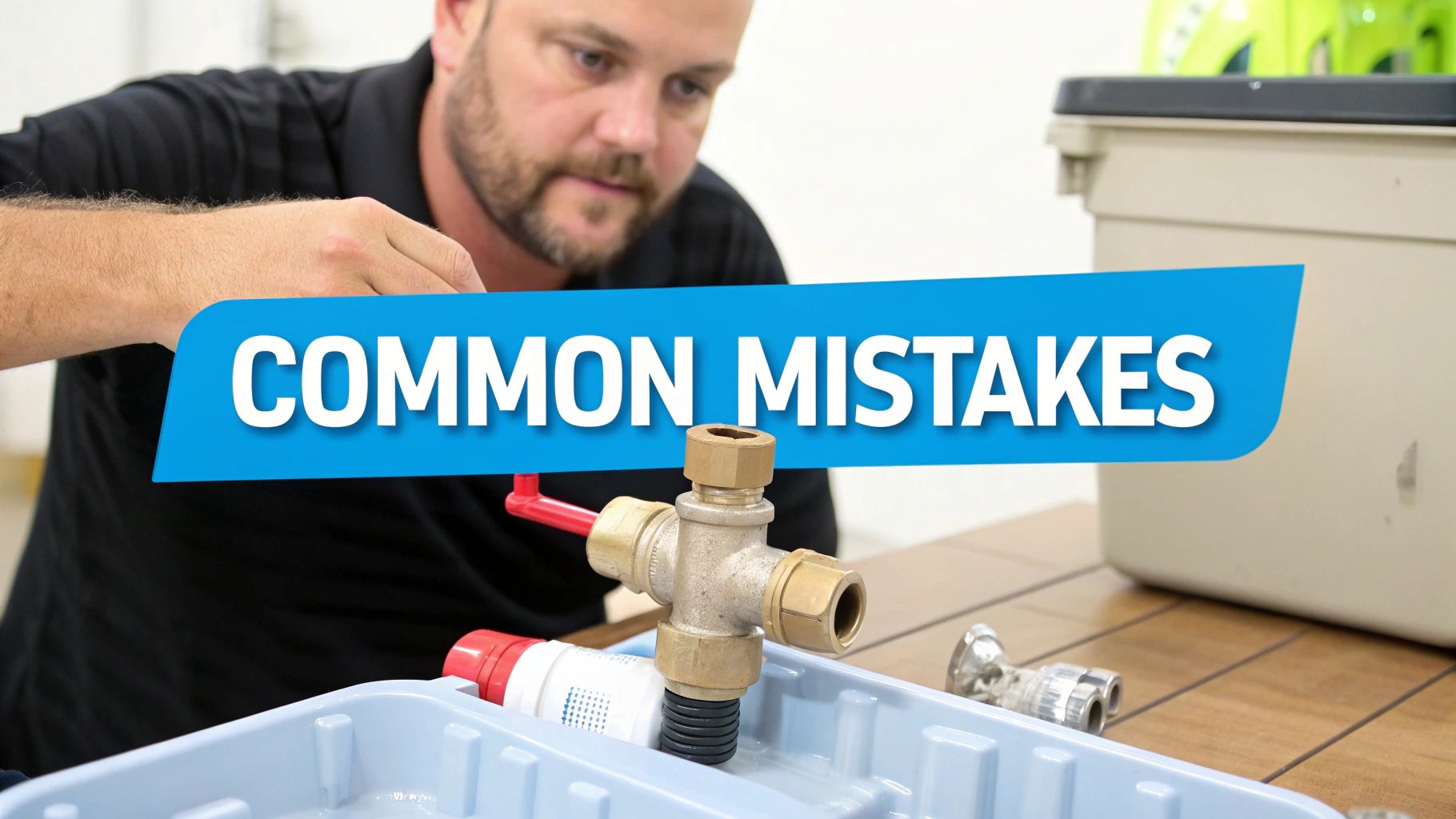
A man with a beard displays plumbing parts and a banner reading 'COMMON MISTAKES' on a table.

Look, even the best water softener installation diagram can’t save you from a few classic blunders I see all the time. The secret to a smooth install isn’t being a master plumber—it’s knowing how to sidestep the handful of common, and often costly, mistakes that trip people up.

These simple errors can quickly turn a satisfying home filtration project into a nightmare of leaks, a softener that doesn't soften, and money down the drain. Let’s walk through the most common foul-ups so you can get it right the first time.

The Classic Inlet and Outlet Mix-Up

It sounds way too basic to be a real issue, but hooking the unit up backward is easily the number one mistake I see. Your control valve will have ports clearly marked "IN" and "OUT." If you connect your incoming hard water to the "OUT" port, you're forcing water through the filtration system the wrong way.

This doesn't just mean your water won't get soft; it can actually damage the internal parts like the resin bed and distribution tube, which are built for water to flow in a specific direction.

The Fix: Before you wrench anything down, stop and trace the pipes with your finger. Say it out loud: "This is the hard water coming from the main, and it's going into the 'IN' port." It feels silly, but this five-second check can save you hours of teardown and frustration.

Forgetting the Essential Drain Line Air Gap

This one isn't just a simple mistake; it's a serious health risk and a code violation in most places. The drain line is where your softener purges all the brine and hard minerals during its cleaning cycle. If you shove the end of that drain tube directly into a floor drain or sink, you risk siphoning that nasty wastewater right back into your clean water supply.

It’s called back-siphonage, and it can contaminate your entire home’s plumbing system.

  • The Rule: You absolutely must have an air gap of at least 1.5 inches between the end of your drain line and the point where water could overflow the drain.
  • The Method: Just secure the tube so it hangs above the drain. Don't create a sealed connection. It’s that simple.

Over-Tightening Plastic Fittings

I get it. When you're dealing with water, you want every connection to be rock solid. But most modern softeners use control valves and bypass valves made from high-strength plastic, not brass. If you crank down on them with the same force you'd use on a metal fitting, you can easily cause hairline cracks.

You might not even see a leak right away. But over time, water pressure will find that weak spot and start a slow drip that can lead to some serious water damage. The goal here is "snug," not strained.

Here’s the right way to do it:

  1. Hand-tighten the fitting as far as it will go.
  2. Then, use your wrench to give it just another quarter to a half turn.
  3. That's it. Stop right there. This is all you need for a perfect seal without risking damage.

Choosing a Poor Location

Where you put your filtration system is just as important as how you plumb it. Stick it in an unheated garage in a cold climate, and you're just asking for a frozen, cracked tank and a massive flood. At the same time, wedging it into a tiny closet will make hauling 40-pound bags of salt a miserable chore.

Before you cut a single pipe, make sure your spot is:

  • Protected: Away from freezing temperatures.
  • Accessible: With plenty of room to open the lid and pour in salt.
  • Level: The unit needs to sit on a flat, stable surface to work correctly.

Getting the location right from the get-go, just like your water softener installation diagram shows, will save you from a world of hurt down the road.

Your Water Softener Installation Questions Answered

Even with the best water softener installation diagram and a pile of new tools, a few questions always manage to pop up. Think of this as your final check-in, where we'll tackle those common head-scratchers that can trip you up. Getting these last few things straight will give you the confidence to finish the job and finally start enjoying the benefits of a complete home water filtration system.

From whether you should call a pro to figuring out just how hard your water actually is, let's get these last few questions answered so you can wrap this project up.

Do I Need a Plumber to Install a Water Softener

This is the big one, and the honest answer is… maybe. For many homeowners with some solid DIY experience, this is a totally doable project. If you’re comfortable with the idea of cutting into your main water line and have a good handle on basic plumbing, you can probably tackle this yourself.

But, if the thought of making that first cut sends a jolt of anxiety down your spine, or if your local codes demand it, hiring a plumber is the way to go. A pro guarantees the install is up to code, which is especially important for things like backflow prevention and the drain line air gap, ensuring your water filtration is both effective and safe.

Where Is the Best Place to Install a Water Softener

Location is everything. The perfect spot is right where the main water line enters your house, but before it splits off to the water heater. That’s the only way to ensure both your hot and cold water get treated, protecting all your pipes and appliances.

Look for a spot that checks these boxes:

  • It's on a level surface that can handle the weight of the tank when it's full of water and salt.
  • It has easy access to a standard electrical outlet.
  • It's close to a suitable drain, like a floor drain or a utility sink.
  • It's in a spot that will never freeze.

Basements, utility closets, or a heated garage are usually your best bets. Just make sure you leave enough elbow room around the unit to make refilling salt and doing maintenance a hassle-free job later on.

Pro Tip: Don't forget about your outside spigots and sprinklers. You almost never want to soften the water going to your lawn and garden—the sodium from the softening process is terrible for plants. Make sure you install the softener after any pipes that tee off to feed your outdoor faucets.

What Happens If I Install My Water Softener Backward

Hooking up your water softener backward by swapping the inlet and outlet pipes means it simply won't work. Water is supposed to flow down through the resin bed in a very specific way. Reversing that flow can actually damage the internal parts of your filtration system, like the delicate resin beads and the distributor tube.

The system also won't be able to regenerate properly, which means it can't clean itself, and you'll be stuck with hard water. Always, always double-check the "IN" and "OUT" arrows on the control valve before you tighten those final connections.

How Do I Determine My Water Hardness Level for Programming

This is the single most important piece of info you'll need to program your new system. The most reliable way to get it is with a simple water hardness test kit, which you can grab online or at any home improvement store. They’re cheap and give you an exact number in just a few minutes.

You can sometimes find this information in your city’s annual water quality report, which is usually posted on your local utility's website. If you're on a private well, testing is an absolute must. Punching in the right hardness level—measured in grains per gallon (GPG)—ensures your softener only regenerates when it needs to. That’s a huge long-term savings in both salt and water.


At Water Filter Advisor, our mission is to give you the clear, practical information you need to improve your home's water. From detailed diagrams to troubleshooting tips, we're here to help you make confident decisions about your home water filtration. Explore our in-depth guides and reviews at https://www.waterfilteradvisor.com.

How to Replace a Water Softener | Whole House Water Filter Installation

How to Replace a Water Softener | Whole House Water Filter Installation


My water softener has been giving me problems lately, so I decided it was finally time to replace the softener, but I won’t be installing another one….I will be replacing the water softener with a whole-home water filter system

DIY Projects:

D100 Videos:

Charger Videos:

VW Beetle Videos:

Fitness Videos:

You can always find me here:
Webpage:
Facebook:
Instagram: @Moonbuilt
Twitter: @BuiltMoon

Tools Used For This Build:
APEC 3-Stage Filter System Amazon
Copper Tube Cutter Amazon
Sharkbite Disconnect Clips Amazon
Sharkbite Disconnect Tool Amazon
Sharkbite Deburring/Depth Gauge Amazon

What I Use To Film:
Canon EOS M50:
DJI Osmo Action:
Zhiyun Smooth 4 Gimbal:
Rode VideoMic Me-L:
Rode VideoMicro:
Rode Wireless Go Wireless Lavalier:
Vijim LED Video Light:
Thronmax MDrill Zero Microphone:
AmazonBasics 60-Inch Lightweight Tripod with Bag:
Vastar Smartphone Mount:

eBay –
Amazon –
Automotive Parts at Jegs –
Custom T-shirt Designs at Printful –

Disclaimer: Some of these links are affiliate links where I’ll earn a small commission if you make a purchase at no additional cost to you. This helps support the channel and allows us to continue to make videos like this. Thank you for the support! All opinions are my own and presented without editorial input from outside sources.

Disclaimer:
Due to factors beyond the control of MoonBuilt Garage and WJM Industries LLC, we cannot guarantee against improper use or unauthorized modifications of this information. MoonBuilt Garage and WJM Industries LLC assume no liability for property damage or injury incurred as a result of any of the information contained in this video. Use this information at your own risk. MoonBuilt Garage and WJM Industries LLC recommend safe practices when working on vehicles and or with tools seen or implied in this video. Due to factors beyond the control of MoonBuilt Garage and WJM Industries LLC, no information contained in this video shall create any expressed or implied warranty or guarantee of any particular result. Any injury, damage, or loss that may result from improper use of these tools, equipment, or from the information contained in this video is the sole responsibility of the user and not MoonBuilt Garage or WJM Industries LLC.

Produced and owned by WJM Industries LLC

#MoonBuiltGarage #DIY #howto #woodworking #storage #storageideas #storagesolutions #woodflag #americanflag #rusticflag #woodshop #garageshop #shopideas #workshop #tools #maker #woodworkingtools #tooltip #woodworkingprojects #garagelife #garagefun #garagenight #builder #homerepair #homeimprovement #homerepairdiy #homeimprovementdiy

Original Video Source