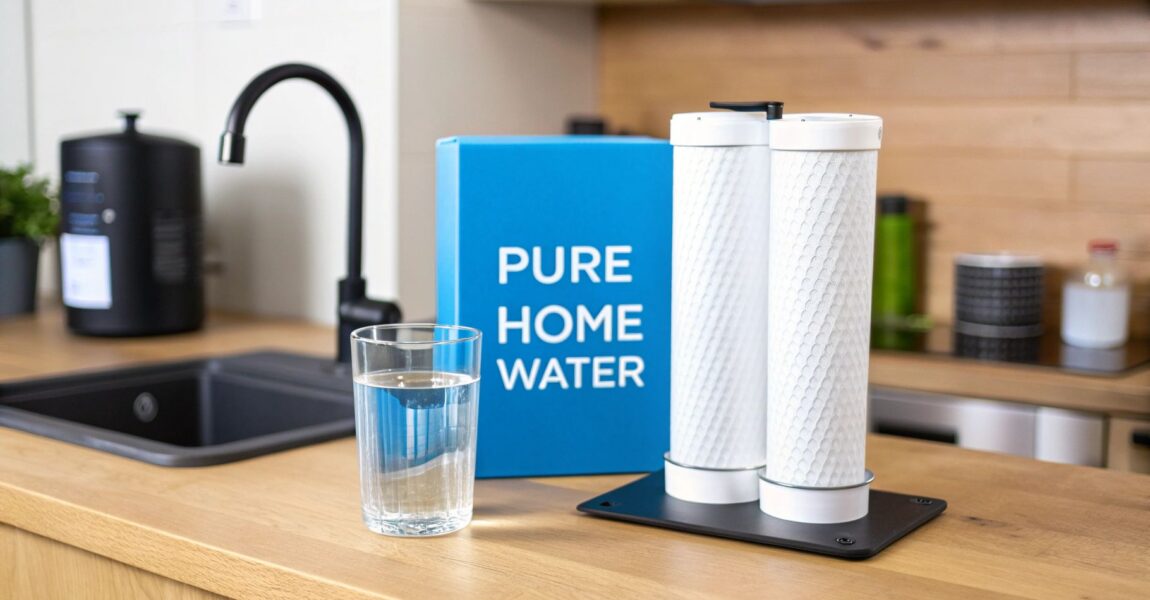
A Splash of Genius: Your Guide to Countertop Water Filtration for the Home
Ever wish you had a personal spring of pure, delicious water right in your kitchen? That's the magic of a countertop water filter. Think of it as your personal hydration station, sitting smartly next to your sink, ready to transform your tap water from "meh" to "magnificent" without you having to touch your plumbing.
This is why they've become the rockstars of home water treatment—you get a massive upgrade in water quality without the commitment of a complex installation. They're the perfect sidekick for both homeowners and renters who are thirsty for better water, right now.
The Clear Choice for Convenient, Pure Water
Imagine unboxing a sleek gadget, spending a few minutes setting it up, and instantly having access to crisp, clean water. That’s the brilliant reality of countertop water filtration. These systems masterfully bridge the gap between a simple water pitcher and a full-blown under-sink renovation.
It operates a bit like a high-tech coffee machine, but instead of brewing your morning joe, it perfects your H₂O. You just connect it to your faucet or fill up a reservoir, and it immediately gets to work, evicting funky tastes, weird smells, and a whole rogues' gallery of contaminants. It's this blend of simplicity and power that has so many people raising a glass.
Before we dive into the nitty-gritty, here’s a quick cheat sheet on the main types of countertop filters. This table will help you spot which one might be your perfect match at a glance.
Countertop Water Filtration At a Glance
| Filter Type | Best For | Installation | Typical Contaminants Removed |
|---|---|---|---|
| Faucet-Connected | High-volume, on-demand filtered water for busy kitchens. | Attaches to faucet with a diverter valve. ~10 minutes. | Chlorine, lead, sediment, bad tastes, odors. |
| Dispenser/Gravity-Fed | Flexibility and portability. Great for offices, dorms, or kitchens with non-standard faucets. | No installation needed. Just fill the reservoir. | Chlorine, heavy metals, bacteria, viruses (depending on filter). |
| Reverse Osmosis (RO) | Maximum contaminant removal for the purest possible water. | Connects to faucet; requires drain line for wastewater. | Fluoride, arsenic, salts, nitrates, and 99%+ of dissolved solids. |
Each of these systems brings something unique to the party, but they all deliver on the core promise: better water with zero fuss.
Why Homeowners Are Making the Switch
This isn't just a trend; it's a movement. People are more curious and concerned than ever about what’s lurking in their tap water. In fact, the global market for home water filtration is projected to swell to an impressive USD 7.13 billion by 2026. This boom is fueled by growing awareness and a demand for home solutions that are both effective and easy. You can dive into the data in this home water filtration market analysis.
So, what makes countertop filters the hero of the modern kitchen? It all comes down to a few knockout advantages:
- Zero-Hassle Installation: You can have most of these units pouring pure water in under 10 minutes, often without needing a single tool. It’s the ultimate plug-and-play upgrade.
- Perfect for Renters: Since there's no drilling or permanent plumbing work, these are a dream for apartments. When you move, your clean water source comes right along with you.
- A Difference You Can Taste, Instantly: They are brilliant at banishing common water woes like the smell of chlorine or an "earthy" aftertaste, making every glass of water a pleasure.
Here's the bottom line: a countertop water filter is your ticket to an immediate and significant upgrade in your drinking water. It blends serious filtration power with absolute convenience, putting you back in control of your home’s water quality.
By placing a compact, powerful filter right where you need it most, you gain the peace of mind that every sip is cleaner, safer, and more delicious.
How Do Countertop Water Filters Work Their Magic?
You don't need a degree in chemistry to understand the wizardry happening inside your countertop water filter. These clever devices employ a few different battle-tested methods to purify your water, with each one targeting specific types of unwanted guests.
Think of it like having an elite security team for your water glass. Each "guard" is a specialist trained to stop a particular kind of intruder—from the chlorine that makes your water taste like a swimming pool to invisible bacteria—before it ever reaches you. This multi-stage approach is what makes these home systems so effective; they’re not just straining things out, they’re actively transforming your water on a molecular level.
Let's pull back the curtain on the most common technologies and see how they deliver that crisp, clean taste right to your kitchen.
Activated Carbon: The Contaminant Magnet
Activated carbon is the undisputed champion of the water filtration world, and for good reason. Picture a tiny, hyper-porous sponge. Its surface is a labyrinth of microscopic nooks and crannies, creating a massive surface area that acts like a powerful magnet for certain chemicals.
As water flows through, a process called adsorption kicks in. This is where chemicals like chlorine, pesticides, and funky-tasting volatile organic compounds (VOCs) get snagged and stuck to the carbon's surface. It's why carbon filters are absolute rockstars at eliminating that "pool water" taste and smell from city tap water.
Ceramic Filtration: The Microscopic Maze
Ceramic filters operate on a simple yet incredibly powerful principle: mechanical filtration. Imagine a maze with passages so tiny that only water molecules can navigate them. The filter itself is a ceramic shell riddled with these minuscule pores, often less than a micron wide.
This physical barrier is like a brick wall for larger contaminants. Anything bigger than the pores—like sediment, protozoan cysts (think Giardia and Cryptosporidium), and most bacteria—is physically blocked from passing through. It's a straightforward, chemical-free method for tackling major microbiological threats in your home.
The real secret sauce of modern countertop systems is combining these methods. Many filters use a ceramic outer shell to block microbes and an activated carbon core to grab chemicals, giving you the best of both worlds.
Reverse Osmosis: The Ultimate Water Purifier
When you demand the absolute purest water your home can produce, Reverse Osmosis (RO) is the undisputed king. Think of an RO system as an ultra-exclusive bouncer at a club. It uses your home's water pressure to force water through a special semipermeable membrane—a material with pores so infinitesimally small that almost nothing besides H₂O can squeeze through.
This process is incredibly thorough, capable of removing up to 99% of all dissolved solids. RO is the go-to for the tough stuff other filters leave behind, including:
- Heavy Metals: A champ at removing lead, arsenic, and mercury.
- Dissolved Salts: Strips out sodium, chloride, and other minerals.
- Fluoride: One of the only residential methods proven to effectively remove fluoride.
Because the filtration is so fine, it produces a small stream of wastewater that carries the rejected contaminants down the drain. While this makes it a bit less water-efficient, its purification power is second to none for those with serious water quality issues.
Ion Exchange & UV Light: The Specialists
Some home systems bring in extra tools for specific jobs. Ion exchange, for instance, is designed to combat "hard" water. It uses tiny resin beads that cleverly swap out hard mineral ions (like calcium and magnesium) for "softer" sodium ions. This not only improves your water's taste but also cuts down on that scaly buildup in your kettle.
Finally, you might find some high-end units that include UV (ultraviolet) sterilization. Imagine a special light that zaps viruses and bacteria on contact, scrambling their DNA so they can't make you sick. A UV lamp acts as a final, powerful line of defense, ensuring your water is biologically pristine and safe to drink.
So, Which Type of Countertop Filter is Right for You?
Now that we’ve peeked under the hood at the technology, let's talk about the actual hardware you’ll have sitting on your counter. The world of countertop water filtration isn't a one-size-fits-all affair. Each system is engineered to solve a specific problem, fitting different lifestyles, kitchens, and water challenges at home.
Choosing the right one is much easier once you can picture how it would fit into your daily routine. Think of this as going from reading the engine specs to actually taking the car for a test drive. We’ll look at the three main players, giving you a clear idea of which one might be the perfect sidekick for your daily grind.
Gravity-Fed Systems: The Off-Grid Powerhouse
Imagine a storm knocks out your power for a couple of days. The faucet runs dry, but you’re not worried. You have a sleek, stainless-steel gravity-fed filter on your counter, ready to turn potable water—even from a rain barrel—into safe drinking water for your family. That’s the real superpower of these units.
They're beautifully simple: two stacked chambers. You pour water into the top, and gravity does all the work, pulling the water down through powerful filter elements (usually ceramic or carbon block) into the bottom reservoir. Because they need no electricity or plumbing connection, they're the ultimate tool for emergency prep and off-grid living.
- Best For: Large families who go through a lot of water, anyone wanting an emergency backup, and homes with funky, non-standard faucets that won't connect to a diverter.
- Key Advantage: They're built like tanks. Unmatched reliability, and you can take them anywhere.
- Heads-Up: Filtration isn't instant. It takes a little time for gravity to work its magic.
Faucet-Diverter Filters: The Renter’s Best Friend
Now, picture someone living in a rented apartment. They want better water but can’t touch the plumbing. A faucet-diverter filter is the perfect answer. It just screws right onto the existing faucet in minutes, and a small lever lets you switch between regular tap water and clean, filtered water on demand.
This setup is the definition of convenient. When it’s time to move, you just unscrew it and take it with you, leaving no trace. You get a continuous flow of filtered water for drinking and cooking without sacrificing precious fridge space for a pitcher.
These systems are a great example of how accessible clean water at home has become. Their simplicity is a big reason why the global countertop water filter market was valued at an impressive US$11,020 million in 2023 and is still growing. You can dig into the numbers in recent market analysis reports.
Countertop Reverse Osmosis: The Purity Specialist
Finally, think about a family whose local water report shows high levels of tough contaminants like fluoride, arsenic, or just a lot of dissolved solids (TDS). They need the strongest filtration they can get without tearing up their kitchen. A standalone countertop reverse osmosis (RO) system delivers exactly that.
These compact units sit next to the sink, connecting to the faucet when you need them and usually draining a small amount of wastewater. They force water through the same powerful RO membranes found in bigger under-sink models, knocking out over 99% of contaminants. For anyone who wants the absolute highest level of water purity for their home, a countertop RO system is the clear winner—it offers performance other portable filters just can't touch.
Countertop vs Under Sink vs Pitcher Filters
So, how do countertop systems really stack up against the other popular options for the home? Each has its place, but seeing them side-by-side makes the decision much clearer.
| Feature | Countertop Systems | Under-Sink Systems | Pitcher Filters |
|---|---|---|---|
| Installation | Super easy; often screws onto the faucet in minutes. No tools needed for gravity models. | Requires plumbing work and drilling a hole in the countertop. | No installation needed; just fill and go. |
| Performance | Excellent; removes a wide range of contaminants, including lead, chlorine, and VOCs. RO models offer top-tier purity. | The best performance available; can handle heavy contamination with multi-stage filters and RO. | Basic; mainly improves taste and odor by reducing chlorine. Limited on other contaminants. |
| Convenience | On-demand filtered water right from the tap (diverter models) or a large reservoir (gravity models). | The most convenient; filtered water comes from a dedicated faucet seamlessly. | Not on-demand. Requires constant refilling and waiting. |
| Cost | Mid-range initial cost ($50 – $400). Filter replacements are a recurring expense. | Highest initial cost ($200 – $600+), plus potential plumber fees. | Lowest initial cost ($20 – $50), but frequent filter replacements add up. |
| Space | Takes up counter space next to the sink. | Hidden away under the sink, keeping countertops clear. | Takes up space in the refrigerator or on the counter. |
| Best For | Renters, small kitchens, and anyone wanting a balance of performance and easy installation. | Homeowners who want the highest level of seamless, invisible filtration. | Individuals or small households looking for a simple, low-cost taste improvement. |
Ultimately, the best choice boils down to your specific needs. If you're a renter or just want a powerful, easy-to-install solution, countertop filters are hard to beat. If you own your home and want top-tier filtration that's out of sight, an under-sink system might be worth the investment. And for basic taste improvement on a budget, a pitcher is a fine starting point.
What Contaminants Do Countertop Filters Actually Remove?
Think of a countertop water filter as a bouncer for your drinking glass—it decides what gets in and what gets kicked to the curb. While you can't see the action happening inside, these systems are working hard to target a whole host of unwanted stuff. Knowing exactly what a filter is designed to remove is the first step in picking the right one for your home.
Let's be clear: not all contaminants are the same. Some are just annoying, messing with the taste and smell of your water. Others are far more serious, posing real health risks over time. We'll break down the common culprits to see how different filters stack up.
Getting Rid of Bad Tastes and Smells
This is usually the first thing people complain about—the water just tastes… wrong. These are called aesthetic contaminants. While they aren't usually harmful, they can make drinking tap water a real chore.
- Chlorine: This is the big one. Your city uses it to keep the water supply safe, but it often leaves behind that classic "swimming pool" taste and smell. Activated carbon filters are fantastic at grabbing chlorine, making your water taste crisp and fresh almost instantly.
- Hydrogen Sulfide: If your water has a "rotten egg" smell, that's hydrogen sulfide. It's a naturally occurring gas, but it's definitely unpleasant. Once again, activated carbon is the hero here, trapping those stinky compounds.
- Sediment and Turbidity: This is just a fancy way of saying your water has fine particles like sand, silt, or rust that make it look cloudy. Ceramic filters and multi-stage carbon blocks work like a physical screen, straining out this gunk and leaving you with crystal-clear water.
Tackling Dangerous Heavy Metals
Heavy metals are a much bigger deal. Things like lead can leach into the water from old plumbing, and you'd never know it because they're invisible and have no taste. Over time, they can build up in your body and cause serious health problems.
A filter's ability to handle heavy metals really depends on the technology inside. A basic carbon filter might reduce a little lead, but for a real solution, you need something more powerful.
Reverse Osmosis (RO) is the clear winner for removing heavy metals. Its membrane is so fine that it acts as a nearly impenetrable wall, blocking lead, mercury, arsenic, cadmium, and chromium from getting through.
Neutralizing Chemical Threats
Our water supplies can pick up a mix of man-made chemicals from farms and factories. These are the silent threats, from pesticides to industrial byproducts.
- Pesticides and Herbicides: Chemicals like atrazine can seep into water sources. A good quality activated carbon block filter is great at capturing these types of organic chemicals.
- Volatile Organic Compounds (VOCs): This is a huge category of chemicals, including things like benzene and trihalomethanes (THMs), which are created when water is treated with chlorine. Carbon filters are your best defense against VOCs.
- PFAS: You might have heard of these "forever chemicals." They are incredibly tough to get rid of, but reverse osmosis and certain types of specialized activated carbon are the most effective options out there.
Concerns over these chemicals are a big reason why advanced home filtration is becoming so popular. In fact, the market for countertop reverse osmosis systems is expected to hit $13.23 billion by 2025, driven by worries over waterborne diseases that, according to the WHO, cause over 485,000 deaths each year. You can dig into the numbers in this global market forecast on RO purifiers.
Guarding Against Germs
If you're on well water or live in an area that gets boil-water advisories, then bacteria, viruses, and other microbes are your main concern.
- Bacteria and Protozoan Cysts: The tiny pores in a ceramic filter are small enough to physically block larger bugs like E. coli, Giardia, and Cryptosporidium.
- Viruses: Viruses are much, much smaller and can sneak past many filters. To truly purify your water, you need a system with UV sterilization. The UV light zaps the DNA of these pathogens, making them totally harmless.
You can find a ton of great information on the NSF website about which certifications match up with specific contaminants.
This image from the NSF site shows why it's so important to look for official certifications. When a product has an NSF/ANSI number on it, you know it's been independently tested to back up its claims, whether it's for lead, cysts, or something else.
Getting Set Up, Staying Maintained, and Sizing Up the Cost
One of the best things about countertop water filters for the home is just how ridiculously easy they are to get going. You can forget about calling a plumber or making major modifications under your sink. Most of these systems are designed to go from the box to pouring pure water in just a few minutes flat.
The whole process is refreshingly simple. For a faucet-diverter model, you just unscrew the little aerator at the end of your faucet and screw on the filter's diverter valve. Flip a tiny switch, and voila—water flows through the filter instead of straight into your sink. Gravity-fed systems? Even easier. Just assemble the chambers, pop in the filter elements, and pour water into the top. It’s a true "no plumber, no problem" situation.
A Simple Plan for Maintenance
Once you’re up and running, keeping that great performance comes down to a little bit of routine maintenance. Think of it like changing the oil in your car—if you skip it, things start to go downhill. For your water filter, that means staying on top of filter changes.
A filter that’s clogged or past its prime simply can't do its job. Your water flow will slow to a trickle, and worse, it might stop removing contaminants effectively. In some cases, a neglected filter can even start releasing the gunk it has already trapped right back into your water.
Following the manufacturer's replacement schedule isn't just a friendly suggestion—it’s the golden rule for ensuring your water stays consistently clean and safe. The easiest way to stay on top of this is to set a reminder on your phone or calendar the day you install a new one.
Here’s a rough guide for how often you'll be swapping out filters:
- Activated Carbon Cartridges: These common workhorses usually need replacing every 2-4 months, or after filtering around 100-200 gallons.
- Ceramic Elements: These are built to last, often going for 6-12 months or even longer. A great feature of many ceramic filters is that you can clean them—a quick scrub with a brush can restore water flow and extend their life.
- Reverse Osmosis (RO) Membranes: The RO membrane is the heart of the system and can last a long time, typically 1-3 years. You'll still need to change out the pre-filters (usually carbon and sediment filters) every 6-12 months to protect it.
Figuring Out the Real Cost of Your Filter
When you're shopping for a countertop water filtration system, don't just stop at the initial price tag. The true cost of ownership is a combination of that upfront purchase and the ongoing expense of new cartridges. It might seem like an extra bill, but when you pit it against buying bottled water, the savings become crystal clear.
Let's break down what a typical year might look like for a family home:
| Filtration Method | Initial Cost (Average) | Annual Replacement Cost (Average) | Total First-Year Cost |
|---|---|---|---|
| Countertop Filter | $70 | $60 | $130 |
| Bottled Water (Family) | $0 | $400+ | $400+ |
| Pitcher Filter | $30 | $120 | $150 |
The numbers don't lie. Even when you factor in the cost of replacement filters, a countertop system is dramatically cheaper than a bottled water habit. You're not just saving a significant amount of money over time; you're also drastically cutting down on plastic waste. It's a smarter move for both your wallet and the planet.
Choosing the Right Countertop Filtration System
Now that you're armed with knowledge about the different technologies and filter types, you're ready to pick a winner. But remember, the "best" countertop filter isn't the one with the most bells and whistles or the highest price. It's the one that fits perfectly into your home and your life.
Think of it as getting a personalized prescription for better water. To figure that out, we just need to answer a few key questions about your home. This will quickly cut through the noise and point you straight to a system that feels like it was made just for you.
Your Personalized Filter Checklist
The goal here is to match a filter's strengths with what you actually need at home. Let’s start with the big questions that will determine your daily happiness with your filter.
- What's in Your Water? This is the most important question. Do you know what you’re trying to remove? If your main complaint is a strong chlorine taste from city water, a good carbon filter is your best friend. But if you’re genuinely concerned about things like lead, fluoride, or other tricky contaminants, a reverse osmosis system is the heavy-hitter you need.
- How Much Water Do You Use? A single person living alone might get by just fine with a smaller dispenser. But a busy family of four that’s constantly filling water bottles, cooking pasta, and making coffee will need something with much higher capacity to keep up.
- What's Your Budget? Don't just look at the upfront price tag. You have to consider the total cost of ownership. That means factoring in the price and lifespan of the replacement cartridges. A cheap unit with expensive filters that need changing every two months can easily cost more over a year than a pricier system with long-lasting cartridges.
- How Much Counter Space Can You Spare? Let's be honest, kitchen real estate is precious. A slim faucet-diverter model takes up almost no room, while a big gravity-fed system needs a dedicated spot. Grab a tape measure and see what you're working with before you fall in love with a filter that won't fit.
This flowchart can help you visualize the decision-making process, starting with your water's contaminants and moving through your daily use and budget.
When you start with these priorities, you can immediately narrow your search to the type of system that makes the most sense for your home.
By thoughtfully answering each of these questions, you build a clear profile of your ideal countertop water filtration system. This moves you from simply browsing options to making a strategic, informed decision you'll feel great about for years.
The goal is to find a system that blends right into your daily routine, giving you clean, fantastic-tasting water without any fuss. If you’re ready to dive deeper and get more tailored recommendations, you can find a ton of expert advice on water filters here.
Your Top Questions About Countertop Water Filters, Answered
It’s totally normal to have a few questions before you commit to a new water filter for your home. You're making an investment in your family's health and well-being, so getting the details right is crucial.
Let's tackle the most common questions we hear, from what happens to healthy minerals to whether these systems are a good fit for well water. Think of this as your final checklist before finding the perfect filter.
Do These Filters Take Out the Good Stuff, Too?
Great question! The answer really comes down to the type of filtration technology you choose for your home.
Most standard countertop filters, especially those using activated carbon or ceramic shells, are quite selective. They're designed to target and grab contaminants like chlorine and lead while letting beneficial minerals like calcium and magnesium pass right on through. You get cleaner, safer water without stripping out the good stuff.
The main exception here is Reverse Osmosis (RO). An RO system is incredibly thorough, and its membrane is so fine that it removes almost everything—including those minerals. To solve this, many modern countertop RO units now include a remineralization stage that adds a balanced mix of healthy minerals back into the water right before it hits your glass.
How Often Do I Really Need to Change the Filter?
This is a big one, and sticking to the schedule is non-negotiable if you want your filter to keep doing its job. The lifespan of a filter cartridge depends on the specific model, the quality of your tap water, and how much water your household uses.
- A typical activated carbon filter will last you 2-4 months, which works out to about 100-200 gallons.
- A high-performance RO membrane can go for 1-3 years, but you'll need to change its pre-filters much more often.
Always, always follow the manufacturer's directions. A filter that's past its prime doesn't just stop working—it can get clogged and become a breeding ground for bacteria. Even worse, it could start releasing all the contaminants it's been holding back into your water. The easiest trick? Set a recurring reminder on your phone's calendar.
Can I Use a Countertop Filter for My Well Water?
You absolutely can, but there's a critical first step for any home on well water: get your water tested. Well water isn't treated by a municipality, so it can have a unique set of challenges, like high iron, bacteria, manganese, or even hydrogen sulfide (that "rotten egg" smell).
Once you have a water test report, you'll know exactly what you're dealing with and can pick a filter certified to remove those specific contaminants. For wells, a multi-stage system is almost always the best bet. A gravity-fed unit with powerful ceramic filters or a countertop RO system usually has the strength needed to make your well water perfectly safe and great-tasting.
Will a Filter Kill My Faucet’s Water Pressure?
This is a common worry, but it’s usually not an issue. If you choose a filter that connects directly to your faucet, you will notice a slightly slower flow only when the diverter is switched to the filter. That's actually a good thing! It means the water is getting enough contact time with the filter media to be purified properly.
Your normal, unfiltered water pressure from the tap remains exactly the same. Even better, standalone units like gravity-fed systems or countertop RO distillers don't connect to your main faucet at all, so they have zero impact on your sink's water pressure.
Ready to stop wondering and start enjoying pure, great-tasting water? At Water Filter Advisor, we provide in-depth reviews, comparisons, and practical guides to help you find the perfect filtration solution for your home. Explore our expert resources and make a confident choice today at https://www.waterfilteradvisor.com.
