Water Filter Cartridge Types Explained for Home Use
You turn on the kitchen faucet and notice a faint chlorine smell. Later, a glass has a few grains of grit at the bottom, or the shower flow feels weaker than it used to. The housing under the sink may look unchanged, but the water filter cartridge types inside it can behave very differently depending on their media, micron rating, size, and condition.
Choosing the right cartridge affects more than taste. The correct filter can capture sediment, reduce chlorine, address a named contaminant, or protect downstream equipment. The wrong one may waste money, restrict flow, clog quickly, or provide less reduction than its packaging suggests. This guide focuses on the practical tradeoffs homeowners face, from simple sediment capture to reverse osmosis.
Why Your Home Water Needs the Right Cartridge
A glass of clear tap water can still have an unwanted chlorine smell. In another home, the water may carry rust, sand, or silt from a private well. The filter housing may look identical in both cases, but the cartridge inside determines what the system captures, how quickly water flows, and how often replacement is needed.
Sediment cartridges remove physical particles. Activated carbon works on dissolved compounds linked to chlorine taste and odor. Other media address narrower concerns, including hardness, metals, acidic well water, or selected dissolved contaminants. The cartridge's format, media, and micron rating work together, so choosing by contaminant name alone can lead to disappointing results.
For municipal water, a granular activated carbon cartridge may improve taste and odor while maintaining stronger flow. A denser carbon block can offer tighter particle capture, yet its smaller passages may increase pressure drop. That tradeoff matters at a kitchen faucet, and it matters even more when several fixtures share the system.
Private-well water creates a different setup problem. Rust, sand, and silt can load a cartridge quickly. Placing a fine carbon block first may cause early clogging before it has time to address taste or odor. A coarse sediment stage ahead of it works like a protective screen, catching larger particles and helping the finer media last longer.
Practical rule: Match the cartridge to the water problem, then match its format and rating to the flow and pressure your home can accept.
Certification helps distinguish a tested reduction claim from a broad marketing description. NSF/ANSI 42 covers aesthetic effects such as chlorine taste and odor, while NSF/ANSI 53 addresses health-related contaminants such as lead. NSF/ANSI 58 applies to reverse osmosis systems, and NSF/ANSI 401 covers certain emerging contaminants. A standard does not mean every cartridge using the same media handles every contaminant. Check the exact cartridge and certified claim.
A household system also needs to fit its existing housing, provide usable flow, and remain affordable to replace. A cartridge that performs well in a controlled application may be a poor home choice if it creates frequent pressure loss or replacement costs.
How Water Filter Cartridges Work at Home
Water enters the housing, passes through the cartridge material, and leaves with some particles or dissolved compounds removed. The result depends on two choices: what the media can capture and how tightly water must pass through it. A cartridge can improve water quality while also reducing flow or loading quickly if its format and rating do not suit the home.
Three basic cleaning actions
Mechanical filtration blocks particles by size. Pleated and spun sediment cartridges can intercept sand, rust, silt, and other debris. Coarse cartridges may start around 50 microns, while finer options can reach 1 micron, according to this overview of water filter cartridge types and micron ratings. A lower micron rating can retain smaller particles, but the tighter passages may create more pressure drop, especially as trapped sediment fills the cartridge.
Adsorption lets activated carbon hold certain dissolved compounds on its internal surface. Carbon commonly addresses chlorine, taste, and odor. Granular activated carbon leaves spaces between loose particles, which can support easier flow. Carbon block compresses the material into a denser structure, often improving contact and fine-particle capture while making pressure loss and clogging more noticeable when the water contains sediment.
Ion exchange uses resin beads to swap selected ions for others. The resin must match the dissolved substance being targeted, so this method is not a general replacement for sediment or carbon filtration. The cartridge's media determines what it can reduce, while its format and capacity affect how often it needs service.
Why micron ratings change the experience
A micron is a unit for measuring particle size. The rating offers a useful guide, but it does not describe the cartridge's entire performance. A 50-micron cartridge acts like a coarse screen and may preserve flow longer in dirty water. A 1-micron cartridge catches smaller particles, yet its narrower passages can slow water sooner as debris accumulates.
That tradeoff is easiest to notice at a busy kitchen faucet or when several fixtures share one filter. Choosing the finest rating available is not automatically better. The rating should be small enough for the problem and open enough to provide usable flow.
Reverse osmosis takes separation much further. RO membranes can reach about 0.0001 micron, but they address dissolved material rather than only visible grit. Sediment and carbon prefilters normally protect the membrane from particles and chlorine-related damage.
Standards as a buying shortcut
NSF/ANSI standards can make cartridge claims easier to compare:
| Standard | Main focus |
|---|---|
| NSF/ANSI 42 | Aesthetic effects, including chlorine taste and odor |
| NSF/ANSI 53 | Health-related contaminants, including lead |
| NSF/ANSI 58 | Reverse osmosis systems |
| NSF/ANSI 401 | Certain emerging contaminants |
Certification applies to the specific tested product and reduction claim. It does not automatically apply to every cartridge using the same material. Check the housing, cartridge purpose, micron rating, and certified claim. If the fit or role of a ceramic cartridge remains unclear, you can call Ring Hot Water for help before purchasing.
Sediment and Carbon Cartridges That Handle Everyday Water
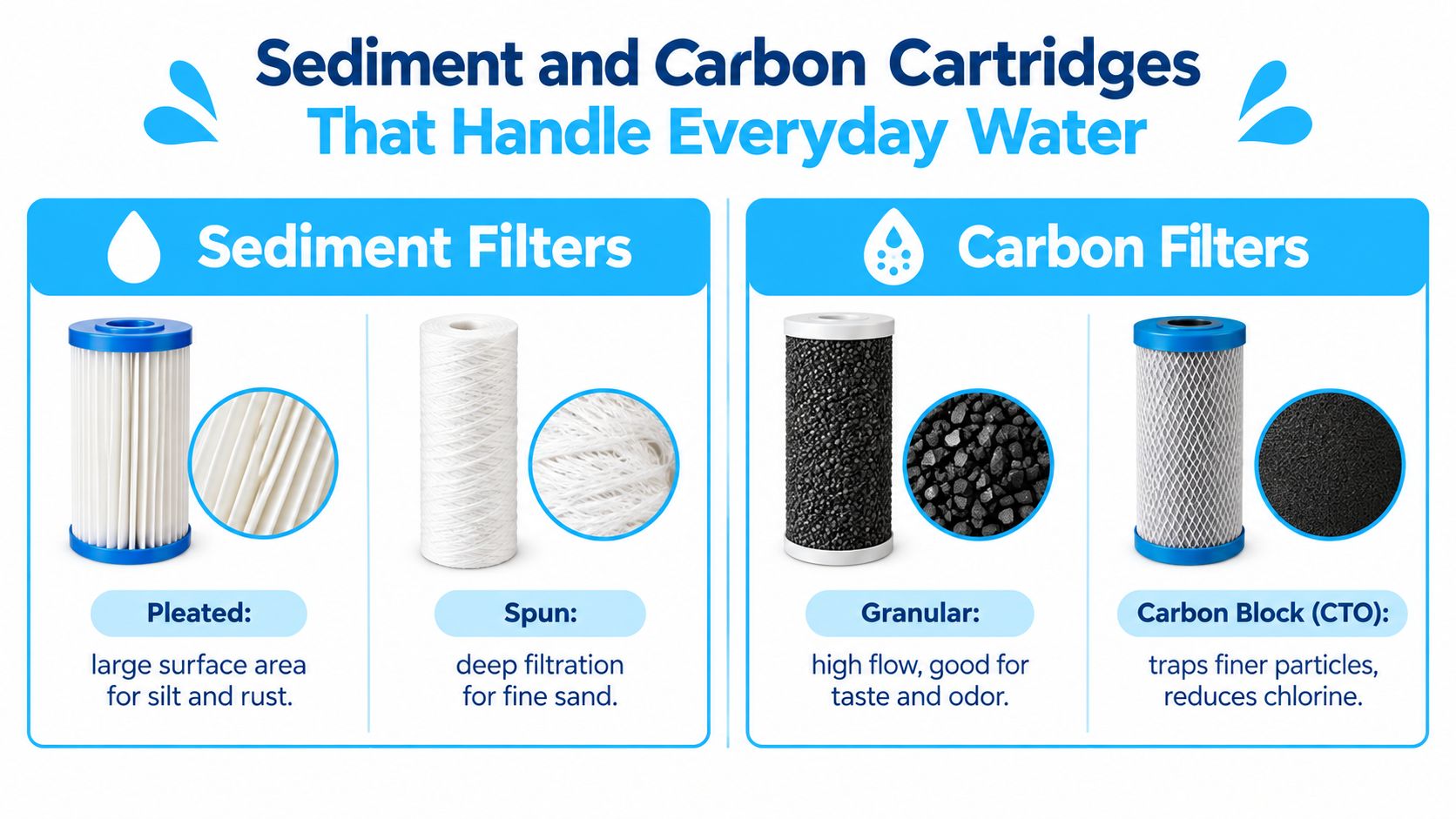
Sediment and carbon cartridges cover many everyday household complaints, but they don't do the same job. Sediment media deal with physical debris. Carbon media deal mainly with taste, odor, chlorine, and selected chemical concerns. A staged system often works better than asking one cartridge to handle everything.
Sediment cartridges
Pleated cartridges fold the filter material into an accordion. That creates a large surface area for silt, rust, and other particles. Some pleated cartridges can be rinsed and reused in compatible housings, which may reduce replacement waste and cost when the cartridge hasn't been damaged.
Spun or depth cartridges capture particles throughout the thickness of the material. They can be useful when water carries fine sand or mixed sediment, but they're generally treated as single-use cartridges. Once the internal passages fill, rinsing usually won't restore the original structure.
A coarse sediment cartridge can protect a finer downstream cartridge. For example, a home with visibly gritty well water might place sediment filtration first, then carbon. Without that first stage, the carbon cartridge has to catch both debris and dissolved compounds, so it can load faster.
Granular carbon compared with carbon block
Granular activated carbon, often called GAC, uses loose carbon particles. Its open structure generally supports higher flow and modest pressure loss, making it useful for broad chlorine, taste, and odor improvement.
Carbon block compresses carbon into a solid form. Household carbon blocks are commonly specified across roughly 0.5 to 10 µm, while independent certification listings report common block ratings between 0.5 and 5 µm in relevant classifications, as shown by the NSF certified drinking-water component listings. A block around 0.5 µm may be selected for cyst reduction and fine particulate capture, while a 1 µm block may suit lead particulate concerns. A 5 to 10 µm block can work more comfortably as a sediment prefilter.
The tradeoff is straightforward. A tighter block can retain smaller particles and provide stronger contact with the carbon, but it usually restricts flow more and clogs sooner in turbid water. A carbon block also needs a specific certification for a health-related claim. The label “carbon block” alone doesn't prove lead or cyst reduction.
Activated carbon remains commercially important because it fits so many residential, commercial, and industrial applications. One 2025 market estimate places carbon cartridges at about $1.5 billion in revenue and 32.4% of global share, according to this water filter cartridge market estimate. That market position reflects broad use, not a claim that carbon is suitable for every water problem.
Specialty Cartridges for Specific Contaminants
A household may notice a rotten-egg odor, metallic staining, or unusually hard water and assume carbon will solve it. These signs can have different causes, so a water test or clearly identified supply problem should guide the cartridge choice. Specialty cartridges work as focused tools, usually alongside sediment and carbon stages. Each stage handles a manageable part of the treatment instead of forcing one cartridge to do everything.
Catalytic carbon and KDF
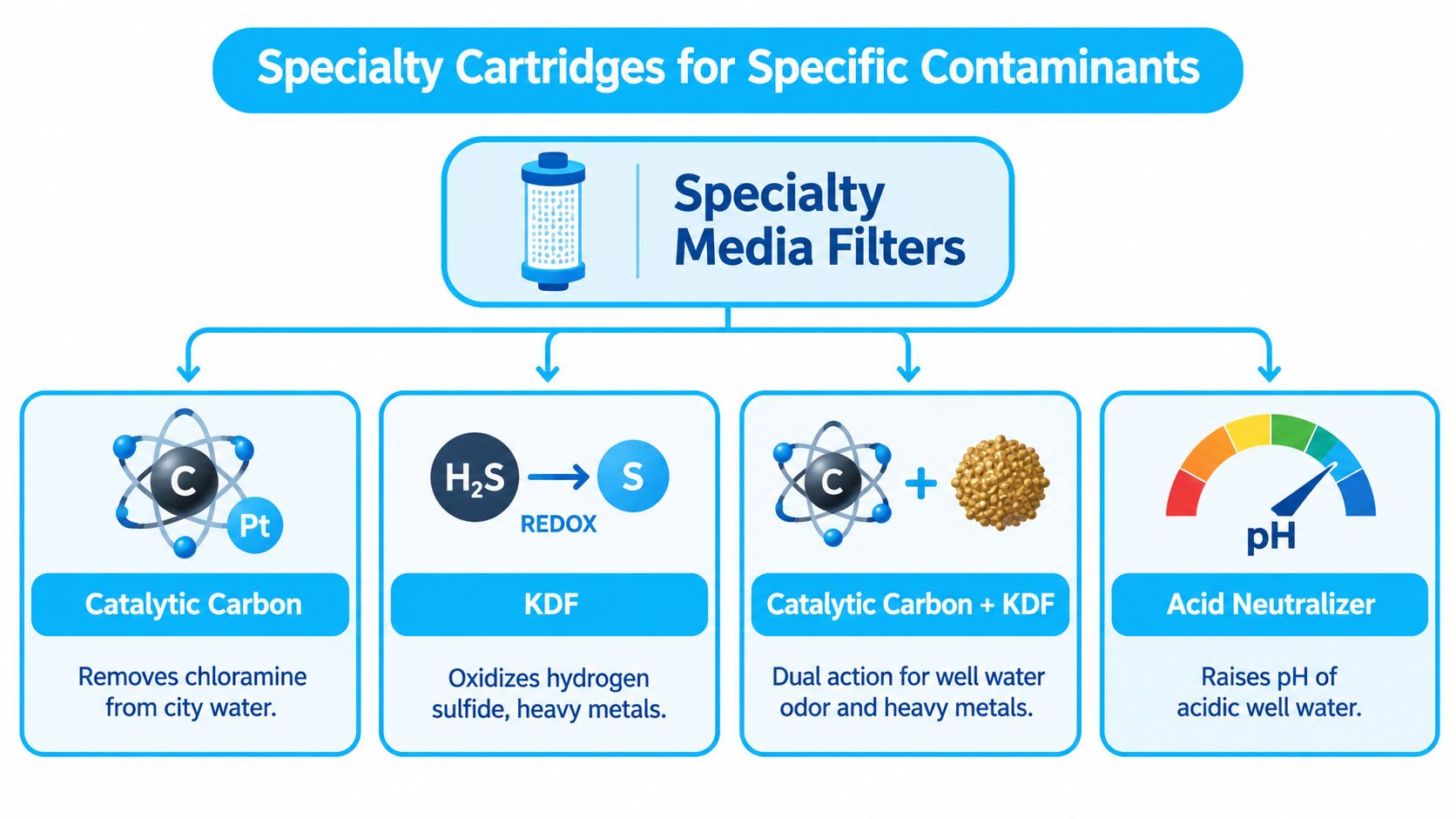
Catalytic carbon suits compounds that standard activated carbon may handle less effectively, including chloramine in some municipal supplies. If the water has a persistent disinfectant odor rather than ordinary chlorine odor, check that the cartridge specification specifically names chloramine reduction.
KDF contains a copper-zinc redox medium. Depending on its design and stated claim, it may help with hydrogen sulfide odor and certain heavy metals. Some cartridges combine KDF with catalytic carbon for disinfectant-related odor and metal concerns. The water chemistry and flow rate still matter, because a medium that works well at one contact time may perform differently when water moves faster.
Ceramic and ion exchange
Ceramic cartridges filter through a porous shell. They may suit sediment, turbidity, bacteria, or cyst concerns when the product is designed and tested for those purposes. Some formats add a carbon core, pairing particle capture with taste and odor treatment.
Ion exchange resin addresses a different category of problem. Water-softening resin exchanges hardness ions, while specialized resins can target named dissolved substances such as lead, fluoride, or nitrate. Resin works best after a sediment stage. Grit can block water movement through the resin and shorten the cartridge's useful service.
Reverse osmosis
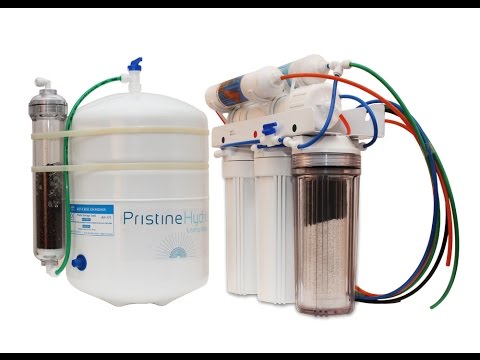
Reverse osmosis membranes separate dissolved solids through a semipermeable barrier. NSF/ANSI 58 is the relevant certification standard for RO systems. An RO setup commonly places sediment and carbon prefilters before the membrane, protecting it from particles and chlorine.
Cartridge order gives each stage a clear job:
- Sediment first, to catch grit and rust.
- Carbon next, to reduce chlorine, taste, and odor.
- Specialty treatment where needed, for a named contaminant or water condition.
- RO or a polishing stage, when the goal requires finer dissolved-contaminant separation.
Acid-neutralizer media can raise the pH of acidic well water. Other specialty media may address iron, manganese, or hydrogen sulfide. Matching the medium to a symptom alone risks an expensive mismatch, because similar odors, stains, or scale can come from different water conditions. Testing helps identify the target before you pay for a cartridge that treats the wrong problem.
How to Match Cartridge Types to Your Home and Water Source
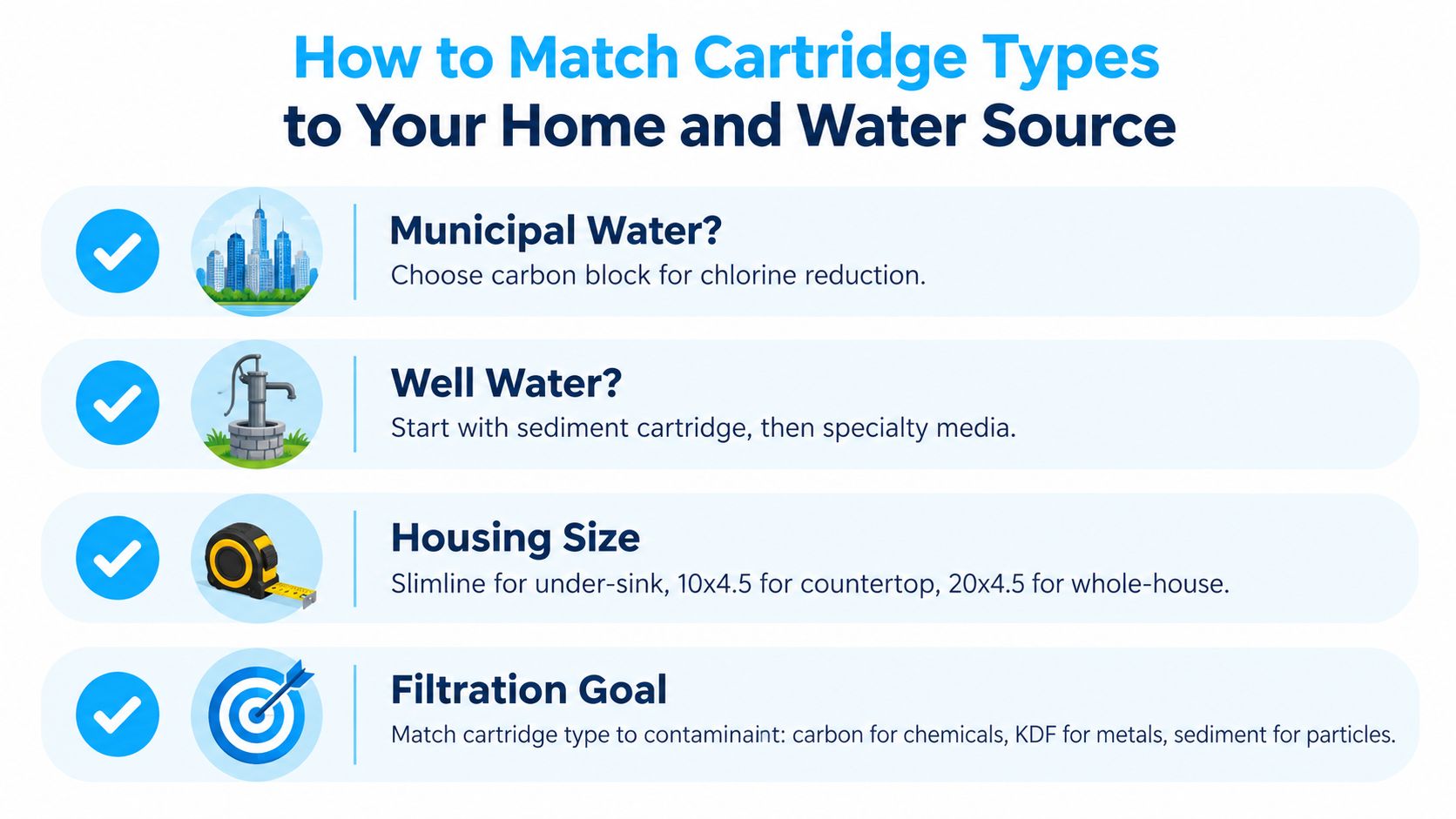
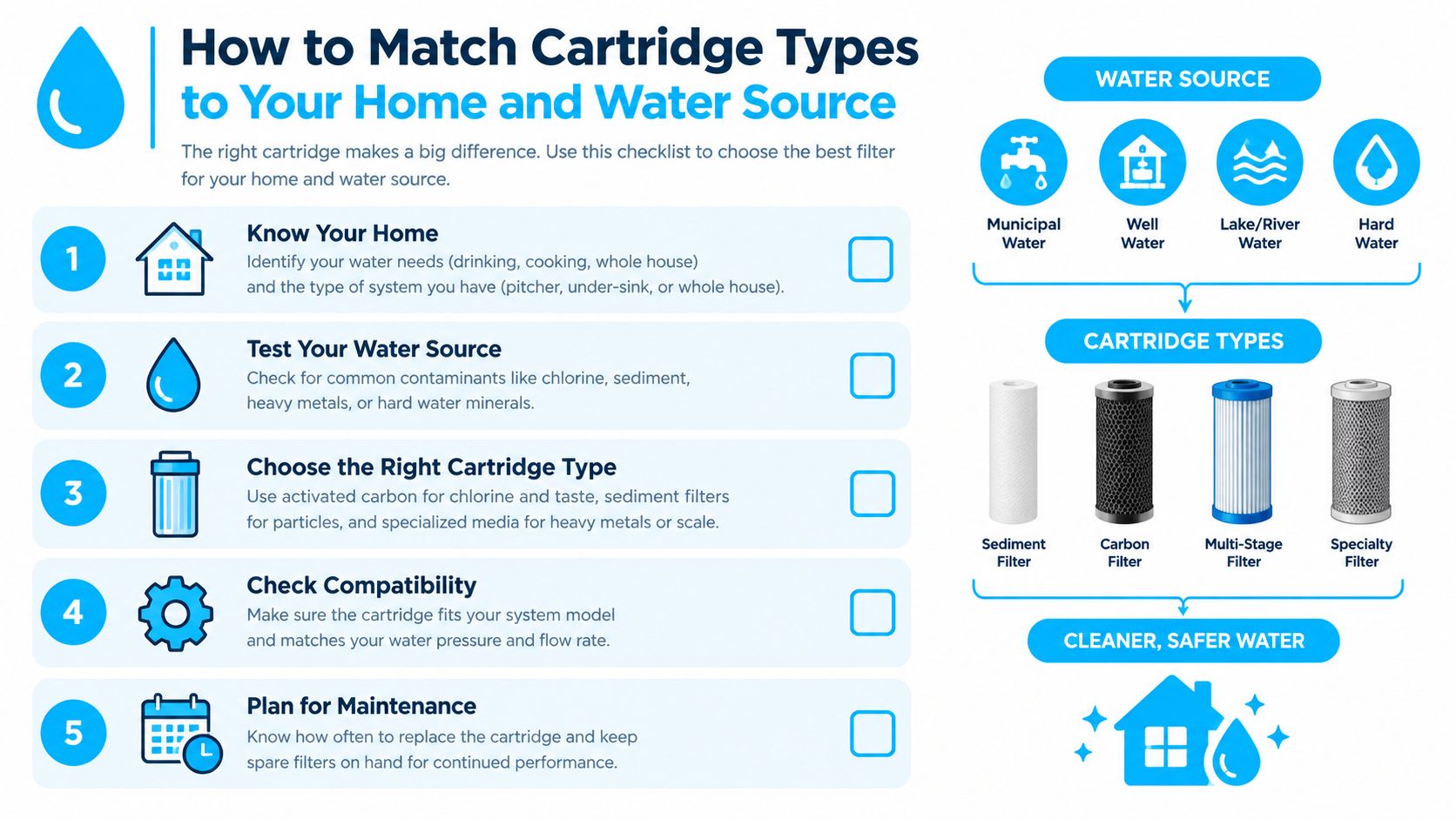
A city-water home may notice chlorine taste or odor, while a well may show sediment, stains, or unusual smells. Those clues narrow the search, but the source alone cannot choose the cartridge. Local water conditions, plumbing, treatment goals, and available flow all affect the decision.
Start with the water problem
For municipal water, a carbon block suits homes focused on chlorine reduction, as long as the product has a tested claim for that purpose. Granular carbon may fit a household that values stronger flow and general taste improvement.
With well water, check the particle load first. A pleated cartridge works well where sediment is heavy and the housing allows cleaning. A spun depth cartridge offers a simpler disposable stage. If testing identifies hydrogen sulfide, metals, hardness, or acidic water, choose media designed for that condition instead of expecting carbon to handle every problem.
Micron rating changes the tradeoff. A finer rating can capture smaller particles, but it usually gives water less room to pass through. That can mean more pressure loss and faster clogging when the source contains plenty of sediment. A larger micron rating may preserve flow while allowing some smaller particles through, so the rating should match both the water and the job.
Match the cartridge format to the housing
The cartridge must fit the housing before its media can work. Common household formats include:
- Slimline formats: Compact cartridges for under-sink or lower-demand applications.
- Big Blue formats: Larger housings for whole-house flow and heavier loading.
- Inline cartridges: Sealed, compact units for refrigerators, water coolers, and similar appliances.
- Pitcher and faucet cartridges: Small formats for renters or point-of-use filtration without permanent plumbing changes.
Housing size affects pressure behavior and replacement work. A larger housing can hold more media and provide more contact area, like a wider lane that lets water pass with less resistance. It also requires enough space, suitable connections, and a cartridge that matches the manufacturer's dimensions.
Set the choice around household flow
A drinking-water filter serving one faucet can use a finer carbon block or ceramic cartridge without affecting the rest of the home. The same tight rating on a whole-house line may restrict showers, toilets, and appliances, while also increasing replacement frequency and cost.
Choose the smallest filtration level that meets the treatment goal, then confirm that the format supports the required flow. Sediment, ceramic, carbon, and RO cartridges serve different particle, microbial, and dissolved-contaminant needs, so the right match balances cleanliness with usable pressure.
Lifespan Flow and Replacement Tradeoffs You Should Know
A filter can still remove contaminants while the tap grows weak. As sediment occupies the media, water meets more resistance, so flow often reveals loading sooner than a calendar reminder. A shower that loses pressure or an appliance that fills slowly deserves attention.
For properly sized 40-inch elements at recommended flow, technical guidance lists a clean pressure drop of roughly 0.07 to 0.15 bar, or 1 to 2.2 psi. Industrial change-out may occur when differential pressure rises about 1.5 to 2.5 bar, or 22 to 36 psi, above the clean baseline, according to this cartridge filter technical manual. These figures do not set a universal household schedule. They show why pressure monitoring can be more useful than a date alone.
What makes a cartridge load quickly
Turbid water can fill a fine cartridge quickly. A 0.5-micron carbon block can capture smaller particles than a more open block, yet its tighter structure may reduce flow and clog sooner when incoming sediment is high. The finer screen works like a narrower doorway: it catches more, but gives buildup less room before passage slows.
Pleated sediment cartridges may be rinsable, depending on the housing and manufacturer's instructions. Spun depth cartridges are generally single-use, while carbon blocks are not normally restored by rinsing. Reusing an unsuitable cartridge can leave captured material in place or damage the media.
Maintenance clue: A sudden flow reduction deserves attention before the cartridge's printed date arrives.
Watch three household signals
- Flow loss: A slower faucet, shower, or appliance feed can indicate rising pressure drop.
- Taste or odor return: Returning chlorine taste or odor may mean the carbon capacity is used up or water is bypassing the media.
- Pressure readings: A differential-pressure gauge gives a clearer view of loading when the system supports one.
Replacement cost depends on housing size, water quality, and household demand. A cheaper cartridge that clogs repeatedly can cost more over time than a larger or washable format. A very fine cartridge can also create unnecessary restriction when the goal is basic taste improvement, making the right micron rating a balance between treatment, usable pressure, and maintenance work.
Choosing Your Next Cartridge With Confidence
The right cartridge begins with a clear target. Sediment media handle sand, rust, silt, and grit. Granular carbon suits broad chlorine, taste, and odor improvement with relatively open flow. Carbon block provides tighter filtration, but you must accept greater resistance and verify any health-related certification.
Specialty media belong in the system when testing identifies a specific need. Ceramic, ion exchange, KDF, catalytic carbon, acid neutralizer media, and RO membranes each have a narrower role than a generic “all-purpose” cartridge. A staged system usually works best because coarse protection can preserve finer and more expensive treatment stages.
Before ordering, use this checklist:
- Identify the contaminant or complaint.
- Confirm the housing format and cartridge dimensions.
- Select a micron rating that fits the particle load and acceptable flow.
- Check the exact NSF/ANSI claim, not just the media name.
- Plan replacement around flow, taste, odor, and pressure behavior.
For additional buying and maintenance guidance, use the water filtration advice library. Water Filter Advisor's replacement-filter resources can help you compare cartridge media, compatibility, certifications, and upkeep before you buy.
Water Filter Advisor offers practical guides for comparing whole-house, under-sink, faucet, shower, refrigerator, and portable filtration options, along with replacement cartridge and water-testing guidance. Visit Water Filter Advisor to match your home's water problem with a suitable cartridge, housing, and maintenance plan.