A Homeowner’s Guide on How to Remove Arsenic from Well Water
So, you've discovered you might have a sneaky, unwanted guest in your well water: arsenic. Take a deep breath. This is a common issue for well owners and, more importantly, a solvable one. But because arsenic is the ultimate ghost—tasteless, odorless, and invisible—guessing isn't an option. The first, non-negotiable step is a professional water test.
This isn't just about getting a "yes" or "no" on arsenic. It's about getting a detailed profile of the specific type of arsenic in your water so you can choose a filtration system that will actually trap it.
Many well owners are surprised to learn they're not alone. The U.S. Geological Survey found that about 7% of private wells they studied had arsenic levels above the EPA's safety limit of 10 micrograms per liter (µg/L). That's a lot of households staring down the same problem.
Why Your Neighbor’s Water Report Means Nothing for You
Here’s a classic mistake: assuming your water is fine because your neighbor's test came back clean. This is like assuming you don't need glasses because your friend has 20/20 vision.
Arsenic leaches into groundwater from surrounding rocks and soil. Its presence can vary wildly from one property to the next based on local geology and water chemistry. Your well could be just a few hundred feet from your neighbor's and have a completely different arsenic profile.
Don't gamble with your family's health. Testing your own well is the only way to know for sure what's coming out of your tap.
The whole process is pretty straightforward, from grabbing a sample to getting the lab results you need to make a smart decision.
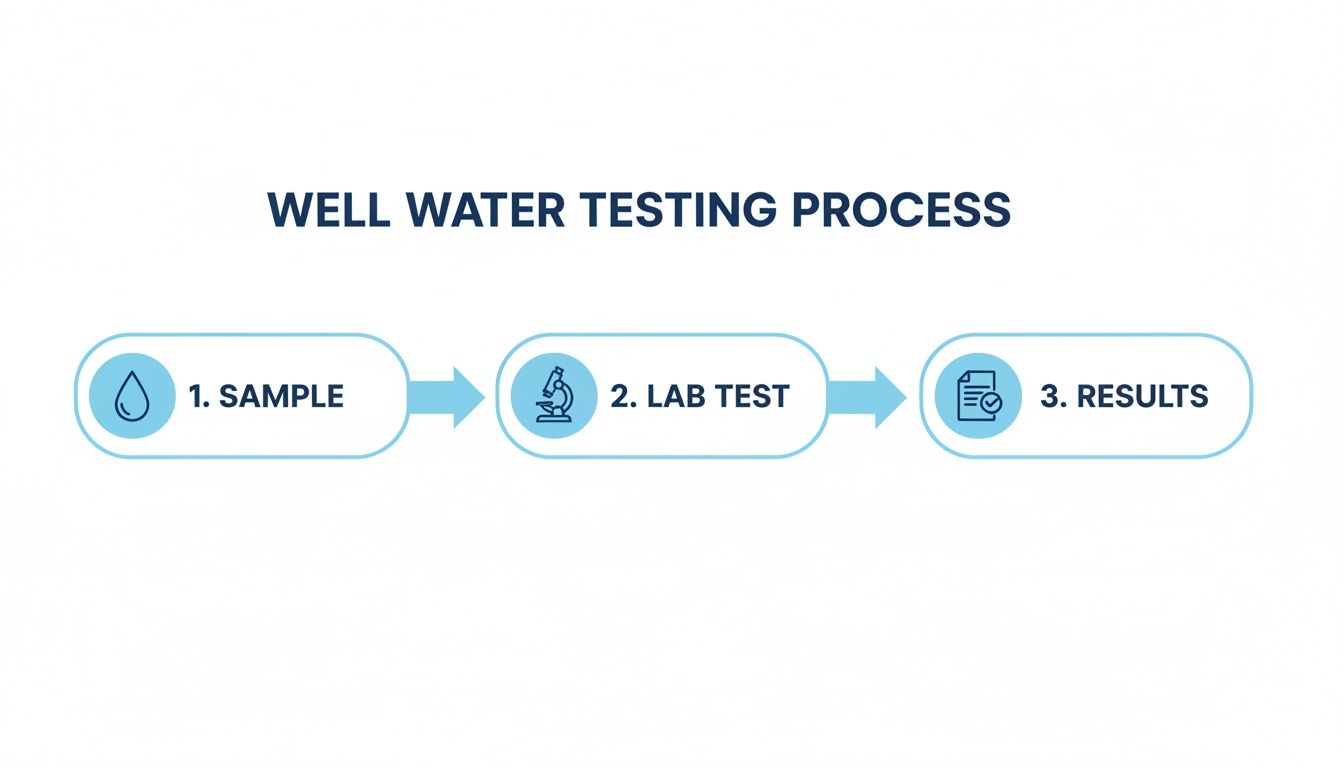
As you can see, getting that certified analysis is the critical step that tells you exactly what you're up against.
The Two Faces of Arsenic: Arsenic III vs. Arsenic V
Your lab report is the key that unlocks the right solution, and one detail is more important than any other: the form of arsenic you have. Arsenic shows up in two main "flavors" in well water, and they require totally different filtration game plans.
- Arsenic-V (Arsenate): This is the "oxidized" form. Think of it as having a magnetic charge, which makes it easy for filtration systems like reverse osmosis and adsorptive media to grab onto and yank out of your water.
- Arsenic-III (Arsenite): This form has no charge, making it super slippery and much harder for most filters to catch. It's the more toxic of the two and a true escape artist.
If your test shows a lot of Arsenic-III, a standard filter won't do the trick. The arsenic will just slide right through. You'll need an extra pre-treatment step—like an oxidation system—to convert the tricky Arsenic-III into the more manageable Arsenic-V before it ever reaches your main filter.
Key Takeaway: Knowing the specific type of arsenic in your well is non-negotiable. An effective filtration strategy depends entirely on targeting the correct form of the contaminant, which is why a comprehensive lab test is the essential first step.
Trying to decipher a water test report can feel like learning a new language. Getting some professional input can make all the difference in matching the right technology to your specific water profile. For more general insights, you can explore expert advice on a variety of water quality topics to make sure you’re not just buying a filter, but a real solution.
Comparing The Best Arsenic Removal Systems
With your lab results in hand, you’re ready to choose your defense against arsenic in your well water. This isn’t about picking the fanciest or most expensive filter; it’s about selecting the right technology for your specific water chemistry and your family’s needs.
Let's break down the heavy hitters in home water filtration to see how they stack up.

The three main technologies you'll encounter are Reverse Osmosis (RO), Adsorptive Media, and Anion Exchange. Each has its own superpowers, so knowing the difference is the key to making a confident choice.
Reverse Osmosis: The Precision Approach
When you want the absolute highest level of purity for drinking water, reverse osmosis is the gold standard. Think of it as a microscopic bouncer at the club door for your water. It uses an ultra-fine membrane to force pure water molecules through while leaving nearly everything else—including arsenic—behind. This method is incredibly effective, especially against the easier-to-remove Arsenic-V.
You’ll most often find RO systems as Point-of-Use (POU) units that fit neatly under the kitchen sink. This makes them a fantastic, budget-friendly way to guarantee your drinking and cooking water is pristine. You get a dedicated faucet that delivers highly purified water right where you need it most.
But this precision comes with a trade-off. RO systems create wastewater (often called brine) that carries away all the concentrated contaminants. For every gallon of pure water you get, several gallons are typically flushed down the drain. This is a key consideration if you're on a sensitive septic system or focused on water conservation.
Expert Insight: While whole-house RO systems exist, they're usually overkill for residential use. Their high water waste and energy demands make them impractical and expensive for most homeowners. An under-sink RO for drinking water is almost always the more practical and cost-effective route.
Adsorptive Media: The Whole-House Workhorse
If you need to treat all the water coming into your home, adsorptive media is often the champion. These systems use a specialized filter material, usually an iron-based media, that acts like a magnet for arsenic. As your water flows through the media tank, arsenic particles literally stick to the surface and are trapped.
The biggest advantage here is its effectiveness for Point-of-Entry (POE), or whole-house, applications. An adsorptive media system protects every single tap in your house, from the shower to the washing machine. It also doesn't produce any wastewater like an RO system, which is a huge bonus.
The main consideration is that the filter media is a consumable. Once it’s saturated with arsenic, it has to be replaced. How often you'll need to do this depends on your water usage and arsenic levels, so be sure to factor that long-term maintenance cost into your budget.
Anion Exchange: The Targeted Specialist
Anion exchange works a lot like a traditional water softener. It uses a special resin loaded up with harmless chloride ions. When water passes through, the resin grabs negatively charged contaminants like arsenate (Arsenic-V) and swaps them out for the chloride ions.
This method is fantastic for Arsenic-V but does absolutely nothing for the uncharged Arsenic-III. Its performance can also be thrown off by other things in your water, like sulfates, which will compete with the arsenic for a spot on the resin and wear it out much faster.
Because of this, an anion exchange system is a very specialized tool. It works best when your water is already fairly clean of other competing minerals and Arsenic-V is your primary target. Just like a softener, it needs regular regeneration with a salt solution to keep working effectively.
Arsenic Removal Methods At-A-Glance
To help you see the big picture, here’s a quick-and-dirty comparison. This table breaks down the key differences so you can weigh the pros and cons for your home.
| Filtration Method | Effectiveness (As-V) | Effectiveness (As-III) | Best For | Avg. Initial Cost | Maintenance Needs |
|---|---|---|---|---|---|
| Reverse Osmosis | Up to 99% | Poor | POU (Drinking Water) | $200 – $600 | Annual filter changes |
| Adsorptive Media | Up to 99% | Poor | POE (Whole House) | $800 – $2,500 | Media replacement (2-5 years) |
| Anion Exchange | Up to 95% | None | POE (Specific Water) | $900 – $2,000 | Salt for regeneration |
Choosing the right system comes down to matching the technology to your specific problem. Each of these methods has proven its worth in real-world applications.
The science backs this up. Independent research shows that these technologies can remove 80% to over 99% of arsenic from well water. Specifically, RO systems are known to achieve greater than 95% removal, though their brine waste is an important factor to weigh. You can dig deeper into the data by reading this in-depth study on arsenic removal from household water treatments.
Ultimately, the best system is the one that fits your lab results, your water usage, and your budget for both the upfront cost and the long-term upkeep.
The Hidden Water Issues That Derail Arsenic Filters
I've seen it happen more times than I can count: a homeowner invests in a top-notch arsenic filter, hooks it up, and… the arsenic levels barely budge. Why? Because simply installing an arsenic filter often isn't enough. You have to look at the rest of your water chemistry.
Think of your arsenic filter as a specialist surgeon. It’s brilliant at its one job, but it can’t perform surgery in a chaotic emergency room. It needs a clean, prepped environment to work effectively.
The real performance of your system hinges on what else is floating around in your well water. Let’s pull back the curtain on the hidden problems that can sabotage your filtration efforts.
The Arsenic-III Conundrum
We've touched on the two forms of arsenic, but this is where it gets critical. If your lab results show you have Arsenic-III (arsenite), most standard arsenic filters will completely fail you.
Because Arsenic-III has no electrical charge, it zips right past the most common treatment methods like adsorptive media and anion exchange resins. They simply can't grab onto it.
To catch this slippery form of arsenic, you first have to change it into the much more cooperative Arsenic-V (arsenate). The process for this is called oxidation. An oxidation system is a pre-treatment step that uses something like chlorine or an air injection system to alter Arsenic-III's chemical structure. This "primes" the water so that by the time it gets to your main filter, the arsenic is in a form that can actually be removed.
A Real-World Example: A client called me, totally frustrated that his brand-new adsorptive media system wasn't working. I took one look at his water report and saw the problem: over 70% of his arsenic was Arsenic-III. We installed a simple chlorine injection system right before his main filter, and his next test came back with non-detectable arsenic levels. Problem solved.
When Iron and Manganese Crash the Party
Iron and manganese are the classic well water villains—they're the culprits behind those ugly reddish-brown or black stains on sinks, toilets, and laundry. But they're not just a nuisance; they are absolute saboteurs when it comes to arsenic removal.
Here’s how they ruin the show:
- They Clog Everything Up: Both iron and manganese will happily coat the specialized media inside your arsenic filter. This is a process called fouling, and it creates a physical barrier that literally stops the media from touching and adsorbing the arsenic.
- They Steal All the Good Seats: Think of your filter media as a concert venue with a limited number of seats for contaminants. Iron and manganese are aggressive—they’ll rush in and take up all the valuable spots, leaving no room for the arsenic.
If your water test shows iron levels above 0.3 parts per million (ppm) or manganese over 0.05 ppm, you absolutely must install a dedicated iron and manganese pre-filter. Think of it as a bodyguard for your arsenic system. It removes the troublemakers so your specialist filter can do its job without interference.
The Problem with Hard Water
Hard water, which is just water with high levels of calcium and magnesium, creates a different kind of disaster, especially for reverse osmosis (RO) systems.
When hard water is forced through a delicate RO membrane, the calcium and magnesium minerals crystallize and form a crusty layer called scale. This scale buildup clogs the microscopic pores of the membrane, crippling its efficiency and eventually destroying it.
If your water hardness is over 7 grains per gallon (GPG), a water softener is a non-negotiable pre-treatment investment. By removing the hardness minerals before they can reach your more sensitive arsenic filter, a softener dramatically extends the life of your equipment and guarantees it performs as intended.
At the end of the day, learning how to remove arsenic from well water is about seeing the whole picture. Your water is a complex ecosystem. A comprehensive water test isn't just about finding the arsenic—it's your roadmap to clearing all the other roadblocks that stand in the way of a truly effective, long-lasting solution.
Deciding Between Whole-House and Point-of-Use Filters
Alright, you've got your lab results and you know what you’re up against. Now for the big strategic question: do you treat just the water you drink and cook with, or do you treat every drop coming into your house? This is the classic Point-of-Use (POU) vs. Point-of-Entry (POE) debate.
There’s no single right answer here. The best choice for your home boils down to your specific water test results, your budget, and your daily habits.
Let's walk through how to make a smart decision you can feel good about.
The Case for Point-of-Use Precision
A Point-of-Use (POU) system is like a sniper rifle—it’s a targeted strike right where you need it most. These systems are installed at a single faucet, usually the kitchen sink, to give you ultra-clean water for drinking and cooking. The go-to POU system for arsenic is typically an under-sink reverse osmosis (RO) unit.
This focused approach is brilliant for a few reasons:
- Cost-Effective: It's way cheaper to install and maintain a small system for one tap than to treat your entire home. You get top-tier protection for the water you're actually ingesting without wasting money purifying toilet water.
- High-Purity Water: Systems like RO are the gold standard for purification, removing an incredibly high percentage of all sorts of contaminants, including arsenic.
- Simple Installation: Most homeowners with basic DIY skills can get an under-sink unit up and running in an afternoon.
If your arsenic levels are just a little over the 10 µg/L limit and your main concern is safe drinking water, a POU system is a smart, budget-friendly move. It tackles the primary risk—ingestion—head-on.
When a Whole-House System Is the Only Answer
A Point-of-Entry (POE) system, also known as a whole-house system, is like a fortress gate. It's installed right where the main water line enters your house, so every single drop gets treated. While it's a bigger investment, a POE system is sometimes the only practical solution.
You should seriously consider a whole-house system if:
- Your Arsenic Levels are Very High: If your lab report came back with a number that made your jaw drop (say, over 50 µg/L), treating everything provides total peace of mind. While skin absorption of arsenic from water is not a primary health concern, at very high levels, eliminating all contact is the safest route.
- You're Fighting Multiple Water Problems: This is a big one. A POE setup lets you build a complete treatment "train." You can line up a water softener, an iron filter, and then an adsorptive media tank for arsenic. It’s a comprehensive fix for complex well water.
- You Value Total Convenience: With a whole-house system, you just don't have to think about it. Every faucet delivers clean, safe water. It simplifies life, especially for a busy family.
A Practical Way to Think About It
If your arsenic level is a minor issue, a POU filter is like hiring a security guard for just the front door. But if arsenic is a major threat, a POE system is like installing a full security system around your entire property.
This isn't just a problem for a few isolated wells; it's a massive global issue. The World Health Organization estimates that 140 million people across 70 countries are drinking water with unsafe arsenic levels. Many rely on private wells that go untested, making home filtration the critical last line of defense. You can learn more about the scale of the problem in this report on global arsenic contamination.
Ultimately, let your lab report be your guide. For low-to-moderate arsenic, a POU system is an effective way to protect your family's health and your wallet. But for higher concentrations or a cocktail of water quality issues, investing in a whole-house system provides the bulletproof protection your home deserves.
Keeping Your Filter in Fighting Shape: Maintenance & Testing
You’ve installed a high-quality arsenic removal system. That’s a massive step toward safer water, but the job isn’t finished. Think of your filter like a car—it needs regular tune-ups to keep running at peak performance. Consistent maintenance isn't just a good idea; it's the only way to guarantee your system continues to protect your family.
Skipping upkeep is a dangerous gamble. Over time, filter media gets saturated, membranes clog, and parts wear out. It's a huge mistake to just assume the system is working because water is still flowing from the tap, especially when you're dealing with an invisible threat like arsenic.
The Hidden Danger of "Media Breakthrough"
One of the biggest risks with adsorptive media and anion exchange systems is something called media breakthrough. This happens when the filter media becomes so loaded with arsenic that it simply can’t grab any more.
Once that media hits its limit, any new arsenic flowing in passes right through the tank, completely untreated, and straight into your pipes. You won't notice a thing—no change in taste, color, or smell. The only way to know for sure that you're still protected is to stick to a proactive maintenance and testing schedule.
The Hard Truth: A filter that has hit media breakthrough is no better than having no filter at all. This is why following a maintenance plan and re-testing your water are non-negotiable for long-term safety.
Your Maintenance and Testing Game Plan
Your system's user manual is your new best friend; it will lay out the specific timelines recommended by the manufacturer. But to give you a clearer picture of what to expect, here’s a general rundown for the most common systems.
-
Reverse Osmosis (POU) Systems:
- Sediment & Carbon Pre-filters: Plan on changing these every 6 to 12 months. Their job is to protect the delicate RO membrane from gunk like sediment and chlorine.
- RO Membrane: This is the heart of the system. It typically needs replacing every 2 to 3 years, depending on your water quality.
- Carbon Post-filter: This "polishing" filter keeps your water tasting fresh and should be swapped out once a year.
-
Adsorptive Media (POE) Systems:
- Media Replacement: The specialized arsenic-grabbing media is the main consumable. Expect to replace it every 3 to 5 years, depending on your water usage and arsenic levels.
- Backwashing: Most of these systems have an automatic backwash cycle that cleans the media. You just need to check that the control valve is programmed correctly and doing its job.
When handling old filter media, remember it's concentrated with arsenic. Proper disposal is crucial, so it's wise to understand the basics of effective hazmat waste management strategies.
A clear schedule is the best way to stay on top of these tasks.
Sample Maintenance Schedule for Arsenic Filters
| System Type | Task | Frequency | Estimated Annual Cost |
|---|---|---|---|
| Reverse Osmosis (POU) | Replace Sediment/Carbon Pre-filters | Every 6-12 months | $30 – $75 |
| Replace RO Membrane | Every 2-3 years | $25 – $50 (prorated) | |
| Replace Carbon Post-filter | Annually | $15 – $30 | |
| Adsorptive Media (POE) | Replace Media Bed | Every 3-5 years | $150 – $400 (prorated) |
| Inspect Control Valve & Seals | Annually | $0 (DIY) – $150 (Pro) | |
| Anion Exchange (POE) | Replenish Salt/Brine Tank | Monthly | $50 – $100 |
| Replace Resin | Every 5-10 years | $100 – $250 (prorated) |
This table gives you a ballpark idea, but always follow the manufacturer's guide for your specific model to ensure you're keeping things in top shape.
The Only Way to Be Sure: Re-Test
So, how do you really know if your filter is still working? You have to test your water again. It's as simple as that. Even with a perfect maintenance routine, your well's water chemistry can shift over time, and that could impact your filter’s performance.
I always recommend this simple plan: test your treated water at least once a year. This "post-filter" test is the ultimate report card for your system. It’s the only way to confirm that your arsenic levels are staying safely below the 10 µg/L standard and gives you concrete proof that your investment is still paying off with safe, clean water for your family.
Common Questions About Arsenic in Well Water
Even with a solid plan, it’s natural for questions to pop up. When you’re dealing with something as critical as your family’s water safety, you need clear, straightforward answers.
Let's tackle some of the most common things homeowners ask about getting arsenic out of their well water.
Is It Safe to Shower in Water with Arsenic?
This is a great question and one we get all the time. For the most part, arsenic isn't absorbed well through the skin, so the actual risk from bathing or showering is considered extremely low.
The real danger comes from drinking the water or using it for cooking, which is how arsenic gets into your body. That said, if your levels are exceptionally high or you just want complete peace of mind, a whole-house (Point-of-Entry) system is the way to go. It treats every single drop of water coming into your home.
Can I Just Boil the Water to Remove Arsenic?
Absolutely not. This is a common and very dangerous misconception. Boiling water will not get rid of arsenic.
In fact, it does the exact opposite. As some of the water turns to steam and evaporates, the arsenic gets left behind in the remaining water. This actually increases the concentration of arsenic, making it even more hazardous. The only safe way to deal with arsenic is with a proper filtration system.
How Do I Know if My Arsenic Filter Is Still Working?
You can’t see, taste, or smell arsenic, so the only way to know for sure if your filter is doing its job is to test the water periodically.
We always tell people to test their treated water at least once a year. This is the only way to confirm your system is keeping arsenic below the 10 parts per billion (ppb) EPA limit. Don't just rely on the manufacturer's replacement schedule; your specific water chemistry and how much water you use can wear out a filter faster than you'd think.
What Happens to the Arsenic My Filter Removes?
Where the captured arsenic ends up completely depends on the type of system you have. It's a key difference to understand for maintenance down the road.
- Reverse Osmosis systems work by flushing the arsenic and other contaminants out with wastewater. This concentrated "brine" just goes down your drain.
- Adsorptive Media and Anion Exchange systems are different—they trap and hold onto the arsenic inside the filter. Once the media is full, you have to replace the cartridge or the entire tank of media. You'll need to dispose of the old filter according to local rules, so always check with your manufacturer or local waste authority for guidance.
At Water Filter Advisor, we're committed to giving you the clear, unbiased information you need to protect your home's water. Explore our expert guides and reviews to find the perfect solution for your family at https://www.waterfilteradvisor.com.
