pH Machine Water Guide: Test & Filter for Purity 2026
Have you ever bought a pH machine for water expecting it to make your tap water “better,” only to realize you're not even sure whether you needed ...
Have you ever bought a pH machine for water expecting it to make your tap water “better,” only to realize you're not even sure whether you needed ...
A Kangen pitch usually arrives wrapped in certainty. A friend swears the water changed their life. A relative says the machine does far more than filter. A distributor starts talking about detox, antioxidants, pH, and “living water” as if your kitchen sink has been hiding a wellness clinic all along.
That’s exactly why a careful kangen water review has to start with a harder question. Does it make household water safer to drink? For most homeowners, that matters more than mystical language about alkalinity. If your water may contain chlorine, lead, PFAS, sediment, or other contaminants, the first job of any expensive water device is simple: remove what shouldn’t be there.
Kangen machines are real appliances, not magic boxes. They use electrolysis, they produce different pH waters, and they include a built-in filter. But those facts alone don’t answer whether they’re a smart buy for the average home. To judge that, you have to separate three things that are often blended together in sales presentations: water treatment, health claims, and business model.
This review does that from a filtration-first perspective. Not from the viewpoint of a distributor, and not from the viewpoint of wellness marketing. From the viewpoint of a homeowner standing in the kitchen asking, “What am I paying for, what does it remove, and what would protect my family better?”
Kangen succeeds because it sells more than water. It sells a story. The story says ordinary tap water is the problem, and ionized alkaline water is the answer. That’s emotionally powerful because there is existing public distrust of municipal water, bottled water, or both.
The pitch also sounds technical enough to feel credible. You hear about alkaline pH, negative ORP, electrode plates, and specialized settings for drinking, cleaning, and beauty use. That language creates the impression that you’re buying a laboratory-grade water system rather than a premium countertop appliance with a very specific feature set.
A Kangen presentation often combines a few ideas that are easy to believe together:
For a consumer advocate, that leap is the key issue. A machine can alter water chemistry without providing broad contaminant reduction. Those are not the same job.
Practical rule: If a water device makes dramatic wellness claims, check its contaminant reduction before you check its pH range.
That rule changes how you evaluate Kangen. Instead of asking whether the water feels smoother or tastes different, ask whether the machine is designed like a real filtration system. A strong filter is like a good front door lock. It keeps bad things out. Ionization is more like repainting the hallway after someone’s already inside.
For home water use, the central test isn’t whether the machine produces water at a different pH. It’s whether the built-in treatment can handle contaminants that matter in actual households, especially in homes with older plumbing or known water quality concerns.
That framing strips away a lot of the mystique. Kangen may still appeal to people who want a multi-function ionizer. But if you’re shopping for cleaner, safer home water, the burden is on the machine to prove it can filter like a real filtration system, not just market like one.
Kangen water is tap water that has been filtered and then electrically altered inside an ionizer machine. The machine doesn’t create water from scratch. It takes the water already coming into your kitchen and changes some of its properties.
A useful way to picture it is a sorting belt in a factory. Water enters the machine, passes through a basic filter, then moves across charged metal plates. During that process, the machine separates the output into different streams, pushing one side toward more alkaline water and the other toward more acidic water.
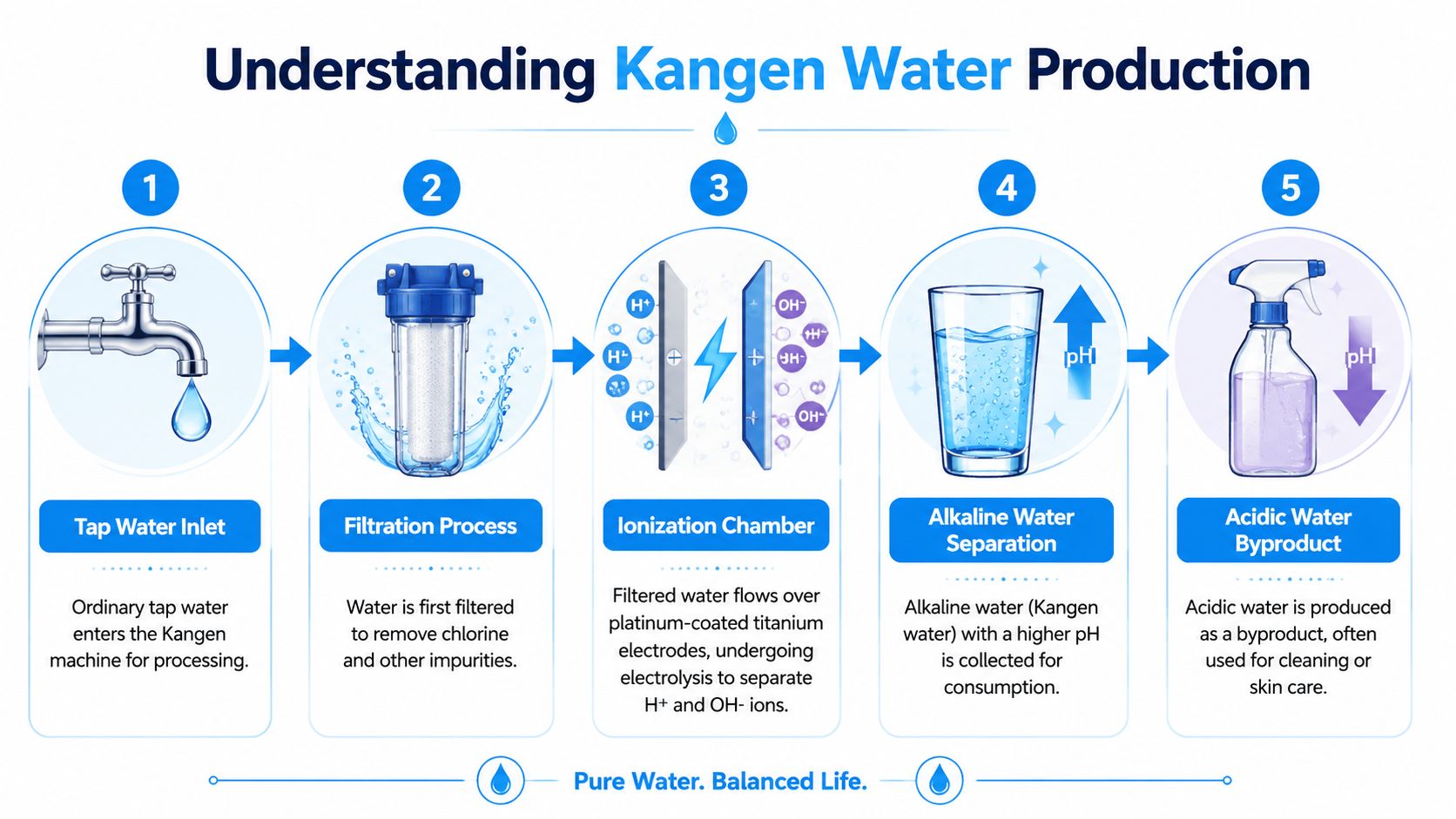
According to the Kangen model specifications chart, Kangen machines such as the K8 use electrolysis to produce several pH-adjusted waters, including drinking water at pH 8.5 to 9.5 with flow rates of 1.3 to 2.1 L/min, and Strong Acidic water at about pH 2.7. The same specifications describe a process in which tap water first passes through a basic carbon block filter, then flows over platinum-coated titanium electrode plates that split the output into alkaline and acidic streams, with an example ORP reading of -787 mV at pH 9.5.
That sounds complicated, but the homeowner version is simple. First, the machine does a light filtering step. Second, it changes the electrical environment of the water. Third, it sends different types of water out of different settings.
pH tells you whether water is more acidic or more alkaline. It doesn’t tell you whether the water is free of lead, PFAS, or pharmaceutical residues. That’s an important distinction. You can have alkaline water that still carries contaminants.
ORP, or oxidation-reduction potential, is often used in Kangen marketing to suggest antioxidant potential. But for practical home water treatment, ORP is not a substitute for verified filtration performance.
If you want a plain-English explanation of the alkaline side of this category, Water Filter Advisor’s guide to alkaline water is a better starting point than distributor language.
Kangen is best understood as an ionizer with a basic pre-filter, not as a full-featured purification system. That distinction matters because many buyers assume the opposite. They see the machine’s complexity and price, then assume the filtration must be equally advanced.
It isn’t enough to know how water is transformed inside the machine. You also need to know what survives that trip.
The strongest sales pitch in the Kangen world is also the weakest part of the evidence. The language suggests a single upgrade to your water. Better hydration, antioxidant protection, detox support, and broad wellness benefits. Science treats those as separate claims that need separate proof.

For a consumer advocate, the first question is simple. Which part of the machine is supposed to produce the health effect. The answer matters because Kangen combines two very different ideas under one premium product. One is ionization. The other is limited filtration. If the claimed benefit comes from dissolved hydrogen, pH marketing is beside the point. If the goal is safer water, hydrogen claims are beside the point.
The more credible research in this category focuses on molecular hydrogen, not alkaline pH by itself. That is a narrower claim than Kangen marketing often implies. It means the relevant performance question is whether the machine produces enough dissolved hydrogen to match the mechanism studied in research.
That framing changes the whole review.
A machine can produce alkaline water and still fall short on the metric that matters most for the health story attached to it. It can also leave buyers with a false sense that “premium water” means cleaner water, even though those are different outcomes measured in different ways.
The verified data for this review states that Kangen water ionizers are sold at premium prices through an MLM structure, while hydrogen output often falls within a range that does not consistently support the stronger therapeutic claims used in sales conversations. That gap matters because the machine is priced like a high-performance health appliance, yet the scientific case depends on a narrow and measurable variable.
In plain terms, Kangen marketing often puts the spotlight on pH and ORP because they are easy to display on a screen. Hydrogen delivery is harder to verify and far more relevant to the research.
That is a recurring pattern in water treatment marketing. Companies emphasize the metric that looks impressive in a demo, even if it is not the metric that best predicts real consumer benefit.
A clearer way to assess Kangen is to separate the common claims by mechanism and by proof standard.
“Alkaline water is healthier water.”
Alkaline pH alone does not establish a health benefit. It also says nothing about whether the water has been treated for lead, PFAS, or other contaminants.
“Negative ORP means strong antioxidant power.”
ORP is a marketing-friendly number. It is not a substitute for direct measurement of dissolved hydrogen, and it has no role in proving contaminant removal.
“People feel better, so the machine works.”
Testimonials cannot isolate cause and effect. A person may drink more water, reduce soda intake, or prefer the taste of filtered water. Those changes can influence how they feel without proving the ionizer delivered a distinct medical benefit.
That distinction is easy to miss because the claims are bundled together. The machine is sold as if one purchase solves hydration, wellness, and water quality in one step. The evidence supports a much narrower conclusion.
Kangen’s health narrative rests on a real scientific concept, but the concept is often stretched past what the evidence can support. The better question is not whether altered water can sound impressive. It is whether this specific machine delivers a meaningful amount of the studied ingredient, and whether it protects your household from harmful contaminants at the same time.
Those are two separate tests.
For buyers who came here looking for safer water, that separation is the key insight. Even if the ionization side has some limited scientific interest, the central mission of a home water system remains contaminant reduction. A machine that majors in pH messaging and minors in filtration deserves much more scrutiny than its marketing suggests.
For a home water buyer, this is the decisive section. Kangen’s biggest weakness isn’t that it ionizes water. It’s that people often mistake ionization for purification.
The verified data for this review says Kangen’s built-in filter is a single filter that removes chlorine and sediment but fails on PFAS, fluoride, lead, and pharmaceuticals, unlike certified multi-stage systems, as described in the analysis of Kangen’s filtration limitations. That same verified data also notes the current EPA focus on PFAS limits of 4 ppt for six compounds.
A standard carbon block filter can be useful. It can improve taste. It can reduce chlorine. It can help with some odor issues. For a household whose only complaint is “our tap water tastes like a swimming pool,” that kind of filtration may feel like a real improvement.
But taste improvement is not the same as broad safety treatment.
Homes don’t buy water systems just to polish flavor. They buy them because they worry about what they can’t see. That includes contaminants tied to plumbing, industrial runoff, treatment byproducts, or local source water issues.
A single carbon filter is like a doormat. It catches dirt at the front entrance. It does not search pockets, inspect bags, or screen every guest. Certified multi-stage systems are built for those harder jobs.
| Contaminant | Kangen Filter (Standard Carbon) | Reverse Osmosis (NSF/ANSI 58) | Activated Carbon Block (NSF/ANSI 42/53) |
|---|---|---|---|
| Chlorine | Yes, based on verified description of chlorine reduction | Can be designed for broad reduction depending on system certification | Often a core strength when certified for it |
| Sediment | Yes, based on verified description of sediment reduction | Typically part of staged treatment | Often handled at basic levels depending on design |
| Lead | No, based on verified data | Often targeted by certified systems | Can be targeted when specifically certified |
| PFAS | No, based on verified data | Often a priority category in certified systems | Some systems target it, but certification matters |
| Fluoride | No, based on verified data | Common reason homeowners choose RO | Not typically the main strength of standard carbon alone |
| Pharmaceuticals | No, based on verified data | Often better addressed in advanced systems | Varies widely by system and certification |
A water treatment claim means much more when it’s tied to a recognized standard than when it’s tied to branding language. “Ionized,” “micro-clustered,” and “antioxidant” may sound advanced, but they don’t tell you whether the system is built to reduce lead from old plumbing or PFAS from a contaminated source.
Bottom line: If your home needs real contaminant reduction, Kangen should not be treated as a stand-alone filtration solution.
For households with municipal water concerns, older pipes, or known contamination issues, certified under-sink systems and reverse osmosis setups answer the right question. Kangen answers a different one. It changes water characteristics after modest filtration. That may interest some buyers, but it doesn’t replace a serious home filter.
Kangen’s sales model deserves scrutiny for the same reason its filtration claims do. Incentives shape what buyers hear first.
Enagic sells Kangen machines through multi-level marketing rather than ordinary retail channels. That changes the conversation around the product. In a store, buyers can compare specs, certifications, and price tags side by side. In an MLM setting, the pitch often comes through friends, family members, or wellness influencers who are compensated for the sale and, in many cases, for recruiting additional sellers.
That structure does not prove the product is ineffective. It does explain why the message often centers on testimony, identity, and aspiration instead of the plain question a water-treatment buyer should ask first: what problem does this machine solve better than a certified filter?
A Kangen machine is priced like premium water treatment equipment, yet the filtration side of the product is relatively modest compared with systems built to target lead, PFAS, or other regulated contaminants. Once you separate ionization from filtration, the price starts to look less like a payment for water safety and more like a mix of hardware, branding, and commissions.
That distinction matters. A buyer comparing home treatment options may assume a higher price signals better contaminant removal. In this category, that assumption can fail. Expensive does not always mean more protective. Sometimes it means the product carries a sales network on its back.
The same dynamic shows up in other high-commission categories. The loudest feature is not always the feature that matters most.
MLM distributors usually sell through personal trust before technical verification. That can make skepticism socially awkward. If the seller is a friend, challenging the claims can feel like rejecting the person.
For a water ionizer, that social pressure has practical consequences. Buyers may hear long explanations about alkalinity, pH, or daily wellness routines before anyone discusses filter certifications, cartridge life, or whether the machine reduces contaminants of concern in their local water. Those are not small omissions. They are the core of a responsible water-treatment purchase.
A consumer advocate would frame it more bluntly. If a product is marketed as a better water solution, the evidence should start with what it removes, not with how inspiring the sales story sounds.
The central issue is not whether every distributor is acting in bad faith. The issue is whether the sales model helps buyers evaluate water treatment the way they should. On that standard, MLM creates friction. It encourages persuasion before comparison.
For households worried about actual contaminants, that is a poor order of operations. The safest buying process starts with local water problems, then certification data, then operating cost. Kangen sales often reverse that sequence.
Kangen’s sticker price gets attention, but ownership costs don’t stop at checkout. Countertop water machines operate in a world of scale buildup, filter changes, source-water quirks, and maintenance habits. That’s where the glamorous part of the sales pitch starts to wear off.
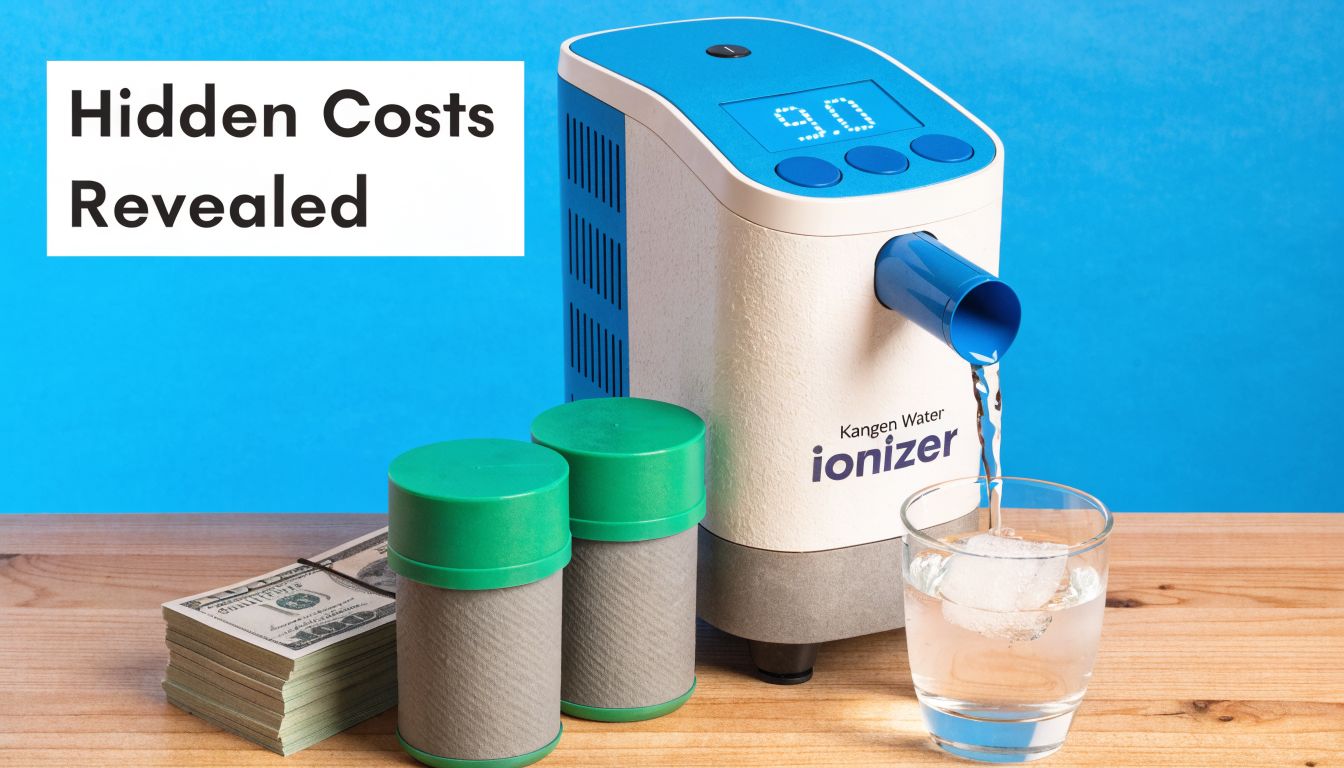
Verified data for this review states that the upfront cost is about $4,980, and that Kangen’s performance relies on 8 platinum-coated titanium plates whose efficiency in producing therapeutic H₂ is weaker than competitors and requires frequent maintenance to prevent mineral scaling, adding to lifetime costs, according to the Alkaline Water Plus review of Kangen pros and cons.
That’s the hidden burden many buyers miss. An ionizer is more like a coffee machine than a passive pitcher. It has parts that need attention. And because Kangen starts with only basic filtration, some households may still need separate treatment if their source water has harder contaminant problems.
The first cost is obvious: a premium purchase price for a machine that is not a full contaminant-removal system.
The second cost is subtler: ongoing upkeep for a machine whose value proposition depends on consistent electrolysis performance. Scale on plates doesn’t help you. Hard water doesn’t help you. A basic built-in filter doesn’t help enough if the incoming water is already challenging.
For readers comparing long-term upkeep across home water options, Water Filter Advisor’s guide to water filter replacement cost is useful because it frames recurring expense the way homeowners experience it.
When people compare Kangen only to bottled water or to untreated tap, the machine can look more attractive than it is. The better comparison is against systems built for contaminant removal first.
A quick visual may help if you want to see how these machines are typically discussed in consumer-facing reviews.
Buy the machine you’ll maintain correctly. A neglected premium ionizer can deliver less practical value than a simpler filter that directly targets your water problems.
The strongest financial argument against Kangen isn’t just that it costs a lot. It’s that its core expense doesn’t line up with the core risk most families are trying to solve.
The best alternative to Kangen depends on what problem you need to solve. That sounds obvious, but it’s where many buyers get pulled off course. Kangen sells a broad identity. Home water treatment works better when you buy a narrow solution for a specific need.
Start with certified filtration, not ionization. Homes worried about lead, PFAS, or a wider contaminant profile should look first at reverse osmosis systems or certified multi-stage under-sink units. These systems are designed around reduction performance, which is the right priority when household safety is on the line.
If your plumbing is older, or your local water report raises concerns, this category deserves your money before any pH device does.
A good carbon block system can be the right answer. It’s simpler, easier to justify, and often much closer to what many Kangen-curious buyers want. If your complaint is chlorinated taste, mild odor, or general tap unpleasantness, there’s no reason to leap straight to a premium ionizer.
That’s like buying a luxury off-road vehicle because your driveway has a pothole.
Then evaluate hydrogen delivery directly. Don’t assume alkaline branding equals strong hydrogen performance. If molecular hydrogen is the mechanism that interests you, assess products through that lens and keep filtration separate if needed.
Many shoppers overbuy. They purchase a machine marketed as a total health system when what they really wanted was either better filtration or access to hydrogen water.
Use this framework before spending serious money on any home water device:
Kangen can still appeal to buyers who enjoy the idea of multiple water settings and countertop ionization. But from a home filtration perspective, it’s hard to recommend as the first or smartest investment. The evidence points in a simpler direction: buy contaminant reduction first, then add specialty features only if they still matter after your water is clean.
If you’re comparing filters, RO systems, replacement cartridges, or whole-house options, Water Filter Advisor can help you sort marketing claims from verified filtration performance so you can choose a system that fits your water, your budget, and your home.
You install a reverse osmosis system because you want cleaner water. The first glass pours out crystal clear. You take a sip and think, “Why does this taste so… empty?”
That reaction is common.
A strong RO system can do such a thorough job that it removes not only unwanted contaminants, but also the naturally occurring minerals that make water taste lively and balanced. That’s why so many homeowners start looking into reverse osmosis with minerals. They want the purity of RO, without the flat taste that can come with highly stripped-down water.
The good news is that remineralization isn’t complicated once you understand what it’s doing. It is the finishing step that helps purified water feel more natural again. The more useful question isn’t just whether to add minerals back. It’s which minerals, how much, and what kind of result you want in the glass.
A lot of homeowners assume the cleanest water should also taste the best. In practice, that’s not always true.
Reverse osmosis is excellent at removing dissolved material. In fact, RO systems remove 92-99% of dissolved minerals, including calcium at 97% and magnesium at 96%, and can reduce typical tap water from 300 ppm TDS to 15-30 ppm while lowering pH to 5.8-7.2 according to Frizzlife’s RO mineral guide.
That result is impressive for purification. It can be underwhelming for taste.
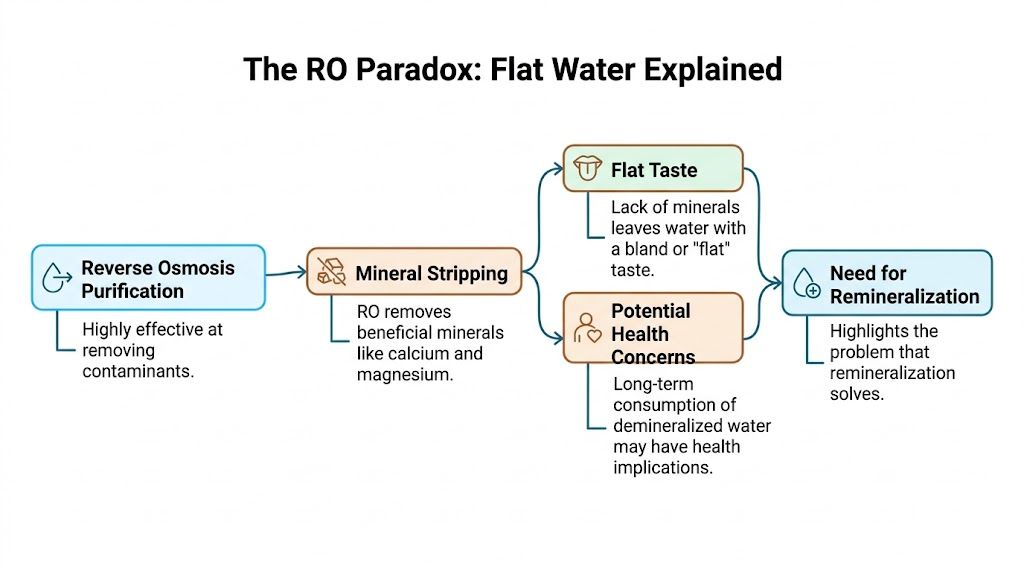
TDS stands for total dissolved solids. That includes many things dissolved in water, both helpful and unhelpful.
A simple way to think about TDS is this:
If you sift flour through a very fine screen, you remove the lumps. If you keep going and strip out everything that gives the dough structure, you don’t end up with better bread. You end up with something incomplete.
RO can create that same effect in water.
People describe demineralized RO water in similar ways. They call it flat, thin, blank, or “dead.” Those aren’t scientific terms, but they’re accurate descriptions of the drinking experience.
Minerals affect more than flavor. They also influence mouthfeel, which is the subtle sensation water leaves on your tongue. Water with some calcium and magnesium often feels crisper or smoother. Water with almost none can seem hollow.
Practical rule: If your new RO system produces very pure water that you don’t enjoy drinking, the problem usually isn’t that the system failed. It may be that it worked exactly as designed.
Many homeowners hear that RO water can become slightly acidic and assume something is wrong. Usually, it’s not a defect.
When water has very few dissolved minerals, it has less buffering capacity. That means its pH can shift more easily. The range noted above, 5.8-7.2, helps explain why plain RO water can taste sharper or less balanced than expected.
That doesn’t mean RO water is dangerous by default. It means highly purified water is missing some of the natural structure that makes drinking water feel stable and satisfying.
Flat-tasting water creates a practical problem. If your family doesn’t like the taste, they won’t use the system as much as they should.
That’s where remineralization comes in. It keeps the purification benefits of RO, then adds back selected minerals to improve taste, support a more balanced pH, and make the water feel more like water people want to drink every day.
A remineralization stage is usually the last stop in the filtration path. Water gets purified first. Then it passes through a cartridge that adds a controlled amount of minerals back.
The easiest analogy is a tea bag.
Plain hot water goes in. As the water moves through the tea, it picks up certain compounds that change flavor and character. A remineralization cartridge works in a similar way. The water flows through mineral media, and the media dissolves small amounts of selected minerals into the finished water.
Inline remineralization cartridges aren’t random “alkaline boosters.” They’re designed to make purified water more balanced.
Inline calcite or magnesium-blend remineralization cartridges typically raise TDS by +20-40 ppm and stabilize pH at 7.2-8.0 according to Frizzlife’s reverse osmosis remineralization guide.
That one sentence explains most of the practical benefit:
Many buying guides become too vague. “Adds minerals back” sounds good, but it hides an important difference. Not all mineral stages produce the same kind of water.
Calcite is commonly used to add calcium.
Calcium can make water taste fuller and slightly creamy or rounded. Homeowners who want a softer, more familiar bottled-water taste often like calcium-rich remineralization.
Calcite also helps raise pH. That can be useful if your plain RO water tastes thin or slightly sour.
The tradeoff is balance. A cartridge that leans too heavily on calcium may improve taste without adding much magnesium.
Magnesium often gives water a brighter, crisper finish.
A magnesium-forward blend can make coffee and tea taste more lively, and many people prefer it if they want the water to feel “fresh” rather than soft. Magnesium also plays a role in raising pH and restoring electrolyte character.
If calcium is the mineral that often rounds the edges, magnesium is the one that gives the water some lift.
A blended cartridge usually gives the most balanced result for general household use.
Many homeowners do best with a cartridge that combines calcium and magnesium, because the two minerals affect taste differently. Calcium adds body. Magnesium adds crispness. Together, they create water that feels less processed and more complete.
Water that tastes good usually isn't the water with the most minerals. It's the water with the best balance.
The term can sound technical, but the basic idea is familiar in other parts of health. If you’ve ever read about what tooth remineralization is, you’ve seen the same principle. A structure loses minerals over time, then gets support from targeted mineral replacement.
Water works differently than teeth, of course. But the logic is similar. You’re restoring something that was intentionally stripped out.
Different households want different outcomes.
That’s the core idea behind reverse osmosis with minerals. You aren’t undoing the RO process. You’re fine-tuning the final glass.
The first benefit people notice is taste. The second is that they start drinking more water without forcing themselves.

That matters more than most homeowners think. A filtration system only helps if people use it. If your kids reach for juice because the RO water tastes lifeless, or if you keep buying bottled water because your filtered water feels dull, the system isn’t delivering its full value.
When remineralization is done well, the change isn’t dramatic in a flashy way. It’s subtle and immediate.
People often notice:
Water isn’t supposed to taste like minerals in a strong, chalky sense. Good remineralized water tastes balanced, not “fortified.”
Mineral choice becomes practical.
The World Health Organization suggests minimum levels of about 20-30 mg/L of calcium and 10 mg/L of magnesium in drinking water for health and taste, as summarized in this remineralization overview from Waterdrop.
Those minerals affect your experience in different ways.
Calcium tends to make water feel smoother and more settled. If you like bottled waters that taste soft and mellow, calcium often drives that preference.
It can also make cooked foods feel more familiar. Water used for boiling grains, simmering soups, or making tea doesn’t seem as stripped.
Magnesium often adds the “spark” that keeps water from tasting sleepy.
In many homes, that translates into better-tasting black coffee and tea. It can also make cold drinking water feel more refreshing, especially if your plain RO water tasted empty.
If your goal is lively taste, don't ignore magnesium. Many homeowners focus only on calcium and miss the mineral that often makes the water feel more refreshing.
A lot of marketing around “alkaline water” gets overblown. In a home RO system, the more useful point is simpler: remineralization often helps move water away from that slightly acidic edge and toward a more balanced profile.
That can help in two ways.
First, the water generally tastes better. Second, balanced water is often gentler on plumbing contact surfaces than highly demineralized water. Homeowners don’t need to obsess over pH numbers every week. They just need to understand that adding minerals back can improve stability as well as flavor.
Here’s a quick visual explanation before the practical takeaway.
Remineralized RO water isn’t a multivitamin. It won’t replace a healthy diet.
But it can help restore minerals that plain RO removes, and that has value for people who drink filtered water all day. It also makes sense for families who want their drinking water to contribute something useful instead of being nutritionally blank.
That’s one reason many wellness conversations now put more emphasis on overall hydration habits instead of just volume. If you’re thinking about the bigger picture, this piece on prioritizing hydration gives helpful lifestyle context.
Most families don’t need extreme alkalinity or a complicated mineral recipe.
They usually want water that:
That’s exactly where a well-chosen remineralization stage shines.
Homeowners usually compare the wrong things. They ask whether RO is better than a pitcher filter, or whether alkaline water is better than filtered water. The more useful question is this: which system gives you the mix of purity, taste, and practicality your home needs?
The biggest dividing line is contaminant removal.
RO membranes remove divalent ions like sulfate and calcium at 95-98% rejection and heavy metals at more than 99%, while standard carbon filters improve taste but do not remove dissolved solids or heavy metals, according to the FDA reverse osmosis technical guide.
That’s why carbon filters and RO systems aren’t direct substitutes. They solve different problems.
A standard carbon filter is mostly a taste and odor tool. It’s useful when chlorine is your main complaint.
Plain reverse osmosis is a purification tool. It’s what you choose when you want stronger protection against dissolved contaminants.
RO with remineralization is a finishing system. It aims to keep the purification strength of RO while improving the final drinking experience.
| Feature | Standard Carbon Filter | Plain Reverse Osmosis | RO with Remineralization |
|---|---|---|---|
| Contaminant removal | Good for chlorine, odor, and basic taste issues | Strong dissolved contaminant reduction | Same core RO purification with a final mineral stage |
| Mineral impact | Usually leaves minerals in place | Removes most dissolved minerals | Removes first, then adds selected minerals back |
| Taste profile | Better than untreated chlorinated water, but depends on source water | Very clean, but can taste flat | Cleaner taste with more body and balance |
| pH effect | Usually little change | Can feel slightly sharp or thin | Often tastes more neutral or smoother |
| Best fit | Homes with minor municipal taste issues | Homes prioritizing maximum purity | Homes wanting purity plus better daily drinkability |
| Maintenance style | Simpler filter changes | More stages to maintain | Similar to RO, plus a remineralization cartridge |
This is the comparison that matters most for serious buyers.
If your main priority is getting dissolved contaminants out of the water, both systems rely on the same core RO process. The difference appears after purification.
Plain RO gives you highly stripped water. Some people like that. Many don’t.
RO with minerals gives you a more finished result. It doesn’t make the water “less filtered” in the everyday sense. It polishes the taste profile after the hard work is done.
Homeowners often frame this as purity versus taste. A good remineralization stage lets you have both.
Alkaline filters are popular because the concept is easy to market. But not every alkaline system is doing meaningful purification.
Some alkaline pitchers and cartridges mainly raise pH or add small amounts of minerals without offering the deep contaminant reduction that an RO membrane provides. If your concern is chlorine taste alone, that may be enough. If your concern includes lead, arsenic, nitrates, or high dissolved solids, it usually isn’t the same class of solution.
That’s why “alkaline” shouldn’t be the first word you shop by. Purification method should come first. Mineral finishing comes second.
The table makes the trade-offs look neat. Real homes aren’t always neat. Some people only need a carbon filter. Some need full RO. But when a homeowner wants cleaner water without the lifeless taste, remineralizing RO is usually the most complete answer.
Shopping for an RO system gets confusing fast because product pages love buzzwords. “Alkaline.” “Mineral boost.” “Natural infusion.” Those phrases don’t tell you much.
What matters is the hardware, the cartridge design, and whether the system fits your water and household habits.
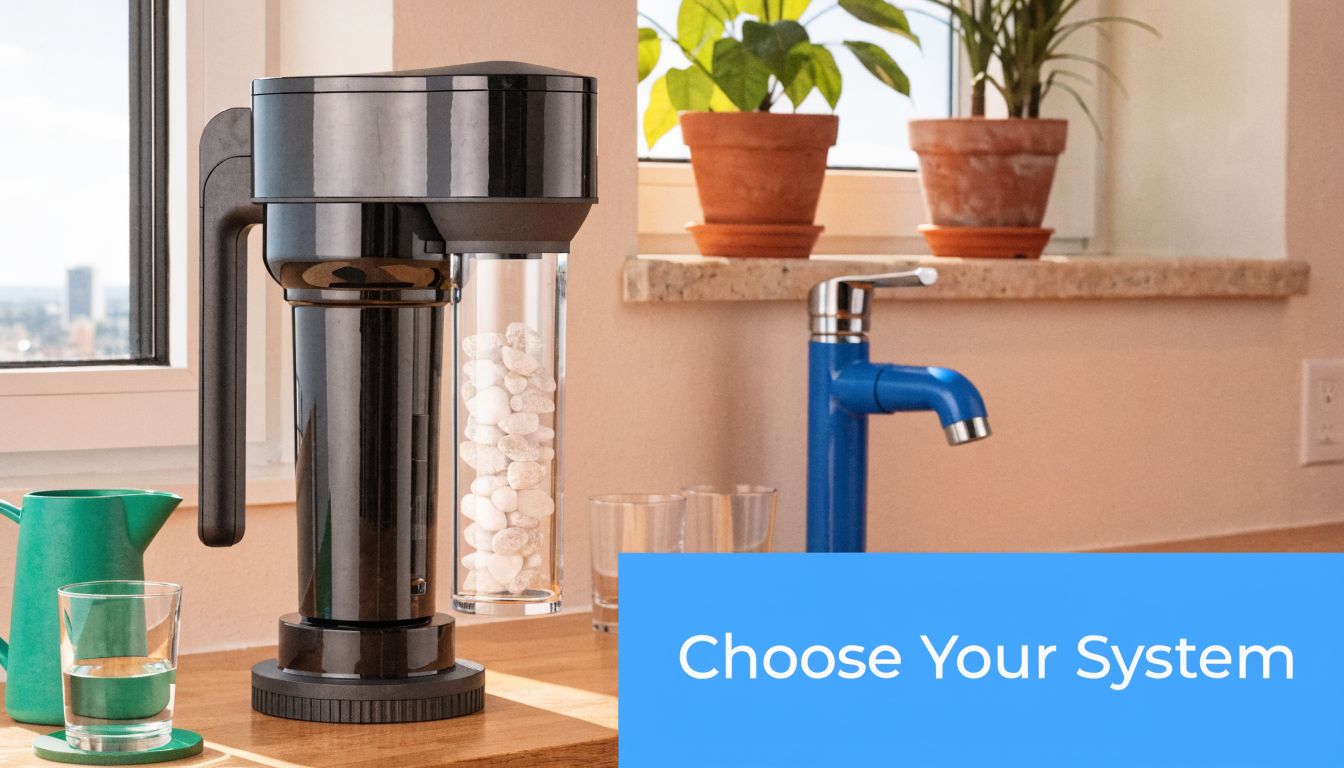
This is one of the biggest current choices.
Emerging tankless RO systems, noted as popular in 2026, often include integrated remineralization, offer flow rates up to 1000 GPD, and use 2:1 drain-to-pure water ratios that reduce water waste by over 50% compared with older tank systems, according to Culligan’s remineralization guide.
That sounds great, but capacity alone shouldn’t decide the purchase.
Traditional RO systems can still make sense when a homeowner wants a straightforward design and doesn’t mind the storage tank footprint. Some people also prefer a setup with simpler, more modular parts.
The right choice depends on your cabinet space, your tolerance for maintenance style, and whether you value compact design over familiarity.
A lot of buyers inspect the RO membrane and ignore the remineralization cartridge. That’s a mistake.
Look for clear answers to these questions:
Here, smart buying beats flashy buying.
You probably installed RO to get away from that heavy mineral taste and scale-forming feel. In that case, go with a gentler remineralization approach. You want balance, not a return to “thick” tasting water.
A stronger calcium-magnesium blend may help more. You’re not trying to erase harshness. You’re trying to build character into the glass.
Don’t choose a cartridge blindly. Look for a blend that doesn’t rely only on calcium. Many people who care about brewed drinks prefer some magnesium contribution.
Use this list when comparing systems side by side.
Buy the system that fits your water and your habits, not the one with the most dramatic label on the box.
This is the part many buyers underestimate. They compare purchase prices and forget that filters are a living cost, not a one-time event.
A remineralizing RO system has the same basic ownership rhythm as a standard RO unit, plus one extra consumable. That extra stage usually isn’t difficult to live with, but it does need to be on your radar.
For most homes, a drinking-water RO system installs under the kitchen sink. The job often includes a feed connection, drain connection, dedicated faucet, and enough tubing space for the filtration stages.
If you’re comfortable with basic plumbing, some systems are manageable as a DIY project. If your sink area is cramped, your plumbing is older, or the system has a more involved layout, hiring a plumber can save frustration.
The key point is less about skill and more about fit. A roomy cabinet with standard plumbing is forgiving. A packed vanity-style sink base with awkward shutoffs is not.
A homeowner gets the best results by treating maintenance as a calendar habit, not a “wait until it tastes weird” habit.
Sediment and carbon pre-filters protect the membrane from the rough stuff coming in from the source water. When these clog up, the whole system can feel slower and less effective.
The membrane is the heart of the system. If pre-filtration is neglected, membrane performance suffers sooner. If pre-filtration is handled well, the membrane usually has an easier life.
This filter is often forgotten because it sits at the end of the system and doesn’t seem as critical as the membrane. But if it’s exhausted, the water can drift back toward that flat, stripped taste that made you want remineralization in the first place.
A simple homeowner schedule often looks like this:
The big ownership variables aren’t mysterious. They usually come down to:
| Cost driver | Why it matters |
|---|---|
| Source water quality | Dirtier or harder water tends to stress filters faster |
| Filter design | Proprietary cartridges can be convenient, but may limit shopping flexibility |
| Household usage | Heavy daily drinking, cooking, and bottle-filling wear through consumables faster |
| Installation complexity | A simple under-sink setup is easier to service than a crowded custom layout |
| Remineralization style | Systems with a dedicated mineral stage add one more replacement item to the schedule |
Most maintenance headaches come from neglect, not complexity.
Use a phone reminder. Keep replacement filters on hand before you need them. Label the install date on each cartridge if the system doesn’t track it for you. If several adults use the kitchen, make sure everyone knows where the shutoff is and what “normal” flow looks like.
A well-maintained RO system usually feels boring in the best way. It just keeps making water that tastes right.
For homeowners who like predictability, that's the main advantage. Once the system is dialed in, maintenance becomes a repeating household task, not an ongoing project.
If you want the strongest home drinking-water purification and you also care about taste, reverse osmosis with minerals is hard to beat. It solves the main complaint people have with plain RO water by restoring some of the calcium, magnesium, or blended mineral character that makes water enjoyable.
It’s a strong fit for homeowners who want cleaner water for drinking, coffee, tea, and cooking without the flat finish of demineralized water. If you’re already considering RO, adding a remineralization stage is usually one of the smartest upgrades you can make.
If you’re comparing systems, replacement filters, or installation options, Water Filter Advisor is a practical place to start. It helps homeowners sort through certifications, filtration stages, maintenance needs, and product differences so you can choose a setup that fits your water, your kitchen, and your budget.
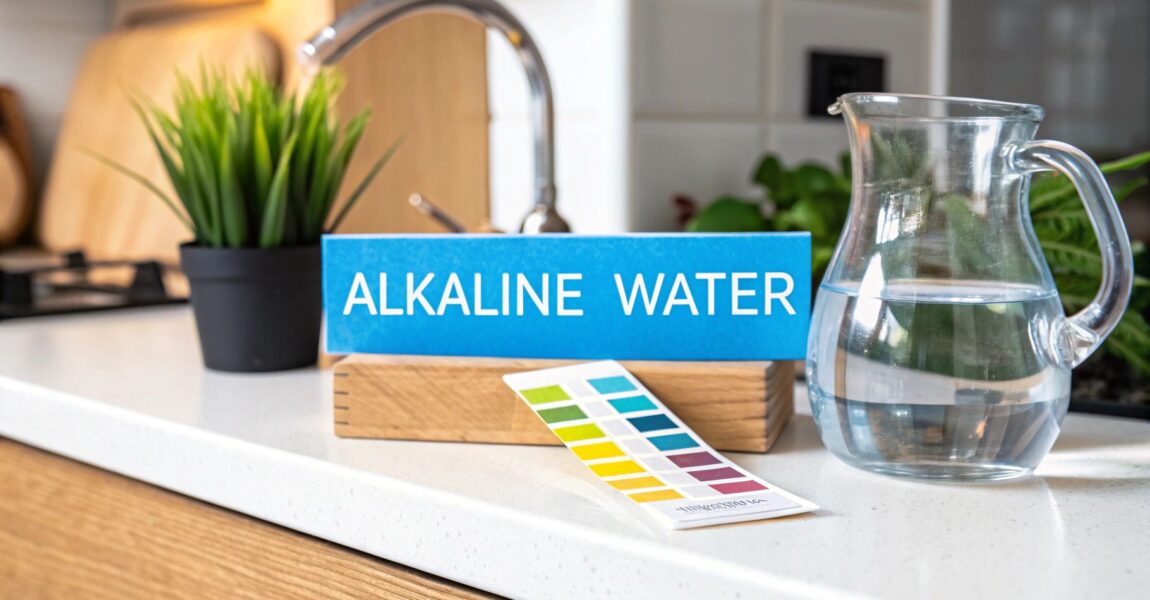
Ever take a sip of tap water and get a faint metallic tang? Or spotted those pesky blue-green stains creeping around your drains? That's not your imagination—it's the calling card of acidic water, a sneaky problem that can wreak havoc on your home's plumbing.
Think of low pH water as the quiet vandal in your pipes. It's naturally corrosive, and it's on a mission to eat away at your plumbing from the inside out.
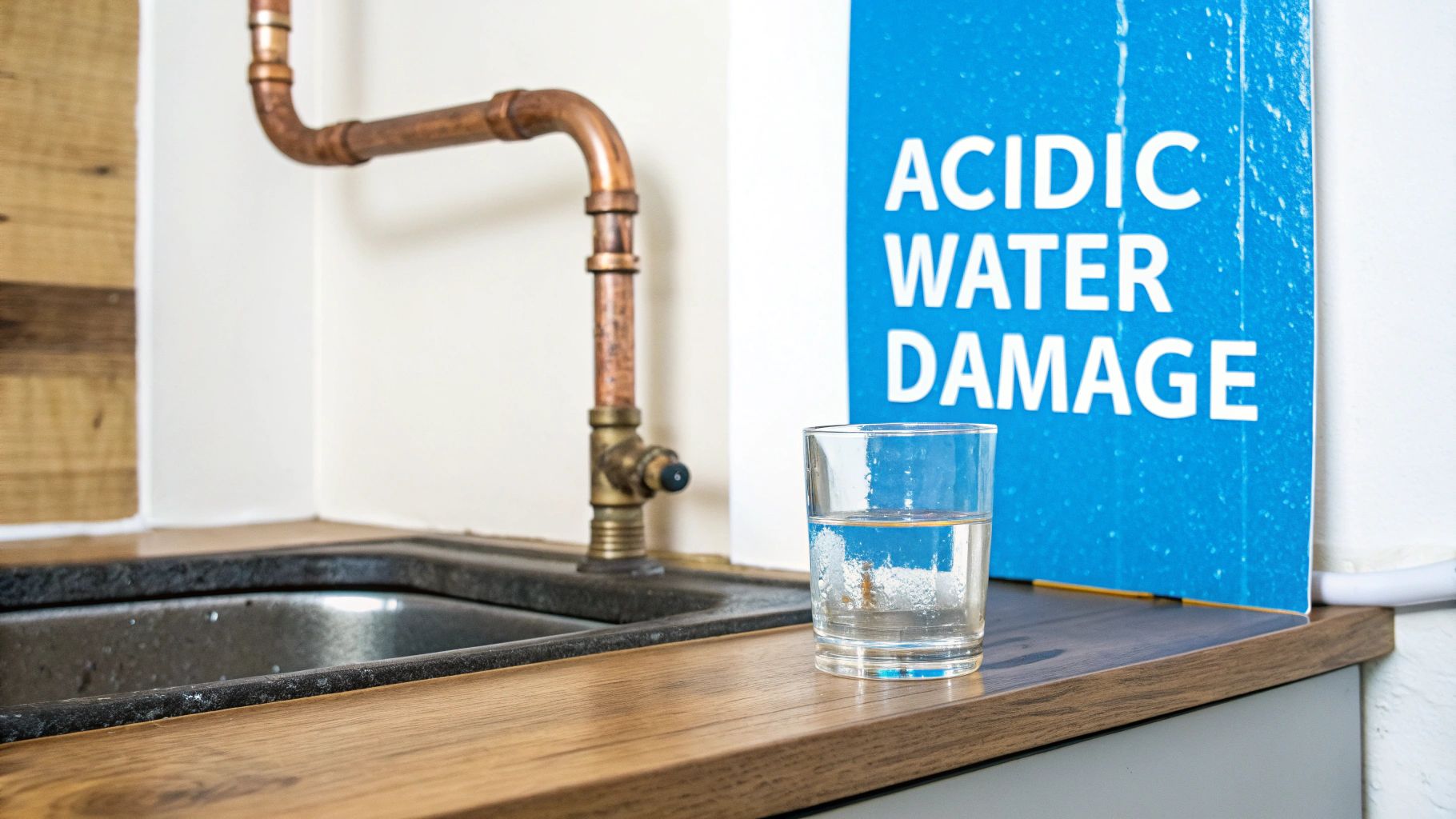
This means it’s slowly but surely dissolving your home’s plumbing. Copper pipes are its favorite snack. Over time, that acidic water can lead to pinhole leaks, water damage, and even mold—a trio of expensive, frustrating problems you didn't sign up for.
Beyond the structural drama, there are health concerns to consider. As corrosive water travels through your pipes, it can leach heavy metals straight into the water you use for drinking, cooking, and bathing. It's like your plumbing is turning against you.
This process can introduce some unwelcome guests into your daily routine:
Basically, your own plumbing turns into an unintentional contamination source. Fixing your water's pH isn't just about home maintenance—it's a crucial step in keeping your family safe.
The EPA doesn't regulate pH as a primary contaminant, but it does recommend keeping municipal water between 6.5 and 8.5. This range is the sweet spot for preventing pipe corrosion and stopping harmful metals from crashing your party.
The damage doesn't stop with your plumbing. Acidic water affects just about every water-using appliance in your home. It can drastically shorten the lifespan of water heaters, dishwashers, and washing machines by corroding their internal parts. If you're invested in the health of your home's systems, you might find our guide on choosing a water heater useful as well.
Taking care of low pH is a proactive move that saves money and prevents those "why me?" appliance breakdowns. For more deep dives into home water systems, check out our advice section, which is packed with practical tips. Now, let's get into the solutions for bringing balance back to your H2O.
Before you try to fix anything, you need to know what you're up against. Trying to raise your water’s pH without knowing its starting point is like trying to bake a cake without a recipe—a total shot in the dark. An accurate test is your non-negotiable first step.
Think about it this way: a pH reading of 6.2 isn't just a number. It’s a bright red flag screaming that your water is acidic enough to start dissolving your copper plumbing. Getting that exact number is crucial because it tells you how serious the problem is and helps you pick the right filtration weapon.
When it comes to checking your water's pH at home, you’ve got a few solid options. There’s no single “best” way to do it; it really comes down to a balance of convenience, how precise you need to be, and your budget.
Here’s a quick rundown of the most common tools in the water testing arsenal:
My Two Cents: If you suspect your low pH has been a long-term problem, or if you live in an older house, just spring for the professional lab test at least once. It gives you a complete chemical snapshot of your water and priceless peace of mind.
No matter which test you use, your results are only as good as your sample. It's incredibly easy to accidentally contaminate it, which throws off the reading and can send you down the wrong filtration path.
To make sure your test actually reflects what's in your pipes, follow these simple but critical steps:
Once you have that solid number, you’re not guessing anymore. You’ve got the data you need to choose the right water filtration method, protect your home, and make your water safe.
Sometimes, the gentle approach just won't cut it, especially when you're battling seriously acidic water. If your home's pH is stubbornly low, you need to bring in the big guns. This is where chemical feed systems shine—they’re the gold standard for getting precise, consistent pH control for your entire house.
Think of it as a custom-tailored treatment for your water the second it enters your home. These systems don't just buffer the water; they actively inject a neutralizing solution to get the pH exactly where you want it. It's a proactive strategy for anyone who needs reliable, professional-grade results from their water filtration setup.
The heart of the system is a chemical feed pump paired with a solution tank. It's installed right where your main water line enters the house, usually after the pressure tank on a well or after the main shutoff valve for city water. The process is surprisingly straightforward.
A neutralizing solution—typically soda ash (sodium carbonate) mixed with water—sits in the tank. As water flows into your home, the pump injects a tiny, precisely measured dose into the waterline. This instantly neutralizes the acidity, raising the pH long before the water reaches your faucets, showers, or appliances.
This filtration method is incredibly effective for a few reasons:
Getting the dosage right is the most critical part of the setup. It feels a bit like a science experiment at first, but once you find that sweet spot, the system is largely a set-and-forget operation. Your calculation will hinge on two main things: your water’s starting pH and your home's water flow rate.
You'll start by mixing a soda ash solution. A good starting point is to mix one to two pounds of soda ash per five gallons of water in your solution tank. After it's mixed, you’ll adjust the pump's feed rate based on your test results. The goal is to find a setting that consistently brings your tap water into that ideal 7.0 to 8.0 pH range.
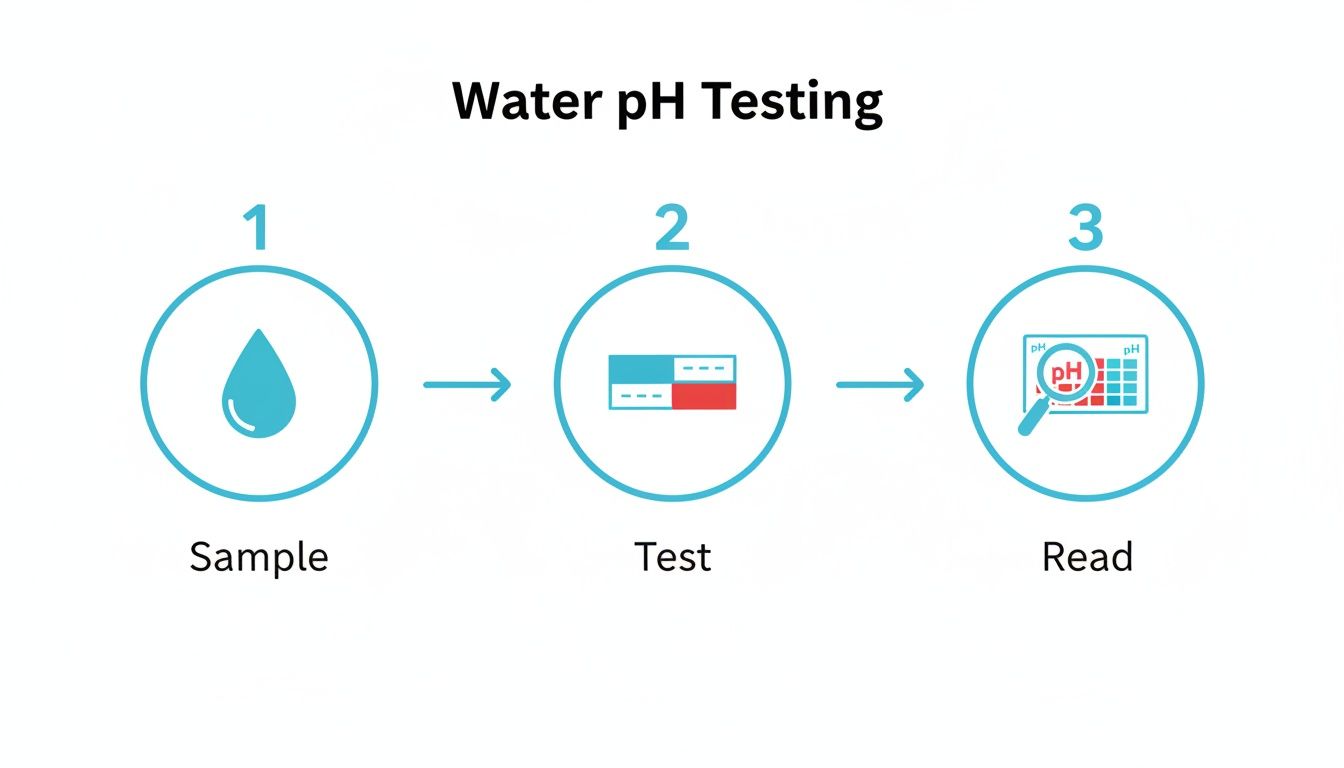
This simple loop of testing, treating, and re-testing is the key to dialing in the perfect pH level for your home.
Pro Tip: Don't try to get it perfect on day one. Start with a lower injection rate, let the system run for 24 hours, and then test the water from a faucet far away from the entry point. Gradually increase the dose until you get a stable, desirable reading.
This might sound like an industrial-level solution, and in a way, it is. Municipal water treatment plants use a very similar concept to manage the pH for entire cities. In fact, one of the most common ways to raise the pH of acidic water in treatment plants is by adding alkalis like lime—a practice that's been standard for a century.
These facilities use precise dosing to ensure water is non-corrosive and safe, often aiming for the EPA-recommended range of 6.5-8.5. Chemical injection lets them respond to changes in the raw water source, protecting billions of dollars in infrastructure from corrosion. You can learn more about how crucial pH control is in large-scale operations from the experts at Walchem.com.
By installing a chemical feed system, you’re essentially bringing that same level of control and technology into your own home filtration system, just on a much smaller scale.
While this method is highly effective, it does require a bit more hands-on attention than a passive filter. Handling soda ash requires care—it can be an irritant, so always wear gloves and eye protection when you're mixing up a new batch.
Routine maintenance is also part of the deal. You’ll need to:
For homeowners facing serious acidity issues, a chemical dosing system is an investment that pays for itself by protecting your entire plumbing network from expensive corrosion damage. It provides a level of control that no other filtration method can really match.
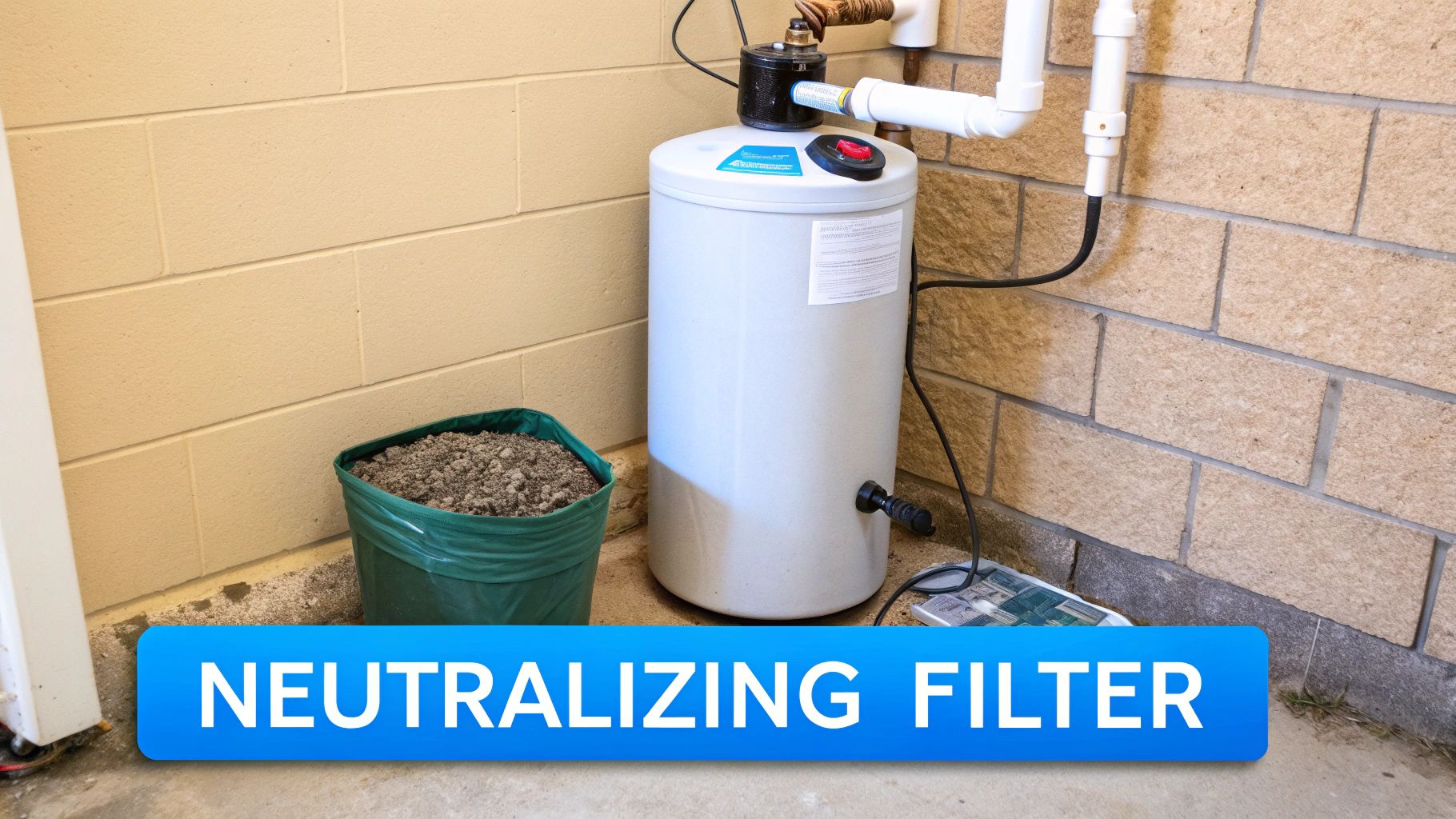
If you're looking for a fix for acidic water that doesn't involve playing chemist in your basement, a neutralizing filter is your hero. These systems are the quiet workhorses of home water filtration, raising your water's pH behind the scenes with practically zero daily effort on your part.
Think of it as a passive, whole-house guardian. Once it's installed on your main water line, it automatically balances your water before it ever touches your pipes, faucets, or appliances. For anyone who values a low-maintenance approach, this is a total game-changer.
The science behind a neutralizing filter is beautifully simple. It's a large tank filled with a special mineral media. As acidic water flows up through the tank, it passes over this bed of minerals, which slowly dissolve. This process naturally neutralizes the acidity, raising the pH to a safe, non-corrosive level.
This has been a trusted, chemical-free method for pH adjustment in drinking water since the 1970s. For it to work right, the filter needs to be sized properly to give the water enough "contact time" with the media. A good rule of thumb is keeping flow rates under 3.0 gallons per minute per square foot of media, which allows the minerals enough time to dissolve and do their job.
The two main types of media you'll run into are:
Real-World Scenario: Let's say your well water tests at a pH of 5.8. A filter with only calcite might struggle to get the pH high enough. A water pro would likely recommend a blend of about 90% calcite and 10% Corosex to effectively bring the pH up to a healthier 7.2.
Picking the right media is crucial. You want to solve the acidity problem without accidentally creating a new one. When looking at Calcite vs. Corosex, it really comes down to how low your pH is to start.
Here's a quick table to break down the key differences between these two workhorses.
| Feature | Calcite (Calcium Carbonate) | Corosex (Magnesium Oxide) |
|---|---|---|
| Best For | Moderately acidic water (pH 6.0-6.9) | Very acidic water (pH 4.5-6.0) |
| Effectiveness | Raises pH to a neutral 7.0-7.5. It's self-limiting. | Can raise pH well above 8.0 if not carefully managed or blended. |
| Dissolving Rate | Slow and steady, requiring less frequent replenishment. | Dissolves much faster, requiring more frequent media top-ups. |
| Impact on Hardness | Adds calcium hardness to the water. | Adds significant magnesium hardness. |
| Primary Trade-Off | May not be powerful enough for severely acidic conditions. | Risk of over-correction, which can lead to cloudy water or scale. |
| Common Application | Used alone for the majority of residential pH correction needs. | Typically mixed in small ratios (5-10%) with calcite for a boost. |
Ultimately, Calcite is the safe bet for most situations. You only bring in Corosex when you have seriously aggressive, low-pH water that needs a more powerful filtration solution.
A great neutralizing filter isn't just about what's inside—its size and setup are just as important. If a system is too small for your home's water demand, the water will rush through too quickly, and you won't get complete neutralization.
Here’s what you need for a successful setup:
The biggest trade-off with a neutralizing filter is that it will increase your water's hardness. You're essentially turning soft, acidic water into harder, alkaline water by dissolving calcium and magnesium. For most people, that's a fair trade, but if your water gets too hard, you might consider installing a water softener after the neutralizing filter to get the best of both worlds.
Not everyone is ready to install a whole-house water treatment system, and that's okay. If you're looking for simple, budget-friendly ways to improve your drinking water, you’ve got options. These solutions are perfect for renters or anyone who just wants to focus on the water coming out of the tap.
Let’s get straight to the practical, point-of-use fixes that give you immediate results without a huge commitment.
Probably the easiest way to start raising your water's pH is with an alkaline water pitcher or a faucet-mounted filter. These things are incredibly simple to use and don't require any permanent installation, which is a lifesaver for apartment dwellers.
The real work happens inside the filter cartridge. As your tap water flows through, it passes over a special blend of natural minerals.
These cartridges are usually packed with a few key ingredients:
So, you're not just raising the pH. You're also re-mineralizing the water with healthy stuff that other filters often strip out. It's a simple swap for your regular pitcher that makes a big difference.
For a quick, manual adjustment, you can turn to a kitchen staple: baking soda (sodium bicarbonate). This method is really only for balancing a single glass or a small pitcher of water, and you need to be precise. You are, after all, adding it directly to your drink.
The key here is that less is always more. You're trying to neutralize acidity, not make your water taste like the ocean.
Start with a tiny pinch—no more than 1/8 teaspoon of baking soda for a full gallon of water. Mix it until it's totally dissolved, then test the pH. You can add a tiny bit more if needed, but it's always smart to start small.
This is a great fix in a pinch if your water tastes a little sharp or acidic. But let's be honest, it’s not a practical long-term strategy for all your drinking water. Measuring and mixing every single time gets old fast.
If you want a more natural, hands-off approach, look no further than an ancient technology that’s getting a second look from modern science: the humble clay pot. People have used unglazed earthenware for thousands of years to store and cool water, but it turns out it does a lot more.
The porous clay naturally leaches beneficial minerals into the water. This process can significantly bump up the water’s alkalinity without any chemicals or electricity. And the research backs it up.
One study showed that just storing tap water in clay pots for 24 hours can dramatically raise its pH. The average pH levels jumped from neutral or acidic all the way up to a highly alkaline 9.5-10.0. With around 10-15% of households in the US and EU already tweaking their water for wellness, this zero-cost method is a powerful alternative. You can dig into the study's details on Eman Research Publishing.
It's a perfect example of how to raise the pH of water using simple, sustainable principles. Sometimes the best solutions have been right in front of us all along.
Once you realize your water's pH is off, a bunch of questions usually pop up. It’s a bit of a journey from spotting the problem to landing on the right fix for your home, so it's totally normal to have a few things you're wondering about. Here are some quick answers to the questions we get all the time.
If you're just adjusting a pitcher of drinking water, remember that less is more. The best way to go about it is to start with a tiny amount and test as you go.
I'd recommend starting with just 1/8 to 1/4 teaspoon of baking soda for every gallon of water. Stir it in until it's totally dissolved, then grab your pH tester and see where you're at. The idea is to get a nice, balanced taste, not to make your water salty. You can always add a little more if you need to, but you can't take it back out.
That's a great question, and the honest answer is: it depends entirely on the filtration method you use. Different treatment systems affect your water's chemistry in different ways.
Here's a quick look at the two main whole-house options:
For the most part, yes. Water that's moderately alkaline—usually in the pH range of 7.5 to 9.0—is considered perfectly safe to drink. In fact, a lot of people find it has a smoother, less metallic taste than acidic water.
The only time you'd need to worry is with extremely high pH levels, which are way beyond what any home treatment system is designed to produce. When a filtration system is installed and maintained correctly, its job is to bring your water into a healthy, balanced state, not push it into dangerously alkaline territory. That’s exactly why testing your water and choosing the right solution is so important.
The goal here is balance. You're not trying to create some kind of super-alkaline water. You're just trying to neutralize acidic, corrosive water to protect your plumbing and keep your family healthy.
Tackling the water for special uses like a fish tank or your garden is a whole different ball game and requires a lot more caution. What's good for your pipes isn't always what's best for your fish or plants.
For aquariums, you absolutely need to use pH buffers made specifically for aquatic life. The simple household solutions we use for tap water can add minerals or other compounds that are flat-out harmful to fish and can throw the tank's delicate ecosystem completely out of whack.
And for the garden, raising your water's pH can spell trouble for any acid-loving plants you have. Things like blueberries, azaleas, and hydrangeas need acidic soil to thrive, and they'll really struggle if you're watering them with alkaline water. Always think about your plants' specific needs before you start adjusting their water source.
At Water Filter Advisor, we're all about helping you find the perfect filtration solution for whatever your home throws at you. From detailed guides to honest reviews, we give you the info you need to make a smart decision. Check out all our resources at https://www.waterfilteradvisor.com.
So, you've discovered your home's water has the personality of a grumpy lemon. What's the plan? Before you do anything, you need an accurate pH reading. From there, your two main battle plans are using alkaline additives like baking soda for a quick, "help-me-now" fix in a pitcher, or installing a whole-home pH neutralizing filter to solve the problem for good. These methods work by telling the acidity in your water to take a hike, bringing its chemistry back into a happy, balanced state.
Ever notice those sneaky blue-green stains in your sink or bathtub? That’s not a quirky design choice from your plumbing—it's a cry for help. It’s the first big warning sign of acidic water, and it's a much bigger problem than a bit of discoloration.
When your water has a low pH, it gets aggressive. It becomes corrosive, silently munching away at your plumbing from the inside out. This isn't just about aesthetics; it's a direct threat to your home's circulatory system. Corroding copper pipes can leach metal into your drinking water, and if you live in an older home, you could be facing lead contamination from old solder. Yikes.
Beyond the serious health concerns, acidic water is a bully to your expensive appliances. It can cause premature failure in water heaters, washing machines, and dishwashers. Tackling low pH isn't just about making your water taste better; it's about protecting your castle from a slow-motion, expensive disaster. That's why testing is the critical first step.
You wouldn't start randomly replacing parts in your car without a diagnostic, and the same logic applies to your water. Guessing your pH is a recipe for frustration and wasted money. Luckily, you've got a few solid options to get a reliable measurement.
Which method you choose really comes down to what you need. If you just want a quick "Is everything okay in here?" check, test strips are fine. But if you're about to invest in a whole-home filtration system, you need the hard numbers that only a digital meter or a lab test can provide.
This flowchart breaks down how to choose the right testing method, whether you need a quick spot-check or a highly detailed analysis.
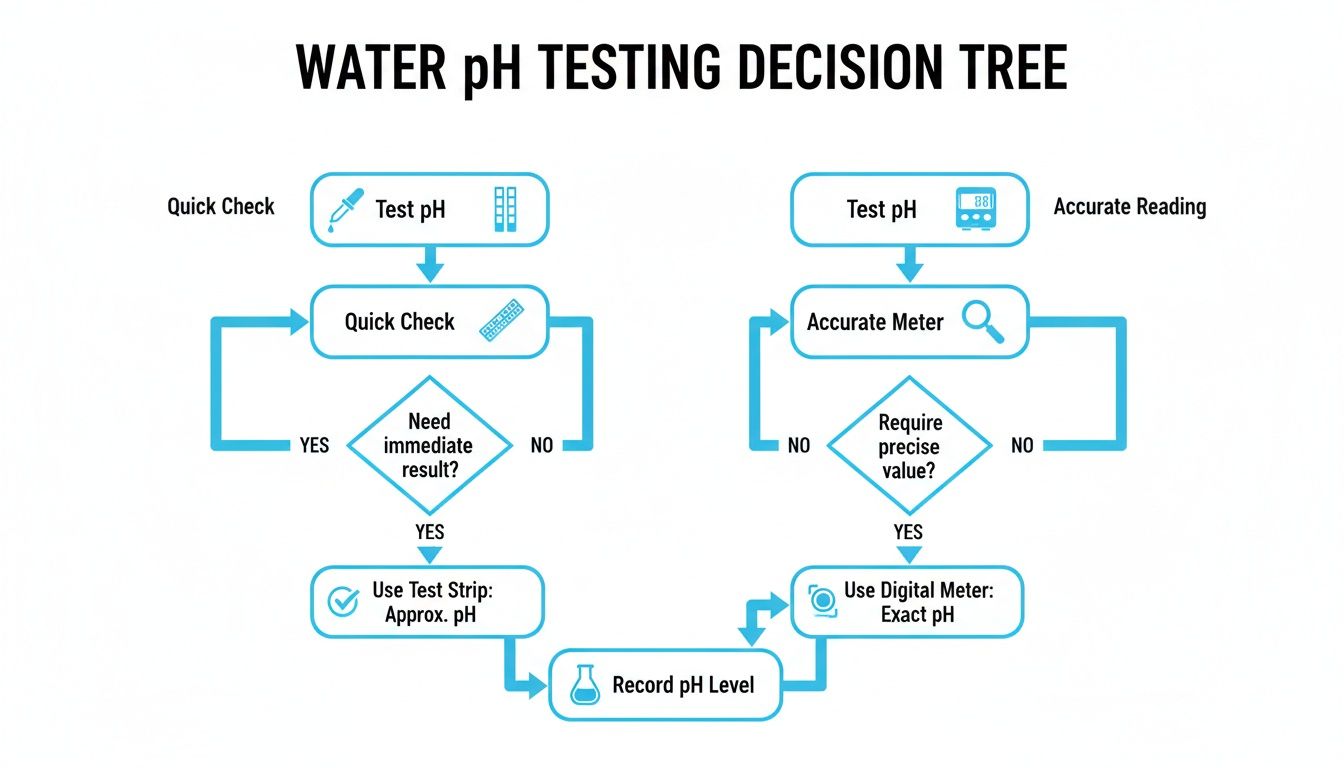
As you can see, while strips are handy for a quick peek, a digital meter is really the minimum you'll want for accuracy when planning any kind of water filtration strategy.
To make it even simpler, here's a quick rundown of the most common home testing methods. This should help you decide which tool is the right one for your mission.
| Testing Method | Accuracy | Cost | Best For |
|---|---|---|---|
| pH Test Strips | Low | Low | Quick, "just curious" checks and getting a general idea. |
| Digital pH Meter | High | Medium | Accurate readings needed for sizing filtration systems. |
| Professional Lab Test | Very High | High | Comprehensive analysis for complex issues or total peace of mind. |
Ultimately, investing in a good digital meter or a lab test upfront can save you a ton of guesswork and money down the road.
You probably remember the pH scale from science class—it runs from 0 to 14 and measures how acidic or alkaline something is. In your home's water, anything below a pH of 7.0 is acidic, and anything above is alkaline.
Modern testing has become incredibly precise. Post-1993 guidelines, for example, have tightened potentiometric uncertainty to less than 0.02 pH units. That level of accuracy is a game-changer for the 80% of the global population that relies on treated water sources.
For most household water, you're aiming for a pH between 6.5 and 8.5. If your water drops below 6.5, it’s corrosive enough to start damaging your pipes. If it creeps above 8.5, you'll start seeing scale buildup on fixtures and might notice a bitter taste.
Knowing your water's exact pH is key because the solution depends entirely on how grumpy your water is. Mildly acidic water might be happy with a simple calcite filter, but extremely low pH levels will demand a more powerful setup. For a broader look at how this fits into your home's water quality, check out our general water filtration advice.
So you've tested your water and confirmed it's on the acidic side. Your mind might jump straight to complex, expensive filtration systems, but hold on. For small, immediate tweaks, the solution might be sitting right in your kitchen pantry.
These simple household additives are perfect for neutralizing acidity in small batches, like a single pitcher of drinking water. It's crucial to understand these are temporary band-aids. They won't do a thing to protect your pipes or appliances from the long-term corrosion party happening throughout your home. Think of this as first aid, not a cure.
The easiest and most common additive is sodium bicarbonate, which you know as good old baking soda. It's a mild alkaline substance that gently raises both pH and total alkalinity. This is great because it also helps stabilize the water chemistry and prevents wild pH swings.
Think of it as an antacid for your water. It calms the acidity down and nudges it back toward neutral. Because it’s so gentle, it’s the perfect place to start. A tiny pinch in a gallon of drinking water can often be enough to get rid of that slightly metallic taste that comes with low pH.
A Word of Caution: Baking soda adds sodium to your water. If you’re watching your sodium intake for health reasons, you’ll want to use this method sparingly for drinking water.
When you're adding anything to your water, precision is everything. Just dumping in a spoonful is a surefire way to send the pH skyrocketing, creating a whole new problem. The mantra is: start small, test, and then adjust.
Here are some real-world starting points for using baking soda:
These are just guidelines. The golden rule here is to add less than you think you need. You can always add a little more, but you can’t take it out.
If your water is more than just slightly acidic, you might need to bring out the bigger guns. Soda ash (sodium carbonate) is a much more concentrated alkaline powder. It packs a bigger punch and will raise pH much more dramatically than baking soda, so you have to handle it carefully. You’ll use a lot less soda ash than baking soda to get the same result.
It’s interesting to think about how what we do in our kitchen mirrors larger-scale environmental chemistry. Just like agricultural runoff can raise the pH in rivers, we’re doing the same thing by adding these mineral-based powders. Research on water quality often shows how elements like calcium play a huge role in elevating pH, which is the exact principle we're using. You can actually explore a full study on physicochemical factors influencing water pH to see how these concepts apply on a global scale.
Ultimately, these quick fixes are handy in a pinch, but they're not a practical whole-home solution. If you’re dealing with acidic water throughout your entire house, a permanent, automated filtration system is always the smarter long-term investment.
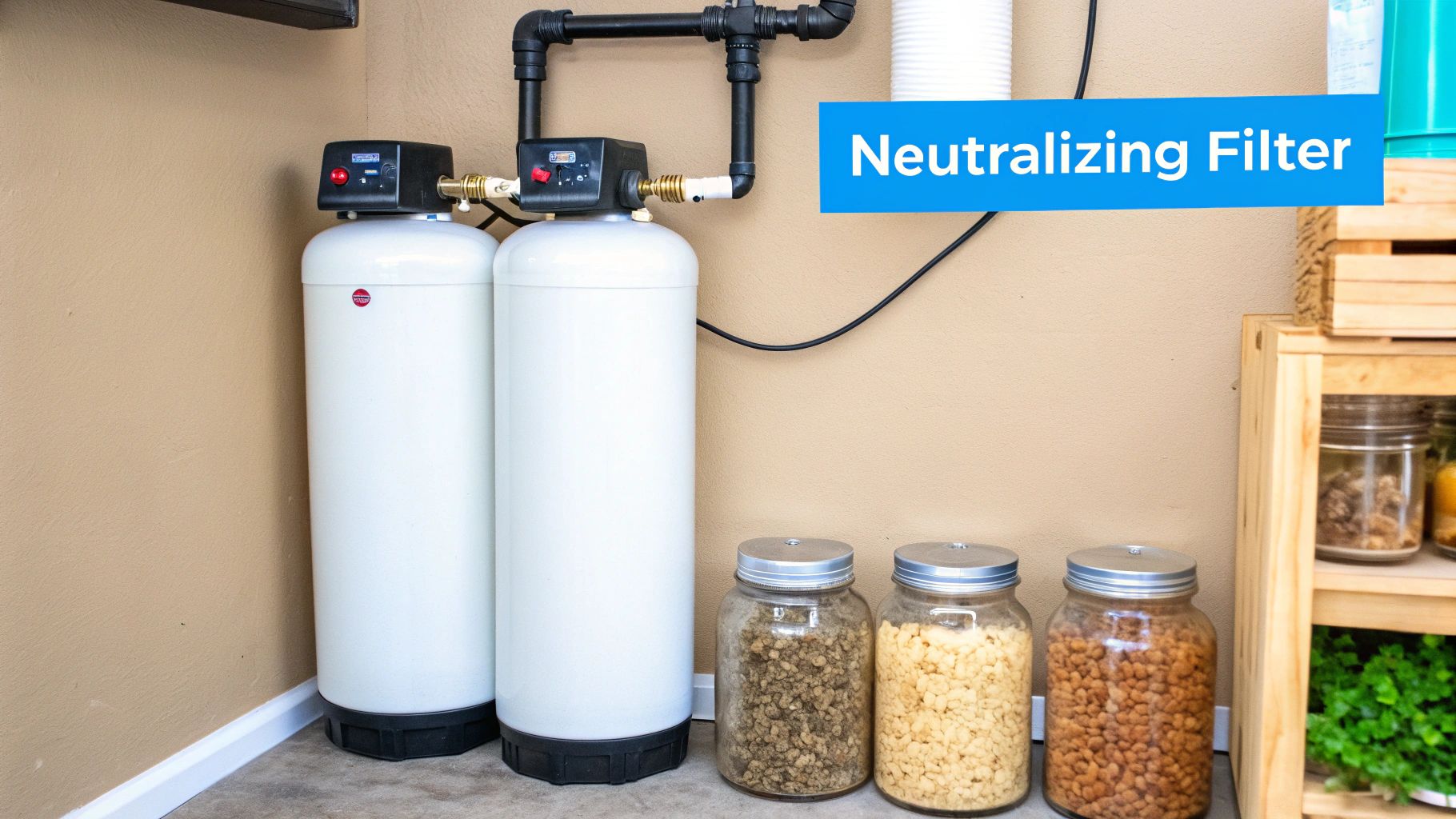
Sure, quick fixes like baking soda can help in an emergency, but they aren't a real strategy for protecting your home. That approach does nothing to stop the acidic water that’s silently eating away at your pipes and appliances. For a permanent, "set it and forget it" solution, a dedicated neutralizing filter is the gold standard of home water treatment.
These systems get installed right where your main water line enters your house, treating every last drop of water before it ever reaches a faucet or shower. They act as a constant guardian, using a special mineral media to raise the pH and bring your water chemistry back into a safe, non-corrosive zone. The real beauty here is that these filters are self-regulating. They’re the workhorses of residential water treatment, and understanding the two main types is key to picking the right one.
The most common type of neutralizing filter uses calcite. Think of it as a super pure, ground-up form of calcium carbonate—basically limestone or marble. When acidic water flows through a tank full of this calcite media, it slowly dissolves the calcium, neutralizing the acid and bumping up the pH.
The process is naturally self-limiting. Calcite will only dissolve until the water hits a neutral pH of around 7.0. Because of this, it's almost impossible to "overcorrect" and make your water too alkaline. This makes calcite a fantastic choice for homes with mildly acidic water, usually in the pH range of 6.0 to 6.9.
A calcite filter is like a slow-release capsule for your water system. It provides a steady, gentle dose of alkalinity that solves the corrosion problem without a lot of fuss or risk of overshooting your target pH.
One thing to know is that this process does add some hardness to your water since you're introducing calcium minerals. For most folks, that's a very minor trade-off for protecting thousands of dollars in plumbing and appliances.
So, what if your water is more than just a little bit acidic? If you've got a pH below 6.0, calcite alone might struggle to keep up. This is where Corosex enters the picture.
Corosex is a specially processed form of magnesium oxide, and it's far more reactive than calcite. It can neutralize acidity much more aggressively—in fact, it can raise the pH up to 100 times more than the same amount of calcite.
That power comes with a serious warning: Corosex is not self-limiting. If water sits in the tank too long (say, overnight), it can push the pH way too high. For this reason, you'll almost always see Corosex used in a blend with calcite, typically a ratio of 80-90% calcite to 10-20% Corosex. This mix gives you the best of both worlds: the gentle, steady action of calcite with an extra kick from Corosex to handle more severe acidity.
Deciding between calcite, Corosex, or a blend all comes down to what your water test results say. Getting a precise pH reading is non-negotiable for making the right call. To help you choose, let's put these two filter media options head-to-head.
| Feature | Calcite (Calcium Carbonate) | Corosex (Magnesium Oxide) |
|---|---|---|
| Best For | Mildly acidic water (pH 6.0 – 6.9) | Severely acidic water (pH below 6.0) |
| Effectiveness | Gentle, slow-acting, and self-limiting | Highly reactive and powerful, not self-limiting |
| Risk of Overcorrection | Very low; naturally stops at a neutral pH | High if used alone; best when blended with calcite |
| Maintenance | Media must be refilled annually as it dissolves | Dissolves faster and requires more frequent refilling |
| Impact on Hardness | Adds calcium hardness to the water | Adds magnesium hardness to the water |
Ultimately, your water test will point you in the right direction. A pH of 6.5? Calcite is your friend. A pH of 5.5? You'll need a calcite/Corosex blend to get the job done right.
Most neutralizing filters are whole-house systems, which means they'll need to be installed by a professional plumber. While there's an upfront cost, the long-term value is undeniable. You're not just getting better drinking water; you're safeguarding your entire plumbing network. A one-time investment in a neutralizing filter can prevent catastrophic and expensive headaches. Maintenance is pretty straightforward, too. You'll just need to top off the tank with new media about once a year.
Sometimes, standard neutralizing filters just don't have the muscle for the job. If your water's pH is extremely low, or if your household has a really high water flow rate, a typical calcite filter can struggle to keep up. This is where you bring in the heavy artillery: a chemical injection system.
Think of it as the precision tool for serious water chemistry problems. Instead of letting water flow over a dissolving media, this system actively injects a neutralizing solution right into your water line. It gives you a level of control that passive filters simply can't match, making it the go-to for really challenging water.
At its heart, a chemical injection system is a proactive approach for when other methods of raising water pH just fall short. The system has a few key parts working together:
This setup delivers an incredibly accurate and consistent pH level throughout your home. It doesn't matter how much water you're using; the system adds the perfect amount of solution to keep everything balanced.
While a neutralizing filter is great for mildly acidic water, an injection system becomes the clear winner in more extreme cases. This method is often the only real choice for homes with a water pH that drops below 5.5. With acidity that aggressive, a standard filter would dissolve its media so fast that maintenance would become a constant headache.
High water demand is another key factor. Large families or homes with high-flow fixtures can send water through a filter tank too quickly for the media to do its job. A chemical pump injects its solution instantly, ensuring complete neutralization no matter the flow rate.
Unlike a calcite filter that more or less self-regulates, a chemical injection system needs to be calibrated perfectly. The dosing pump's injection rate has to be fine-tuned based on your water's starting pH, your flow rate, and the concentration of your soda ash solution. Get this balance wrong, and you could overcorrect and send the pH way too high, leading to a bitter taste and nasty scale buildup. Because of this, professional setup and calibration are critical to get the chemistry just right.
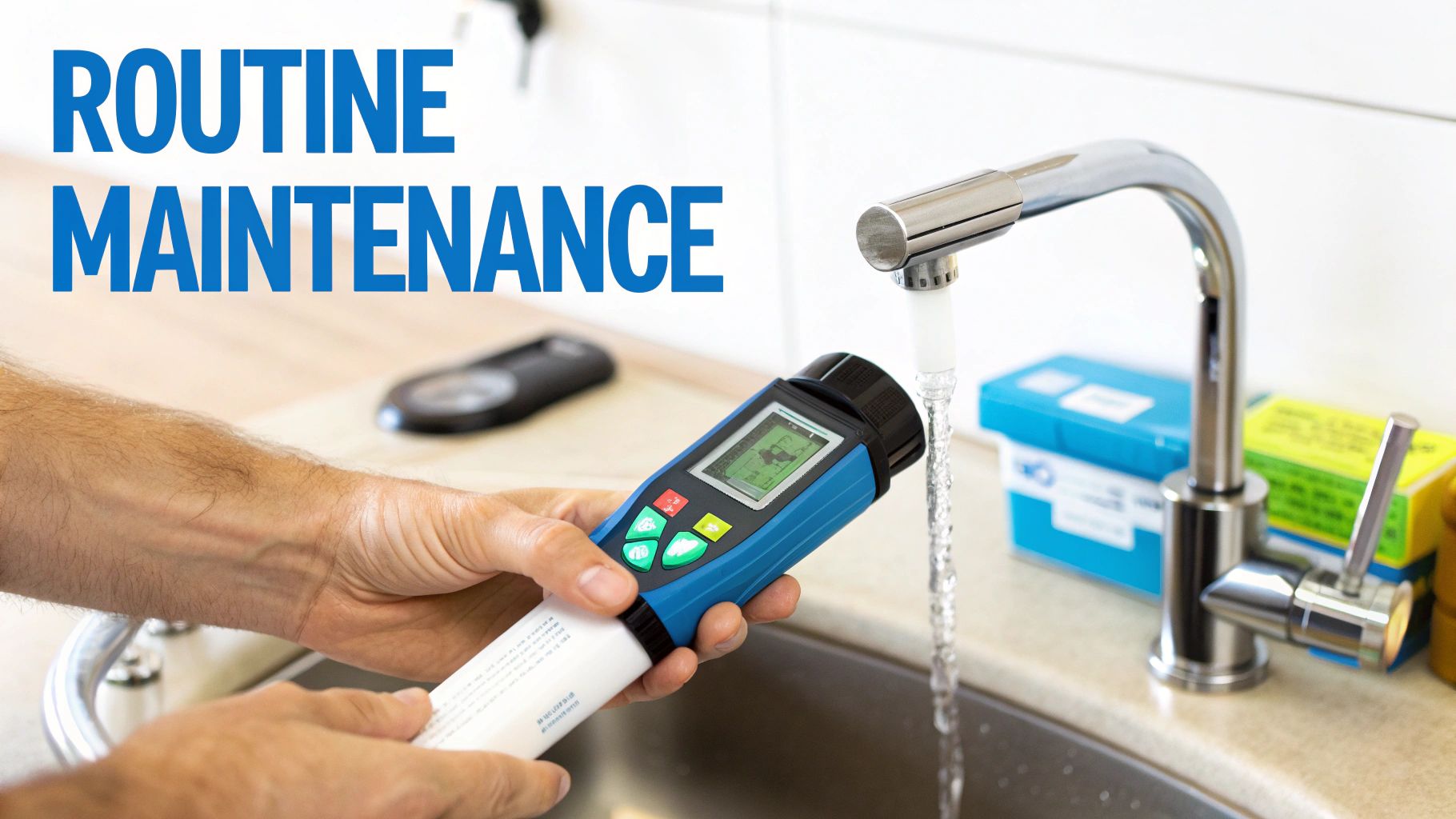
Getting your home's water pH into that perfect neutral zone is a huge win, but the job isn't quite finished. Think of your water treatment setup like any other major home system—it needs a little ongoing attention to keep performing at its best. This isn't about creating more work. It's about a smart, simple maintenance plan that ensures your filtration investment continues to protect your home.
The golden rule of water filtration is to never just assume your system is working. Regular testing is the only way you know for sure, and it's how you catch small issues before they snowball into big problems.
This regular feedback loop is your best defense against surprises.
The actual maintenance you'll need to do depends on the kind of filter system you chose. For neutralizing filters that use calcite or a calcite/Corosex blend, your main job is topping off the media. This mineral bed is designed to slowly dissolve, so it will need to be replenished. A good rule of thumb is to check the media level every 6 months and plan to add more roughly once a year.
If you're running a chemical injection system, your routine will center around the solution tank. You'll have to mix a new batch of soda ash solution whenever the tank runs low. Getting into the habit of checking the level monthly is smart.
Don’t forget the simple stuff. No matter what system you have, give the filter tank or solution pump a quick visual inspection every few months. Look for leaks, listen for unusual noises, and just make sure everything looks clean and operational.
Even with a great system, things can sometimes drift off-course. One of the most common issues is overcorrection, where the water becomes too alkaline (pH over 8.5).
Keep an eye out for these signs of overcorrection:
Another thing to be aware of is increased water hardness. Since calcite filters work by adding calcium minerals, they will naturally make your water harder. This is a normal trade-off. If the hardness becomes a nuisance, you might consider adding a water softener after your neutralizing filter for the ultimate one-two punch.
Interestingly, the principles we use to manage water chemistry in our homes are the same ones being considered for our oceans. Since pre-industrial times, global surface ocean pH has dropped from 8.11 to 8.04. One proposed solution involves adding calcium carbonate to boost alkalinity—the exact same principle your calcite filter uses. You can learn more about the science behind counteracting acidification on a global scale.
This ongoing vigilance ensures your journey of learning how to raise pH in water ends with a stable, long-term filtration solution, not a whole new set of problems.
Even with the best plan, you're bound to have some questions pop up when you're figuring out how to raise the pH in your water. Let's be honest, tweaking your home's water chemistry can feel a little intimidating. We'll walk through some of the most common questions we hear from homeowners to help you feel good about your next steps.
This is a big point of confusion for a lot of people. While you can find specialized (and usually pricey) alkaline water pitchers designed to bump up pH, your standard carbon pitcher from a brand like Brita isn't going to do it. The main job of those filters is to get rid of things like chlorine to make your water taste and smell better, not to fix a core chemistry issue like low pH.
Think of a regular pitcher filter like a strainer—it catches the big stuff. It just doesn't contain the right kind of filter media to actually neutralize acid. So, while it might improve the taste, it offers zero protection for your home’s plumbing against the corrosive damage that acidic water causes.
Yes, it often will, and it’s a really important trade-off to get your head around. The most common whole-house filtration fixes for low pH—calcite and Corosex filters—work by dissolving minerals like calcium carbonate and magnesium oxide into your water. Those happen to be the exact same minerals that cause water hardness.
This process is great for solving the acidity problem and saving your pipes. The flip side is you might start seeing the classic signs of hard water, like soap scum in the shower or chalky scale on your faucets. For most people, that's a much easier problem to deal with than corroding pipes.
Pro Tip: If the new hardness is driving you crazy, the best setup is to install a water softener after the pH neutralizing filter. That combination gives you the best of both worlds: water that’s non-corrosive and soft all through the house.
For a one-off, small adjustment, adding a tiny, carefully measured pinch of baking soda to a pitcher of drinking water is generally considered fine. But it is absolutely not a healthy or sustainable long-term solution for your daily drinking water.
Doing this every day can add a lot of sodium to your diet, which is a real concern if you're watching your blood pressure. Even more critical, it’s just a spot treatment. It does absolutely nothing to protect all the plumbing that brings the water to your tap. A proper neutralizing filter that adds beneficial minerals like calcium is a far safer and more effective way to treat your whole home.
Just like acidic water causes headaches, so does water that's swung too far the other way. If your pH is consistently testing above 8.5, you've likely overcorrected. The signs are usually pretty obvious and can become a whole new set of frustrations.
Here’s what you should be looking out for:
The only way to know for sure is to test your water again after your treatment system has been running. If you find the pH is way too high, you’ll need to adjust your system, which might mean dialing back the feed rate on a chemical injection pump or calling a pro to adjust your filter's bypass valve.
At Water Filter Advisor, we believe every homeowner deserves access to safe, clean, and balanced water. Navigating the world of pH correction and filtration can be complex, but our in-depth guides and unbiased reviews are here to help you make confident decisions. Explore our resources to find the perfect solution for your home at https://www.waterfilteradvisor.com.
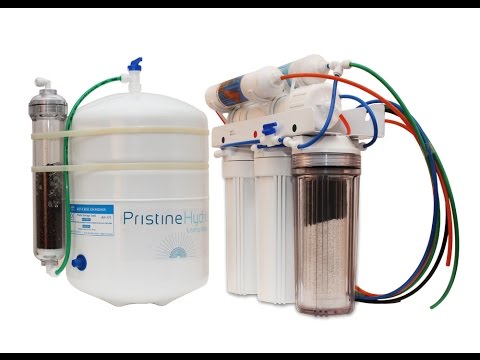
Evaluating the alternatives:
1. Carbon Block Filter
2. Reverse Osmosis
3. Purified Water
4. Water Ionizer
5. Bottled Water
6. PristineHydro Water Revival System
INSPIRING AND EDUCATING HUMANITY TO ADOPT A HEALTHY LIFESTYLE
Original Video Source
Water that can give you better digestion, improved hydration, and even help prevent cancer… These are just some of the benefits that water filters promise to give you, but are they everything they claim to be? What exactly do they do to your water, and do you really need one at home?
Through a series of tests, Talking Point host Steven Chia goes in search of answers to find out if filtered water can truly be healthier, cleaner and safer than what we get straight from the tap.
Watch more #TalkingPoint:
About the show: Talking Point investigates a current issue or event, offering different perspectives to local stories and revealing how it all affects you.
================================================
#CNAInsider #CNATalkingPoint #Water #WaterFilter
For more, SUBSCRIBE to CNA INSIDER!
Follow CNA INSIDER on:
Instagram:
Facebook:
Website:
Original Video Source
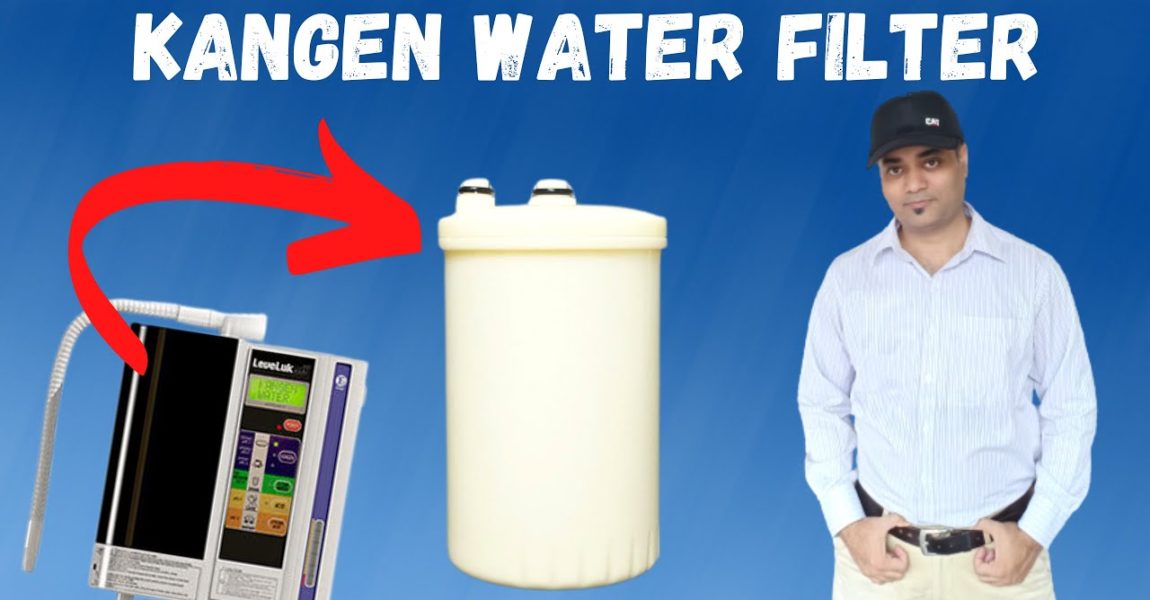
kangen water filter | leveluk water filter | kangen water filter price | enagic water filter
For your help we are sharing the best buy link(Affiliate) below—
kangen water filter —-
KANGEN Compatible HG-type Replacement Ionizer Filter for Enagic MW-7000 Leveluk SD501
Buy from:
Japan Made”HG-N” Type Premium Grade Compatible Filter for Enagic Kangen SD501HG-N”HG-N”
Buy from:
1)Kangen Water Machine LeveLuk SD 501
USA ——Buy from Link: —-
INDIA—- Buy from Link: —-
2) Kangen Water K8 Machine Leveluk JRll
USA—–Buy from Link: —-
INDIA—- Buy from Link: —-
3) MONITOR JR-IV Japanese Kangen Ionized Electrolysis Water Generator Machine with 4 Plates
INDIA —- Buy from link:–
Other Popular brands in USA———
1) Bawell Platinum Alkaline Water Ionizer Machine
Buy link—
2) Rhorawill Alkaline Water Ionizer Machine Home Water Filtration System
Buy link—-
3)Alkaline Water Ionizer Machine by Bawell
Buy link—-
Other Popular brands in INDIA———
1)CUCKOO King Top Alkaline Water Purifier | Hot & Cold Alkaline Water
Buy link—–
2) Havells Max Alkaline 7-Liter RO+UV Water Purifier
Buy link—
3) Blue Star Eleanor EL5BLAM01 8-Liter ,RO + UV + UF + IBT + Alkaline Water Purifier
Buy link—
4) RO+UV+UF+MAT 100gpd Misty, 10 Liters, 14 Stage Alkaline Mineral Water Purifier with Upto 3000 TDS
Buy link—
➖➖➖➖➖➖In this topic Covered➖➖
#usesofkangenwater #kangen #kangenwater
➖➖➖➖➖➖➖➖➖➖➖➖➖➖
Thanks For Watching
Like Share Subscribe
#creativeexpouser
Subscribe :
YouTube :
Website: www.homekitchenzone.in
➖➖➖➖➖➖➖➖➖➖➖➖
Disclaimer: My channel and my passion is to share my knowledge to people. Whatever i have shared in videos are completely my point of view and thinking. It is not an order or rule to follow. It is totally up-to viewers, in which way they are considering my all videos. This video description contains affiliate links. Meaning, if you click on one of the product links and make a purchase, we receive a commission.
kangen water filte,
leveluk water filter,
kangen water filter price,
enagic water filter,
kangen water,
enagic kangen water,
alkaline water,
leveluk sd501 filter,
kangen filter,
kangen water filter replacement,
enagic filter,
leveluk sd501 filter price,
enagic kangen water filter,
kangen filter price,sd501 filter,
kangen water machine filter,
leveluk filter,
kangen alkaline water filter,
kangen machine filter,
leveluk water filter price,
kangen water filter cost
Original Video Source
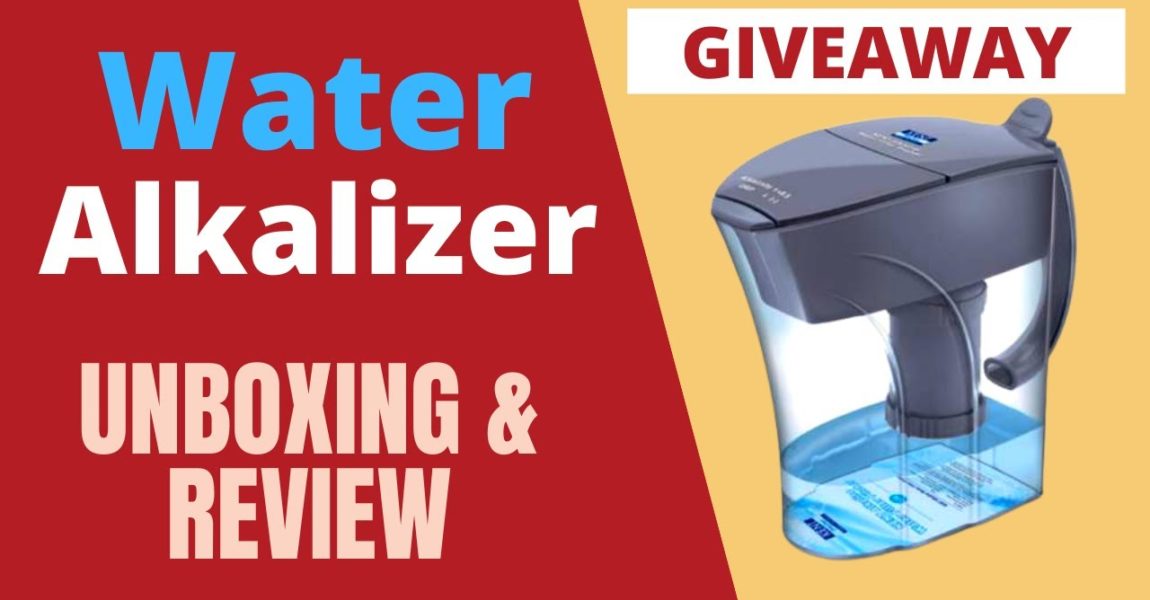
In this video, I have done Kent alkaline water filter pitcher unboxing. You will also find Alkaline Water Pitcher Unboxing and Review in this video. It is known that alkaline water has some good effects in our body. An alkaline water pitcher is the most simple way to get alkaline water.
We are happy that we are organizing the first giveaway in our channel. We will give away 1 Kent Alkaline Water Filter Pitcher to the lucky winner. This competition is valid in India only.
Give away link:
Kent Alkaline Water Filter Pitcher Purchase link:
PLEASE FOLLOW ME ON INSTAGRAM:
PLEASE VISIT MY WEBSITE:
1. Kent Alkaline Water Filter Pitcher Unboxing
2. Alkaline Water Pitcher Unboxing and Review
3. Alkaline Water purifier Demo
4. Alkaline Water
5. Alkaline Water Filter
6. Alkaline Water Pitcher
#TheDevReviews
#AlkalineWaterPitcher
#KentAlkalineWaterFilterPitcherUnboxing
#AlkalineWaterPitcherUnboxingAndReview
Original Video Source
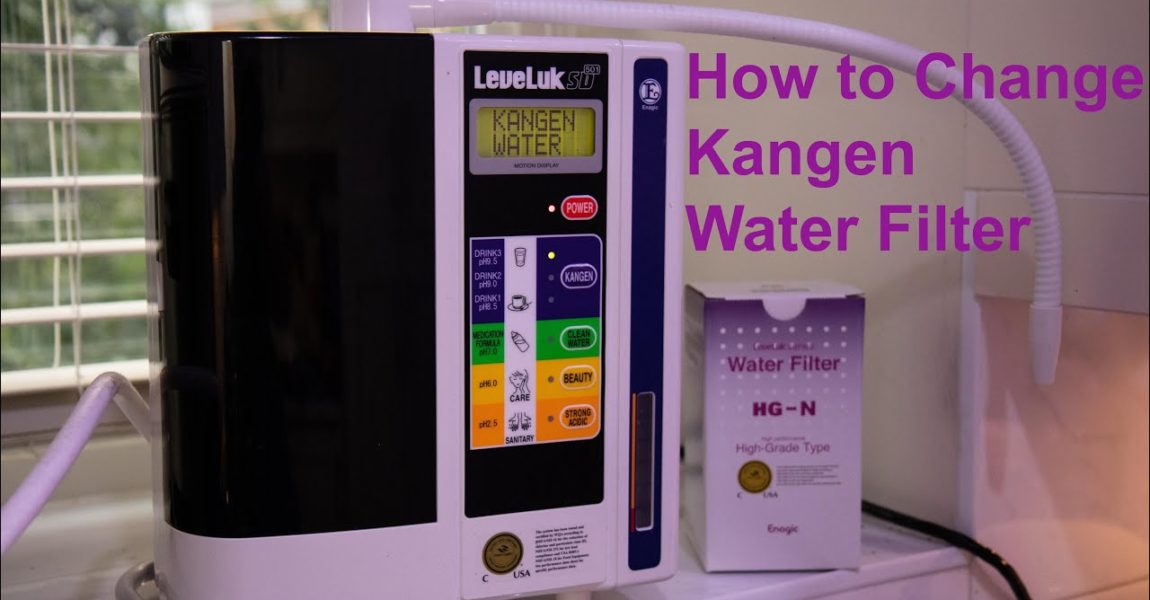
The water filter is a standard accessory that comes with a new unit. When the filter needs to be replaced, the unit issues a notification through voice guidance, alarm sounds and the LCD on the operation panel when the water supply stopped.
The SD501 is the “Flagship” model and #1 Seller!
The SD501 is the finest machine in its class, with the highest quality built-in electrolysis chamber on the market. This Kangen Water® filtration machine generates a continuous stream of 5 types of water. Generates: Strong Kangen Water, Kangen Water®, Neutral Water, Beauty Water, and Strong Acidic Water.
You can easily operate the SD501 thanks to a large LCD panel and clear voice prompts. When you need enough delicious, healthy alkaline water to hydrate your whole family, the SD501 is the product you’ve been searching for!
7 Titanium Plates
The SD501 is Enagic’s “Flagship” model because it provides additional stable oxygen, better micro-clustering, and higher negative ORP levels. Like all 501 models, the SD501 uses innovative electrolysis technology with 7 platinum-coated 99.97% pure titanium electrode plates.
Although it is incredibly powerful, the SD501 is also very compact and perfectly suitable for your kitchen cabinet.
#kangen #LevelukSD501 #enagic
Original Video Source
