How to Raise the pH of Water: Your Ultimate Home Filtration Guide
Ever take a sip of tap water and get a faint metallic tang? Or spotted those pesky blue-green stains creeping around your drains? That's not your imagination—it's the calling card of acidic water, a sneaky problem that can wreak havoc on your home's plumbing.
Think of low pH water as the quiet vandal in your pipes. It's naturally corrosive, and it's on a mission to eat away at your plumbing from the inside out.
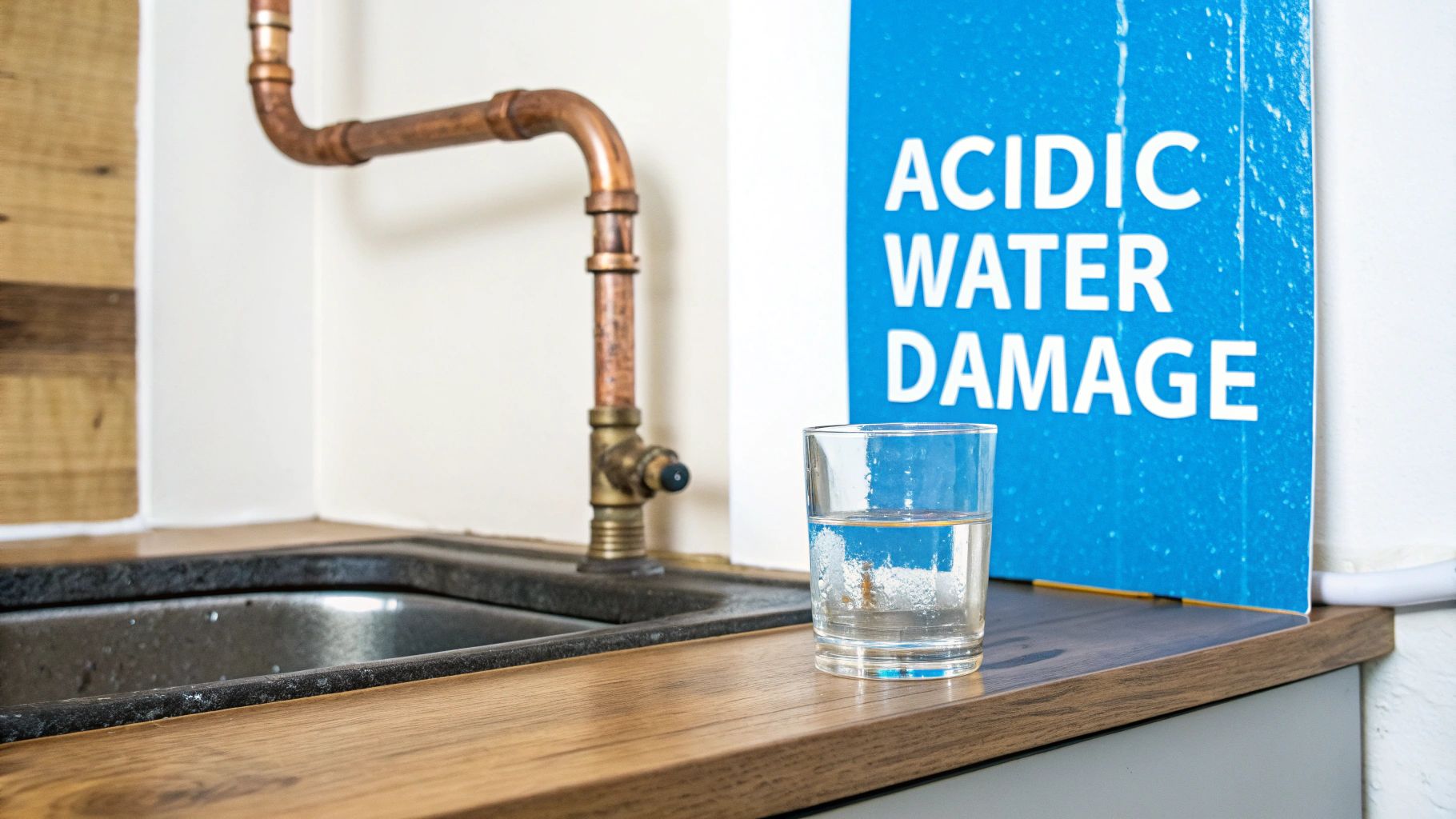
This means it’s slowly but surely dissolving your home’s plumbing. Copper pipes are its favorite snack. Over time, that acidic water can lead to pinhole leaks, water damage, and even mold—a trio of expensive, frustrating problems you didn't sign up for.
The Hidden Risks in Your Drinking Water
Beyond the structural drama, there are health concerns to consider. As corrosive water travels through your pipes, it can leach heavy metals straight into the water you use for drinking, cooking, and bathing. It's like your plumbing is turning against you.
This process can introduce some unwelcome guests into your daily routine:
- Copper: High levels can cause stomach issues and, over the long haul, may lead to liver or kidney damage.
- Lead: If your home has older plumbing, acidic water dramatically increases the risk of lead contamination. Lead is a potent neurotoxin with no safe level of exposure.
- Zinc: While not as toxic, too much zinc can give your water that metallic taste and cause nausea.
Basically, your own plumbing turns into an unintentional contamination source. Fixing your water's pH isn't just about home maintenance—it's a crucial step in keeping your family safe.
The EPA doesn't regulate pH as a primary contaminant, but it does recommend keeping municipal water between 6.5 and 8.5. This range is the sweet spot for preventing pipe corrosion and stopping harmful metals from crashing your party.
It's Not Just About the Pipes
The damage doesn't stop with your plumbing. Acidic water affects just about every water-using appliance in your home. It can drastically shorten the lifespan of water heaters, dishwashers, and washing machines by corroding their internal parts. If you're invested in the health of your home's systems, you might find our guide on choosing a water heater useful as well.
Taking care of low pH is a proactive move that saves money and prevents those "why me?" appliance breakdowns. For more deep dives into home water systems, check out our advice section, which is packed with practical tips. Now, let's get into the solutions for bringing balance back to your H2O.
How to Accurately Test Your Water's pH Level
Before you try to fix anything, you need to know what you're up against. Trying to raise your water’s pH without knowing its starting point is like trying to bake a cake without a recipe—a total shot in the dark. An accurate test is your non-negotiable first step.
Think about it this way: a pH reading of 6.2 isn't just a number. It’s a bright red flag screaming that your water is acidic enough to start dissolving your copper plumbing. Getting that exact number is crucial because it tells you how serious the problem is and helps you pick the right filtration weapon.
Choosing Your Testing Method
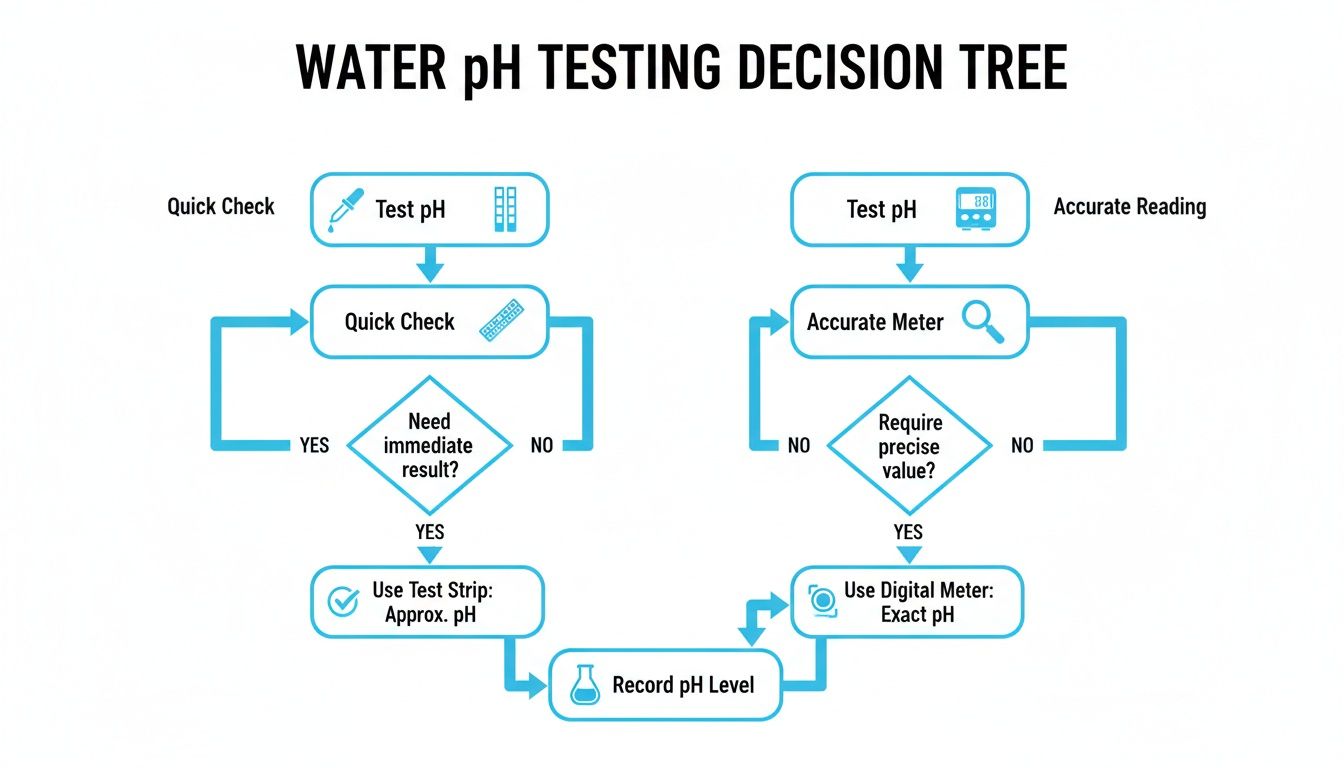
When it comes to checking your water's pH at home, you’ve got a few solid options. There’s no single “best” way to do it; it really comes down to a balance of convenience, how precise you need to be, and your budget.
Here’s a quick rundown of the most common tools in the water testing arsenal:
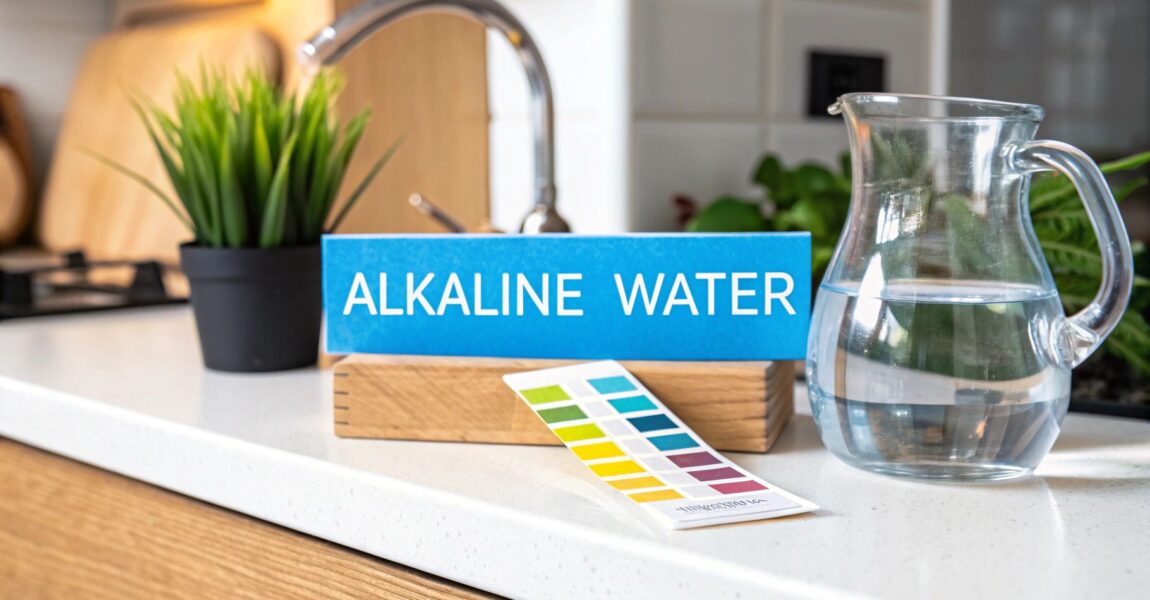
- Litmus Strips (pH Test Strips): These are by far the easiest and cheapest way to get a ballpark figure. Just dip a strip in your water, watch the color show, and match it to the included chart. They’re perfect for a quick spot-check but don't expect lab-grade accuracy.
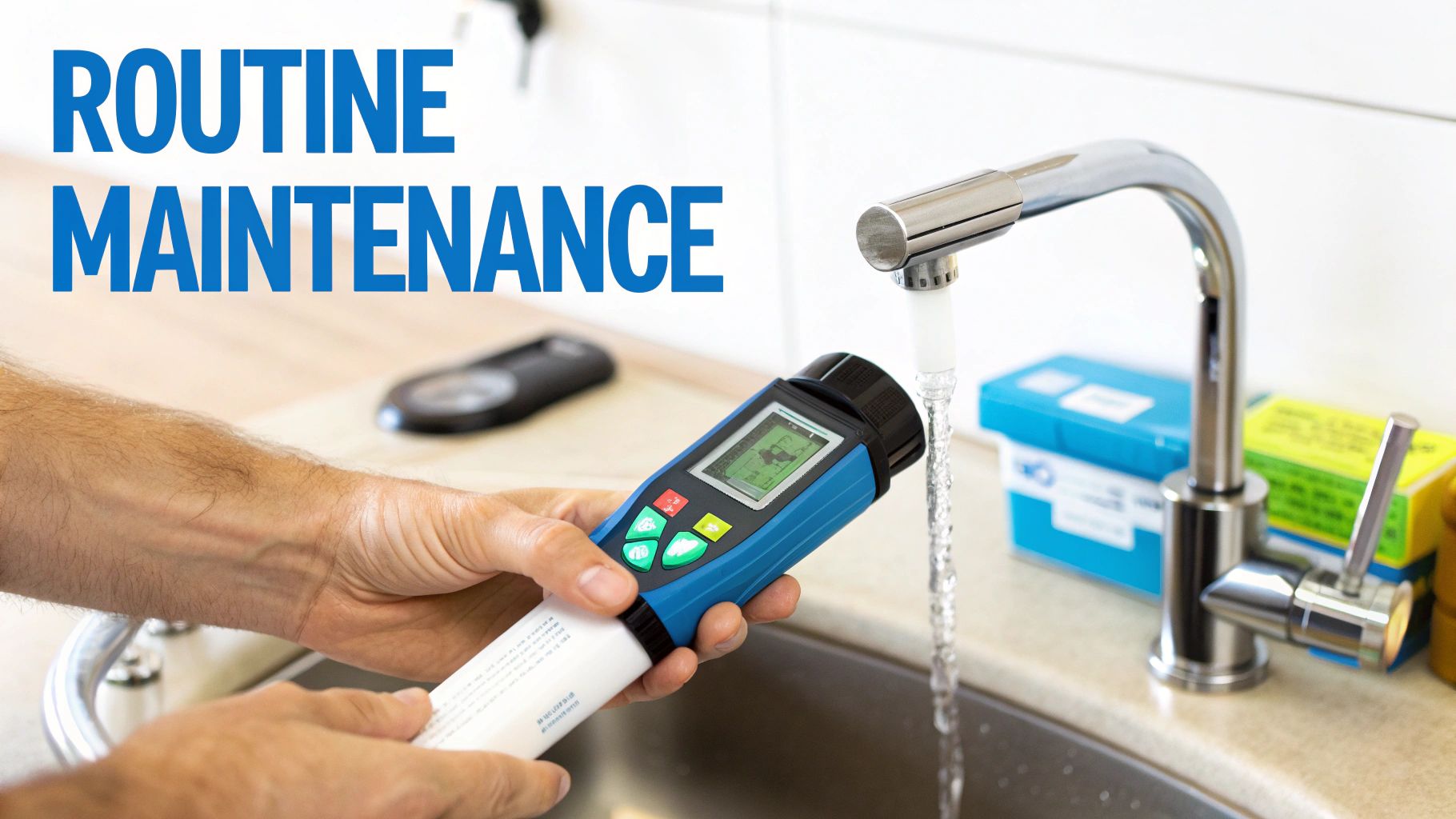
- Digital pH Meters: If you're a data geek who needs a reliable number, a digital meter is your best friend. These handheld gadgets give you a direct numerical reading, often down to two decimal places. You’ll need to calibrate them periodically, but they’re a huge step up from strips for home filtration diagnostics.
- Professional Lab Testing: This is the gold standard. You collect a water sample using the lab’s kit and mail it in. It’s more expensive, but a lab report will give you a precise pH and can also screen for other nasty stuff that low pH water might be leaching from your pipes, like heavy metals.
My Two Cents: If you suspect your low pH has been a long-term problem, or if you live in an older house, just spring for the professional lab test at least once. It gives you a complete chemical snapshot of your water and priceless peace of mind.
Getting a Clean and Reliable Water Sample
No matter which test you use, your results are only as good as your sample. It's incredibly easy to accidentally contaminate it, which throws off the reading and can send you down the wrong filtration path.
To make sure your test actually reflects what's in your pipes, follow these simple but critical steps:
- Pick the Right Tap: Use a cold water faucet that doesn’t have a fancy aerator or softener hooked up to it. Your kitchen sink or an outdoor spigot is usually a safe bet.
- Let It Run: Turn on the cold water and let it run for a solid 2-3 minutes. This clears out any water that’s been sitting stagnant in the pipes and gives you a true sample from your main supply.
- Use a Clean Container: Grab a sterile bottle or a squeaky-clean glass. If you're reusing something, wash it thoroughly with soap and hot water, then rinse it out a few times to get rid of any residue.
- Test It Immediately: As soon as water hits the air, carbon dioxide starts to dissolve into it, which can ever so slightly alter the pH. For the most accurate reading, test the sample right after you collect it.
Once you have that solid number, you’re not guessing anymore. You’ve got the data you need to choose the right water filtration method, protect your home, and make your water safe.
Using Chemical Dosing for Precise pH Adjustment
Sometimes, the gentle approach just won't cut it, especially when you're battling seriously acidic water. If your home's pH is stubbornly low, you need to bring in the big guns. This is where chemical feed systems shine—they’re the gold standard for getting precise, consistent pH control for your entire house.
Think of it as a custom-tailored treatment for your water the second it enters your home. These systems don't just buffer the water; they actively inject a neutralizing solution to get the pH exactly where you want it. It's a proactive strategy for anyone who needs reliable, professional-grade results from their water filtration setup.
How Chemical Injection Systems Work
The heart of the system is a chemical feed pump paired with a solution tank. It's installed right where your main water line enters the house, usually after the pressure tank on a well or after the main shutoff valve for city water. The process is surprisingly straightforward.
A neutralizing solution—typically soda ash (sodium carbonate) mixed with water—sits in the tank. As water flows into your home, the pump injects a tiny, precisely measured dose into the waterline. This instantly neutralizes the acidity, raising the pH long before the water reaches your faucets, showers, or appliances.
This filtration method is incredibly effective for a few reasons:
- Precision: You can dial in the exact amount of solution needed to hit your target pH. This makes it perfect for water that is very acidic (think pH below 6.0).
- Consistency: Unlike some filter media that can lose effectiveness over time, a chemical feed system delivers the same dose as long as the solution tank is full.
- Power: It can easily handle high flow rates and severe acidity levels that would overwhelm a standard neutralizing filter.
Calculating the Right Dose for Your Home
Getting the dosage right is the most critical part of the setup. It feels a bit like a science experiment at first, but once you find that sweet spot, the system is largely a set-and-forget operation. Your calculation will hinge on two main things: your water’s starting pH and your home's water flow rate.
You'll start by mixing a soda ash solution. A good starting point is to mix one to two pounds of soda ash per five gallons of water in your solution tank. After it's mixed, you’ll adjust the pump's feed rate based on your test results. The goal is to find a setting that consistently brings your tap water into that ideal 7.0 to 8.0 pH range.
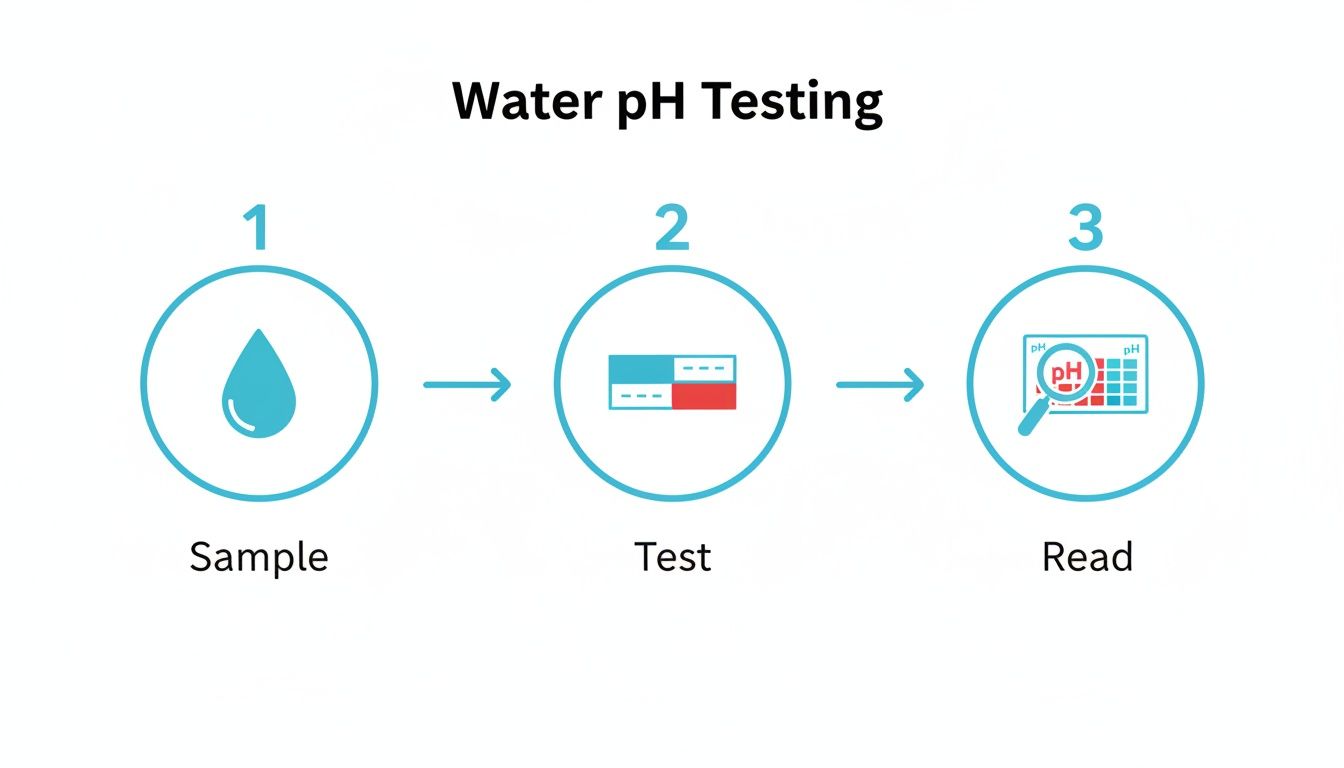
This simple loop of testing, treating, and re-testing is the key to dialing in the perfect pH level for your home.
Pro Tip: Don't try to get it perfect on day one. Start with a lower injection rate, let the system run for 24 hours, and then test the water from a faucet far away from the entry point. Gradually increase the dose until you get a stable, desirable reading.
A Scaled-Down Professional Method
This might sound like an industrial-level solution, and in a way, it is. Municipal water treatment plants use a very similar concept to manage the pH for entire cities. In fact, one of the most common ways to raise the pH of acidic water in treatment plants is by adding alkalis like lime—a practice that's been standard for a century.
These facilities use precise dosing to ensure water is non-corrosive and safe, often aiming for the EPA-recommended range of 6.5-8.5. Chemical injection lets them respond to changes in the raw water source, protecting billions of dollars in infrastructure from corrosion. You can learn more about how crucial pH control is in large-scale operations from the experts at Walchem.com.
By installing a chemical feed system, you’re essentially bringing that same level of control and technology into your own home filtration system, just on a much smaller scale.
Safety and Maintenance Considerations
While this method is highly effective, it does require a bit more hands-on attention than a passive filter. Handling soda ash requires care—it can be an irritant, so always wear gloves and eye protection when you're mixing up a new batch.
Routine maintenance is also part of the deal. You’ll need to:
- Refill the Solution Tank: Depending on your water usage and acidity, this could be every few weeks or every few months.
- Check the Injection Point: Give the injection fitting a quick inspection every now and then to make sure it isn't getting clogged with mineral buildup.
- Monitor the Pump: Listen to the pump to make sure it’s running smoothly and priming correctly after you refill the tank.
For homeowners facing serious acidity issues, a chemical dosing system is an investment that pays for itself by protecting your entire plumbing network from expensive corrosion damage. It provides a level of control that no other filtration method can really match.
Neutralizing Filters: The Set It and Forget It Solution
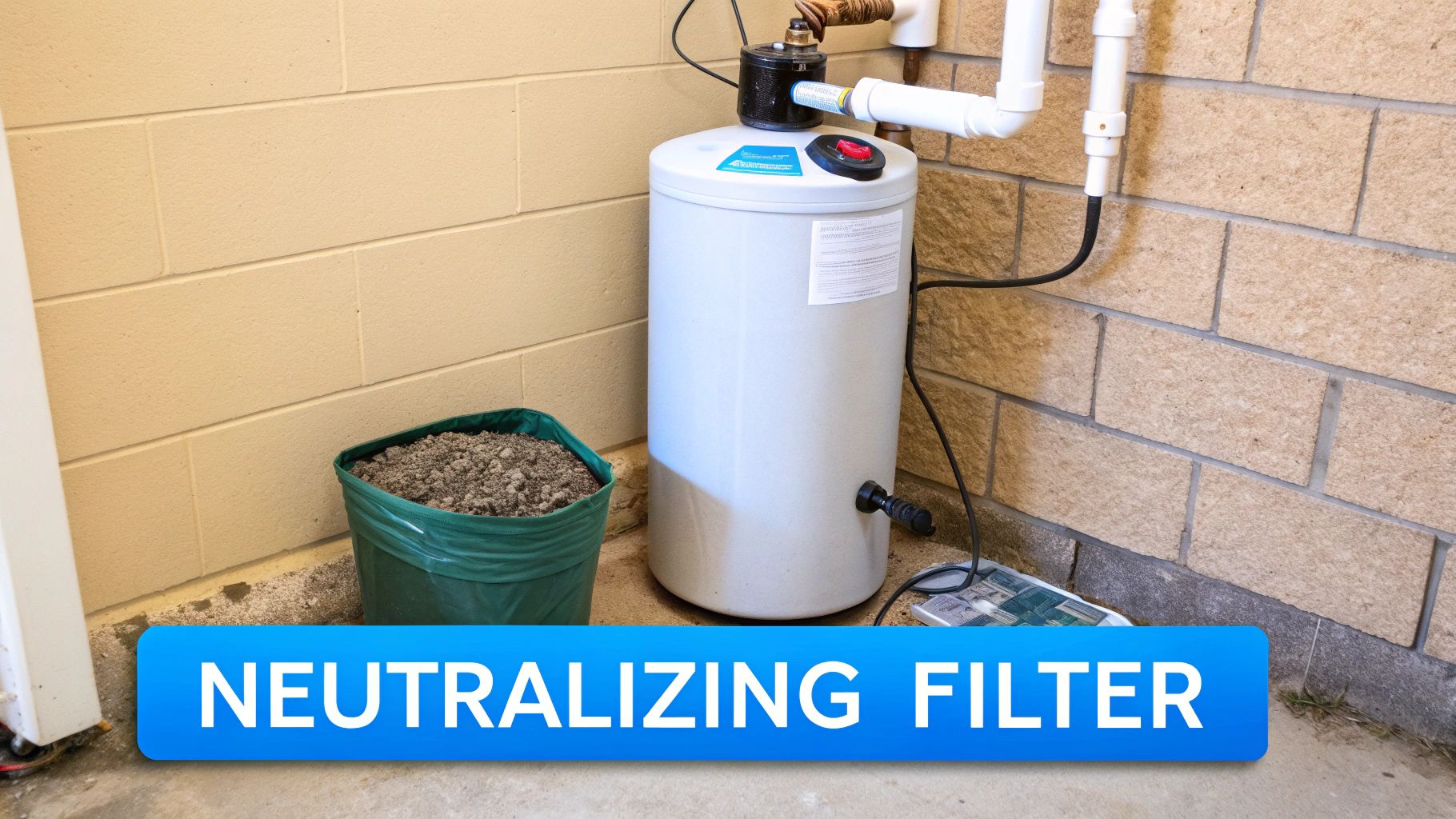
If you're looking for a fix for acidic water that doesn't involve playing chemist in your basement, a neutralizing filter is your hero. These systems are the quiet workhorses of home water filtration, raising your water's pH behind the scenes with practically zero daily effort on your part.
Think of it as a passive, whole-house guardian. Once it's installed on your main water line, it automatically balances your water before it ever touches your pipes, faucets, or appliances. For anyone who values a low-maintenance approach, this is a total game-changer.
How These Filters Work Their Magic
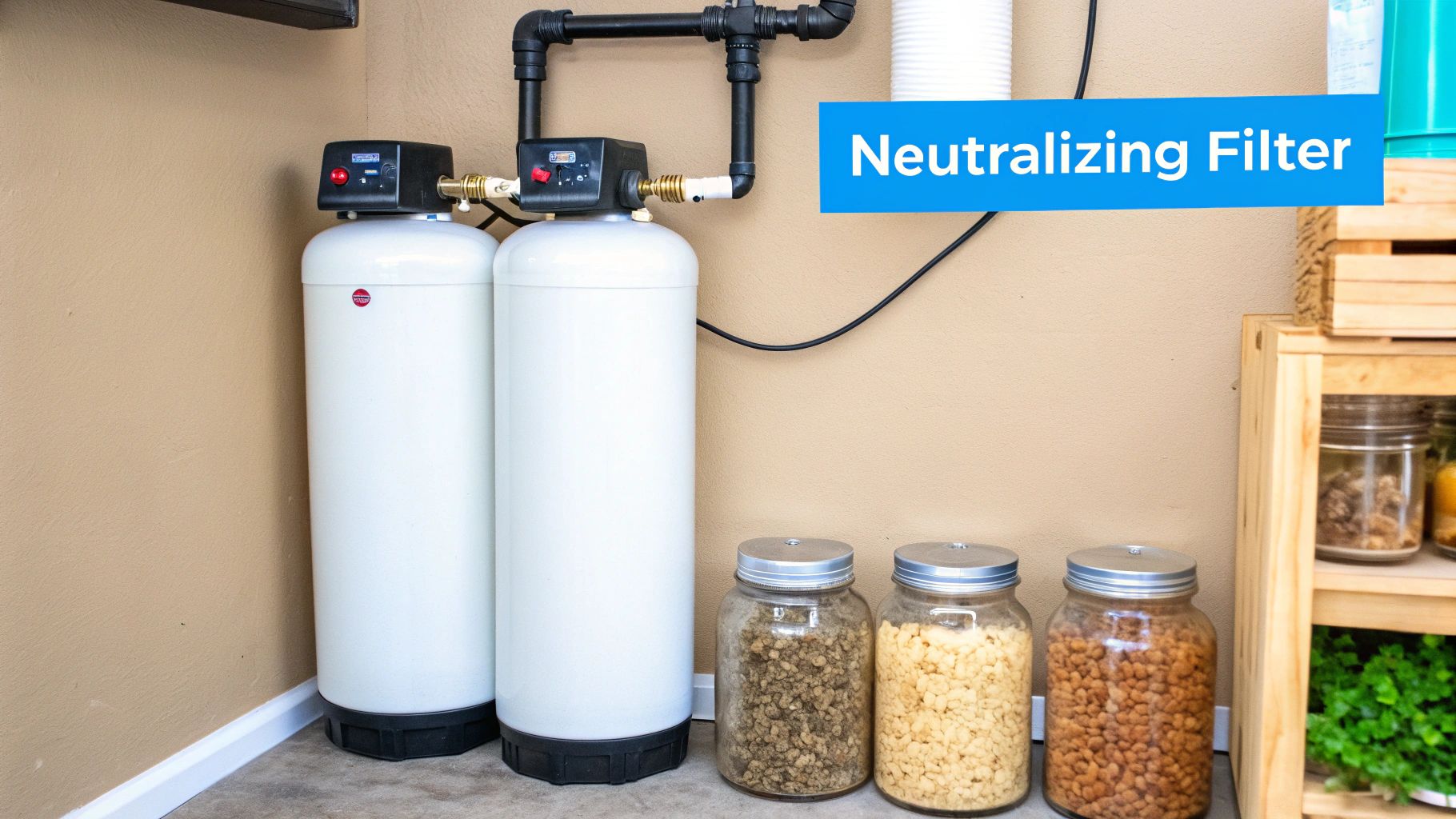
The science behind a neutralizing filter is beautifully simple. It's a large tank filled with a special mineral media. As acidic water flows up through the tank, it passes over this bed of minerals, which slowly dissolve. This process naturally neutralizes the acidity, raising the pH to a safe, non-corrosive level.
This has been a trusted, chemical-free method for pH adjustment in drinking water since the 1970s. For it to work right, the filter needs to be sized properly to give the water enough "contact time" with the media. A good rule of thumb is keeping flow rates under 3.0 gallons per minute per square foot of media, which allows the minerals enough time to dissolve and do their job.
The two main types of media you'll run into are:
- Calcite: This is the go-to choice for most homes. It’s essentially crushed and screened white marble (calcium carbonate). It's self-limiting, meaning it will only dissolve enough to bring the pH to around neutral (7.0) and won't overcorrect it.
- Corosex: This is magnesium oxide, a much more potent and reactive material. It's usually reserved for very acidic water (below a 6.0 pH) because it can raise the pH much higher and faster. You'll often see it mixed in small amounts with calcite for an extra kick.
Real-World Scenario: Let's say your well water tests at a pH of 5.8. A filter with only calcite might struggle to get the pH high enough. A water pro would likely recommend a blend of about 90% calcite and 10% Corosex to effectively bring the pH up to a healthier 7.2.
Comparing pH Neutralizing Filter Media
Picking the right media is crucial. You want to solve the acidity problem without accidentally creating a new one. When looking at Calcite vs. Corosex, it really comes down to how low your pH is to start.
Here's a quick table to break down the key differences between these two workhorses.
| Feature | Calcite (Calcium Carbonate) | Corosex (Magnesium Oxide) |
|---|---|---|
| Best For | Moderately acidic water (pH 6.0-6.9) | Very acidic water (pH 4.5-6.0) |
| Effectiveness | Raises pH to a neutral 7.0-7.5. It's self-limiting. | Can raise pH well above 8.0 if not carefully managed or blended. |
| Dissolving Rate | Slow and steady, requiring less frequent replenishment. | Dissolves much faster, requiring more frequent media top-ups. |
| Impact on Hardness | Adds calcium hardness to the water. | Adds significant magnesium hardness. |
| Primary Trade-Off | May not be powerful enough for severely acidic conditions. | Risk of over-correction, which can lead to cloudy water or scale. |
| Common Application | Used alone for the majority of residential pH correction needs. | Typically mixed in small ratios (5-10%) with calcite for a boost. |
Ultimately, Calcite is the safe bet for most situations. You only bring in Corosex when you have seriously aggressive, low-pH water that needs a more powerful filtration solution.
Sizing and Installation Considerations
A great neutralizing filter isn't just about what's inside—its size and setup are just as important. If a system is too small for your home's water demand, the water will rush through too quickly, and you won't get complete neutralization.
Here’s what you need for a successful setup:
- Correct Sizing: The filter size must match your household's peak water flow rate. A typical family of four might need a filter that can handle 8-10 gallons per minute (GPM) to keep water pressure steady when the shower and dishwasher are running at the same time.
- Upflow vs. Downflow: Most modern systems are upflow filters. This design is better because it lifts the media bed as water flows through, preventing it from packing down and creating channels. The result is more even treatment and less need for backwashing.
- Media Replenishment: That mineral media is a consumable—it dissolves over time. You'll need to top off the tank periodically, which is usually a simple DIY job you do every 6 to 12 months, depending on your water's acidity and usage.
The biggest trade-off with a neutralizing filter is that it will increase your water's hardness. You're essentially turning soft, acidic water into harder, alkaline water by dissolving calcium and magnesium. For most people, that's a fair trade, but if your water gets too hard, you might consider installing a water softener after the neutralizing filter to get the best of both worlds.
Simple DIY Fixes for Your Drinking Water
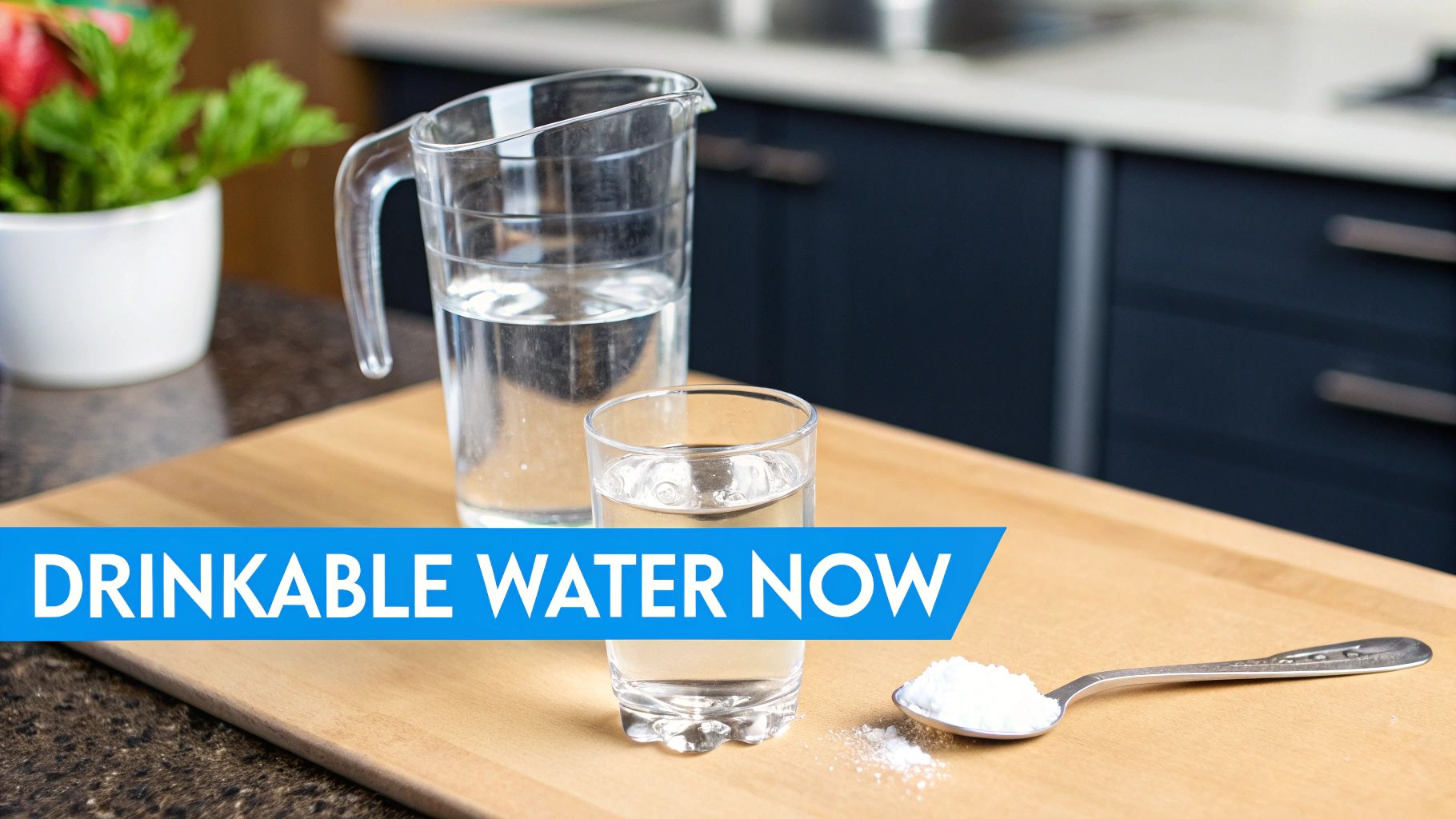
Not everyone is ready to install a whole-house water treatment system, and that's okay. If you're looking for simple, budget-friendly ways to improve your drinking water, you’ve got options. These solutions are perfect for renters or anyone who just wants to focus on the water coming out of the tap.
Let’s get straight to the practical, point-of-use fixes that give you immediate results without a huge commitment.
Alkaline Water Pitchers and Filters
Probably the easiest way to start raising your water's pH is with an alkaline water pitcher or a faucet-mounted filter. These things are incredibly simple to use and don't require any permanent installation, which is a lifesaver for apartment dwellers.
The real work happens inside the filter cartridge. As your tap water flows through, it passes over a special blend of natural minerals.
These cartridges are usually packed with a few key ingredients:
- Calcium and Magnesium: These are the heavy lifters. They dissolve into the water, gently boosting its pH and making it taste better.
- Tourmaline Ceramics: You'll sometimes see these included to enhance the water's alkalinity and antioxidant properties.
- Activated Carbon: This is a classic for a reason. It's fantastic at grabbing contaminants like chlorine, which is a game-changer for improving the water's smell and taste.
So, you're not just raising the pH. You're also re-mineralizing the water with healthy stuff that other filters often strip out. It's a simple swap for your regular pitcher that makes a big difference.
A Measured Approach with Baking Soda
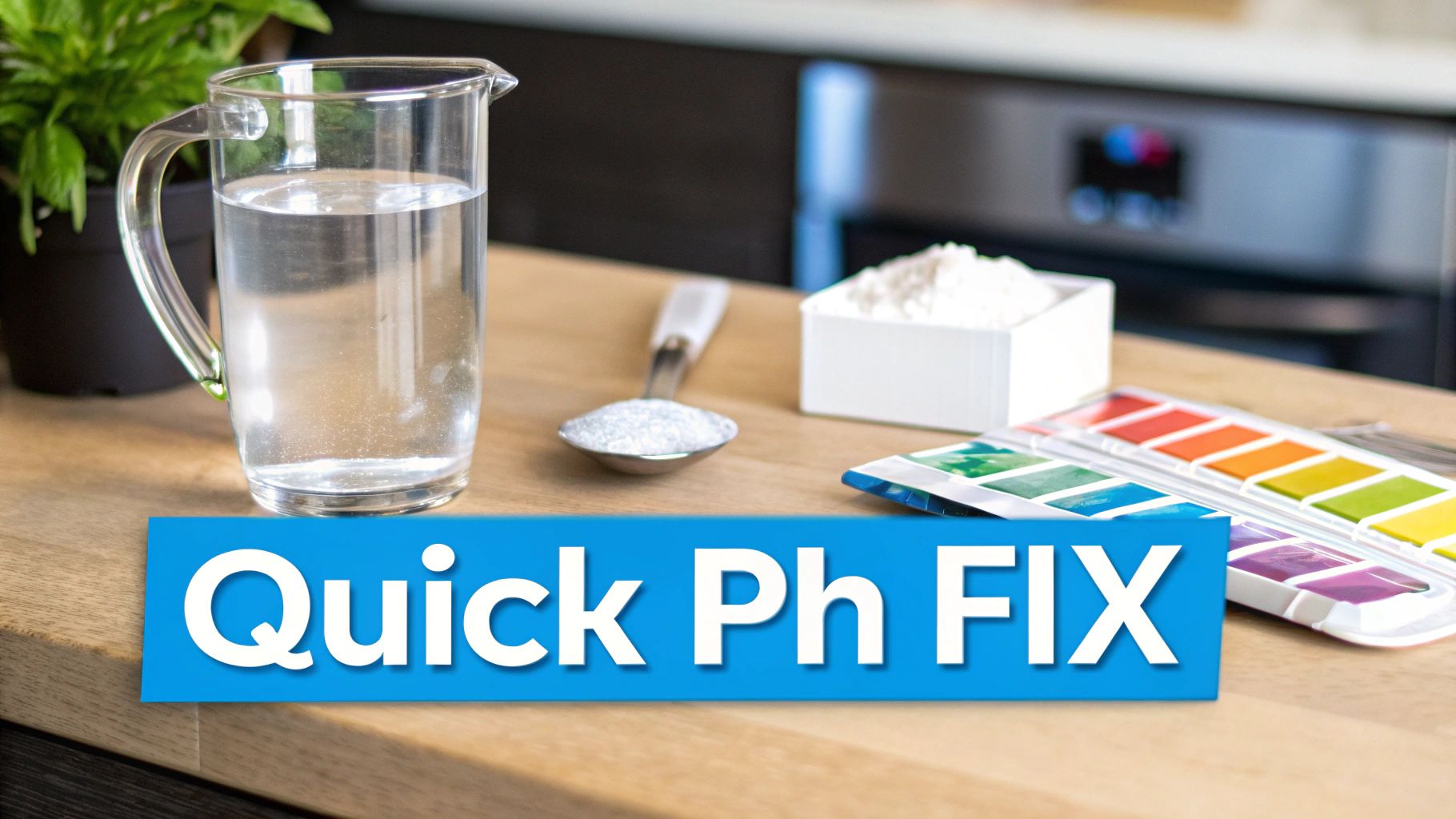
For a quick, manual adjustment, you can turn to a kitchen staple: baking soda (sodium bicarbonate). This method is really only for balancing a single glass or a small pitcher of water, and you need to be precise. You are, after all, adding it directly to your drink.
The key here is that less is always more. You're trying to neutralize acidity, not make your water taste like the ocean.
Start with a tiny pinch—no more than 1/8 teaspoon of baking soda for a full gallon of water. Mix it until it's totally dissolved, then test the pH. You can add a tiny bit more if needed, but it's always smart to start small.
This is a great fix in a pinch if your water tastes a little sharp or acidic. But let's be honest, it’s not a practical long-term strategy for all your drinking water. Measuring and mixing every single time gets old fast.
The Ancient Wisdom of Clay Pots
If you want a more natural, hands-off approach, look no further than an ancient technology that’s getting a second look from modern science: the humble clay pot. People have used unglazed earthenware for thousands of years to store and cool water, but it turns out it does a lot more.
The porous clay naturally leaches beneficial minerals into the water. This process can significantly bump up the water’s alkalinity without any chemicals or electricity. And the research backs it up.
One study showed that just storing tap water in clay pots for 24 hours can dramatically raise its pH. The average pH levels jumped from neutral or acidic all the way up to a highly alkaline 9.5-10.0. With around 10-15% of households in the US and EU already tweaking their water for wellness, this zero-cost method is a powerful alternative. You can dig into the study's details on Eman Research Publishing.
It's a perfect example of how to raise the pH of water using simple, sustainable principles. Sometimes the best solutions have been right in front of us all along.
A Few Common Questions About Raising Water pH
Once you realize your water's pH is off, a bunch of questions usually pop up. It’s a bit of a journey from spotting the problem to landing on the right fix for your home, so it's totally normal to have a few things you're wondering about. Here are some quick answers to the questions we get all the time.
How Much Baking Soda Do I Need for Drinking Water?
If you're just adjusting a pitcher of drinking water, remember that less is more. The best way to go about it is to start with a tiny amount and test as you go.
I'd recommend starting with just 1/8 to 1/4 teaspoon of baking soda for every gallon of water. Stir it in until it's totally dissolved, then grab your pH tester and see where you're at. The idea is to get a nice, balanced taste, not to make your water salty. You can always add a little more if you need to, but you can't take it back out.
Will Raising My Water's pH Make It Hard?
That's a great question, and the honest answer is: it depends entirely on the filtration method you use. Different treatment systems affect your water's chemistry in different ways.
Here's a quick look at the two main whole-house options:
- A calcite neutralizing filter works by dissolving calcium carbonate directly into your water. This will, without a doubt, increase the calcium hardness. It's something you have to keep an eye on, because if the hardness gets too high, you might need to look into a water softener to deal with it.
- A soda ash injection system is a different beast altogether. It's designed specifically to raise pH without messing with hardness too much. This system uses sodium carbonate, which neutralizes the acidity but adds very little to the water's overall mineral load.
Is It Actually Safe to Drink High pH Water?
For the most part, yes. Water that's moderately alkaline—usually in the pH range of 7.5 to 9.0—is considered perfectly safe to drink. In fact, a lot of people find it has a smoother, less metallic taste than acidic water.
The only time you'd need to worry is with extremely high pH levels, which are way beyond what any home treatment system is designed to produce. When a filtration system is installed and maintained correctly, its job is to bring your water into a healthy, balanced state, not push it into dangerously alkaline territory. That’s exactly why testing your water and choosing the right solution is so important.
The goal here is balance. You're not trying to create some kind of super-alkaline water. You're just trying to neutralize acidic, corrosive water to protect your plumbing and keep your family healthy.
Can I Use These Methods for My Aquarium or Garden?
Tackling the water for special uses like a fish tank or your garden is a whole different ball game and requires a lot more caution. What's good for your pipes isn't always what's best for your fish or plants.
For aquariums, you absolutely need to use pH buffers made specifically for aquatic life. The simple household solutions we use for tap water can add minerals or other compounds that are flat-out harmful to fish and can throw the tank's delicate ecosystem completely out of whack.
And for the garden, raising your water's pH can spell trouble for any acid-loving plants you have. Things like blueberries, azaleas, and hydrangeas need acidic soil to thrive, and they'll really struggle if you're watering them with alkaline water. Always think about your plants' specific needs before you start adjusting their water source.
At Water Filter Advisor, we're all about helping you find the perfect filtration solution for whatever your home throws at you. From detailed guides to honest reviews, we give you the info you need to make a smart decision. Check out all our resources at https://www.waterfilteradvisor.com.