Is Your Tap Water *Really* Clean? The Filtered Truth

We’ve all been there—holding a glass under the tap, pausing for a split second, and wondering, is this stuff actually safe to drink? That moment of hesitation is more common than you think. While our cities do a pretty good job treating our water, what they consider "safe" might not line up with what you consider ideal for your family. Think of municipal treatment as the first draft. A home water filter? That's your final, polished edit.

This guide is all about taking back control. We’re going to dive into why home filtration isn't just a luxury—it's the crucial last step to ensuring the water in your glass is as pure as it can possibly be.

The Unfiltered Truth About Your Tap Water
A clean glass of water being filled from a modern kitchen tap.

Imagine your water is a VIP guest traveling to a gala (your faucet). It leaves the treatment plant looking sharp and clean. But then it has to navigate miles of old, sometimes ancient, underground pipes. Along the way, it can pick up some rather unsavory party crashers.

This is the "last mile" problem. The water was clean when it started its journey, but the trip itself can introduce a whole host of contaminants. That's where a home filtration system steps in, acting like a personal bouncer at your kitchen sink, ensuring only the invited guest—pure water—gets through.

Why Municipal Treatment Is Only Half the Story

Your local water utility is fighting the big battles, neutralizing major threats before they send water into the system. But they can't control the unique conditions of every pipe between their plant and your home. Things like local plumbing integrity and even things like backflow prevention device inspections play a role. A home filter closes that gap.

Think of a home filtration system as your personal quality control manager. It's the final checkpoint that guarantees the water making it into your coffee, your soup, and your drinking glass is nothing but the best.

A Global Thirst for Purity

This isn't just about what's happening in your town. Globally, the quest for clean water is a massive challenge. In 2022, a report from WHO and UNICEF revealed that 1.7 billion people were using drinking water sources contaminated with feces. Even in developed countries, the journey through aging infrastructure means risks remain. It's a powerful reminder that the final say on water quality should happen right at your tap.

What Party Crashers Are Hiding in Your Water?
A magnifying glass held over a glass of water, showing illustrative particles.

Even crystal-clear water can be a crowded party of invisible gatecrashers. Let's meet the usual suspects that your personal filter-bouncer might need to show the door.

Without a filter, you’re essentially trusting that none of these troublemakers hitched a ride into your home. A good filter lets you stop trusting and start knowing.

The Chemical Crew

The most famous member of this group is chlorine. It’s the chemical bouncer hired by the city to kill off dangerous bacteria. It does its job, but it has a bad habit of lingering, leaving behind that "public pool" taste and smell. A simple carbon filter can politely ask it to leave.

But some uninvited chemical guests are far more sinister. Lead is a major villain, often leaching from old pipes and solder. The scary part? There is no safe level of lead exposure. This makes a filter that specifically targets lead an absolute must-have for many homes.

Then there are the stealthier chemicals: pesticides from farm runoff, herbicides, and industrial chemicals known as volatile organic compounds (VOCs). They're the shadowy figures in the corner you definitely don't want sticking around.

Even after a major disaster like a wildfire, toxic chemicals from burnt infrastructure can contaminate the underground pipe network. This can introduce dangerous compounds like benzene into the water supply, posing serious health risks long after the event.

The Gritty Gang

Next up are the physical particles that make your water less than perfect. They might not be a direct health threat, but they're certainly not welcome.

  • Sediment, Silt, and Rust: These are the clumsy party guests who knock things over. They come from old pipes and can make your water cloudy, taste metallic, and even stain your sinks and clothes.
  • Microplastics: This is a growing problem. Tiny plastic fragments from countless sources are now found in tap water around the world. We're still learning about the long-term health effects, but who wants to be a guinea pig? A quality filter is your best bet for keeping them out.

The Biological Bugs

Even with city-level disinfection, there's always a tiny chance of biological contaminants showing up, especially if a pipe breaks. These are the microscopic menaces a filter can stop dead in their tracks.

  • Bacteria and Viruses: Pathogens that can cause nasty, immediate stomach issues.
  • Cysts: Think of these as microbial tanks. Hardy parasites like Giardia and Cryptosporidium are resistant to chlorine and can make you seriously ill.

This rogue's gallery shows why a multi-talented filtration system is so important.

Common Tap Water Contaminants and Their Sources

Contaminant Common Source Potential Impact
Lead Leaching from old pipes, solder, and fixtures Developmental issues, neurological damage
Chlorine Municipal water treatment disinfectant Unpleasant taste and odor
Pesticides/Herbicides Agricultural and urban runoff Potential long-term health risks
VOCs (e.g., Benzene) Industrial pollution, fuel spills, solvents Can increase cancer risk; liver/kidney damage
Sediment/Rust Corrosion of old water mains and plumbing Cloudy water, poor taste, stains fixtures
Microplastics Breakdown of plastic waste, synthetic fibers Health effects are still being studied
Bacteria/Viruses Contamination from sewage or animal waste Gastrointestinal illness (e.g., E. coli)
Cysts (Giardia) Contamination from human/animal feces Severe diarrheal disease ("Beaver Fever")

A home water filter isn't just an appliance; it's a personalized security detail for your drinking water, ensuring it's pure the moment it hits your glass.

How to Decode Your Local Water Quality Report

Every year, your water utility releases a document called a Consumer Confidence Report (CCR). Let's be real: it often looks like a rejected script from a science show, filled with charts and jargon.

But don't throw it away! This report is your secret weapon. It's a report card that tells you exactly what contaminants were found in your water over the past year. You can find it on your utility's website or by searching for "[Your City Name] water quality report."

Translating the Geek-Speak

Once you have the report, you need to know two key terms:

  • Maximum Contaminant Level (MCL): This is the legal limit. It's the highest amount of a substance allowed in drinking water.
  • Maximum Contaminant Level Goal (MCLG): This is the health goal. It's the level where there's no known health risk. This is the perfect-world number.

The most eye-opening part is the gap between the MCL (legal) and the MCLG (ideal). For nasty stuff like lead, the health goal (MCLG) is zero. But the legal limit (MCL) is higher. This creates a "legally acceptable" risk that you might not find acceptable at all.

From Report to Filter: Connecting the Dots

This is where you become the hero of your home's water story. Scan your report for any contaminant with a level above the MCLG, even if it’s below the legal MCL. Those are the specific party crashers that made it past the city's security.

Your report might show trace amounts of lead, pesticides, or disinfection byproducts. Now, the question isn't a vague "is my water safe?" It's a laser-focused "how do I get rid of these specific things?" This insight lets you choose a filter that’s a sharpshooter, targeting your water’s unique problems.

Choosing Your Filtration Champion

Alright, you've unmasked the villains in your water report. Now it's time to choose your champion—the right home water filter for the job. It sounds daunting, but it’s really about matching the filter's superpower to the specific contaminant you want to defeat.

You wouldn't hire a bodyguard who's great at spotting pickpockets if your main threat is a cyber-attack. The same logic applies here. Match the tool to the task.

From Bouncer to Fortress: Know Your Tech

Let's meet the main players. First up, activated carbon filters. These are the friendly bouncers at the door. You’ll find them in pitchers and faucet-mounted filters. They excel at grabbing chlorine, which instantly makes your water taste and smell fantastic. They're an affordable and effective first line of defense.

On the other end of the spectrum is Reverse Osmosis (RO). This is your impenetrable fortress. An RO system, usually installed under the sink, uses a semi-permeable membrane to muscle out nearly everything that isn't pure water. It's a beast, wiping out tough contaminants like lead, arsenic, fluoride, and countless other dissolved solids.

This chart is your treasure map, guiding you from your water report to the right filtration system.
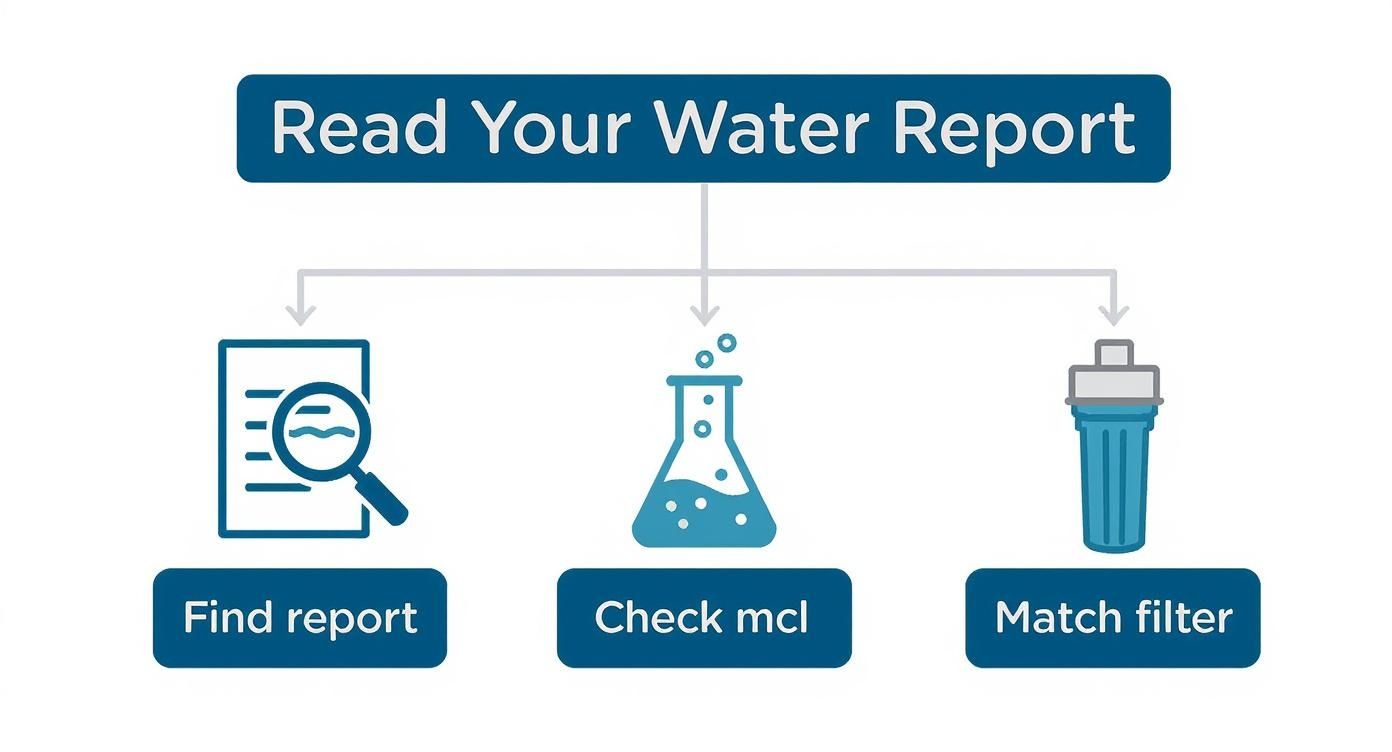
Infographic decision tree for choosing a water filter based on a water quality report.

The key takeaway? Your water report empowers you to make an informed choice, not a wild guess.

The Full Spectrum of Water Warriors

There’s a whole world of options between a simple pitcher and a full-blown RO system. Getting to know them helps you pick the perfect ally for your home.

This table breaks down the most popular filtration technologies, showing what they're best at, what they cost, and how much upkeep they need.

Comparing Home Water Filter Technologies

Filtration Type Best For Removing Average Cost Maintenance Level
Pitcher/Dispenser Filters Chlorine, taste, odor $20 – $70 High (frequent filter changes)
Faucet-Mounted Filters Chlorine, some lead, VOCs $30 – $100 Moderate (replace every 2-3 months)
Countertop Filters Wider range of contaminants than pitchers $50 – $300 Moderate (replace every 6-12 months)
Under-Sink Filters Lead, cysts, chlorine, VOCs, sediment $100 – $500+ Low (replace annually)
Reverse Osmosis (RO) Lead, arsenic, fluoride, TDS, nitrates $200 – $1,000+ Moderate (multiple filters/membrane)
Whole-House Systems Sediment, chlorine, hard water minerals $500 – $3,000+ Low to Moderate (depends on system)

The perfect filter for you is one that balances powerful performance with a price and maintenance schedule you can live with.

Matching Your Filter to Your Foe

So how do you make the final decision? Just line up the problem from your water report with a filter's known strengths. Here are a few scenarios:

  1. Foe: Your water tastes like it came from a swimming pool.

    • Champion: An activated carbon filter (pitcher, faucet, or under-sink) is the perfect, budget-friendly hero.
  2. Foe: Your report shows lead levels are above the zero-tolerance health goal.

    • Champion: A Reverse Osmosis (RO) system is your super-soldier. It offers the highest level of protection against lead.
  3. Foe: You have hard water leaving crusty deposits everywhere, and your water is full of sediment.

    • Champion: A whole-house filtration system, often paired with a water softener, is your all-in-one solution. It protects every tap and appliance in your home.

Choosing a filter is a big deal, but it becomes simple when you focus on solving a specific problem. For a deep dive into models and brands, check out this extensive collection of water filter advice. It’s a fantastic resource for finding the perfect filtration partner for your home.

The Everyday Perks of Filtered Water

Switching to a home water filter does more than just banish invisible contaminants—it delivers an immediate, noticeable upgrade to your daily life. The first thing you'll experience is the taste. It's like switching from standard definition to 4K for your taste buds.

This simple upgrade creates a ripple effect. Your morning coffee is suddenly richer. Your tea is cleaner and brighter. Even simple foods like pasta and steamed vegetables taste purer, free from that subtle chemical background noise you didn't even know was there.

Beyond a Better-Tasting Brew

The benefits go far beyond flavor. By consistently filtering out contaminants like lead, VOCs, and disinfection byproducts, you reduce your family's daily exposure to substances linked to long-term health issues.

It's a proactive health investment. Every glass of filtered water you drink is a small, positive step toward long-term wellness, giving you priceless peace of mind.

It's easy to take clean water for granted. But a staggering 2.1 billion people worldwide still lack access to safely managed drinking water. You can learn more about this global challenge in a report from WHO and UNICEF.

A Win for Your Wallet and the Planet

Let's talk dollars and sense. Yes, there's an upfront cost for a filtration system. But it pays for itself surprisingly quickly once you break free from the endless cycle of buying bottled water.

And the environmental win is huge. Every time you refill a glass from your tap, you're preventing another plastic bottle from ending up in a landfill or the ocean. Filtering at home is a triple win:

  • For Your Health: You're in complete control of your water quality.
  • For Your Wallet: You stop renting your water from beverage companies.
  • For The Planet: You dramatically reduce your plastic waste.

Common Questions About Water Filtration

Even when you're convinced, a few nagging questions can pop up before you pull the trigger on a filtration system. Let's clear the air and tackle the most common concerns.

Getting straight answers is the final step to feeling confident that your tap water isn't just okay—it's awesome.

If My Water Tastes Fine, Do I Really Need a Filter?

This is the biggest myth in the world of water. Great taste is not a guarantee of safety. Many of the most dangerous contaminants—lead, arsenic, pesticides, and VOCs—are completely tasteless, odorless, and invisible.

A filter acts as a safety net, catching the threats you can't detect with your senses. Your taste buds are great, but they're not a science lab.

The only way to know for sure what's in your water is by looking up your local water quality report or having it tested yourself. A filter ensures that even if contaminants are lurking at low levels, they won't end up in your glass.

Are Pitcher Filters Just as Good as Under-Sink Filters?

They're different tools for different jobs. A pitcher filter is a fantastic starting point. It's affordable, portable, and does an excellent job removing chlorine to improve taste and smell.

An under-sink system, however, is a major upgrade. These systems, especially Reverse Osmosis (RO) units, are certified to remove a much longer list of serious contaminants like lead, fluoride, nitrates, and dissolved solids. If your water report shows any of those red flags, an under-sink system is the more powerful and reliable choice.

How Often Do I Actually Have to Change My Filter?

This is non-negotiable. Following the manufacturer's replacement schedule is crucial. An old, clogged filter doesn't just stop working; it can become a breeding ground for bacteria. A neglected filter can actually make your water quality worse than unfiltered tap water.

Here's a quick cheat sheet:

  • Pitcher Filters: Every 2 months or after 40 gallons.
  • Faucet Filters: About every 3 months.
  • Under-Sink & Whole-House Filters: Anywhere from 6 months to a year or more.

Always read the manual for your specific model. It’s the only way to ensure your filter continues to be your champion, protecting you with every drop.


At Water Filter Advisor, our goal is to help you find the right filtration system for your home. Our detailed guides and honest reviews are here to help you protect your family and enjoy cleaner, safer water. Find out more at https://www.waterfilteradvisor.com.
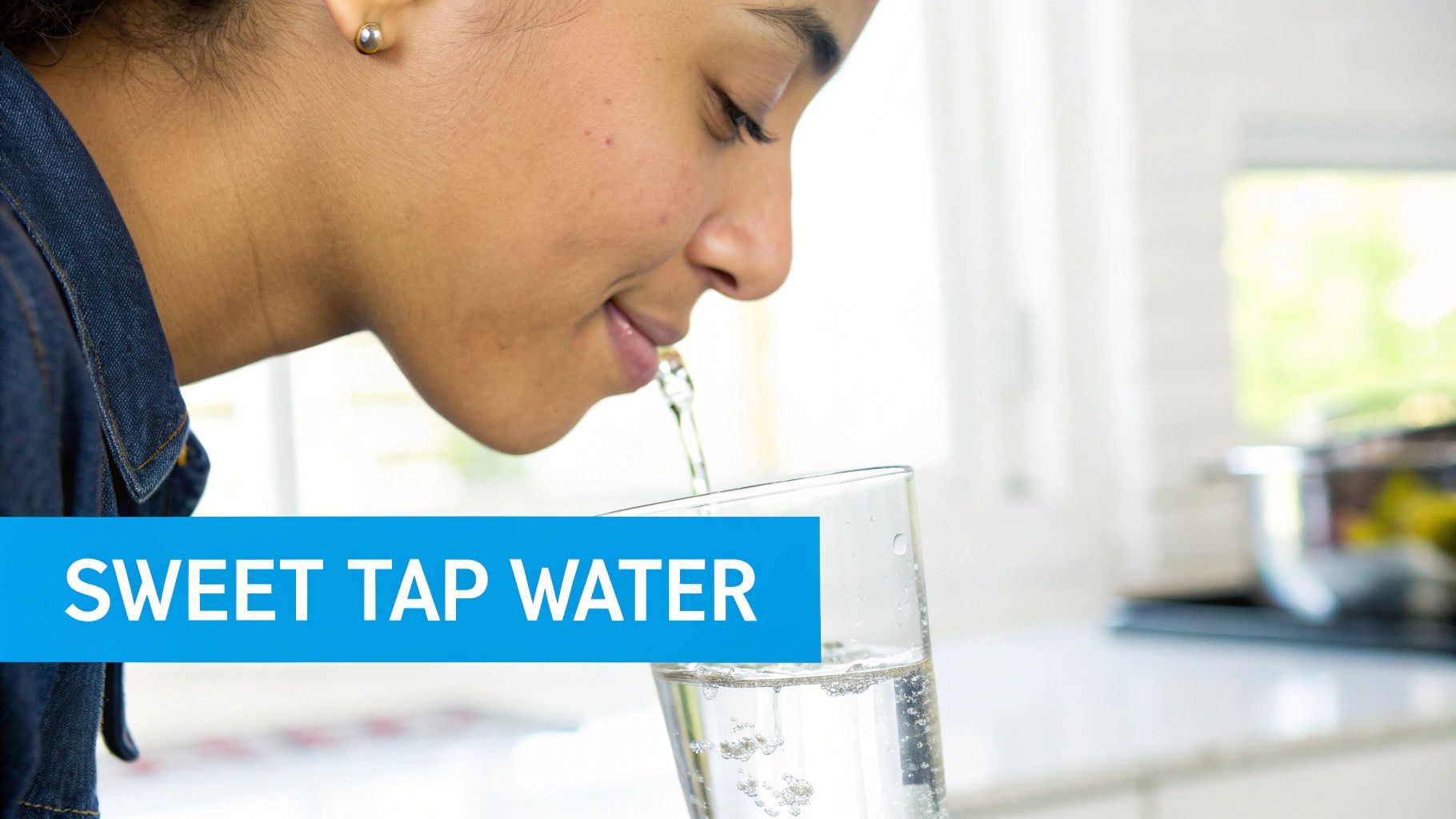
Why Does Water Taste Sweet? Your Home Water Filter Might Be the Answer

You pour a glass of water, expecting that familiar, crisp taste, but instead, you get… sweetness? It’s a strange and often confusing experience. The short answer is that this sweetness usually comes from a few places: naturally occurring minerals, your home’s plumbing, or even your water filter system.

While a sweet taste is often harmless, a sudden change in your water's flavor is your cue to play detective. It’s time to take a closer look at your water quality and what your home filter is—or isn't—doing.

Decoding the Sweet Taste in Your Tap Water

A woman drinking a glass of water, looking thoughtfully at its taste

When you’re thirsty for a neutral, refreshing drink and get a hint of sugar instead, it’s only natural to wonder what’s going on. The reason your water tastes sweet isn't a single issue but more like a puzzle with several possible pieces. Interestingly, your home's water filtration system is a central part of this puzzle, sometimes acting as the cause and other times as the hero.

This guide will walk you through the usual suspects behind sweet-tasting water, with a laser focus on how your home filter fits into the picture. We’ll explore everything from harmless mineral content to the more serious signs of potential contamination, giving you the knowledge to diagnose the cause and find the right filtration fix. Getting that pure, clean taste back is totally achievable—it just starts with understanding your water.

Why Water Taste Matters

How we perceive our water's taste is tied directly to its chemical makeup and where it comes from. This isn't just about personal preference; it can actually impact how much water we drink. For example, a 2018 U.S. study found that about 26% of adults felt their local tap water didn't taste good, which can seriously affect hydration habits.

Getting to the bottom of an "off" taste, like sweetness, is the first step toward installing a home filtration system that solves the problem for good. You can learn more about the study's findings on water taste perceptions.

To get a clearer picture of what might be happening in your pipes, let’s break down the common reasons.

Key Takeaway: A sweet taste in your water can come from its mineral content, your plumbing, or your filter. Figuring out the source is the key to choosing the right home filtration solution to fix it.

The table below is a handy guide to help you start troubleshooting.

Quick Guide to Sweet Tasting Water Causes

Here’s a quick look at the most common reasons your tap water might taste sweet, where the issue likely originates, and whether a home water filter is the solution.

Potential Cause Common Source Filtration Fix?
Natural Minerals High levels of calcium & magnesium in "hard water". Yes (Water Softener/RO)
Plumbing Materials Leaching from old copper or iron pipes. Yes (Reverse Osmosis)
New Filter Cartridge Release of fine particles from new carbon filters. Yes (Flush the new filter)
Contamination Presence of certain organic compounds or lead. Yes (RO/Carbon Filters)
Old Filter Bacteria buildup in an expired filter cartridge. Yes (Replace the filter)

This summary should give you a solid starting point. From here, you can dig deeper into each potential cause to find the perfect home filtration solution.

Natural Minerals and Your Water's Flavor Profile

A clear stream flowing over smooth, multi-colored rocks and minerals

Sometimes, the simplest answer is the right one. The reason your water tastes sweet might have nothing to do with your plumbing or any outside contaminants. It could be coming straight from nature.

Water is a fantastic solvent. As it trickles through underground aquifers and flows over ancient rock formations, it naturally dissolves and picks up a whole host of minerals along the way. That mineral content is often the secret ingredient giving your tap water its unique character. If you live in an area with hard water, your supply is loaded with minerals like calcium and magnesium. While they're perfectly safe to drink, these elements can give the water a subtle, almost earthy sweetness.

Think of it as the water’s terroir, just like with wine. The specific blend of minerals it collects is a direct reflection of your local geology.

The Role of pH and Alkalinity

Beyond the minerals themselves, the pH level of your water is a big player in how it tastes. Water that leans more alkaline (meaning it has a higher pH) is often described as feeling smoother and tasting just a little bit sweeter than more acidic water. This is exactly why some bottled "alkaline waters" have become so popular—people enjoy that smoother taste. Your tap water can be naturally alkaline, too, depending on its source.

A subtle sweetness from minerals and alkalinity is often just the water's natural signature. However, if this natural sweetness just isn't your cup of tea, a home filtration system can easily neutralize it.

How Regional Differences Shape Water Taste

The idea that your local geology changes how your water tastes isn't just a guess—it's a well-documented fact. For example, in areas where water hardness has calcium and magnesium concentrations over 60 mg/L, people often perceive the water as having a softer, sweeter flavor compared to softer water that might be treated with more chlorine.

These mineral profiles are the reason tap water in one city can taste completely different from the next. If you're curious to learn more about the building blocks of our planet's crust, you can check out these fascinating facts about minerals.

Ultimately, if your water's natural sweetness just isn't for you, the good news is you can fix it. A home filtration system like a water softener or a reverse osmosis unit can remove those specific minerals and give you the neutral, crisp taste you're looking for.

When Sweetness Signals a Deeper Problem

A close-up of an old, corroded pipe with water dripping from it

While the light sweetness from natural minerals is typically fine, a sudden, very noticeable sweet taste in your water should raise a red flag. Think of it as your taste buds sending up a flare—something might be seriously wrong with your plumbing. When the flavor changes out of the blue, it's time to stop guessing and start investigating.

This kind of abrupt shift is often the first sign that unwanted contaminants have made their way into your water supply. You can't just ignore it. Some of the most dangerous contaminants, unfortunately, happen to taste sweet. Knowing what these threats are is the first step toward finding a home filtration system that can actually handle them.

The Hidden Danger of Lead and Heavy Metals

One of the most alarming reasons for sweet-tasting water is lead. It’s a heavy metal with a distinctively sweet flavor—which is precisely why it was used in products like paint and even wine for centuries before we fully understood how toxic it is. Lead presents major health risks, especially for children and pregnant women. In fact, there is no safe level of lead exposure.

So where does it come from?

  • Older Pipes: If your home was built before 1986, there’s a good chance it has lead service lines, pipes, or solder joining the pipes to the city’s water main.
  • Corrosion: As these old pipes age and break down, they can corrode, causing lead to leach straight into the water flowing to your tap.
  • Fixtures: Even homes built more recently aren't completely safe. Some brass fixtures and faucets can still contain small amounts of lead.

If you even suspect lead is the problem, don't count on a standard pitcher filter to solve it. You'll need something much more powerful, like a reverse osmosis (RO) system or a filter specifically certified to reduce lead.

Unseen Organic Compounds

Another potential culprit is the presence of certain organic compounds. These substances can get into the water from agricultural runoff, industrial pollution, or even just from decaying organic matter in reservoirs. While not all of them are immediately harmful, some can pose serious long-term health risks.

For example, the chemical structure of some pesticides and herbicides is perceived by our taste buds as sweet. If those chemicals seep into groundwater, they can eventually show up at your faucet. Similarly, certain glycols—often found in antifreeze but also used in food processing—can create a sweet taste if they contaminate the water supply.

A sudden, chemical-like sweetness should never be ignored. It's a clear signal to get your water tested by a certified lab to identify the specific contaminants you're dealing with.

An activated carbon filter is usually your best bet against these kinds of organic compounds. The carbon is incredibly porous, which makes it great at trapping and absorbing these chemicals, stripping them from your water and leaving it with a clean, neutral taste. When you don't know the exact cause of the sweetness, a multi-stage filtration system that combines carbon with other technologies will give you the most comprehensive protection.

Is Your Water Filter Causing the Sweet Taste?

It sounds completely backward, doesn't it? The very thing you installed to guarantee pure, clean water might be the reason it suddenly tastes sweet. This unexpected flavor can pop up for a couple of different reasons, depending on whether your filter is fresh out of the box or has seen better days.

Figuring out the link between your home filtration system and that sweet taste is the first step. It helps you get to the bottom of the issue and make sure you're getting the performance you paid for. Let's dig into how both new and old filters can be the source of the problem.

The New Filter "Break-In" Period

If you've just popped in a new filter cartridge—especially an activated carbon one—you might notice a temporary sweetness. Think of it like breaking in a new pair of leather boots; the filter needs a little time to settle in and start doing its best work.

During this initial "break-in" phase, the filter can release tiny, harmless carbon fines. These are just microscopic dust particles leftover from manufacturing. While they are perfectly safe to drink, these fines can give the water a slightly sweet flavor. This is totally normal and usually goes away on its own after a few gallons of water have run through the system.

Pro Tip: Always flush a new water filter cartridge before you start drinking from it. Just run the water for a few minutes (or whatever the manufacturer's instructions say) to wash away any of those loose carbon fines and get the filter primed for action.

When an Old Filter Turns Against You

Now for the other side of the coin: an old, neglected filter is a much more concerning reason for sweet-tasting water. A water filter isn't a "set it and forget it" kind of deal. It has a limited lifespan and can only capture so many contaminants. Once it's full, it's full.

Worse yet, a saturated filter can turn into a breeding ground for bacteria. As water struggles to pass through the clogged filter media, these bacteria can multiply and release their own byproducts, some of which taste distinctly sweet. At this point, your filter isn't just failing to clean your water—it's actively making it dirtier.

This is exactly why sticking to a regular replacement schedule is absolutely critical for safe, great-tasting water. Here’s a quick checklist to figure out if your filter is the culprit:

  • Check the Date: When was the last time you swapped out the cartridge? If it's been more than three to six months for a standard filter, it's probably time.
  • Notice the Flow: A clogged filter will almost always cause a noticeable drop in your water pressure.
  • Taste the Difference: If the sweet taste showed up gradually and seems to be getting stronger, an old filter is the prime suspect.

Proper filter maintenance is the single most important thing you can do to prevent weird flavors from showing up. By flushing new cartridges and swapping out old ones on time, you make sure your system delivers the pure, refreshing water you expect, not an unwelcome sugary surprise.

Choosing the Right Filtration System for Pure Taste

So, you’ve figured out why your water tastes sweet. Now comes the important part: picking the right tool to fix it. Choosing a home water filtration system isn't about grabbing the first pitcher you see at the store. It's about matching the filter's technology to the specific problem you're dealing with, whether that's excess minerals, weird organic compounds, or something more serious like lead contamination.

When you're up against a funky flavor, the two most effective systems you can get for your home are activated carbon filters and reverse osmosis (RO) systems. They work in completely different ways, and each one is a champ at targeting specific types of contaminants. Getting this choice right is the key to enjoying that pure, crisp water you're after.

Activated Carbon: The Taste and Odor Specialist

Think of an activated carbon filter as a high-tech sponge for your water. The carbon inside is specially treated to create millions of microscopic pores, giving it a massive surface area that traps and soaks up chemical contaminants. This process is called adsorption, and it's what makes these filters so great at getting rid of things that cause weird tastes and smells.

Activated carbon is a fantastic choice for targeting:

  • Organic Compounds: It’s great at removing many of the pesticides and industrial solvents that can give water a chemical-like sweetness.
  • Chlorine: While not sweet, chlorine is a super common additive that messes with your water's overall taste. Carbon filters knock it out of the park.

But you need to know what they can't do. Standard carbon filters won't touch dissolved minerals, salts, or heavy metals like lead. If your sweet taste is coming from hard water, a carbon filter alone isn't going to solve your problem.

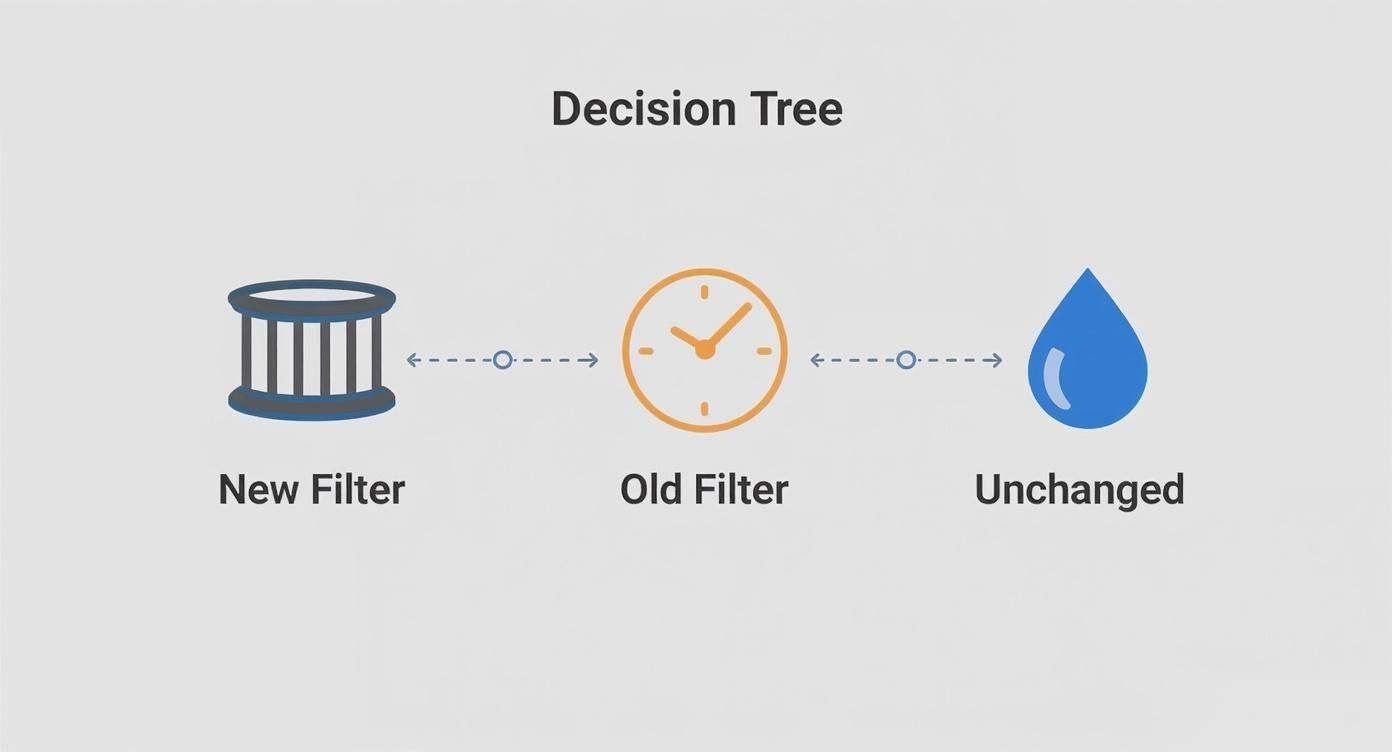
This infographic lays out a simple decision tree to help you figure out if your filter itself is the source of the sweetness.

Infographic about why does water taste sweet

As the chart shows, both brand-new and old filters can be the culprit, which really drives home the importance of flushing new cartridges and keeping up with maintenance.

Reverse Osmosis: The Purity Powerhouse

If you have a strong suspicion that the sweet taste is coming from something more serious, like heavy metals or a really high mineral content, you need to bring in the big guns. A reverse osmosis (RO) system is that bigger gun. It works by forcing water through a special membrane packed with microscopic pores—so tiny that it blocks almost everything that isn't a pure water molecule.

RO systems are the undisputed gold standard for removing:

  • Heavy Metals: They are proven to remove over 99% of lead from drinking water.
  • Dissolved Minerals: They completely eliminate the calcium and magnesium that often cause that sweet taste in hard water.
  • A Wide Range of Contaminants: From fluoride to nitrates and tons of other impurities, RO systems get rid of it all.

Because they're so incredibly thorough, RO systems deliver some of the purest drinking water you can get right from your tap.

A consumer study looking into flavored water discovered that 65.7% of people expect their water to have a pleasant, often slightly sweet, taste. This just goes to show how much our perception is shaped by both what's in the water and what we expect. You can read the full research on water taste preferences to dig deeper.

Comparing Home Water Filtration Systems

With different technologies available, it can be tough to decide which filtration system is best for your home. This table breaks down the most common options to help you compare them at a glance, focusing on what they're good at, what they cost, and how much work they are to maintain.

Filtration Type Effective Against Average Cost Maintenance
Activated Carbon Chlorine, organic compounds, pesticides, bad taste & odor. $20 – $150 Replace filters every 2-6 months.
Reverse Osmosis Heavy metals (lead), minerals, salts, nitrates, fluoride. $150 – $500+ Replace pre-filters every 6-12 months; membrane every 2-3 years.
Water Softener Hard water minerals (calcium, magnesium). $500 – $2,000+ Refill salt periodically (every 1-3 months).
UV Purifier Bacteria, viruses, microorganisms. (Does not remove chemicals or minerals). $200 – $600 Replace UV lamp annually.

Ultimately, the best system is the one that targets the specific contaminants causing your sweet taste. For most flavor issues, an activated carbon or RO system will get the job done right. If you need more help deciding, check out our full collection of water filter advice for more in-depth guides.

Got Questions About Your Water's Taste? We've Got Answers.

When something as basic as your tap water starts tasting funny, it's natural to have questions. A sudden sweet taste can be unsettling, and you need clear, direct answers to feel confident about what you're drinking.

Let's cut through the confusion. Here are the most common questions we hear from people dealing with this exact problem, with a focus on how home water filtration provides the solution.

Is It Safe to Drink Water That Tastes Sweet?

This is the big one, and the honest answer is: it depends. A sweet taste from something harmless like calcium is perfectly fine. But that same taste can also signal a serious problem, like lead contamination. The trouble is, you can't tell the difference by taste alone.

If your water suddenly starts tasting sweet, the safest bet is to stop drinking it and get it tested. You just can't risk it. A professional lab test will tell you exactly what’s in there, so you can find a filter certified to remove that specific contaminant.

How Do I Test My Water?

For a surefire answer, send a sample to a state-certified laboratory. They'll run a full analysis and give you a detailed report on everything from minerals and heavy metals to organic compounds. It’s the most reliable way to know what you’re dealing with.

Want a quicker first look? Grab a quality at-home test kit. These can screen for common culprits like lead, high mineral content (water hardness), and pH imbalances. The results can give you a good idea of whether you need to follow up with a professional lab.

When it comes to safety, don't guess. A water test is a small price to pay for peace of mind, and it points you directly to the right filtration solution for your home.

Will a Basic Pitcher Filter Fix This?

It really hinges on what's causing the sweetness. A standard pitcher with an activated carbon filter does a great job of removing chlorine and certain organic compounds that mess with taste and smell. But that's where its power ends. It's not effective against dissolved minerals or heavy metals.

If your water tastes sweet because of high mineral content or, worse, lead, a simple pitcher filter won't solve the problem. For issues like those, you'll need to step up to a more robust system, like an under-sink reverse osmosis unit or a whole-house water softener.

How Often Should I Change My Filter?

Keeping up with filter changes is non-negotiable if you want your system to work right. Always follow the manufacturer's schedule for your specific model—lifespans can vary a lot.

As a general guideline:

  • Pitcher filters: Every 2-3 months.
  • Faucet-mounted filters: Usually 3-4 months.
  • Under-sink and whole-house filters: Can go anywhere from 6 to 12 months.

If you let it go too long, the filter can get clogged or even become a breeding ground for bacteria. When that happens, it can start dumping new, unwanted tastes—including sweetness—right back into your "filtered" water.


At Water Filter Advisor, our mission is to help you get the purest, best-tasting water for your home. Dive into our detailed guides and reviews to find the perfect filtration system for your needs. Visit us at https://www.waterfilteradvisor.com to learn more.