Reverse Osmosis vs Carbon Filter: The Ultimate Showdown for Your Kitchen Sink
So you want better tap water, but you're stuck in the great filtration face-off: reverse osmosis vs. carbon filter. It's a classic matchup, and figuring out the winner for your home boils down to one simple question: What microscopic villains are you trying to kick out of your water?
Think of it like this: a Reverse Osmosis (RO) system is the heavyweight champion of purification. It's the bouncer that throws out up to 99% of the really nasty stuff—we're talking lead, arsenic, fluoride, and salts. On the other side of the ring, an activated carbon filter is more of a finesse fighter, a specialist. It’s the undisputed king of tackling annoying taste and smell problems, like that swimming-pool vibe from chlorine or funky organic chemicals.
Choosing Your Water Warrior: A Clear-Cut Guide
Jumping into the world of home water filtration can feel like you need a chemistry degree, but it's way simpler once you get the core difference between these two contenders.
An RO system is your home's personal bodyguard for water. It uses raw pressure to shove water through a ridiculously fine membrane. The pores are so tiny, it's like trying to fit a basketball through a keyhole—only pure, tiny water molecules make the cut.
An activated carbon filter is more like a super-powered magnetic sponge. Its surface is a maze of millions of pores that grab and trap contaminants in a process called adsorption. This makes it a champ at snagging the things that make your water taste and smell funky, like the chlorine your city adds to the water supply.
It really comes down to purification vs. improvement. RO systems are all about producing the purest water possible by evicting a huge range of contaminants. Carbon filters focus on making your water taste and smell amazing by adsorbing specific chemicals.
To make the right call, you first need to know who you're fighting. If you’re on city water and just want to banish that "public pool" aftertaste, a good carbon filter is probably your champion.
But if you’re worried about invisible enemies like heavy metals, high levels of total dissolved solids (TDS), or contaminants like fluoride, only a reverse osmosis system has the muscle to give you true peace of mind. For homeowners looking for more specific guidance, you can find a ton of helpful water filter advice tailored to different water quality problems.
To make things even simpler, here's a quick tale of the tape.
Quick Look: Reverse Osmosis vs Carbon Filter
| Feature | Reverse Osmosis (RO) System | Activated Carbon Filter |
|---|---|---|
| Primary Function | Purifies water by evicting a massive range of contaminants, including dissolved solids and heavy metals. | Improves water taste and odor by trapping chlorine and certain organic compounds. |
| Contaminant Removal | Knocks out lead, fluoride, arsenic, salts, viruses, bacteria, and microplastics (up to 99%). | Nabs chlorine, pesticides, VOCs, and reduces sediment. Useless against most inorganic contaminants or microbes. |
| Best For | Homes with serious concerns about heavy metals, high TDS, or specific health-related contaminants. | Homes with municipally treated water where the main goal is simply better-tasting, chlorine-free water. |
| System Complexity | A multi-stage system, usually installed under the sink with its own faucet and a small storage tank. | Can be anything from a simple pitcher or faucet mount to a whole-house system. Super versatile. |
This table should give you a solid starting point for figuring out which corner you're in.
How Each Filtration Technology Works: A Peek Under the Hood

To really get the difference between reverse osmosis and a carbon filter, you have to look under the hood. They both clean your water, sure, but their methods are worlds apart. One is a bouncer with a list, and the other is a chemical magnet.
Understanding these mechanics is the key to picking the right system. It makes it crystal clear why one is a master of total purification, while the other is fantastic for making your water simply taste and smell better.
The Science Of Reverse Osmosis: Brute-Force Purification
Reverse osmosis, or RO, is basically a brute-force approach to cleaning water. It uses your home's water pressure to literally force water through a special semipermeable membrane. This isn't just a simple strainer; it's a molecular gatekeeper with a serious attitude.
Imagine trying to push sand through a screen door—only air gets through. An RO membrane works on the same principle, just on a microscopic scale. Its pores are incredibly tiny, about 0.0001 microns, so only water molecules can squeeze through. Everything else—lead, salt, fluoride, you name it—gets physically blocked and flushed down the drain.
This process is what allows an RO system to get rid of a huge list of contaminants that other filters can't touch.
- Heavy Metals: Nasty stuff like lead, mercury, and arsenic are flat-out rejected by the membrane.
- Dissolved Solids: Salts, fluoride, and nitrates are simply too big to get through the tiny pores.
- Microorganisms: Bacteria, viruses, and cysts don't stand a chance—they're blocked at the door.
Because it removes so many of these dissolved solids, RO is considered a purification method, not just filtration. This is why the reverse osmosis segment holds a massive 29% share of the global water treatment market. Its ability to remove up to 99% of bacteria, heavy metals, and even microplastics makes it the heavy hitter for total purification. You can dig into more of these water treatment market trends if you're curious.
Activated Carbon: The Chemical Magnet
Activated carbon filters use a totally different, much more elegant process called adsorption. That's adsorption, not absorption—it's not soaking things up like a sponge. Instead, contaminants physically stick to the surface of the carbon like lint to a sweater.
The carbon in these filters is "activated" by superheating it with oxygen. This creates millions of tiny pores all over its surface. To give you an idea, this process gives a single gram of activated carbon a surface area of over 3,000 square meters. That's bigger than half a football field.
Think of an activated carbon filter as a magnetic field for specific chemicals. As water flows past, stuff like chlorine and volatile organic compounds (VOCs) are chemically drawn to the carbon's surface and trapped there for good.
This mechanism makes carbon filters fantastic at what they do, but their specialty is pretty narrow. They're great at targeting organic chemicals and anything that gives your water a bad taste or smell. They won't, however, remove dissolved salts, heavy metals, or nitrates because those contaminants simply don't "stick" to the carbon.
Head-To-Head: The Contaminant Removal Throwdown
When you’re weighing reverse osmosis against a carbon filter, it really boils down to one crucial question: what are you actually trying to get out of your water? The two technologies couldn't be more different in how they work, and that dictates what they can remove. Think of one as a microscopic net and the other as a chemical magnet.
This breakdown will show you exactly how each one stacks up against the most common water problems you'll find in your home. Getting this part right is the key to picking the right tool for the job.
Heavy Metals And Dissolved Solids: No Contest
This is where the difference between RO and carbon filters becomes painfully obvious. For things like heavy metals and what's known as total dissolved solids (TDS), one of these is the undisputed champion.
Reverse osmosis systems absolutely dominate this category. The RO membrane is a physical barrier with pores so tiny—around 0.0001 microns—that it physically blocks bigger molecules like lead, arsenic, mercury, and chromium. They simply can't squeeze through. This same process is what removes dissolved salts, fluoride, and nitrates, all of which contribute to your water's TDS level.
On the other hand, activated carbon filters are pretty much useless against these contaminants. The magic of adsorption, which makes carbon a superstar for chlorine, has no effect on dissolved inorganic compounds. They just flow right on by the carbon media without getting trapped.
- Lead & Arsenic: An RO system is your best line of defense, capable of removing over 95-99% of these dangerous metals. A basic carbon filter won't touch them unless it's a specialized carbon block filter that’s specifically certified for lead reduction under NSF/ANSI 53.
- Fluoride & Nitrates: Only a reverse osmosis system will reliably remove these. Carbon filters won't make a dent.
So, when we look at contaminant removal, it's not a simple "better or worse" situation. It's about matching the filter's strength to the specific problem in your water.
To make it even clearer, let's look at a scorecard that pits these two technologies against each other on a range of common contaminants. This table gives you a quick visual on where each one shines.
Contaminant Removal Scorecard: RO vs. Carbon
| Contaminant | Reverse Osmosis Effectiveness | Carbon Filter Effectiveness |
|---|---|---|
| Heavy Metals (Lead, Arsenic, Mercury) | Excellent (95-99%+) | Poor (unless NSF 53 certified for lead) |
| Total Dissolved Solids (TDS) | Excellent (90-99%) | None |
| Fluoride | Excellent (90-98%) | None |
| Nitrates/Nitrites | Excellent (85-95%) | None |
| Chlorine | Good | Excellent |
| Chloramines | Good | Good (with catalytic carbon) |
| Pesticides & Herbicides | Good | Excellent |
| Volatile Organic Compounds (VOCs) | Good | Excellent |
| Taste & Odor | Excellent | Excellent |
| Bacteria & Viruses | Excellent | Poor (unless specialized) |
| Cysts (Giardia, Cryptosporidium) | Excellent | Good (with 0.5 micron rating) |
As you can see, RO is the powerhouse for purification, tackling the tough, dissolved contaminants. Carbon, however, is the go-to specialist for making your water taste and smell great by targeting specific chemicals.
Chlorine And Chemical Contaminants: The Tables Turn
Now, let's flip the coin. If your main complaint is the chemical smell or taste from your city's water treatment, the carbon filter takes center stage.
Activated carbon has a huge, porous surface that acts like a magnet for organic chemicals like chlorine, chloramines, pesticides, and volatile organic compounds (VOCs). Through a process called adsorption, it traps these substances, stripping them from the water before they ever hit your glass. This is exactly why carbon filters are so fantastic at getting rid of that "swimming pool" taste and smell.
The core strength of a carbon filter is improving the aesthetic qualities of your water by targeting organic chemicals. The strength of an RO system is purification—removing nearly everything else.
While RO systems do remove chlorine, they actually need a little help to do it. Every good multi-stage RO unit has a carbon pre-filter. Its job is to remove the chlorine before the water gets to the delicate RO membrane, which can be damaged by it over time. This teamwork really shows how specialized and complementary these two technologies are.
Microbiological Threats: Don't Mess Around
If you're worried about bacteria, viruses, or cysts, you need to pay close attention. The filtration method you choose here makes a world of difference in your level of protection.
The reverse osmosis membrane is a formidable barrier against microscopic bugs. Its pores are just too small for bacteria, protozoan cysts like Giardia and Cryptosporidium, and even tiny viruses to get through. This makes RO a powerful purification tool, especially if you're on well water or have concerns about biological safety.
The performance of carbon filters is a bit more of a mixed bag.
- Standard Carbon Filters: Most basic granular activated carbon (GAC) filters are not designed to remove bacteria or viruses. They just aren't fine enough.
- Specialized Carbon Blocks: Some high-end, dense carbon block filters with a very small pore size (like 0.5 microns absolute) can physically screen out larger organisms like cysts. But even these are not typically rated to remove viruses.
The Market Reflects The Performance
The numbers don't lie. The incredible, broad-spectrum contaminant removal of RO technology is why it's the leader in the high-level water purification market. Reverse osmosis systems are on track to capture 36% of the global water filter market, a spot earned by their ability to remove up to 99% of dissolved salts, heavy metals, and microbes. These are serious filtration capabilities that a standard carbon filter, which is mostly focused on taste and odor, just can't compete with. For a deeper dive, you can check out more data on global water filter market trends.
At the end of the day, the reverse osmosis vs. carbon filter debate isn’t about which is "better." It's about which is the right solution for the specific problems in your water.
Costs, Maintenance, and Long-Term Value: The Money Talk
When you're trying to decide between a reverse osmosis system and a carbon filter, it's easy to just look at the price tag. But that's only the beginning of the story. The real investment comes out when you consider the total cost of ownership—everything from the upfront purchase to filter changes and even the water that goes down the drain. Let's break down the financials so you can make a smart decision for the long haul.
The initial cash you'll spend can be worlds apart. You can grab a simple activated carbon pitcher filter for under $30, but a more serious under-sink or whole-house carbon filter will set you back anywhere from $100 to over $1,000.
On the other hand, a quality under-sink reverse osmosis system usually starts around $200 and can climb to $600 or more, depending on how many stages it has and how efficient it is. Yes, the upfront cost for RO is almost always higher, but that's because you're buying a multi-stage purification powerhouse, not just a single filter.
Forecasting Long-Term Expenses
The true cost difference really shows up in the long-term maintenance and filter replacements. Both systems need regular attention to keep working right, but their schedules and costs are pretty different.
With carbon filters, how often you swap them out depends entirely on the type you have and how much water you use.
- Pitcher Filters: Expect to change these cartridges every 1-2 months. Each one costs about $5-$10.
- Faucet-Mount Filters: These last a bit longer, usually 2-3 months, and replacements run $15-$25.
- Under-Sink/Whole-House Systems: The big boys. These filters can go anywhere from 6 months to several years, with replacements costing from $30 to over $100.
Reverse osmosis systems have a more involved maintenance schedule since they have multiple filter stages. Here’s what a typical schedule looks like:
- Sediment & Carbon Pre-filters: These guys protect the main RO membrane. You'll replace them every 6-12 months for about $30-$60 a set.
- RO Membrane: This is the heart of the system. It's a workhorse and usually lasts 2-4 years. A new membrane costs between $50 and $100.
- Carbon Post-filter: This is the final "polishing" filter. It gets changed every 12 months and costs around $15-$25.
The real long-term cost isn't just one filter's price; it's what you spend annually. A cheap carbon pitcher might seem like a bargain, but those frequent replacements can add up to $60-$80 a year. A full RO system's annual filter costs might average out to a similar amount, but you're getting a much higher level of purification for your money.
The chart below gives you a visual on what each system is actually removing, which ties directly into the value you're getting.
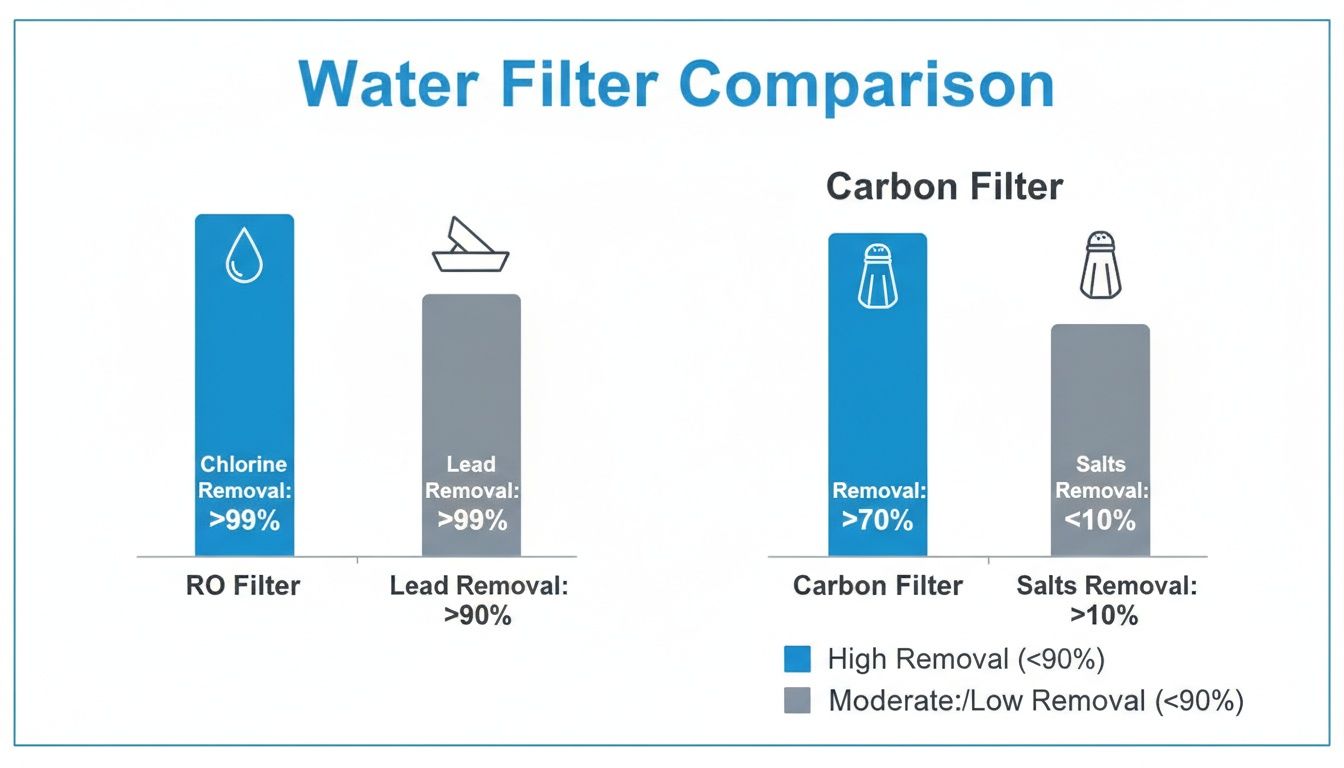
It's clear that while both are great for chlorine, only RO really puts up a fight against heavy metals and dissolved salts. That’s a huge difference in purification value.
The Hidden Cost: Water Waste
There’s one unique long-term cost that comes with reverse osmosis: water waste. The process works by flushing the contaminants it removes down the drain along with some wastewater. Older, inefficient systems were notorious for this, sometimes wasting 5 gallons of water for every one gallon of pure water they made.
Thankfully, technology has come a long way. Many new RO systems are built for high efficiency, with waste-to-pure-water ratios as low as 1:1. When you’re shopping, keep an eye out for that "efficiency rating" or "waste ratio" to keep this hidden cost down and reduce your environmental footprint.
Flow Rate And Installation: How It Affects Your Daily Life
Beyond what's removed from your water, the biggest day-to-day differences between RO and carbon filters are all about convenience. We're talking about how you install the system and, just as importantly, how long you have to wait to fill up your glass. One gives you water right away, while the other asks for a bit more patience.
The first thing you’ll notice with a reverse osmosis system is its flow rate. The purification process is incredibly thorough, and forcing water through that super-fine membrane just takes time. To get around this, nearly all under-sink RO units include a small storage tank that keeps a supply of purified water ready to go from its own dedicated faucet.
This setup gives you a steady stream when you need it, but it’s almost always slower than your main kitchen faucet. It's perfectly fine for filling a glass, but plan on waiting a minute or two if you're filling a big pot for pasta.
Speed And Convenience: A Real-World Test
Carbon filters, on the other hand, barely slow things down. Because they work through adsorption and don't need to push water through such a restrictive barrier, they have a minimal impact on your home's water pressure. For anyone who prizes speed, this is a huge plus.
Let's put this into a practical, everyday kitchen scenario: filling a 64-ounce water pitcher.
- Carbon Filter (Faucet-Mount or Under-Sink): The water flows at almost full blast. You’ll have that pitcher full in about 15-20 seconds.
- Reverse Osmosis System: Drawing from its storage tank, the dedicated RO faucet will take noticeably longer—often 45-60 seconds to fill the exact same pitcher.
This speed difference really comes down to a lifestyle choice. If you prioritize the absolute highest level of purity and don't mind the wait, the slower RO flow is a perfectly acceptable trade-off. But if you're always in a hurry and filling large containers, a high-flow carbon filter might be the better match for your routine.
Installation: What’s Your DIY Comfort Level?
The other major split is how these systems get into your kitchen in the first place. The setup can be anything from a two-minute, tool-free task to a project that requires some basic plumbing know-how.
Activated carbon filters are champions of easy installation. Many options, like faucet-mount filters, simply screw onto your existing faucet with no tools needed. An under-sink carbon unit is a step up, but it usually just involves connecting two water lines—a very manageable DIY job for most.
Reverse osmosis systems are a more permanent and involved installation. You have to install a separate, dedicated faucet, which usually means drilling a new hole in your countertop or sink. You also have to hook up a drain line to your sink's plumbing to flush away the wastewater. While it's certainly a project many homeowners can tackle themselves, it's a much bigger commitment than a simple carbon filter.
It's also worth thinking about how a new filter fits into your home's overall system. A good installation is key to improving your home's plumbing efficiency and ensuring you don't end up with leaks or pressure drops. Ultimately, you have to decide if you want a quick and simple solution or if you're up for a more hands-on installation to get the most powerful purification available.
Making The Right Choice For Your Home: The Final Verdict
Figuring out whether to go with reverse osmosis or a carbon filter really boils down to two things: what’s lurking in your water, and what do you want gone? This isn’t about crowning one filter as the absolute "best," but about matching the right tool to the job at hand.
Let's break it down into a few common home scenarios. Some water problems have a clear-cut, non-negotiable solution, while others come down to personal preference and how much you want to spend.
When Reverse Osmosis Is The Only Answer
Sometimes, the heavy-duty purification you get from a reverse osmosis system isn't just a nice feature—it's an absolute must. If your water report flags any of the issues below, an RO system is really the only way to truly protect your family's health.
These are the kinds of problems where a standard carbon filter just can't cut it.
- High Total Dissolved Solids (TDS): If your water’s TDS level is over 200 PPM, which is common with well water or even some city supplies, RO is the only technology that can knock that number down. It physically removes the dissolved salts, minerals, and other inorganic stuff.
- Presence of Heavy Metals: When you’re dealing with serious contaminants like lead, arsenic, chromium, or mercury, an RO membrane is the critical barrier you need. It can remove up to 99% of these dangerous elements.
- Fluoride or Nitrate Concerns: Many cities add fluoride to their water, and nitrates from agricultural runoff can seep into supplies. Only a reverse osmosis system is certified to effectively remove these contaminants.
If you're on a private well, a reverse osmosis system should be your starting point. Wells aren't federally regulated, leaving them vulnerable to a whole host of contaminants that only a true purification system like RO can handle reliably.
When A Carbon Filter Is The Smart Choice
On the flip side, millions of us get perfectly safe, high-quality water straight from the city. In these cases, the goal isn't removing dangerous contaminants; it's simply making the water taste and smell better. This is where a good carbon filter shines as a smart, cost-effective solution.
A carbon filter is probably the right move for you if this sounds familiar:
- You're on Reliable City Water: Your main complaint is the taste and smell of chlorine or chloramines used to disinfect the water. Activated carbon is a champ at adsorbing these, making your water genuinely pleasant to drink.
- You Want to Reduce Specific Chemicals: Carbon filters are fantastic at grabbing onto things like volatile organic compounds (VOCs) and certain pesticides that might be lingering in your treated water.
- Budget and Simplicity are Priorities: From a simple pitcher in the fridge to a filter that screws onto your faucet, carbon offers a low-cost, no-fuss way to get better-tasting water without calling a plumber.
The Best of Both Worlds: A Hybrid Approach
Here’s the thing most people miss: you don’t always have to choose. In fact, the very best water filter systems use both technologies together. Just about every quality reverse osmosis unit you can buy is a multi-stage system that includes carbon filters as part of the package.
A typical RO system will have a carbon pre-filter to strip out chlorine (which protects the delicate RO membrane) and a carbon post-filter to "polish" the water, removing any final, lingering tastes or odors after it's been purified. This hybrid setup gives you the unmatched purification of RO and the fantastic taste from activated carbon.
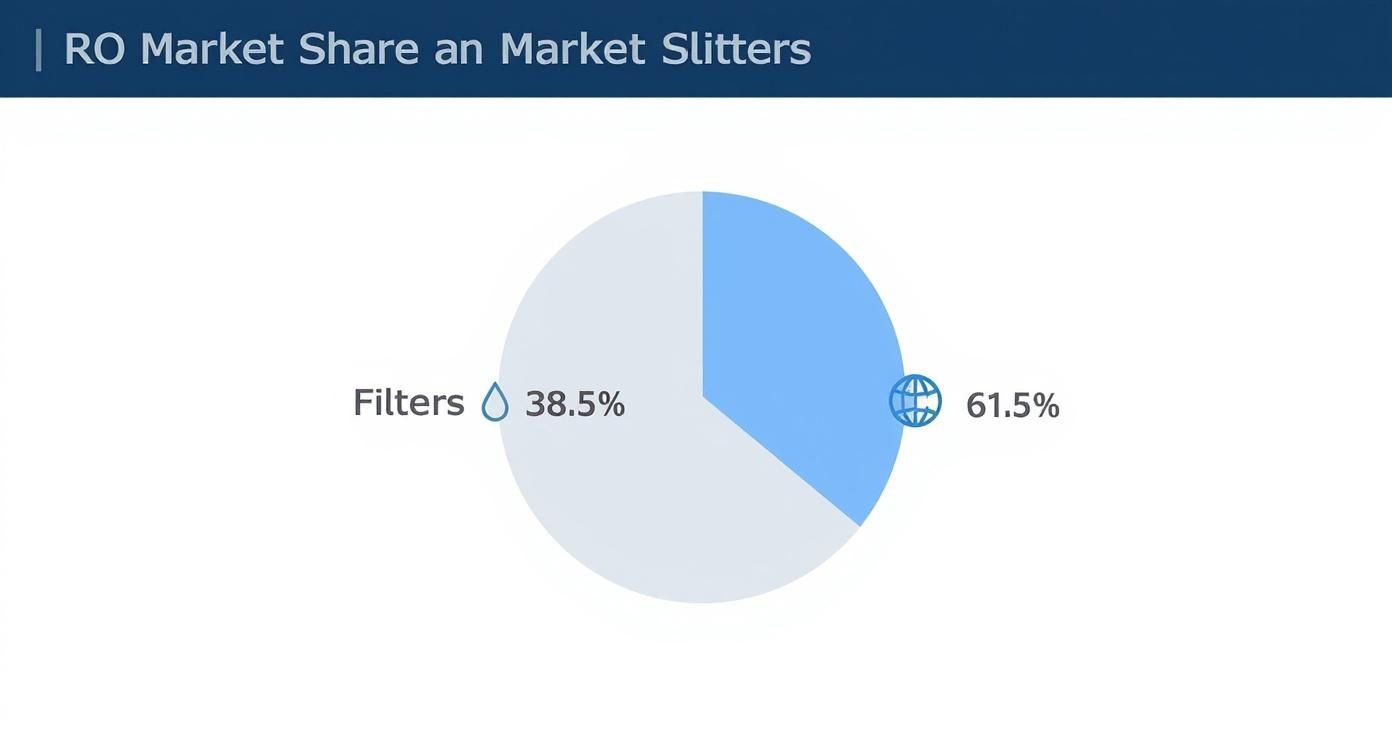
This superior performance is a big reason why the reverse osmosis segment has taken over the global water filters market, holding a massive 38.5% market share. That dominance comes from RO's ability to deal with the tough stuff like lead, dissolved salts, and fluoride—challenges a basic carbon filter just wasn't built for. You can explore the full water filter market analysis to see a global breakdown of how these technologies compare.
Got Questions? We’ve Got Answers.
When you're trying to figure out the best water filter for your home, a few questions always seem to pop up. Let's tackle the common ones head-on so you can feel confident in your choice.
Does Reverse Osmosis Strip Out Healthy Minerals?
Yes, it does. An RO system is an equal-opportunity purifier. Its membrane has pores as small as 0.0001 microns and can't tell the difference between a harmful contaminant and a beneficial mineral like calcium or magnesium, so it removes them all.
Now, we get most of our essential minerals from food, not water. But if you prefer the taste of mineral water, it's an easy fix. Many modern RO systems have an optional remineralization filter that adds a balanced amount of those healthy minerals right back into the water before it hits your glass.
Will a Carbon Filter Get Rid of Lead?
This is a really important one: it depends entirely on the type of carbon filter. Your basic pitcher filter with granular activated carbon (GAC) is not going to cut it for lead.
For effective lead removal, you need a high-quality carbon block filter. More specifically, it must be certified to NSF/ANSI 53 for lead reduction. Always double-check the product's certifications if lead is a concern in your area.
How Much Water Do Reverse Osmosis Systems Really Waste?
Older RO systems had a bad reputation for being water hogs, sometimes wasting several gallons for every one gallon of clean water they made. Thankfully, technology has come a long way.
Today’s high-efficiency models are much smarter about water use. You can easily find systems with a waste-to-pure water ratio as low as 1:1. Just look for the "efficiency rating" or "waste ratio" when you're comparing models.
The Big Picture: A modern RO system isn't an "either/or" choice—it's a "both/and." It already uses carbon filters as part of its multi-stage process to protect the main membrane and deliver the best-tasting, purest water possible.
So, Do I Need Both a Carbon Filter and an RO System?
You do, but any good RO system already has you covered. A quality reverse osmosis unit is built with multiple stages, and that always includes carbon filters.
There's usually a carbon pre-filter that catches chlorine and sediment to protect the delicate RO membrane. Then, a carbon post-filter "polishes" the water one last time to remove any lingering off-tastes or odors. It’s a complete solution all in one package.
At Water Filter Advisor, we're here to help you navigate the world of water filtration with in-depth guides and honest reviews. We want you to find the perfect fit for your home and family.
Explore our resources at Water Filter Advisor to learn more.