The Best Water Filter Pitcher for Pure and Simple Hydration in 2026
When you're hunting for the best water filter pitcher, you'll find heavy hitters like Brita, PUR, and Clearly Filtered all vying for your attention. But let's be real: the right pitcher isn't about brand loyalty. It's the one that's a perfect match for your specific water quality and your daily life.
Why a Pitcher is Your First Step to Better Water
Let's talk about the magic of turning your tap water into crisp, clean hydration, straight from your fridge. With a growing list of concerns about what's really in our tap water—from the swimming pool perfume of chlorine to invisible intruders like lead and PFAS—a water filter pitcher is more than just a kitchen gadget. It's your home's first line of defense.
This simple tool puts the power back in your hands. It demands zero installation, fits into any home, and makes an immediate, noticeable difference in your water's taste and quality. For most of us, it’s the easiest and most accessible way to start the journey to better home water filtration.
A Practical Solution for Common Concerns
A water filter pitcher delivers peace of mind without a hefty investment or a complicated setup. It's the hero of home hydration.
Here’s what you're signing up for:
- A Taste and Odor Revolution: The most dramatic change you'll notice is the banishment of chlorine. It's essential for disinfecting city water but leaves behind that distinct "public pool" taste and smell. A good filter erases it.
- Serious Contaminant Reduction: A certified pitcher isn't just making water taste good; it can significantly reduce a wide array of harmful contaminants, including heavy metals, pesticides, and insidious emerging chemicals.
- A Win for Your Wallet: Using a pitcher costs a fraction of buying bottled water. You get a continuous supply of clean water and can save hundreds of dollars a year.
A pitcher is a proactive step toward better health and a more sustainable lifestyle. It bridges the gap between uncertainty about your tap water and the pure, clean hydration you crave.
This guide is your roadmap. We’ll dive into the science happening inside the filter and break down the real-world costs. This is a booming market, valued at USD 3.5 billion in 2024 and projected to hit USD 5.4 billion by 2030. That growth tells a story: households are ditching single-use plastics and embracing smarter, in-home solutions. You can find more data on water filtration market trends here.
By the end of this guide, you'll be an expert, ready to choose the best water filter pitcher for your home, your budget, and your family's health.
How Pitcher Filters Turn Tap Water Into Clean Water
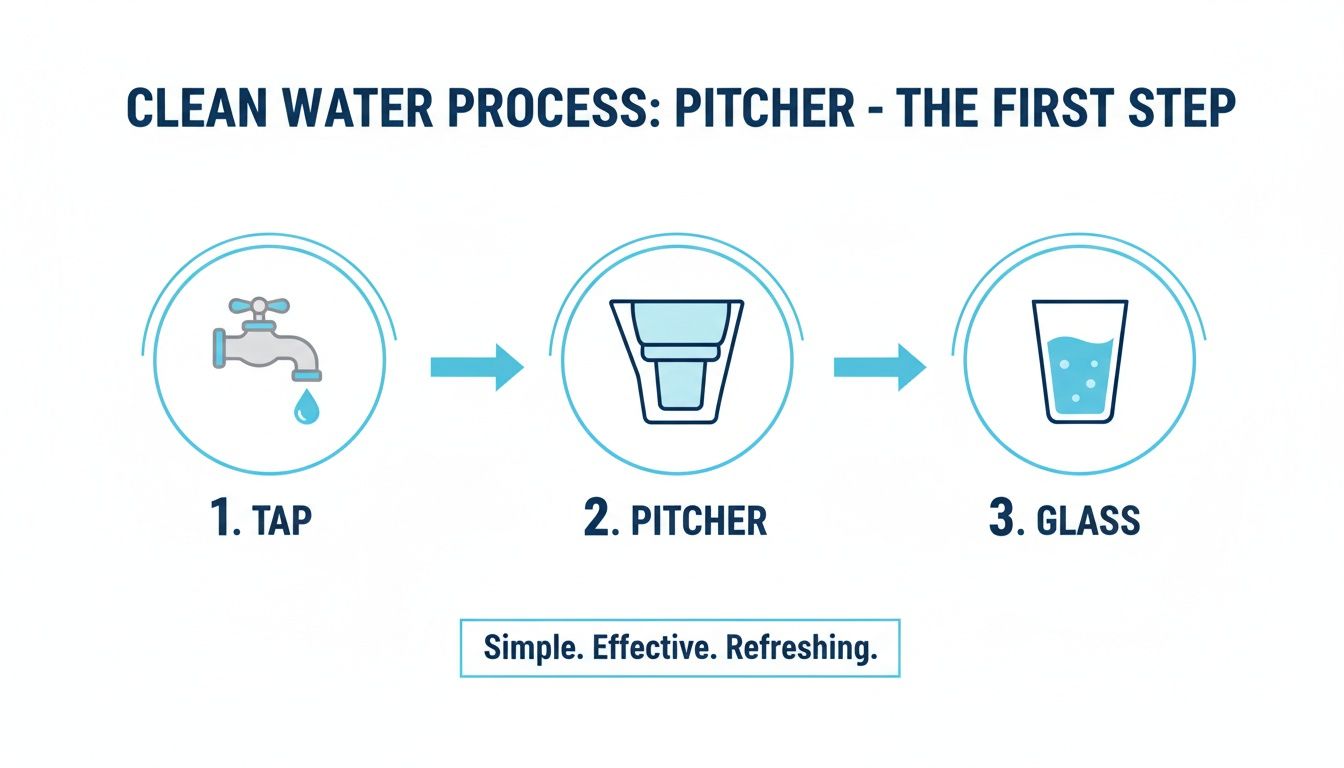
Ever stare at a water filter pitcher and wonder what sorcery is happening inside? It’s not magic, but it is some seriously clever engineering. Think of the filter as a microscopic obstacle course, precision-designed to trap the bad guys while letting only pure, clean water molecules pass through.
The whole show is powered by good old gravity. When you fill the top reservoir, water begins its slow descent through the filter cartridge. This deliberate drip is crucial—it gives the filter media inside enough contact time to work its purification magic.
The Workhorse: Activated Carbon
The undisputed MVP of almost every pitcher filter is activated carbon. Picture it as a super-porous sponge on a molecular level. This carbon, often derived from coconut shells, is treated to create an astronomical internal surface area packed with microscopic nooks and crannies. To put it in perspective, just one gram of activated carbon can have the surface area of a football field.
As water meanders through, this vast surface acts like a chemical magnet, trapping contaminants in a process called adsorption. It’s like flypaper for the unwanted stuff in your water.
Activated carbon is the champion of improving taste and smell. It’s responsible for tackling:
- Chlorine: The number one offender behind tap water that tastes and smells like it came from the local Y. Activated carbon is exceptional at neutralizing it, leading to a massive improvement in flavor.
- Volatile Organic Compounds (VOCs): A broad class of industrial and commercial chemicals that can find their way into water sources.
- Bad Tastes and Odors: Carbon traps the organic compounds that cause musty, earthy, or just plain weird smells, leaving your water tasting crisp, fresh, and like… well, nothing.
The Specialist: Ion-Exchange Resins
While activated carbon is the all-star for taste and odor, higher-end filters deploy a second, specialized unit: ion-exchange resins. Think of these as tiny, microscopic commandos on a mission to target specific contaminants that carbon alone can't handle.
These are tiny resin beads engineered to perform a very specific trade. They attract certain dissolved metals and minerals, swapping them for something harmless.
This ion-swap is the secret sauce that separates a basic taste-and-odor filter from one that can remove serious health-related contaminants. It's the key technology behind filters certified to reduce nasty things like lead and mercury.
Here’s the trade: The resin beads come loaded with harmless ions, like sodium or potassium. When water containing a heavy metal like lead flows past, the resin has a stronger chemical attraction to the lead. It snags the lead ion and releases one of its harmless ions in its place. It's a one-for-one swap that makes your water significantly safer. This process is brilliant for reducing heavy metals like lead, mercury, and copper. As an added bonus, it can also reduce the minerals that cause limescale, making your kettle happy.
When you're staring at a shelf full of water filter pitchers, the marketing claims can be a tidal wave of confusion. How do you cut through the noise and figure out which one actually delivers on its promises?
The answer is third-party certifications. Specifically, you want to be on the lookout for the NSF International seal.
Think of it like a crash-test rating for a car. You wouldn't trust a vehicle that hasn't been independently verified for safety. The same logic applies to the water you drink every day. These NSF standards aren't just marketing fluff; they are tough, legally enforceable benchmarks that prove a filter can do what it says it does.

NSF 42: The Taste and Odor Standard
You'll see NSF/ANSI 42 on nearly every pitcher. This is the foundational certification for "aesthetic effects"—things that impact the way your water tastes, smells, and looks.
A filter certified to NSF 42 is proven to reduce:
- Chlorine: This is the big one. It's what your city adds for disinfection and what gives tap water that "swimming pool" vibe. NSF 42 guarantees a significant reduction.
- Particulates: This covers the tiny bits of sediment and rust that can make water look cloudy.
If your main goal is simply to make your tap water taste better and more inviting, NSF 42 is your starting point. It’s the baseline for improving your water’s drinkability.
NSF 53: The Health Effects Standard
For serious, health-focused protection, you need to look for NSF/ANSI 53. While NSF 42 is about taste, this standard is all about health and safety. Filters bearing this seal have endured much more rigorous testing to prove they remove specific contaminants that can pose a genuine health risk.
An NSF 53 mark on a filter means it has proven it can reduce specific health-related contaminants to a level deemed safe. This isn't about preference; it's about protection.
Now, here's the crucial detail: manufacturers must specify exactly which contaminants their filter is certified for under this standard. You need to check the packaging or the fine print. Common NSF 53 certifications include:
- Lead: Reduces lead that can leach from old pipes and plumbing.
- Mercury: Removes this dangerous heavy metal.
- Cysts: Filters out nasty microorganisms like Giardia and Cryptosporidium.
- Volatile Organic Compounds (VOCs): Tackles a range of industrial chemicals.
Just because a filter is NSF 53 certified for lead doesn't mean it's also certified for VOCs. Always verify it targets your specific water concerns.
NSF 401: The Emerging Contaminants Standard
Finally, we have NSF/ANSI 401. This is a newer standard for "emerging contaminants"—things like prescription drugs, herbicides, and chemicals that aren't yet regulated by the EPA but are being detected in our water supplies.
This standard covers trace amounts of substances like:
- Certain prescription and over-the-counter drugs
- Common herbicides and pesticides
- Chemicals like Bisphenol A (BPA)
An NSF 401 certification offers an extra layer of confidence that your filter is tackling some of the modern pollutants finding their way into our water. Public awareness of these issues is exploding. After the Flint water crisis in 2014, pitcher sales shot up 25% in the area. Today, with PFAS—"forever chemicals"—found in the blood of 99% of Americans according to the CDC, filters certified for their removal are in high demand. You can learn more about the trends driving the water filter pitcher market and why these certifications matter more than ever.
To make this easier, the table below helps you match common water issues to the certification you should be looking for.
Common Contaminants and Corresponding NSF Certifications
This table helps you match your water quality concerns with the specific NSF/ANSI certification that guarantees a filter's effectiveness against that contaminant.
| Contaminant Type | Examples | Primary Concern | Relevant NSF/ANSI Standard |
|---|---|---|---|
| Aesthetic | Chlorine, Particulates | Bad taste, "pool" smell, cloudy water | NSF 42 |
| Heavy Metals | Lead, Mercury, Cadmium | Neurological damage, developmental issues | NSF 53 |
| Microbiological | Cysts (Giardia, Cryptosporidium) | Gastrointestinal illness ("beaver fever") | NSF 53 |
| Organic Chemicals | Benzene, Pesticides (VOCs) | Cancer risk, organ damage | NSF 53 |
| Emerging | Pharmaceuticals, BPA, Herbicides | Endocrine disruption, unknown long-term effects | NSF 401 |
| "Forever Chemicals" | PFOA, PFOS (types of PFAS) | Cancer risk, immune system effects | NSF 53 (for PFOA/PFOS) |
Ultimately, a filter is only as good as what it's proven to remove. By cross-referencing with these specific NSF certifications, you can be confident you're buying a product that will actually protect your health and deliver cleaner, safer water.
Matching a Pitcher to Your Lifestyle and Budget
Powerful filtration is essential, but the best water filter pitcher is the one you’ll actually use every single day. After you’ve pinpointed the right certifications for your water, it’s time to get practical. A pitcher that’s too slow, too small, or too expensive to maintain will just end up as a dusty relic in the back of a cupboard.
Let’s look beyond the contaminant removal stats and explore the real-world factors that make a pitcher fit seamlessly into your life. We'll cover size, design, and the true cost of ownership to help you find a model that feels like it was made for your home.
Finding the Right Size and Capacity
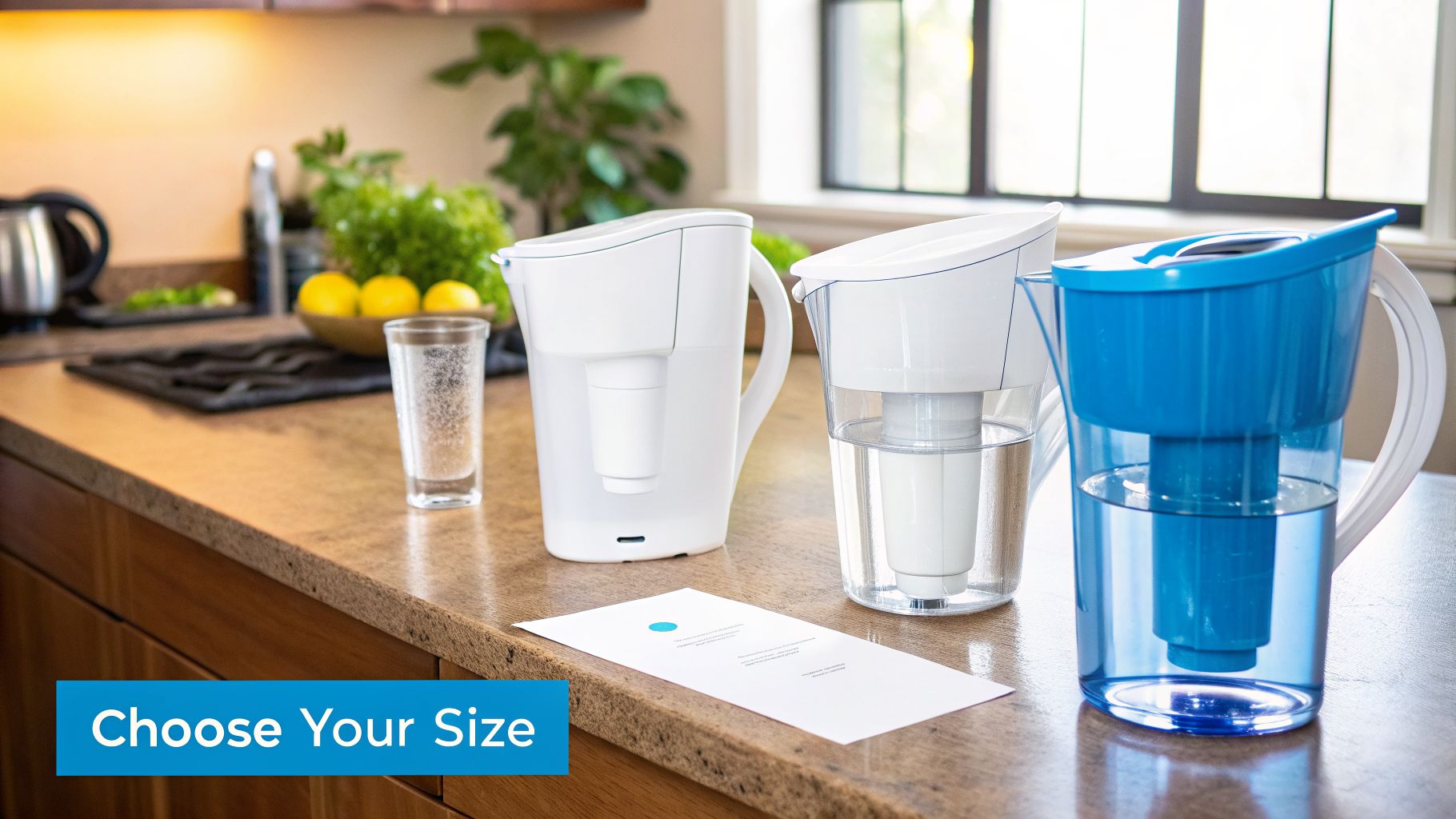
Water filter pitchers are typically measured by the number of cups of filtered water they hold. Choosing the right size boils down to your household’s daily water habits and the number of people you're hydrating.
For solo dwellers or a couple in a cozy apartment, a small pitcher (5–6 cups) is a perfect fit. Its slim profile won't dominate your fridge, but be ready for frequent refills if you're a big water drinker.
A standard pitcher (8–10 cups) is the sweet spot for a family of three or four. This size provides enough filtered water for drinking and cooking without feeling like you're chained to the sink. It's the most common size, giving you the widest variety of options.
If you have a large family or chug water like it's your job, consider an extra-large dispenser (18+ cups). These countertop or fridge-shelf models feature a handy spigot, offering a large, chilled reservoir of filtered water on demand.
Don't Overlook Design and Ergonomics
It’s the small design details that make the biggest difference in your daily experience. Before you fall in love with a pitcher, imagine yourself actually handling it day in and day out.
Keep an eye out for these practical features:
- Easy-Fill Lid: Can you fill it without removing the entire lid? A simple flip-top or a small opening is a surprisingly significant quality-of-life improvement.
- Comfortable Handle: Picture carrying a full, heavy pitcher from the sink to the fridge. A solid, ergonomic handle prevents spills and makes pouring a breeze.
- Spout Design: A well-designed spout delivers a smooth, drip-free pour. Some even have a cover to keep dust and stray fridge odors out of your pristine water.
- Filter Change Indicator: Most pitchers come with some kind of reminder—from a simple sticker to a digital timer—to tell you when it's time to swap the filter. This is crucial for ensuring your filter is always performing at its peak.
The little conveniences are what separate a pitcher you tolerate from one you love. A pitcher that's a pain to fill or pour is one you're less likely to use consistently.
Calculating the True Cost of Ownership
The price on the box is just the opening act. The real cost of a water filter pitcher is the ongoing expense of replacement filters. A cheap pitcher with pricey, short-lived filters can easily end up costing you more over a year than a more expensive model with long-lasting, affordable filters.
To unearth the best long-term deal, you need to calculate the cost-per-gallon.
It's a simple, powerful formula:
Filter Price ÷ Gallons Filtered = Cost Per Gallon
For example, a filter that costs $7 and is rated for 40 gallons comes out to 17.5 cents per gallon. But what if another brand offers a $15 filter rated for 120 gallons? That one costs only 12.5 cents per gallon. Over the course of a year, the second option is the clear winner for your wallet.
Always check the filter's price and its rated gallon capacity before you commit to a pitcher.
Understanding the Trade-Offs Between Speed and Power
When you start exploring water filter pitchers, you'll quickly encounter a fundamental choice: do you want speed, or do you want power? Getting both is the holy grail, but it's a tough one to find. This is arguably the most important trade-off you’ll have to make.
Think of it this way. A simple filter that just removes chlorine is like a four-lane highway—water flows through quickly and easily. But a high-performance filter certified to remove lead, PFAS, and other serious contaminants? That's more like a winding country road with multiple security checkpoints. The journey is much slower, but the screening process is far more thorough.
The Speed vs. Safety Dilemma
So why does a filter certified for lead pour with the urgency of a sloth compared to one that just makes your water taste better? It all comes down to the filter's internal architecture. To trap stubborn contaminants like heavy metals, the filter needs a much more complex and dense structure, often combining activated carbon with ion-exchange resins.
This dense media creates significant resistance, which naturally slows the water down. This isn't a bug; it's a critical feature. This increased contact time is what gives the filter media enough time to actually grab onto and neutralize those tougher contaminants.
- Fast Flow Filters: These are fantastic if you just want to improve the taste and smell of your tap water. If your only mission is to get rid of that chlorine taste for better coffee, a basic, fast-filtering model will serve you well.
- Slow Flow Filters: These are engineered for health and safety. You absolutely need one if your water has known issues with lead, mercury, or those infamous "forever chemicals" like PFAS.
The flow rate is a direct clue to the filter's power. A slow drip isn't a design flaw; it's a sign that the filter is working diligently to provide a higher level of purification.
For instance, a standard Brita filter does a great job on chlorine and can fill your pitcher in just a few minutes. But a pitcher from a brand like Clearly Filtered, which is engineered to remove over 365 contaminants, is going to take considerably longer. We're talking 15-20 minutes or even more to filter the same volume of water.
Cost Versus Capability
The other major trade-off is cost versus what the filter can actually remove. It's a straightforward equation: filters that remove a wider, more serious range of contaminants will cost you more. That applies to both the pitcher itself and the replacement cartridges. The real question is, do you need to pay for a filter that can tackle things like fluoride or pharmaceuticals?
The answer depends entirely on your priorities and, more importantly, what’s in your local water. If your city’s water report is squeaky clean, a basic filter with an NSF 42 certification for chlorine might be all you need.
But if you’re concerned about "forever chemicals"—which have been found in the tap water of nearly half of all Americans—investing in a more powerful filter is a wise move. A recent Duke University study highlighted that a brand like AquaTru, while pricier, achieved non-detect levels for all the PFAS chemicals they tested.
Let’s consider two scenarios:
- Pitcher A: Costs $25, and replacement filters are $7. It's fast, and by removing chlorine, it makes water taste great.
- Pitcher B: Costs $70, and replacement filters are $15. It's slow, but it's certified to remove 99% of lead and also reduces PFAS.
If you live in a home with older plumbing, the peace of mind from Pitcher B is worth every penny and every extra minute of filtration time. Choosing the right pitcher is all about balancing what you value most: speed, safety, or your budget.
Your Action Plan for Choosing the Right Pitcher
You now understand how filters work, what certifications matter, and the performance trade-offs. It's time to channel that knowledge into a simple, actionable framework for choosing the perfect water filter pitcher for your home.
This is your step-by-step checklist to make a confident, informed decision.
Step 1 Identify Your Water Concerns
First things first: you need to become an expert on your own tap water. The best way to do this is by getting a copy of your local water quality report.
Every community water supplier in the U.S. is required to provide an annual Consumer Confidence Report (CCR). This document lists the contaminants detected in your water supply and at what levels. You can usually find it with a quick online search for "[Your City Name] water quality report". If you're on a private well, you'll need to arrange for independent water testing.
As you review the report, look for red flags:
- High chlorine levels, which are the primary cause of bad taste and odor.
- The presence of lead, a common concern in homes with older plumbing.
- Any mention of PFAS, VOCs, or other industrial chemicals.
Step 2 Match Concerns to Certifications
With your water report in hand, you can now play matchmaker between your concerns and the right NSF certifications. This crucial step ensures you get a filter that solves your specific problems without overpaying for features you don't need.
- For taste and odor (chlorine): An NSF 42 certification is the baseline standard you need.
- For health contaminants (lead, mercury, PFAS): An NSF 53 certification is non-negotiable. It's critical to check the fine print to confirm which specific contaminants the filter is certified to remove.
- For emerging contaminants (pharmaceuticals, BPA): Look for NSF 401 certification for an added layer of protection against modern pollutants.
Think of it like this: The water report is your diagnosis. The NSF certification is the specific prescription. If they don't match, the filter won't be effective for your needs.
Step 3 Calculate Your Household Needs
Next, be realistic about your daily water usage. A pitcher that’s too small will become a constant source of refill-related frustration.
- 1-2 people: A slim 5- to 6-cup model is often sufficient.
- 3-4 people: A standard 8- to 10-cup pitcher is the most common and versatile choice.
- Large families or high consumption: An 18-cup dispenser is a more convenient, set-it-and-forget-it option.
Also, consider the design ergonomics. Do you need a flip-top lid for one-handed refills? Is the handle comfortable when the pitcher is full and heavy? These small details have a huge impact on daily satisfaction.
Step 4 Compare Long-Term Costs
The initial purchase price is just the cover charge. The true cost of ownership lies in the replacement filters. To make a financially savvy choice, calculate the cost-per-gallon.
Divide the price of one replacement filter by the number of gallons it's rated to filter. For example, a $15 filter rated for 120 gallons costs just 12.5 cents per gallon. That's a much better long-term value than a $7 filter rated for only 40 gallons, which costs 17.5 cents per gallon.
Don't let a low-cost pitcher lure you into a high-cost maintenance trap. For more expert insights, check out the in-depth water filter advice from Water Filter Advisor.
Water Filter Pitcher Selection Checklist
Use this checklist to crystallize your needs and guide your selection. Go through each step to build a clear profile of your ideal pitcher.
| Consideration | Your Requirement/Preference | Notes |
|---|---|---|
| Primary Contaminants | e.g., Lead, Chlorine, PFAS | List the top 1-3 contaminants from your water report. |
| Required Certifications | e.g., NSF 53 for Lead, NSF 42 | Match the contaminants to NSF standards (42, 53, 401). |
| Household Size | e.g., 2 people | How many people will use the pitcher daily? |
| Daily Water Usage | e.g., ~1 gallon/day | Estimate your total daily drinking water consumption. |
| Ideal Pitcher Capacity | e.g., 8-10 cups | Based on size and usage, what's the minimum capacity? |
| Filter Lifespan Goal | e.g., 3+ months | How often are you willing to change the filter? |
| Budget (Long-Term) | e.g., <$0.20 per gallon | Calculate the cost-per-gallon for your top choices. |
| Must-Have Features | e.g., Easy-fill lid, ergonomic handle | What design features are non-negotiable for you? |
Using this checklist will demystify the process, narrow your choices, and lead you to the perfect pitcher for your specific needs and budget.
Common Questions About Water Filter Pitchers
You've got the pitcher. Now you've got questions. Here are the straight answers to the most common queries, so you can use your new filter like a pro.
How Often Should I Really Change My Filter?
Follow the manufacturer's guidelines religiously. For most standard pitchers, that means replacing the filter every 40 gallons or roughly every two months, whichever comes first.
If you push a filter past its expiration date, it stops being effective. Even worse, an old, saturated filter can become a breeding ground for bacteria and may even release some of the contaminants it previously captured. Use the pitcher’s indicator if it has one, but also set a recurring reminder on your phone. Don't leave it to guesswork.
Can I Run Hot Water Through My Pitcher Filter?
Absolutely not. Never use hot water in your pitcher filter. These systems are designed for cold or room-temperature water only.
Hot water will damage the filter media—both the activated carbon and the ion-exchange resins. It can destroy the filter's carefully engineered internal structure and could even cause it to flush out contaminants it has already trapped right into your "clean" water.
Ever see those little black specks in the water when your filter is brand new? That's just harmless carbon dust. It's perfectly safe and is the reason you're instructed to soak and flush a new cartridge before use—it clears out any loose particles from shipping.
Does Keeping My Pitcher in the Fridge Make the Filter Last Longer?
It's a fantastic idea for having chilled, delicious water ready to go, but it will not extend the filter's life. Refrigeration has no effect on the filter's capacity.
A filter's lifespan is determined by volume—how many gallons of water pass through it. Time and temperature don't change that equation. However, keeping the pitcher in the fridge does help slow down any potential bacteria growth in the filtered water reservoir, so it's still a highly recommended practice.
At Water Filter Advisor, we provide the expert guidance you need to choose, use, and maintain the perfect filtration system for your home. Explore our comprehensive buying guides to find your ideal solution.
