Whole House Water Filter NSF Certified: A 2026 Guide

NSF/ANSI 53 is the specific standard for health contaminants such as lead and cysts, whereas NSF/ANSI 42 covers taste and odor. A whole-house filter labeled NSF certified may improve chlorine taste without being certified to reduce health-related contaminants.

You turn on the kitchen tap, fill a glass, and the water looks perfectly clear. Then you notice a chlorine smell, a metallic taste, or a shower that leaves your skin feeling dry. The natural question is simple: does “NSF certified” mean the filter protects the whole family from everything that might be in the water?

It doesn't. NSF certification applies to specific standards, claims, and test conditions, not to every possible contaminant. A whole-house water filter can carry certification for aesthetic improvements while offering no certified protection against lead, PFAS, cysts, or chloramine.

That distinction matters because the right filter depends on your water problem. Before comparing housings, media, flow rates, or replacement cartridges, identify the exact NSF/ANSI standard attached to the reduction claim. The Water Filter Advisor guidance library offers additional homeowner-focused information for comparing filtration options.

Understanding NSF Certified Water Filtration

The confusion usually starts at the store shelf. A homeowner sees a large NSF logo on a box and reasonably assumes the product has passed one universal safety test. The label may look reassuring, but the standard number beside it tells you what the system was evaluated to do.
A person pouring fresh, clear water into a glass from a modern stainless steel kitchen faucet.

Think of certification like a plumbing inspection with a written scope. An inspector checking a water heater for leaks hasn't also certified the electrical panel, and a filter tested for chlorine reduction hasn't automatically been tested for lead or PFAS. The standard defines the job.

What the NSF mark actually tells you

NSF's home water-treatment framework distinguishes point-of-entry systems, including whole-house filters, from point-of-use systems, which treat water at a particular fixture. NSF/ANSI 42 specifically covers point-of-entry systems designed to reduce aesthetic impurities such as chlorine, taste, and odor. NSF's water-filtration overview explains that certified home systems are evaluated for structural integrity, material safety, performance testing, and label claims.

For a pressurized whole-house unit, that scope is broader than testing loose filter media on a workbench. The housing and connected components must withstand pressure testing, the materials must not introduce contaminants, performance claims must meet pass/fail testing, and packaging claims must match official results. NSF also describes independent testing and ongoing verification, which gives certification more meaning than a manufacturer's internal statement.

Practical rule: Read the standard number and the certified contaminant claim together. The logo alone isn't enough.

NSF began testing and certifying water-related products in 1980, and standards 60 and 61 were completed by 1988, according to NSF's historical overview from Multipure. NSF later became NSF International in 1990, and it now reports more than 140 active public-health standards and independent testing protocols. Multipure's NSF overview also identifies NSF/ANSI 42 and 53 as important reference points for certified filters.

Why the distinction protects your budget

Suppose your main complaint is a swimming-pool smell throughout the house. A system certified under NSF/ANSI 42 may be a sensible match. If a water test also raises concern about lead, the same system might not satisfy that need unless its certification record specifically includes the relevant NSF/ANSI 53 claim.

A filter can therefore be properly certified and still be the wrong purchase. Certification isn't a promise that one cartridge handles every contaminant. It's evidence that a defined product, under a defined standard, achieved defined results.

Decoding the Key NSF/ANSI Standards

The standard number is the quickest way to separate a taste-and-odor filter from a health-focused system. Read it as a label for the filter's tested assignment, not as a score that ranks one product above another.
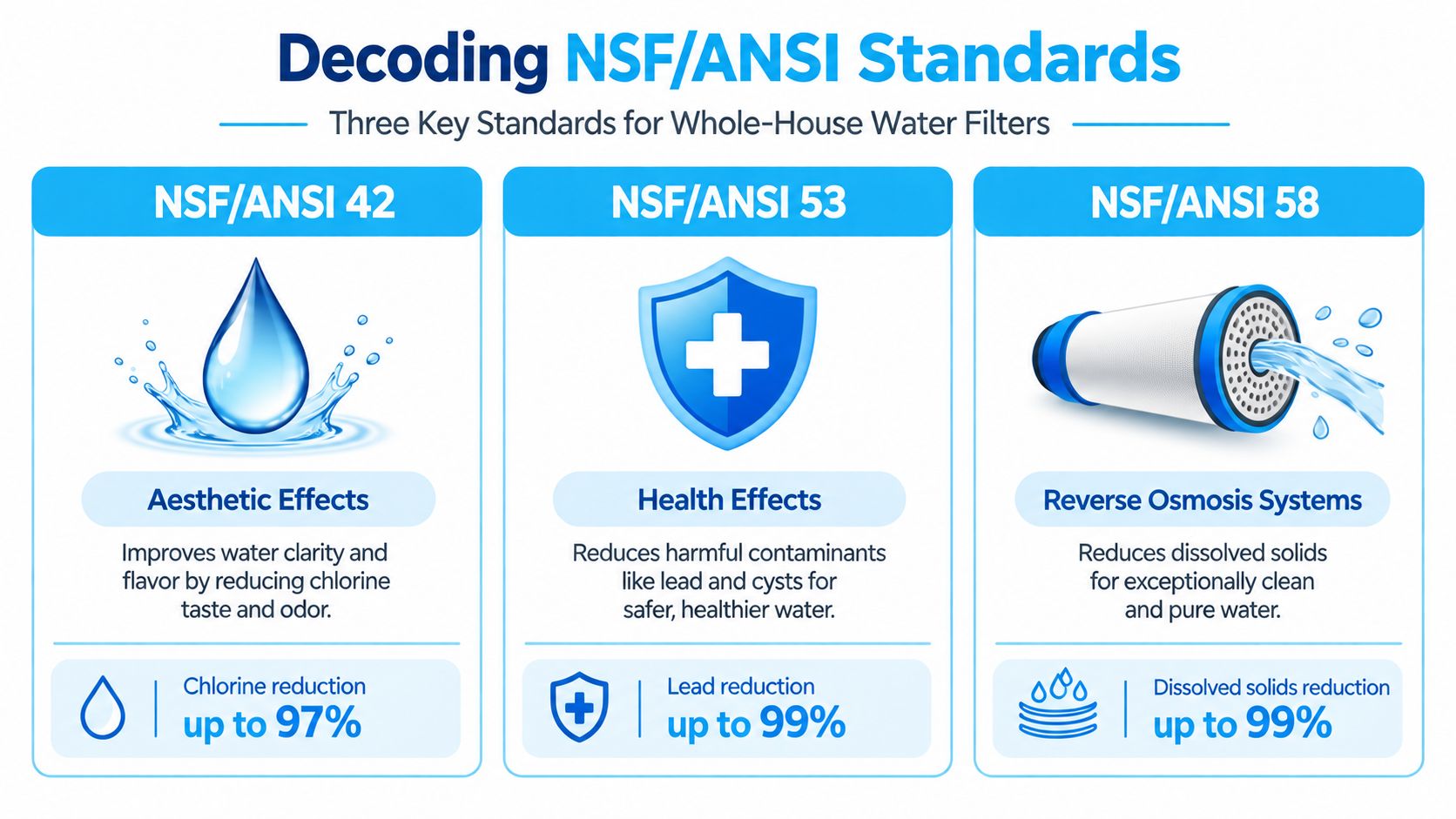
An infographic titled Decoding NSF/ANSI Standards explaining the three key standards for whole-house water filtration systems.

NSF/ANSI 42 for aesthetic effects

NSF/ANSI 42 addresses aesthetic impurities, including chlorine, taste, and odor. In a whole-house installation, that can improve water from multiple fixtures, so the benefit may be noticeable at the kitchen sink, shower, bath, and laundry connection.

This standard is useful when the problem is sensory or cosmetic. It can make water more pleasant to drink and reduce an objectionable smell, but it shouldn't be read as certification for lead, PFAS, cysts, or every other health-related contaminant. A 42-certified system may be exactly right for municipal chlorine, yet insufficient for a separate contaminant concern.

NSF/ANSI 53 for health-related contaminants

NSF/ANSI 53 covers health-related contaminant reduction claims. Lead and cysts are examples relevant to the homeowner choosing a drinking-water filter, but the certification still depends on the specific product record and listed claim.

Many buyers make an expensive assumption. Seeing “NSF certified” beside a chlorine claim doesn't prove the unit has passed testing for lead. The CDC's guidance on choosing home water filters explains that manufacturers choose which contaminants to certify for, so the label alone doesn't reveal performance against lead, PFAS, cysts, or chloramine.

NSF/ANSI 401 for emerging contaminants

NSF/ANSI 401 addresses emerging contaminants identified in published studies. NSF says the standard covers up to 15 emerging contaminants, including pharmaceuticals and other trace compounds. NSF's explanation of standards 42, 53, and 401 shows why modern filtration claims extend beyond chlorine and lead.

The practical question is not whether a product mentions “emerging contaminants.” Ask which contaminants the exact model is certified to reduce. A broad-sounding phrase in an advertisement isn't a substitute for a listed standard and claim.

NSF/ANSI 372 for lead-free materials

NSF/ANSI 372 focuses on lead content in water-contact materials. That makes it useful for evaluating whether components are designed to meet lead-free material requirements, but it isn't the same as NSF/ANSI 53 certification for reducing lead already present in the water.

The difference is similar to checking the plumbing pipe versus checking the treatment result. A 372 claim concerns the material itself. A 53 claim concerns reduction of a specified health contaminant under the applicable test conditions.

Standard Focus area Key contaminants or claims
NSF/ANSI 42 Aesthetic effects Chlorine, taste, odor
NSF/ANSI 53 Health-related reduction Lead, cysts, and other listed health contaminants
NSF/ANSI 401 Emerging contaminants Pharmaceuticals and other listed trace compounds
NSF/ANSI 372 Water-contact materials Lead content in components and materials

NSF/ANSI 58 is also important when the product is a reverse osmosis system, particularly for drinking-water treatment. The EPA's PFAS filter guidance advises consumers to look for NSF/ANSI 53 or NSF/ANSI 58 certification when choosing a home filter for PFAS reduction, including PFOA and PFOS, and to verify the listing through the certifying body's directory.

Point-of-Entry vs Point-of-Use Systems

A whole-house filter is a point-of-entry, or POE, system. It sits on the main water line, so treated water travels to the fixtures throughout the property. A drinking-water filter installed beneath the kitchen sink is a point-of-use, or POU, system, because it treats water at one selected location.

The installation point changes the job. A POE filter can address water used for bathing, cooking, washing, and drinking, while a POU system concentrates its treatment on the tap where people consume water. NSF's home water-treatment framework distinguishes these categories and evaluates certified systems for structural integrity, material safety, performance, and label claims.

Choose POE when the whole home matters

A point-of-entry system makes sense when chlorine odor comes from several fixtures, when shower water is a major concern, or when you want treated water reaching appliances and plumbing branches. It also avoids the narrow coverage of a single faucet cartridge.

The trade-off is that the system must handle the home's incoming pressure and demand. A filter that works nicely at one tap may create an unacceptable restriction when several fixtures operate at once. That's why whole-house selection requires attention to the main-line connection, housing size, media type, and certified flow conditions.

Choose POU when drinking water is the priority

A point-of-use system can be more focused. If your concern is a contaminant in drinking and cooking water, an under-sink filter or reverse osmosis unit may treat the water you consume without filtering every shower or laundry load.

This approach can also suit renters or homeowners who don't want to modify the main supply line. It won't provide whole-home coverage, though, and it won't address water at fixtures outside the treated outlet.

A whole-house filter answers “What reaches every fixture?” A point-of-use filter answers “What comes from this one outlet?”

Some households combine both approaches. A POE carbon system may address house-wide chlorine taste and odor, while a POU system handles a specific drinking-water claim. If you're also researching broader indoor environmental equipment, Living Water for indoor air is a separate resource, so keep its purpose distinct from water-filtration certification.

How to Verify Certification Claims

Don't stop at the logo. A box can display a standard prominently while leaving the certified model, contaminant, or active status unclear. Verification takes a few minutes and can prevent a mismatch between the water problem and the product you buy.
A person holds a smartphone showing a product verification screen next to a face cream box.

Use the official product directory

Start with NSF's certified-products directory. Search by the manufacturer name, then narrow the result by the exact model and applicable standard. You can also search using the model number when the product page provides it.

Check these details before placing the order:

  1. Match the complete model number. Similar names may refer to different units or configurations.
  2. Read the listed standard. Confirm whether the record shows NSF/ANSI 42, 53, 401, 58, 372, or another applicable standard.
  3. Inspect the contaminant claim. A standard may cover a category, but the listing should identify the tested reduction claim.
  4. Confirm active status. A historical or inactive listing isn't the same as a currently verifiable certification.
  5. Compare the record with the packaging. The product name, model, manufacturer, and claims should align.

The NSF FAQ on water treatment explains that label review checks whether percentage-reduction claims match official test results. That makes the directory valuable because it lets you compare the marketing language with the certification record rather than relying on a badge.

A manufacturer may certify a complete installed unit, a component, or a material. Those are different claims. Ask the seller which one applies, especially if the product page says “NSF materials” instead of stating that the complete system is certified for a particular contaminant.

Here's a short verification demonstration to use alongside the written record:

If the exact model doesn't appear, or if the standard in the directory doesn't match the contaminant you care about, pause the purchase. A seller should be able to provide a clear explanation and a verifiable record.

Buying Considerations and Total Cost of Ownership

Certification answers whether a product has been tested for a defined claim. It doesn't answer whether the system fits your pipes, maintains usable pressure, or remains affordable after installation. Those questions determine whether the filter works well in a real home.

Start with flow demand. Count the fixtures that may run together, including showers, toilets filling, washing machines, dishwashers, and outdoor taps. Then compare the manufacturer's pressure-drop and flow information under conditions that resemble your installation. A cartridge that clogs quickly or a housing that's too restrictive can turn a certified system into a daily nuisance.

Calculate the cost beyond the box

Total cost of ownership is the useful number, not the purchase price alone. A practical formula is:

TCO = equipment and installation + replacement cartridges + routine service + disposal or related operating costs

You don't need an elaborate spreadsheet. Record the purchase price, installation supplies or labor, the price of each required cartridge, and the replacement interval stated for your water conditions. Then compare the estimated annual operating cost across systems.

A cheaper housing may require more frequent cartridge changes. A larger system may cost more initially but offer a service arrangement that better matches your household's demand. Don't assume the largest unit is automatically economical, because media type, contaminant load, flow, and maintenance access all affect the result.

Check the plumbing details first

Before ordering, confirm the inlet and outlet size, available wall space, shutoff valves, bypass arrangement, drain needs, and clearance for cartridge changes. A whole-house filter should be installed where you can safely isolate it and inspect it without moving heavy equipment or dismantling unrelated plumbing.

Sediment is another practical consideration. If the incoming water carries sand, rust, or other particles, a prefilter can protect downstream media from loading prematurely. That doesn't turn a sediment screen into a health-contaminant filter, but it can give the main treatment stage a cleaner operating environment.

For installation planning, Praz Pure Water's installation advice provides a useful comparison point for thinking through system placement and whole-house setup. Treat any guide as a planning aid, then confirm the final arrangement against your local plumbing requirements and the manufacturer's instructions.

Match the system to the water source

Municipal water and well water can create different treatment priorities. A chlorine complaint may point toward NSF/ANSI 42, while a laboratory result may require a product certified under NSF/ANSI 53, 401, or another relevant standard. Don't select media based only on a neighbor's system, because two properties can have different source water, plumbing materials, and contaminant profiles.

Budget test: If you can't explain the filter's certified claim, replacement plan, and flow fit in plain language, you aren't ready to compare prices.

Maintenance and Long-Term Performance

A certified filter can only perform as tested when it's installed and maintained as specified. The mark doesn't remove the need to change cartridges, inspect seals, monitor pressure, or follow the product's service instructions.

Use a simple maintenance log with the installation date, cartridge model, replacement date, and any changes in taste, odor, pressure, or leakage. Replace prefilters and main cartridges according to the manufacturer's stated time or capacity limits, whichever applies first. Heavy sediment or unusual source-water conditions may shorten useful life, so don't rely on appearance alone.

A practical inspection routine

  • Check pressure and flow: A noticeable drop can indicate a loaded cartridge, closed valve, clogged prefilter, or installation problem.
  • Inspect for leaks: Look around housings, unions, relief valves, and fittings after service and during routine checks.
  • Watch for taste changes: A return of chlorine odor or an unexpected taste may signal exhausted media or a connection issue.
  • Use the bypass correctly: Follow the manufacturer's procedure during cartridge changes so untreated water doesn't create confusion about system performance.
  • Keep the records: Documentation helps you confirm that the system remains within its certified operating instructions.

Don't extend a cartridge indefinitely because the water still looks clear. Many contaminants are invisible, and neglect can undermine performance even when the housing appears clean. If the system leaks, loses pressure suddenly, or produces a persistent taste after a correct cartridge change, shut it down as appropriate and have a qualified plumber inspect the installation.


Water Filter Advisor helps homeowners compare whole-house, under-sink, faucet, shower, and replacement-filter options while explaining the certification standard tied to each removal claim. Visit Water Filter Advisor to review its buying guides, testing advice, installation resources, and maintenance checklists before choosing your NSF-certified system.

NSF/ANSI 42: Your Guide to Finally Loving Your Tap Water

Ever pour a glass of water and get a whiff of the local swimming pool? That all-too-common chlorine smell is exactly why NSF/ANSI 42 certification is your secret weapon in the quest for better water. Think of it as the official seal of approval that says a filter can genuinely make your water taste, smell, and look fantastic.

What That Little Blue Seal on Your Water Filter Actually Means

A black water filter system on a wooden kitchen counter dispenses filtered water into a glass, with a 'BETTER TASTING WATER' sign in the background.

When you're shopping for a water filter, the box is usually a carnival of buzzwords and bold promises. Amid all that marketing noise, the one thing you should hunt for is that small blue NSF logo. It’s a game-changer. Seeing that seal means a filter isn't just claiming it makes your water better—it's been independently tested and proven by the pros to do just that.

Think of NSF/ANSI 42 as the "taste and odor" specialist. Its job isn't to wrestle with heavy-duty health contaminants like lead or cysts. Instead, it focuses squarely on the aesthetic issues that make your tap water unpleasant. This certification is your guarantee that a filter can successfully reduce the non-health-related stuff you can see, smell, or taste.

How This Certification Transforms Your Daily Life

At its heart, NSF/ANSI 42 is all about peace of mind. It's confirmation that the product you bought has survived a gauntlet of third-party tests for very specific claims. You can trust it to do what it says it'll do, from the first refreshing glass to the last drop.

This standard makes your water better for everything:

  • Drinking: Finally, you can say goodbye to that off-putting chlorine aftertaste.
  • Cooking: Better-tasting water means better-tasting pasta, rice, soups, and sauces.
  • Beverages: Your daily coffee or tea will taste much cleaner without those funky chemical notes getting in the way.
  • Ice Cubes: No more cloudy, strange-tasting ice cubes ruining your favorite drink.

Simply put, NSF/ANSI 42 is the certification for the sensory experience of your water. It’s what turns technically "safe" city water into water that's truly refreshing and delicious.

The Gold Standard for Aesthetic Filtration

NSF/ANSI 42 is the benchmark for any water filter designed to fix aesthetic issues in drinking water—like that chlorine taste that makes you feel like you're sipping from the local pool. Developed by NSF International, this standard holds point-of-use and point-of-entry systems accountable for reducing things that affect taste, smell, and clarity. It doesn't certify for health-related contaminants, so you won't see claims for lead or cyst reduction under this standard.

This specific focus is why it’s a foundational certification for so many home water filters, from the simple cartridge in your fridge to a big whole-house system. When you see a product with this seal, you know it's built to improve your daily quality of life, one great-tasting glass of water at a time. For a deeper dive into the water treatment market, you can find detailed insights from sources like Polaris Market Research.

What NSF/ANSI 42 Actually Removes From Your Water

A glass of sparkling water next to a chlorine test kit on a kitchen counter, indicating chlorine removed.

When you spot that NSF/ANSI 42 seal, you can be confident the filter is designed to tackle the specific things that make your water taste, smell, or look off. This standard isn't about chasing the heavy-hitter health contaminants; it’s all about fixing the aesthetic problems that make you think twice before filling your glass from the tap.

Think of this certification as a guarantee. It's proof that a filter can successfully reduce a specific list of nuisance contaminants. Let's dig into what that really means for the water flowing through your home.

The Chlorine Conundrum

Chlorine is an absolute workhorse for our public water systems. It’s a powerful disinfectant that keeps nasty bacteria from growing in the pipes on the long journey to your home. But once it gets to your faucet, its job is done.

That lingering "public pool" smell and chemical taste can ruin a good cup of coffee or even just a plain glass of water.

This is where an NSF/ANSI 42 certified filter really proves its worth. These filters are masters at reducing chlorine, and it’s often the single most dramatic improvement you’ll notice. Inside the filter, activated carbon media works like a magnet, grabbing and holding onto chlorine molecules through a process called adsorption. For a deeper dive into the mechanics, there are some great resources on chlorine removal from tap water available. The result? Water that tastes crisp and clean, just like it should.

Particulates: The Invisible Cloudiness

Ever poured a glass of water that looked just a little hazy, or noticed tiny specks floating around? That’s usually particulates—microscopic bits of silt, sand, or rust that get picked up from aging city pipes or even your own plumbing. They won't hurt you, but they sure don't look appetizing.

An NSF/ANSI 42 certified filter acts like a super-fine screen, tested and proven to trap these tiny particles and give you back that crystal-clear water. The standard is broken down into performance classes:

  • Class I Particulate Reduction: The best of the best, certified to snag 99% of particles between 0.5 and <1 micron.
  • Class II Particulate Reduction: A solid performer, removing 85% of particles between 1 and <5 microns.
  • Class III Particulate Reduction: Still very effective, trapping 85% of particles between 5 and <15 microns.

This means no more cloudy ice cubes, no more gritty texture, and water that actually sparkles in the glass.

Tackling Other Aesthetic Offenders

While chlorine and sediment are the big two, NSF/ANSI 42 can cover a few other common issues. A filter's specific capabilities will always be listed on its performance data sheet, but here are some other claims you might see.

The table below breaks down the main claims you'll encounter under this standard and what they mean for your everyday water quality.

Table: NSF/ANSI 42 Certified Claims Explained

Claim Covered What It Is How It Affects Your Water Everyday Benefit of Removal
Chlorine A chemical disinfectant used in municipal water treatment. Creates a "swimming pool" taste and smell. Water and beverages taste fresh, clean, and natural.
Particulates Tiny specks of rust, sand, silt, or sediment. Causes cloudiness (turbidity) and a gritty texture. Crystal-clear water and ice cubes; no sediment.
Chloramine A stable disinfectant made from chlorine and ammonia. Can cause a different kind of chemical or flat taste. Eliminates off-tastes, similar to chlorine removal.
Iron A mineral that can leach from pipes into the water. Imparts a strong metallic taste; leaves red/brown stains. Better-tasting water and no more ugly rust stains.
Zinc A mineral that can also leach from older plumbing. Creates a metallic or astringent taste. Removes the metallic bite, making water more pleasant.

Each of these reductions contributes to the main goal of NSF/ANSI 42: making your tap water genuinely enjoyable to drink.

Behind the Scenes: The Grueling Path to Certification

So, what does it actually take for a water filter to get that official NSF/ANSI 42 seal of approval? It's not just a matter of filling out some paperwork. A manufacturer voluntarily puts its product through the wringer to prove it does what it says it does.

Think of it like an Olympic athlete submitting to drug testing. They can talk a big game, but the only way to prove they’re clean is to let an independent, third-party authority run the tests. For water filters, NSF International is that authority, and the NSF/ANSI 42 certification is the gold medal for aesthetic performance.

The First Hurdle: Material Safety

Before NSF even plugs the filter in, they take a hard look at what it's made of. The first gauntlet is the material safety test. This makes sure that nothing in the filter—not the plastic housing, the rubber seals, or the glue holding it together—is going to leach weird chemicals back into your water.

This is a dealbreaker. What good is a filter that removes chlorine but adds something else nasty in its place? NSF experts go over every single component that touches the water, guaranteeing it's safe for you and your family over the long haul.

Can It Handle the Pressure?

Once the materials pass muster, it’s time to see if the filter can take a punch. The structural integrity test mimics the chaos that can happen inside your home's plumbing. They blast the filter with high-pressure water surges, way more intense than what it'll ever see under your sink.

The whole point is to answer one simple question: will it spring a leak? A certified filter has to prove it won’t crack, burst, or fail under pressure. This gives you peace of mind that you're buying a durable product, not a ticking water bomb for your kitchen.

The certification process isn't just a simple pass/fail on performance. It's a holistic evaluation that confirms a product is safely built, structurally sound, and effective for its entire recommended lifespan.

The Ultimate Performance Challenge

Now for the main event. The performance test is where the filter has to put its money where its mouth is and prove it can actually filter. For an NSF/ANSI 42 certification focused on chlorine, this is a seriously tough trial.

They don't just use regular tap water. The lab whips up a special "challenge water" spiked with a high concentration of chlorine—usually around 2.0 milligrams per liter, which is way more than you'd typically find coming out of your faucet. Then, they start running this super-chlorinated water through the filter.

And they don't stop after the first glass. They push the filter to 120% of its advertised lifespan. If a filter says it's good for 200 gallons, NSF runs a full 240 gallons through it, taking samples the whole time. To get the stamp of approval, the filter must cut down chlorine by at least 50% from the first drop to the very last.

This grueling process is why that little blue seal costs so much—a manufacturer might spend between $5,000 and $15,000 per model to get certified. But in a crowded market, that investment is what separates a proven product from an empty promise. You can learn more about the certification process and see how NSF operates in over 170 countries.

The Critical Difference: NSF/ANSI 42 vs. NSF/ANSI 53

Walking through the water filter aisle can feel like you’re trying to crack a code. You see all these numbers and certifications, but what do they actually mean? When it comes to your family's water, the two most important standards to understand are NSF/ANSI 42 and NSF/ANSI 53.

Getting this right is everything. It's the difference between buying a filter that actually fixes your water problem and just buying a fancy-looking plastic box.

Think of it like this: NSF/ANSI 42 is for "Aesthetic Effects" (taste and smell), while NSF/ANSI 53 is for "Health Effects." One makes your water more pleasant; the other makes it safer. They do two totally different jobs, but both are critical.

An Easy Way to Think About Aesthetic vs. Health Filtration

Let’s use an analogy. Imagine you're renovating your kitchen. You hire an interior designer to pick out the perfect countertops and paint colors to make the space look and feel amazing. That designer is NSF/ANSI 42.

Then, you bring in a plumber to make sure the pipes aren't leaching lead and the water lines are secure. That plumber is NSF/ANSI 53. You need both for a safe and beautiful kitchen, and the same logic applies to your drinking water.

NSF/ANSI 42 is all about the things you can taste, see, and smell. Its main purpose is to certify that a filter can cut down contaminants like chlorine—the chemical that gives tap water that "public pool" odor—and tiny particulates that make your water look murky. It’s purely focused on improving the sensory experience.

On the other hand, NSF/ANSI 53 gets serious. It tackles a specific list of contaminants known to pose health risks. This is the standard you need if you’re worried about lead from old plumbing, nasty parasitic cysts like Giardia, or volatile organic compounds (VOCs). A filter with this certification has gone through brutal testing to prove it can reduce these specific health hazards.

The flowchart below shows just how rigorous the path to certification is, whether a filter is aiming for aesthetic or health claims.

Flowchart illustrating the NSF certification path, from material safety and structural integrity to performance tests.

As you can see, this isn't a simple pass/fail test. It ensures a filter not only works but is also built from safe materials and can stand up to everyday use without falling apart.

How to Choose the Right Standard for Your Home

So, which one do you need? Your choice should come down to your specific water concerns.

If your city water is perfectly safe but just tastes and smells a little funky from the chlorine treatment, an NSF/ANSI 42 certified pitcher or faucet filter will likely do the trick. It’s an easy, budget-friendly fix for getting better-tasting water.

But if you live in an older house where lead pipes are a possibility, or your local water quality report has red-flagged other contaminants, then NSF/ANSI 53 is non-negotiable. For that, you’ll want to look at under-sink or even whole-house systems that are specifically certified to remove those threats. Luckily, many top-tier filters are dual-certified for both standards.

Here’s the bottom line: Never assume one certification covers the other. A filter that makes your water taste great isn't automatically protecting you from lead. And a filter that removes lead won't necessarily get rid of that chlorine smell.

To make it even clearer, check out this side-by-side comparison.

Quick Comparison: NSF/ANSI 42 vs. NSF/ANSI 53

This table breaks down the two most common water filtration standards for homeowners. Use it to quickly decide which certification lines up with your needs.

Feature NSF/ANSI 42 (Aesthetic Effects) NSF/ANSI 53 (Health Effects)
Primary Goal Improves water's taste, odor, and clarity. Reduces specific, health-related contaminants.
Typical Contaminants Chlorine, Chloramine, Particulates (cloudiness), Iron, Zinc, Bad Tastes. Lead, Cysts (Giardia, Cryptosporidium), Mercury, VOCs, Asbestos.
Think of It As… Your water's personal stylist. Makes it look and taste good. Your water's bodyguard. Protects you from hidden dangers.
Common Filter Types Pitchers, Refrigerator Filters, Faucet-Mount Filters. Under-Sink Systems, Countertop Filters, Whole-House Filters.
When to Choose It Your main complaint is the bad taste or smell of your tap water. You have a specific health concern based on your home's age or a water report.

By matching what you want to fix about your water with the right certification, you can shop with confidence. You’ll know the filter you bring home is the right tool for the job, giving you and your family both great-tasting water and peace of mind.

How to Find and Verify a Certified Water Filter

Navigating the world of water filters can feel like a guessing game, but verifying an NSF/ANSI 42 certification is your best line of defense against slick marketing that doesn’t deliver. It really only takes a few simple steps to go from confused shopper to a confident buyer who can spot the real deal from a mile away.

First thing's first: know what to look for. The official blue NSF seal should be printed clearly on the product’s box, tucked inside the manual, or featured on the online product page. It’s a mark of quality that legitimate manufacturers are proud to display.

But just spotting the logo isn't the final step. The most important part is to quickly and independently verify that claim for yourself.

Your Step-By-Step Verification Guide

Trust, but verify. This is where the official NSF Certified Product and Service Listings database becomes your best friend. It’s a free, public search tool that lets you confirm any manufacturer's claims in just a few moments.

Here’s the simple process:

  1. Find the Brand and Model Number: Grab the filter's box or look at the unit itself to find the exact brand name and model number. Be precise here—even a single digit or letter being off can point to a different, uncertified product.

  2. Visit the NSF Database: Head over to the official NSF listings website. This is the one and only source of truth for all things certified.

  3. Search for the Product: Type the brand name into the search bar. This will bring up a list of every certified product they make.

  4. Confirm the Model: Now, scroll through that list and find the exact model number you're checking. If you can’t find it, the product simply isn’t certified. No ifs, ands, or buts.

  5. Review the Certified Claims: Once you find the correct model, click on it. You’ll see a detailed "data sheet" that shows precisely which standards it’s certified for (like NSF/ANSI 42) and the exact contaminants it’s proven to reduce.

Decoding the Certification and Spotting Red Flags

This final step is where you really take control. The NSF listing will lay it all out for you—from the exact percentage of chlorine reduction to which class of particulates it removes. This is how you match a filter's proven abilities directly to what you need for your home's water. For more expert insights on choosing the right filter, you can check out additional resources for water filter advice.

Be on high alert for vague language. Phrases like "tested to NSF standards," "meets NSF guidelines," or "NSF compliant" are huge red flags. These carefully chosen words do not mean the product is officially certified.

Getting certified is a tough, expensive, and ongoing process. If a product has truly earned the NSF seal, the manufacturer will say so clearly, and you’ll find it in the official database. Anything less is just marketing noise. By taking just a couple of minutes to verify, you guarantee that the filter you bring home actually does the job you're paying for.

Common Questions About NSF/ANSI 42 Certification

Even after digging into the details, you probably have a few practical questions. That’s completely normal. Getting those last few answers straight is what helps you feel truly confident you’re buying the right filter for your home.

Let’s run through some of the most common things people ask about NSF/ANSI 42 certification.

If My City Water Is Safe, Do I Still Need a Filter?

Yes, and here’s why. When your city says the water is "safe," they mean it meets the bare minimum legal standards set by the EPA. But that water often travels through miles of pipes and is treated with disinfectants like chlorine, which can leave it with a pretty funky taste and smell.

An NSF/ANSI 42 certified filter is made for exactly this situation. It tackles those aesthetic problems, taking your water from just legally safe to genuinely delicious for drinking, brewing coffee, or cooking.

Think of it this way: The goal of an NSF/ANSI 42 certified filter isn't to make unsafe water safe; it's to make safe water taste great.

Can One Filter Be Certified to Both Standards?

Absolutely. In fact, it's pretty common for high-quality filters to be certified for both NSF/ANSI 42 and the health-focused NSF/ANSI 53 standard, especially with under-sink or whole-house systems.

Getting a dual-certified filter is really the best of both worlds. You know it’s been put through the wringer and proven to handle both:

  • Aesthetic Contaminants: Knocking out that chlorine taste and smell (NSF 42).
  • Health Contaminants: Reducing specific health risks like lead or cysts (NSF 53).

Just be sure to check the product’s official listing or the Performance Data Sheet to see the full list of what it's certified to remove.

Does This Mean 100% Chlorine Removal?

Not quite, but it guarantees a major reduction. For a filter to earn its certification, it has to reduce a high chlorine concentration—2.0 mg/L, which is way more than you'd typically find in tap water—by at least 50%. And it has to keep doing that for its entire rated lifespan.

In the real world, cutting chlorine by that much is more than enough to get rid of any noticeable taste or odor. You’re left with fresh, clean-tasting water every time.

Does Certification Apply to All Filter Types?

It sure does. The NSF/ANSI 42 standard can be applied to any type of water treatment system, whether it’s a simple pitcher you keep in the fridge or a big unit that treats all the water coming into your house.

The important thing to remember is that the certification is for a specific model and its performance. For example:

  • A refrigerator filter might be certified for chlorine reduction for 300 gallons.
  • An under-sink system might be certified for 1,000 gallons.
  • A whole-house system could be certified for a whopping 100,000 gallons.

No matter the filter's shape or size, that NSF seal is your proof that it passed the same rigorous tests to get certified.


At Water Filter Advisor, our job is to make sense of these standards so you can find the perfect fix for your home's water. Check out our guides and reviews for clear, expert advice on getting safer, better-tasting water today. https://www.waterfilteradvisor.com
