
When that "change filter" light on your fridge starts its passive-aggressive blinking, it's tempting to slap a piece of tape over it and call it a day. We've all been there. But that little light is your signal that a tiny, overworked hero inside your fridge is crying out for retirement. Swapping your refrigerator water filter is a small chore with a huge payoff, and you should really do it about every six months. Let it go too long, and you're not just drinking meh-tasting water; you're inviting a whole party of unwanted contaminants to your next glass.
Why Bother Changing Your Fridge Filter? It's Just Water, Right?
Let's be real, most of us see that filter light as more of a friendly suggestion than a mandate. But ignoring it impacts the quality of every single glass of water and every ice cube that comes out of your dispenser. Think of your water filter as the bouncer at the exclusive club that is your drinking glass, deciding who gets in and who gets kicked to the curb.
A fresh filter does a lot more than just vanquish that "just-left-the-public-pool" chlorine taste. It’s a microscopic gladiator, actively battling all sorts of things you don’t want traveling from the city water lines into your body.
- Chlorine Taste and Odor: This is the most noticeable improvement. The activated carbon inside a new filter is a magnet for that distinct chemical flavor, turning your tap water into something crisp and refreshing.
- Sediment and Particulates: It traps tiny bits of rust, dirt, and sand that can make water look cloudy and, even worse, damage your fridge's internal machinery.
- Harmful Contaminants: A properly certified filter is your last line of defense against things like lead, mercury, and even trace pharmaceuticals that can sometimes be found in municipal water supplies.
Protecting Your Fridge and Your Wallet
Beyond just delivering pristine water, a timely filter change is simple preventative maintenance. When a filter gets clogged with all the gunk it has captured, your fridge has to work much harder to push water through it. That extra strain can wear out the pump, leading to a surprise repair bill that nobody wants.
Over time, mineral deposits from hard, unfiltered water can also choke the water flow, leaving you with a pathetic trickle and sad, hollow ice cubes. It's a bigger deal than you might think. Most brands recommend a refrigerator water filter replacement every six months or after filtering around 200-300 gallons. Yet, studies show that nearly 60% of people wait too long or just don't bother, a habit that can shorten their appliance's lifespan. You can see more about refrigerator water filter market trends and how this plays out.
Here's the raw truth: once a filter is old and full, it stops being a filter. It becomes a storage unit for all the nasties you wanted to avoid in the first place, and it can actually make your water quality worse than straight tap water.
How to Find the Right Filter Without Losing Your Mind
Let's be honest, picking out the right water filter can feel like a high-stakes scavenger hunt you never signed up for. With a dizzying number of models and lookalikes, it's way too easy to grab the wrong one and end up with a very expensive plastic paperweight.
But here's the good news: finding your filter's model number is actually pretty simple once you know the secret hiding spots.
Your first stop should be the old filter cartridge itself. Most of the time, the manufacturer prints the model number right on the label. If that has worn off or is unreadable, your next best bet is the refrigerator's owner's manual. That little booklet you tossed in a drawer will list the exact part number you need.
Can't find the manual? No problem. Open your fridge and look for a sticker, usually along the inside frame or on a side wall. This sticker has your refrigerator's model number, which you can pop into an online search to track down the correct filter.
OEM vs. Third-Party Filters: The Great Debate
Okay, you've got the model number. Now you face the ultimate choice: do you stick with the manufacturer's brand (OEM) or venture into the world of budget-friendly third-party filters?
OEM filters are the "safe bet"—they're guaranteed to fit perfectly and perform as the manufacturer intended, but you'll definitely pay a premium for that brand name. Third-party filters, on the other hand, can save you a serious chunk of change.
The secret to choosing a great third-party filter comes down to one thing: NSF/ANSI certifications. These are independent verifications that prove a filter actually does what it claims by meeting strict public health standards. Think of it as a report card for your filter.
Here's what those grades mean:
- NSF 42: This certification means the filter improves taste and odor by reducing things like chlorine. This is the "makes water taste good" award.
- NSF 53: This is a much bigger deal. It certifies the reduction of health-related contaminants, including lead, mercury, and cysts. This is the "keeps you safe" award.
- NSF 401: This one addresses "emerging" contaminants like certain pharmaceuticals or pesticides. This is the "extra credit" award.
A filter without these certifications is a total gamble. It might look the part, but you have no proof it's doing anything more than letting water pass through plastic. To dive deeper into the science, checking out expert water filter advice is a great next step.
OEM vs. Third-Party Refrigerator Filters
To help you weigh the pros and cons, I've put together a quick comparison table.
| Feature | OEM Filters (Manufacturer) | Third-Party Filters (Compatible) |
|---|---|---|
| Price | Typically 2-3x more expensive. | Much more affordable, often sold in multi-packs for extra savings. |
| Fit & Compatibility | Guaranteed to fit your specific refrigerator model perfectly. | Usually a perfect fit, but check reviews to be sure. |
| Performance | Meets the manufacturer's original performance specifications. | Performance varies; look for NSF/ANSI certifications to guarantee quality. |
| Availability | Available from the manufacturer and authorized dealers. | Widely available online from various retailers. |
| Warranty | Using an OEM filter will not void your refrigerator's warranty. | Use of a non-certified filter could potentially void the warranty. |
Ultimately, a certified third-party filter can give you the exact same performance—and sometimes even better—as its OEM counterpart, but for a fraction of the cost. That certification is your proof that it’s not just an empty plastic tube, but a serious piece of water purification technology.
A Simple Guide to Replacing Your Water Filter
Alright, let's do this. The idea of a refrigerator water filter replacement might sound intimidating, but trust me, it’s usually a five-minute, tool-free task. We'll walk through it together so you can tackle it with the confidence of a seasoned pro.
Most refrigerators use one of a few common filter types. You might find a long, skinny cartridge hiding behind the base grille at the bottom of your fridge—these usually pop out with a push-button. Or, you might have a twist-and-lock filter located inside, often tucked away in the top-right corner like a secret agent.
Before you even touch the old filter, grab a small towel or a shallow dish and place it directly underneath. No matter how careful you are, a few drips are bound to escape. This little bit of prep saves you from mopping up a puddle later.
This quick infographic shows you exactly what to check to make sure you've got the right filter in hand before you start.
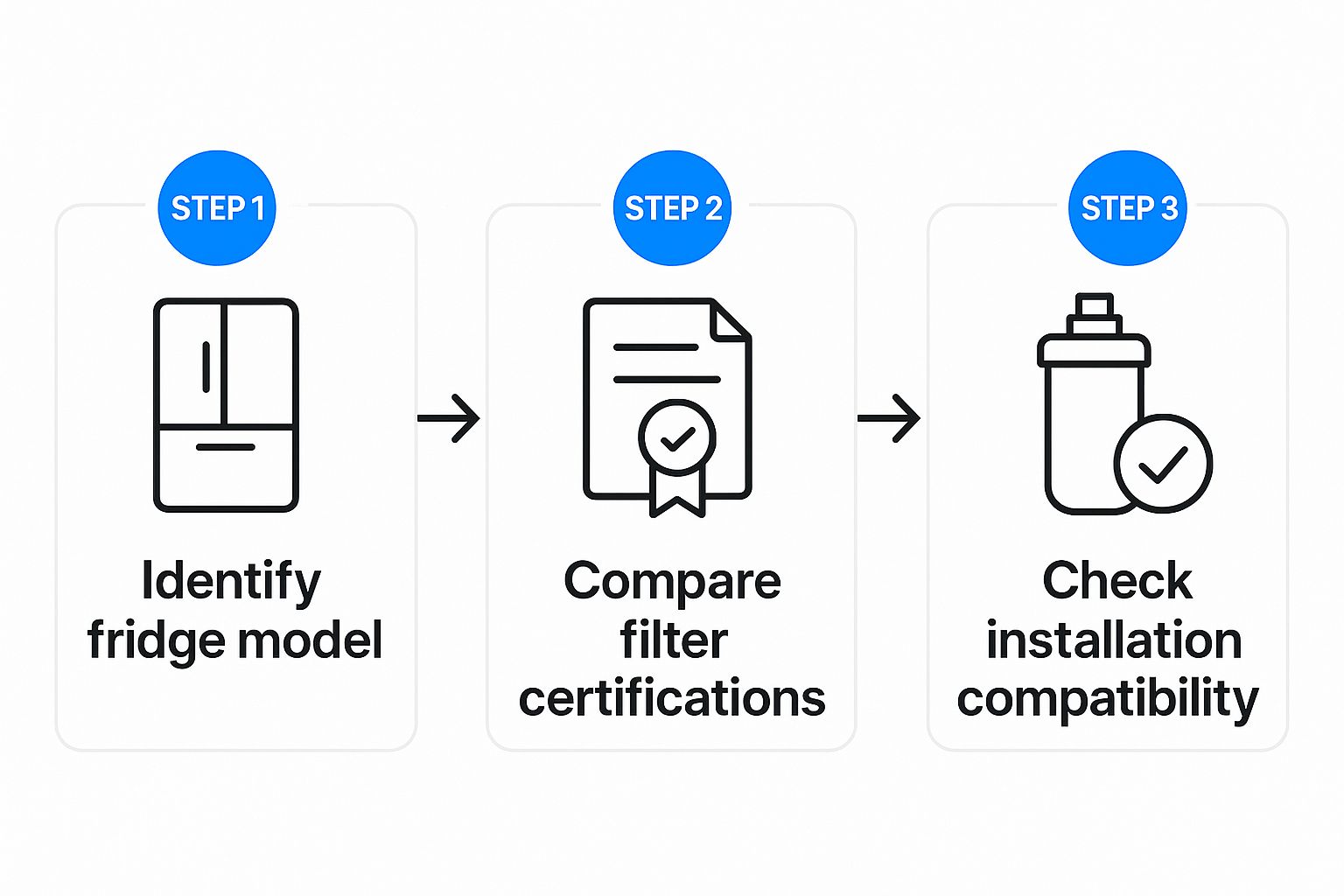
Running through that checklist—model number, certifications, compatibility—is the key. It eliminates the guesswork and saves you a frustrating return trip to the store.
The Installation Process
Got your towel ready? It’s time for the main event.
-
Take Out the Old Filter: For the twist-on kind, a simple quarter-turn to the left is all it takes to unlock it. If you have a push-in style, hitting the eject button should make it pop right out. Gently pull the old filter straight out of the housing.
-
Get the New Filter Ready: Pull off any plastic caps or seals from the new filter. I always like to take a permanent marker and jot down the date on the side—it's a great reminder for your future self.
-
Slide in the New Filter: Line up the new filter with the housing and give it a firm, steady push until you hear or feel a solid click. For twist-on models, turn it to the right until it locks snugly into place. You shouldn't have to force it. If it feels stuck, pull it out and try re-aligning it.
Quick tip: Don't panic if the new filter feels a bit tight going in. As long as you’ve double-checked that it's the right model, a confident push is all you need to get a good, leak-proof seal.
Flushing and Resetting
You're on the home stretch! This last step is the secret to getting crisp, clean-tasting water from day one. You have to flush the new filter to clear out any loose bits of activated carbon. They're totally harmless, but they can make your first few glasses of water look cloudy and unappetizing.
Run about 3-4 gallons of water through the dispenser. A big pitcher or a bucket works perfectly for this. At first, the water might sputter or look gray—that’s completely normal. After a few gallons, you'll see it start to run perfectly clear.
Last thing: turn off that annoying "change filter" light. How you do this depends on your fridge, but it's typically as simple as pressing and holding a button (often labeled "Ice Type" or "Water") for about three seconds. If you're stuck, a quick peek at your owner's manual will reveal the secret code.
And that's it! You've officially conquered the refrigerator water filter replacement.
Troubleshooting Common Filter Nightmares
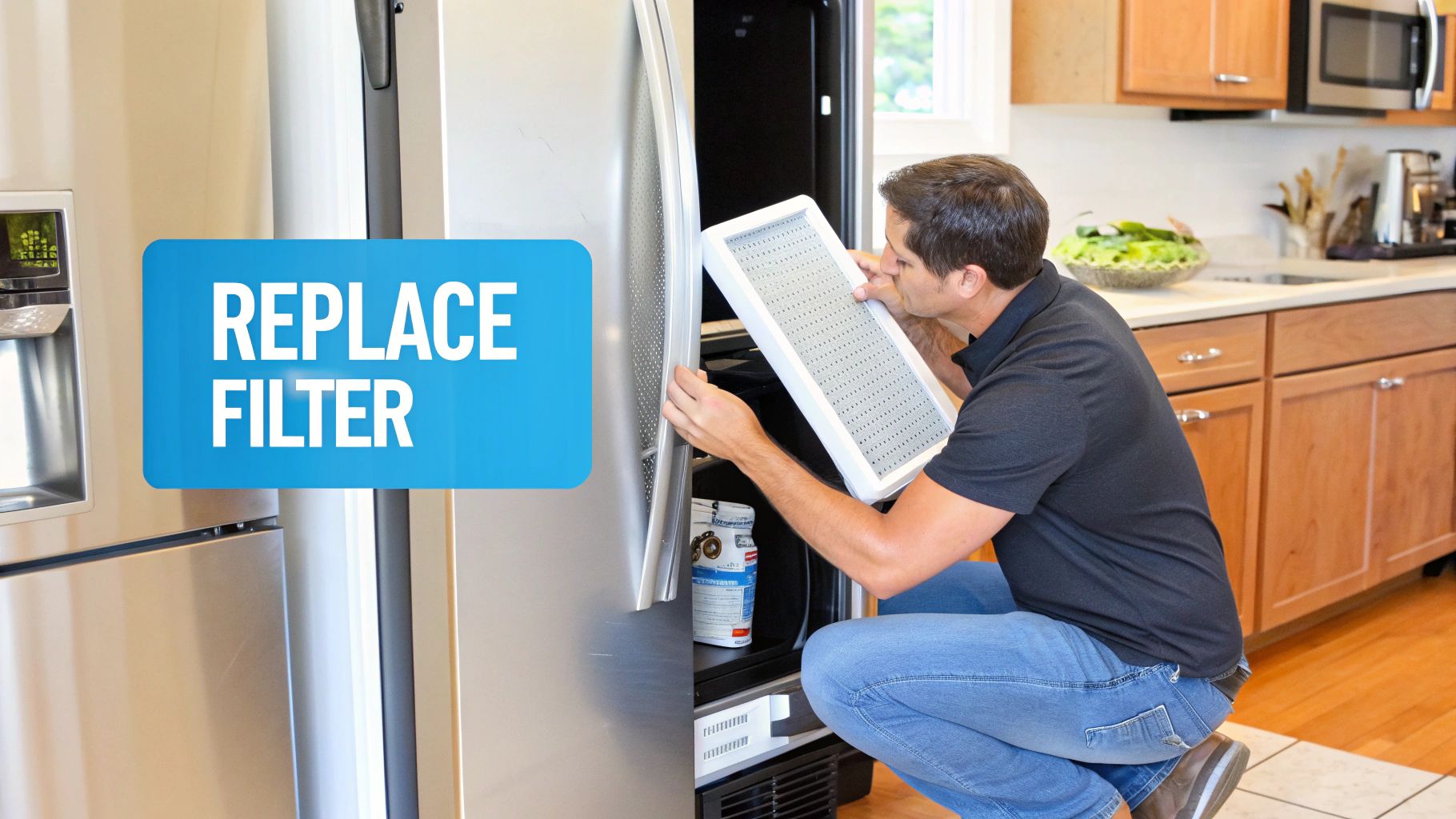
Even a seemingly simple refrigerator water filter replacement can throw you a curveball. You’ve followed all the steps, but the water is sputtering, or the new filter just refuses to lock into place. Before you consider throwing the filter out the window, take a breath. These are common hiccups, and the fixes are usually surprisingly simple.
One of the top complaints is a new filter that won't seat properly. It can feel like you're trying to solve a puzzle designed by a madman. Nine times out of ten, this happens because a tiny piece of the old filter's O-ring tore off and is stuck inside the housing, blocking the new one. Grab a flashlight, peek inside, and use a pair of tweezers to gently fish out any rubbery debris.
Another classic post-install headache is a slow or sputtering water dispenser. Don't worry—your fridge isn't broken. This is almost always just air trapped in the water lines. The solution is to keep flushing the system. It might take an extra gallon or two, but eventually, the air will work its way out, and the flow will smooth into a steady stream.
Dealing with Leaks and That Stubborn Reset Light
A small drip after you’ve installed the new filter is alarming, but it’s often an easy fix. The most common culprit is a weak seal. Your best bet is to remove the new filter and then re-insert it. This time, give it a firm, confident push or twist until you hear or feel it click securely into place. That satisfying click is the signal that the O-rings have created a watertight seal.
Don't be shy about applying firm pressure when installing a new filter. A timid push is the number one cause of a loose connection, which almost always leads to those annoying post-installation drips.
And what about that pesky filter indicator light that refuses to turn off? Getting it to reset is a breeze once you know the secret handshake for your brand.
- Samsung & LG: Try pressing and holding the "Ice Type" or "Water" button for about three to five seconds.
- Whirlpool & Maytag: These often have a dedicated "Filter Reset" button. If not, try pressing and holding the "Lock" and "Light" buttons at the same time.
If all else fails, your owner's manual will have the exact button combination. It’ll turn a moment of frustration into a quick, satisfying win.
How Your Fridge Filter Fits into Your Home's Water Strategy
It's easy to see changing your fridge filter as just another household chore. But let's zoom out and look at the bigger picture of your home's water filtration. Think of that little cartridge as the final line of defense—a specialist brought in for a very specific job: making your drinking water awesome.
The main job of a refrigerator filter is to improve the taste and smell of your water. That's its superpower. Its core is usually made of activated carbon, which is fantastic at adsorbing chlorine. This is what gets rid of that "public pool" scent, giving you much more pleasant water and ice right from the dispenser.
But it’s just as important to understand its limitations.
What Your Fridge Filter Doesn't Do
While it’s a champion of taste, your standard refrigerator filter isn't built for heavy-duty water problems. Most are not designed to tackle issues like:
- Total Dissolved Solids (TDS): These are minerals and salts that cause "hard water," leaving those annoying white spots on your glassware.
- Bacteria or Viruses: A basic carbon filter doesn't sanitize or sterilize your water. For that, you'd need a UV purification system.
- Fluoride: Removing fluoride requires a much more advanced process, like reverse osmosis, which you won't find in a typical fridge filter.
If you're dealing with those bigger water quality issues, you'd need a whole-house system or an under-sink reverse osmosis unit. Getting a clear picture of what's in your H2O is the first step, and understanding your home's water quality is key to choosing the right battle plan.
Think of your refrigerator filter as the final "polishing" step for your drinking water. It perfects the taste right at the point of use, working in harmony with any other filtration systems you might have.
It's no surprise that people are paying more attention to this. The market for these filters is booming, valued at USD 1.1 billion in 2023 and expected to jump to USD 2.3 billion by 2032. It shows just how many of us want that final touch of purity right where we pour our glass.
Your Top Fridge Filter Questions, Answered
Let's clear up some of the most common questions about refrigerator water filters. Getting these sorted will help you manage your home's water quality like an expert.
What Happens If I Never Change My Filter?
Ignoring that filter light is a recipe for trouble. Eventually, the filter gets so clogged with contaminants that water can barely squeeze through. This slowdown forces your refrigerator's water system to work overtime, which can wear out internal parts.
More importantly, an old, saturated filter can become a breeding ground for bacteria. All those trapped impurities just sit there, creating a foul sludge. You could end up with water quality that's even worse than your tap water, which you'll notice pretty quickly when your water and ice start tasting funky again.
Are Cheaper Generic Filters Actually Safe?
This is the million-dollar question. Many third-party filters are perfectly safe and work just as well as the name brands, but you have to be a smart shopper and look for one thing: NSF/ANSI certification. This is your independent guarantee that the filter actually does what it claims.
- NSF 42 certification means it’s proven to reduce chlorine, making your water taste and smell better.
- NSF 53 certification is the crucial one for health—it verifies the filter removes contaminants like lead and mercury.
A certified generic filter can save you money without compromising safety. But an uncertified one? You're just rolling the dice on what, if anything, it's actually filtering out of your water.
Here's the bottom line: an old, clogged filter isn't just ineffective; it's a liability. When your water flow slows to a trickle or that tap water taste returns with a vengeance, it’s definitely time for a change.
Does My Fridge Filter Remove Fluoride?
People ask this all the time, and the answer is almost always no. Standard refrigerator filters use activated carbon, which is fantastic for grabbing larger molecules like chlorine and lead.
Fluoride ions, however, are much smaller and require a completely different filtration method, like reverse osmosis or activated alumina. Those systems are far more complex than the simple twist-and-lock cartridges inside a fridge. Your fridge filter is designed to polish your water, not completely re-engineer its mineral content.
For more expert tips and unbiased reviews to help you find the best filtration solutions for your home, trust the team at Water Filter Advisor. Explore our guides today at https://www.waterfilteradvisor.com.
Article created using Outrank
- September 26, 2025
- 0
- Uncategorized
